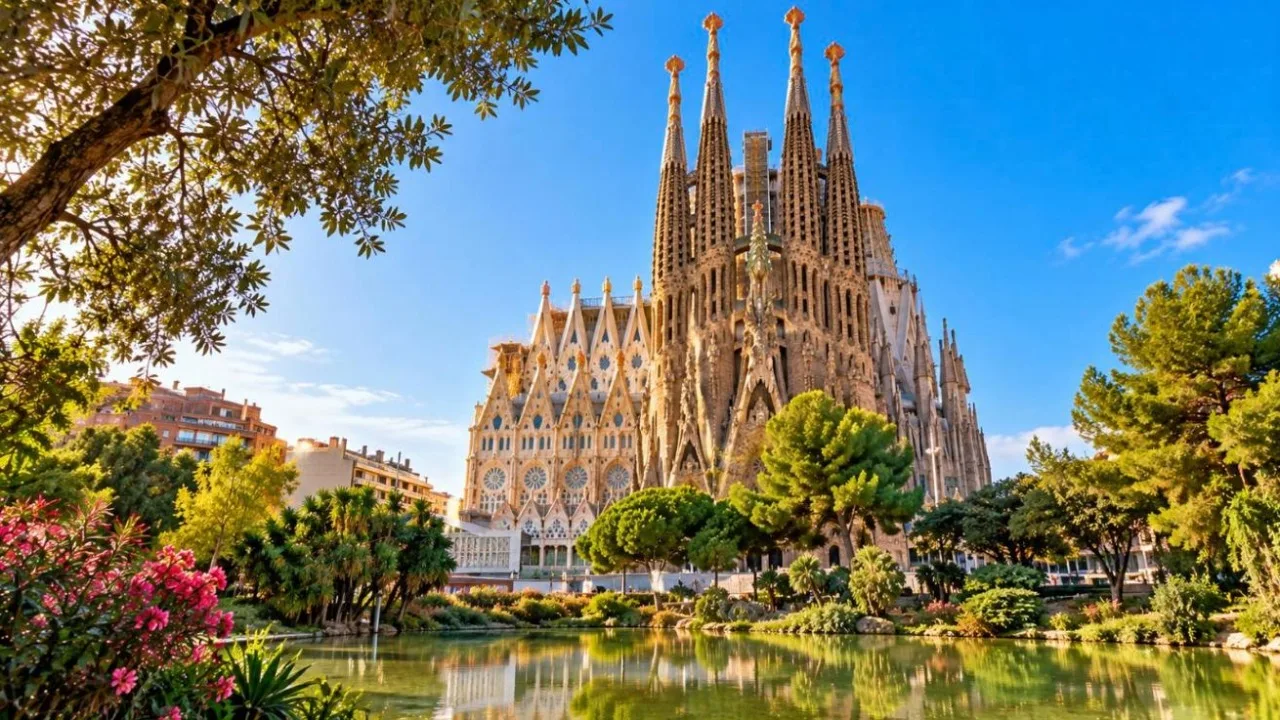
For more than a century, Barcelona's Sagrada Família has been the world's most famous unfinished building. In 2026, the year marking 100 years since the death of its architect Antoni Gaudí, it reached a historic milestone: its central Tower of Jesus Christ was completed, making it, at 172.5 metres, reported to be the tallest church in the world. In Part 8 of World Landmarks, we tell the basilica's story and explain how to visit.
Sagrada Família at a glance
| Fact | Detail |
|---|---|
| Location | Eixample district, Barcelona, Spain |
| First stone | 19 March 1882 |
| Architect | Antoni Gaudí from 1883 until his death in 1926 |
| Final height | 172.5 m (Tower of Jesus Christ, completed February 2026) |
| Status | Minor basilica since 2010; construction continues |
| UNESCO | Nativity façade and crypt listed as part of "Works of Antoni Gaudí" |
| Basic ticket | €26 |
A short history
Work began on 19 March 1882 to a neo-Gothic design by Francisco de Paula del Villar. A year later the young Antoni Gaudí took over and transformed the project into something entirely new: a basilica inspired by nature, geometry and Catalan faith, with towers like termite mounds and an interior designed to feel like a forest of stone.
Gaudí devoted his final years almost entirely to the basilica. On 7 June 1926 he was hit by a tram on Gran Via, and he died three days later, on 10 June 1926. Only one bell tower, St Barnabas, had been completed in his lifetime. He is buried in the crypt.
During the Spanish Civil War in 1936, his workshop was burned and many plans and plaster models destroyed. Architects have since worked from surviving fragments and Gaudí's principles, increasingly with computer modelling. Funded entirely by donations and ticket sales, the work has continued for generations:
| Year | Milestone |
|---|---|
| 2010 | Pope Benedict XVI dedicated the church and declared it a minor basilica |
| 2021 | Tower of the Virgin Mary completed (138 m), crowned with an illuminated star |
| 2023 | Four towers of the Evangelists inaugurated (135 m) |
| 20 February 2026 | Final piece of the cross placed on the Tower of Jesus Christ: 172.5 m |
| 10 June 2026 | On the centenary of Gaudí’s death, Pope Leo XIV said Mass and blessed the new tower |
Work continues on the Glory façade, the future main entrance, which began rising vertically in 2025. No official completion date for the whole building has been announced.
What to see
- Nativity façade (east): built in Gaudí's lifetime and listed by UNESCO, teeming with sculpture celebrating the birth of Christ.
- Passion façade (west): stark, angular sculpture depicting the crucifixion.
- The interior: tree-like columns branching to a canopy ceiling and stained glass that bathes the nave in colour.
- The towers: go up by lift for views over Barcelona and walk down a spiral staircase.
- The museum and crypt: models, drawings and Gaudí's tomb.
Ticket prices 2026
These are the official prices on the basilica's website:
| Ticket | Standard | Seniors | Under 30 / students |
|---|---|---|---|
| Basilica (with app audio guide) | €26 | €21 | €24 |
| Basilica + guided tour | €30 | €23 | €28 |
| Basilica + towers | €36 | €28 | €34 |
| Guided tour + towers | €40 | €32 | €38 |
- Free for children under 11 and people with disabilities (companions pay only for extras such as the towers).
- The official audio guide is free in the official app, in 19 languages.
- Tickets are sold online only through official channels, are named, and give entry at a fixed time. Bring photo ID.
- Towers: no children under 6, and the towers can close in bad weather (no refund).
Opening hours
| Period | Monday–Friday | Saturday | Sunday |
|---|---|---|---|
| November–February | 9:00–18:00 | 9:00–18:00 | 10:30–18:00 |
| March and October | 9:00–19:00 | 9:00–18:00 | 10:30–19:00 |
| April–September | 9:00–20:00 | 9:00–18:00 | 10:30–20:00 |
International Mass is held on Sundays at 9:00 am and on Saturdays at 8:00 pm; entry is free but limited. Hours can change for special events, so check the official site before visiting.
Best time to visit
- Morning: sunlight pours through the cool blue and green windows on the Nativity side.
- Late afternoon: the warm red and orange windows on the Passion side glow, the most spectacular time for many visitors.
- The basilica welcomed about 4.8 million visitors in 2024, so book well ahead in peak season.
Getting there
Take the metro (lines L2 or L5) to Sagrada Família station, or buses 19, 33, 34, D50, H10 or B24. Individual visitors enter via the Nativity façade.
Rules
- This is a working church: dress respectfully (covering shoulders and avoiding very short shorts is advisable).
- All bags are checked, and bags must go in lockers before climbing the towers.
- The towers are not adapted for visitors with reduced mobility.
Nearby
Walk along Avinguda de Gaudí to the modernist Sant Pau hospital complex, or visit Park Güell, also part of the UNESCO Gaudí listing. For another great European church, see Part 18: St Peter's Basilica and the Vatican.
Frequently asked questions
Is the Sagrada Família finished?
Not yet. Its tallest tower was completed in 2026, but the Glory façade and other elements are still under construction, with no official completion date.
Is it worth paying for the towers?
If you enjoy views and do not mind narrow spiral stairs on the way down, yes. The interior alone is the main highlight.
Can I buy tickets at the door?
No. Tickets are sold online only through official channels, so book in advance.
Where is Gaudí buried?
In the crypt of the Sagrada Família.
Sources
- Sagrada Família – Prices (official)
- Sagrada Família – Schedules and how to get there (official)
- Sagrada Família – Blessing and inauguration of the Tower of Jesus Christ (official)
- UNESCO World Heritage Centre – Works of Antoni Gaudí
- Catalan News – Sagrada Família reaches final height of 172.5 metres
- Crux – Pope Leo inaugurates new tower of Spain’s famed Sagrada Família (June 2026)
World Landmarks: the full series
- Part 1: Eiffel Tower
- Part 2: Acropolis of Athens
- Part 3: Angkor Wat
- Part 4: Great Wall of China
- Part 5: Chichén Itzá
- Part 6: Stonehenge
- Part 7: Alhambra
- Part 8: Sagrada Família (you are here)
- Part 9: Statue of Liberty
- Part 10: Christ the Redeemer
- Part 11: Neuschwanstein Castle
- Part 12: Tower of London
- Part 13: Forbidden City
- Part 14: Terracotta Army
- Part 15: Sydney Opera House
- Part 16: Pompeii
- Part 17: Palace of Versailles
- Part 18: Vatican and Sistine Chapel
- Part 19: Hagia Sophia
- Part 20: Louvre Museum
Prices, opening hours and entry rules in this guide were checked against official sources in October 2026. They change often, so always confirm on the official website before you travel.