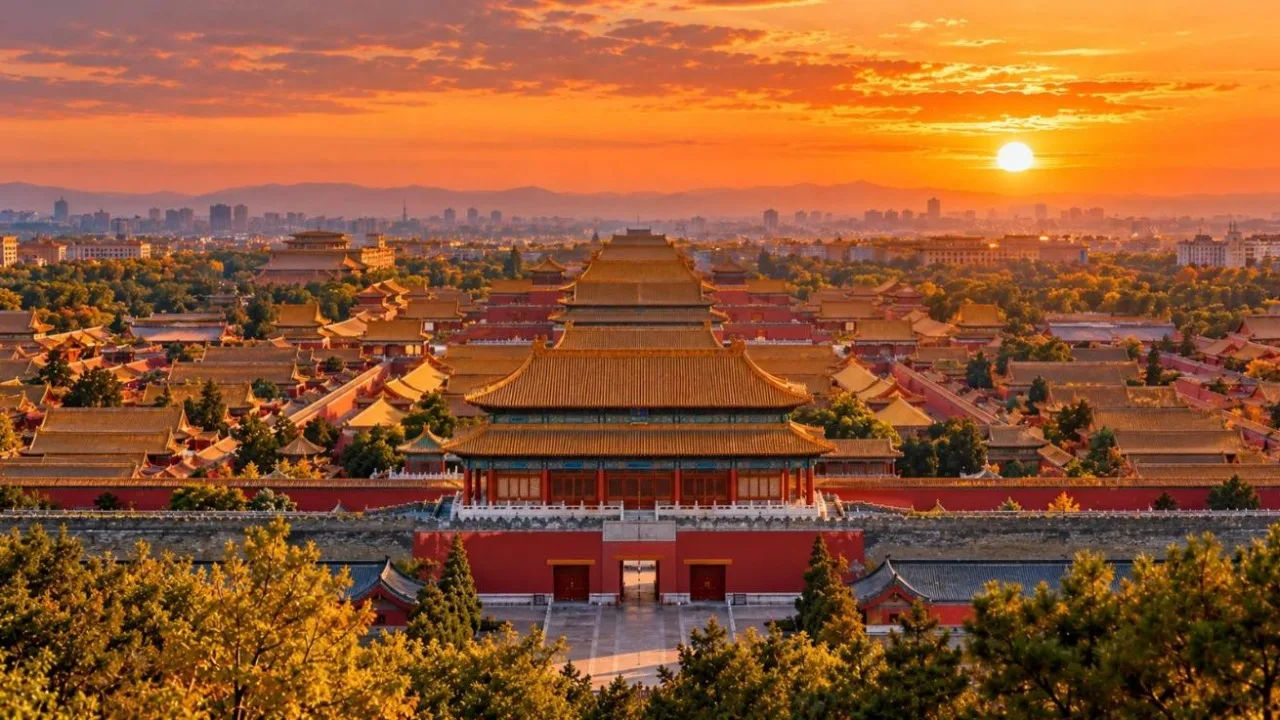
At the heart of Beijing lies the largest surviving palace complex of imperial China. For nearly 500 years, the Forbidden City was the home of emperors and the centre of power, closed to ordinary people. Since 1925 it has been the Palace Museum, and in 2025 it celebrated its centenary. In Part 13 of World Landmarks, we explain its history and the strict booking system every visitor needs to know.
The Forbidden City at a glance
| Fact | Detail |
|---|---|
| Location | Central Beijing, north of Tiananmen Square |
| Built | 1406–1420, under the Ming Yongle Emperor |
| Emperors | 24 (14 Ming and 10 Qing) |
| Became a museum | 10 October 1925 |
| UNESCO | World Heritage Site since 1987 |
| Ticket | CNY 60 (April–October), CNY 40 (November–March) |
| Daily visitor limit | 40,000 |
A short history
When the Ming dynasty's Yongle Emperor moved his capital from Nanjing to Beijing, he ordered a vast new palace. Built between 1406 and 1420, it was laid out along a north–south axis according to principles of cosmic order, with the emperor, the "Son of Heaven", at its centre. Yellow, the imperial colour, covered the roofs, and red walls enclosed the complex.
Over the following centuries, 24 emperors of the Ming and Qing dynasties ruled from here. The palace was known as the "Purple Forbidden City" because entry without the emperor's permission was forbidden. UNESCO describes the complex as having nearly 10,000 rooms; the popular claim of exactly 9,999 is a legend, and counts vary by method.
The last emperor, Puyi, abdicated in 1912 but continued to live in the inner court until he was expelled in 1924. On 10 October 1925, the Palace Museum opened to the public. During the 20th century's wars, many treasures were evacuated, and part of the collection is today held by the National Palace Museum in Taipei. In 2025 the Palace Museum marked its 100th anniversary with a special exhibition at the Meridian Gate.
What to see
- Meridian Gate (Wumen): the grand southern entrance, also used for major exhibitions.
- Hall of Supreme Harmony: the largest hall, where emperors held enthronements and major ceremonies.
- Central axis halls: the Hall of Central Harmony and Hall of Preserving Harmony.
- Palace of Heavenly Purity: the heart of the inner court.
- Imperial Garden: ancient trees and rockeries near the northern exit.
- Treasure Gallery and Gallery of Clocks: separate tickets, but well worth it.
Tickets and booking 2026
| Item | Price |
|---|---|
| Entry, 1 April – 31 October | CNY 60 |
| Entry, 1 November – 31 March | CNY 40 |
| Treasure Gallery | CNY 10 |
| Gallery of Clocks | CNY 10 |
The booking rules are strict:
- Advance online booking is required. No tickets are sold on the day.
- Use your passport. Foreign visitors book with their passport number and must show the same passport at the gate.
- Book seven days ahead. Tickets are released at 8:00 pm Beijing time, seven days before the visit date, and popular dates can sell out within minutes.
- Daily cap: 40,000 visitors.
Book through the Palace Museum's official channels. The museum provides an email address for booking help on its official visitor page.
Opening hours
| Season | Hours | Last entry |
|---|---|---|
| 1 April – 31 October | 8:30 am – 5:00 pm | 4:00 pm |
| 1 November – 31 March | 8:30 am – 4:30 pm | 3:30 pm |
The museum is closed on Mondays, except on national holidays, and may close on other days with notice. Allow two to three hours for the central axis, or four to five hours with the galleries and side halls.
Best time to visit
- Avoid Chinese public holidays, especially the 1–7 October Golden Week, Labour Day and Spring Festival, and summer school holidays.
- Weekday mornings are calmest.
- Spring and autumn offer the best weather; winter is quieter and cheaper, and the palace looks magical after snow.
Getting there
Take Metro Line 1 to Tian'anmen East and walk north through Tiananmen to the Meridian Gate. Entry is from the south only. You exit at the north (Gate of Divine Prowess) or east, so plan your onward route.
Don't miss the view from Jingshan Park
Directly opposite the north exit, Jingshan Park has a small hill whose pavilion offers the classic panorama of the Forbidden City's golden roofs. It is the perfect end to a visit, especially in late afternoon light.
Rules
- Airport-style security checks; lighters and sharp objects are banned.
- No smoking or pets.
- The central axis has ramps, but side courtyards have cobblestones and high thresholds.
Entering China
China's 240-hour visa-free transit policy allows many nationalities to visit when travelling on to a third country, and many countries have 30-day unilateral visa-free entry until the end of 2026. Indian citizens are not covered and need a visa. Check with a Chinese embassy before booking.
Combine your visit with the Great Wall (Part 4), and head to Xi'an for the Terracotta Army (Part 14).
Frequently asked questions
Can I buy Forbidden City tickets at the gate?
No. All tickets must be booked online in advance with a valid ID or passport.
When are tickets released?
At 8:00 pm Beijing time, seven days before your visit date.
Is the Forbidden City open on Mondays?
Generally no, except on national holidays.
Does the Forbidden City really have 9,999 rooms?
That is a legend. UNESCO describes nearly 10,000 rooms, and the exact count depends on how rooms are defined.
Sources
- Palace Museum – Official visitor information
- UNESCO World Heritage Centre – Imperial Palaces of the Ming and Qing Dynasties
- Beijing Government – A Century of Stewardship exhibition
- China Daily / Chinabound – Tickets and attractions
- Shanghai Government – 240-hour visa-free transit policy
World Landmarks: the full series
- Part 1: Eiffel Tower
- Part 2: Acropolis of Athens
- Part 3: Angkor Wat
- Part 4: Great Wall of China
- Part 5: Chichén Itzá
- Part 6: Stonehenge
- Part 7: Alhambra
- Part 8: Sagrada Família
- Part 9: Statue of Liberty
- Part 10: Christ the Redeemer
- Part 11: Neuschwanstein Castle
- Part 12: Tower of London
- Part 13: Forbidden City (you are here)
- Part 14: Terracotta Army
- Part 15: Sydney Opera House
- Part 16: Pompeii
- Part 17: Palace of Versailles
- Part 18: Vatican and Sistine Chapel
- Part 19: Hagia Sophia
- Part 20: Louvre Museum
Prices, opening hours and entry rules in this guide were checked against official sources in October 2026. They change often, so always confirm on the official website before you travel.