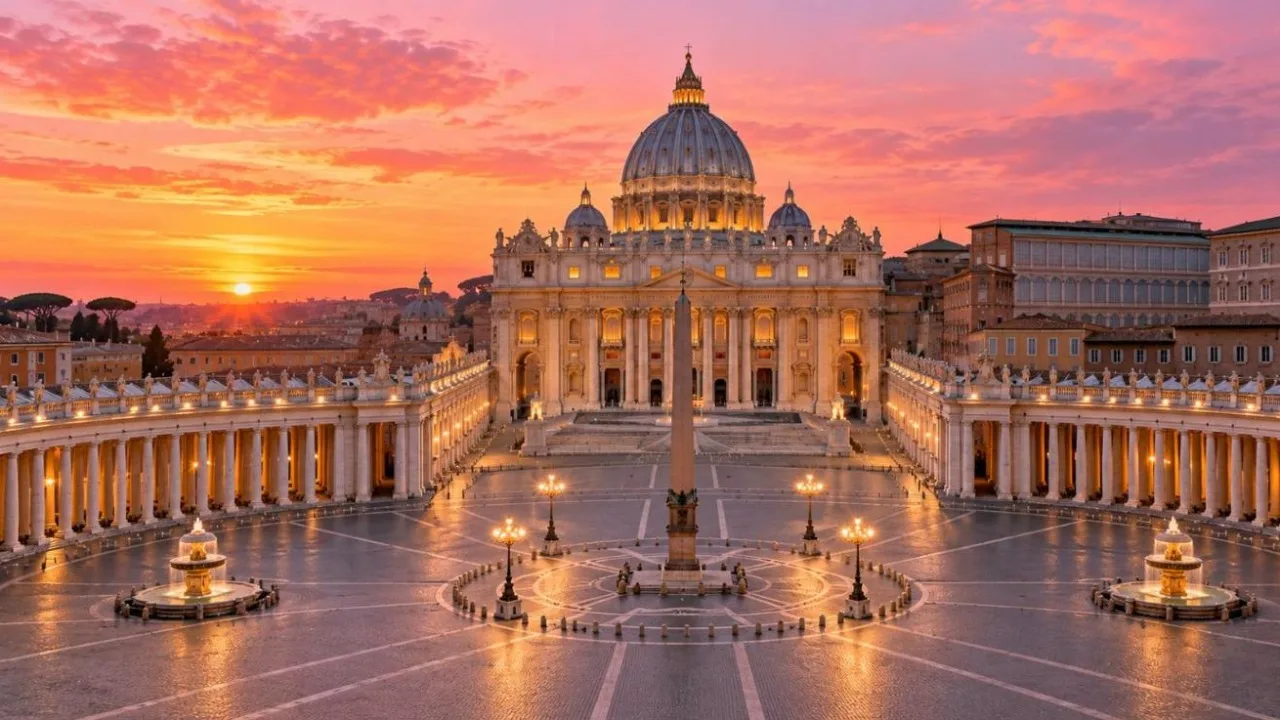
Covering less than half a square kilometre, Vatican City is the smallest independent state in the world, yet it contains some of humanity's greatest treasures: St Peter's Basilica, the Sistine Chapel painted by Michelangelo, and the vast Vatican Museums. In 2026, St Peter's marks the 400th anniversary of its consecration. In Part 18 of World Landmarks, we explain the history and how to plan a visit.
The Vatican at a glance
| Fact | Detail |
|---|---|
| Status | Independent state since the Lateran Treaty, 11 February 1929 |
| St Peter’s Basilica | Begun 1506, consecrated 1626 |
| Sistine Chapel ceiling | Painted by Michelangelo, 1508–1512 |
| The Last Judgment | Michelangelo, 1536–1541 |
| UNESCO | World Heritage Site since 1984 |
| Vatican Museums ticket | €20 (€25 booked online) |
| St Peter’s Basilica | Free entry |
A short history
Tradition holds that St Peter, the first pope, was buried on the Vatican Hill after his martyrdom. Emperor Constantine built a basilica over the site in the 4th century. By the Renaissance it was crumbling, and in 1506 Pope Julius II laid the foundation stone of a new basilica. Over 120 years, a succession of great architects worked on it, including Bramante, Raphael, Michelangelo, who designed the great dome, and Carlo Maderno. The basilica was consecrated in 1626; Bernini later added the bronze baldacchino over the altar and the embracing colonnades of St Peter's Square.
Julius II also commissioned two of the greatest works of the Renaissance. Michelangelo, who considered himself a sculptor rather than a painter, spent four years (1508–1512) painting the Sistine Chapel ceiling, with its scenes from Genesis including the Creation of Adam. Decades later he returned to paint the vast Last Judgment on the altar wall (1536–1541). The chapel is still where cardinals gather to elect a new pope, as they did in May 2025 when Pope Leo XIV was elected.
The Vatican Museums grew from Julius II's sculpture collection, begun in 1506 – the same year the ancient Laocoön statue was discovered in Rome.
What to see
- Vatican Museums: the Pio-Clementino Museum of classical sculpture (Laocoön, Apollo Belvedere), the Gallery of Maps, and the Raphael Rooms, including the School of Athens.
- Sistine Chapel: the climax of the museum route. Maintenance of the Last Judgment was completed in 2026.
- St Peter's Basilica: Michelangelo's Pietà, Bernini's baldacchino and the papal tombs in the Vatican Grottoes.
- The dome climb: about 551 steps, or a lift for part of the way followed by about 320 steps, for views over Rome.
- The Scavi: guided tours of the ancient necropolis beneath the basilica, booked through the Excavations Office.
Vatican Museums tickets 2026
| Ticket | Price |
|---|---|
| Full ticket | €20 |
| Reduced ticket | €10 |
| Online "skip the line" booking fee | +€5 |
| Children under 7 | Free |
| Last Sunday of the month | Free, 9:00 am–2:00 pm (last entry 12:30) |
Buy only on the official site, tickets.museivaticani.va; the museums warn about lookalike websites that charge more. Tickets are valid only for the day booked and are non-refundable.
St Peter's Basilica and the dome
Entry to the basilica is free, but expect airport-style security queues that can exceed an hour. For the 400th anniversary, the Vatican announced a new online reservation system and wider terrace access in 2026. Dome climb tickets are sold separately; recent guides report around €10 for stairs and €15 for lift plus stairs at the door. Check current prices and basilica hours on the official basilica website, which announced new opening hours in 2026.
Opening hours
- Vatican Museums: Monday–Saturday, 8:00 am–8:00 pm (last entry 6:00 pm). Closed on Sundays, except the last Sunday of the month, and on certain religious holidays.
- St Peter's Basilica: open daily from early morning; closed on Wednesday mornings during papal General Audiences.
Allow about three hours for the museums and two to three hours for the basilica and dome.
Dress code and rules
- Cover shoulders and knees. Sleeveless tops, shorts and short skirts can lead to refused entry, especially at St Peter's.
- No photography in the Sistine Chapel, and silence is requested.
- Airport-style security; glass bottles and knives are not allowed. Large bags must be left at the cloakroom.
Best time to visit
Book the first museum slot of the day or go in the late afternoon. Avoid the free last Sundays, which are extremely crowded. Visit St Peter's early in the morning for shorter queues.
Getting there
Take Metro Line A to Ottaviano–San Pietro or Cipro, both a short walk from the museums. From St Peter's, walk along Via della Conciliazione to Castel Sant'Angelo.
For another of Christianity's great churches, see Part 19: Hagia Sophia, and for Rome's ancient past, our guide to the Colosseum and Roman Forum.
Frequently asked questions
Is St Peter's Basilica free?
Yes. Entry is free, but the dome climb and some tours cost extra.
Can I visit the Sistine Chapel without the Vatican Museums?
No. The Sistine Chapel is visited as part of the Vatican Museums ticket.
What should I wear to the Vatican?
Clothing that covers your shoulders and knees.
Are the Vatican Museums open on Sunday?
Only on the last Sunday of each month, when entry is free (unless it falls on a major holiday).
Sources
- Vatican Museums – Prices and tickets (official)
- Vatican Museums – Last Judgement maintenance completed (2026)
- St Peter’s Basilica – Official website
- PBS NewsHour / AP – Vatican expands visitor access at St Peter’s for its 400th anniversary (Feb 2026)
- UNESCO World Heritage Centre – Vatican City
World Landmarks: the full series
- Part 1: Eiffel Tower
- Part 2: Acropolis of Athens
- Part 3: Angkor Wat
- Part 4: Great Wall of China
- Part 5: Chichén Itzá
- Part 6: Stonehenge
- Part 7: Alhambra
- Part 8: Sagrada Família
- Part 9: Statue of Liberty
- Part 10: Christ the Redeemer
- Part 11: Neuschwanstein Castle
- Part 12: Tower of London
- Part 13: Forbidden City
- Part 14: Terracotta Army
- Part 15: Sydney Opera House
- Part 16: Pompeii
- Part 17: Palace of Versailles
- Part 18: Vatican and Sistine Chapel (you are here)
- Part 19: Hagia Sophia
- Part 20: Louvre Museum
Prices, opening hours and entry rules in this guide were checked against official sources in October 2026. They change often, so always confirm on the official website before you travel.