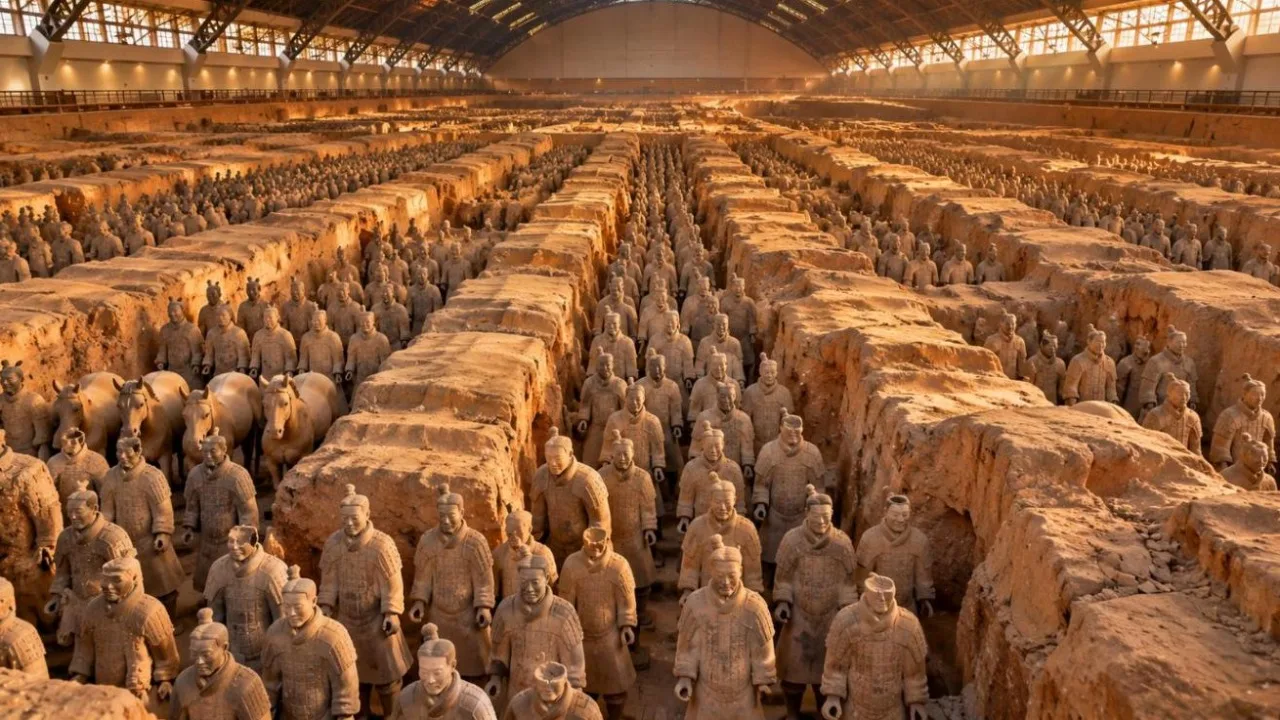
In March 1974, farmers digging a well in the countryside east of Xi'an struck fragments of clay figures. They had found one of the greatest archaeological discoveries of the 20th century: an underground army of life-size soldiers, horses and chariots, buried more than 2,200 years ago to protect China's first emperor in the afterlife. In Part 14 of World Landmarks, we explain the history of the Terracotta Army and how to visit.
The Terracotta Army at a glance
| Fact | Detail |
|---|---|
| Location | Lintong District, about 35 km east of Xi’an, Shaanxi |
| Built for | Qin Shi Huang, China’s first emperor (died 210 BC) |
| Work on mausoleum began | 246 BC |
| Discovered | March 1974 |
| Estimated figures | Nearly 8,000 in three pits (estimate) |
| UNESCO | World Heritage Site since 1987 |
| Ticket | CNY 120 all year |
China's first emperor
Qin Shi Huang unified China's warring states in 221 BC and declared himself its first emperor. He standardised writing, coins, weights and measures, and began linking the defensive walls that became the Great Wall. Work on his tomb started in 246 BC, when he became king of Qin as a boy, and continued for decades. The historian Sima Qian, writing about a century later, said labourers came from every province of the empire.
His tomb mound, about 51 metres high, sits at the foot of Mount Lishan. It has never been excavated. Sima Qian described rivers of mercury inside, and soil surveys around the mound have found unusually high mercury levels. Archaeologists have chosen to wait until they can open it without damaging what lies within.
The pits explained
| Pit | Size | What it contains |
|---|---|---|
| Pit 1 | About 14,260 m² | The main infantry army, about 6,000 warriors and horses (estimated) |
| Pit 2 | About 6,000 m² | Mixed units of chariots, cavalry, infantry and archers |
| Pit 3 | Smallest | 72 figures, thought to be the command headquarters |
The figure of "nearly 8,000" is an estimate of what the pits contain, not the number already dug up; only part of the army has been excavated. Each warrior has individual facial features, hairstyles and armour, and the figures were originally brightly painted, though most colour has faded or flaked off after exposure to air. Real bronze weapons were found with them.
A pair of exquisite bronze chariots with horses, found near the tomb, is displayed at the museum and is a highlight of any visit.
Latest discoveries
Excavation continues. In January 2026, archaeologists announced new finds in Pit 2, including two chariots buried without wheels, chariot fittings and weapons, suggesting the corridor belonged to the chariot unit. Since 2024, on-site laboratories at Pits 1 and 2 have used moisture control, ultrasonic testing and 3D imaging to protect newly excavated figures.
Tickets and booking
- Price: CNY 120 all year (CNY 60 for full-time students). There is no peak or off-peak difference.
- Includes: the Terracotta Warriors museum, the Lishan Garden (the mausoleum area) and a free shuttle between them. The ticket is valid for one day.
- Real-name booking: book online through the museum's official website or official WeChat account, using your passport. The name, ticket and passport must match at the gate.
- Arrive about 30 minutes before your time slot.
- Free admission for children and seniors applies to Chinese nationals.
Opening hours
| Season | Ticket checking |
|---|---|
| 16 March – 15 November | 8:30 am – 5:00 pm |
| 16 November – 15 March | 8:30 am – 4:30 pm |
The museum suggests about 1.5 hours for each site, so plan for three hours or more in total.
How to get there from Xi'an
- Metro and bus: take Metro Line 9 to Huaqingchi station, then a short local bus to the museum.
- Tourist bus: buses have traditionally run from Xi'an Railway Station's east square; check current services locally.
- Taxi or ride-hailing: about 45–60 minutes from central Xi'an.
Rules
- Photography is allowed, but flash and tripods are banned.
- Drones, lighters and weapons are prohibited.
- Entry is through the North Gate, following a one-way route; free luggage storage is available for non-valuables.
- Electric carts can help visitors with limited mobility move between areas.
Best time to visit
Avoid Chinese public holidays, when crowds are enormous. Arrive at opening time and start with Pit 1 before tour groups arrive. Spring and autumn are the most pleasant seasons in Xi'an.
Nearby
Combine your visit with Huaqing Palace, an imperial hot-spring retreat near the metro station, and spend time on Xi'an's City Wall. For China's capital, see the Forbidden City (Part 13) and the Great Wall (Part 4).
Frequently asked questions
How many terracotta warriors are there?
About 8,000 are estimated across the three pits, but only part has been excavated.
Has Qin Shi Huang's tomb been opened?
No. The tomb mound remains unexcavated to protect it.
How much is the Terracotta Army ticket?
CNY 120 all year, including Lishan Garden and the shuttle bus.
Do I need to book in advance?
Yes. Real-name booking with your passport is required.
Sources
- Emperor Qinshihuang’s Mausoleum Site Museum – Ticketing (official)
- UNESCO World Heritage Centre – Mausoleum of the First Qin Emperor
- Shaanxi Government – New chariot finds in Pit 2 (Jan 2026)
- Xinhua – Conservation labs at Pits 1 and 2 (Sep 2026)
- Shaanxi Government – Emperor Qinshihuang’s Mausoleum Site Museum
World Landmarks: the full series
- Part 1: Eiffel Tower
- Part 2: Acropolis of Athens
- Part 3: Angkor Wat
- Part 4: Great Wall of China
- Part 5: Chichén Itzá
- Part 6: Stonehenge
- Part 7: Alhambra
- Part 8: Sagrada Família
- Part 9: Statue of Liberty
- Part 10: Christ the Redeemer
- Part 11: Neuschwanstein Castle
- Part 12: Tower of London
- Part 13: Forbidden City
- Part 14: Terracotta Army (you are here)
- Part 15: Sydney Opera House
- Part 16: Pompeii
- Part 17: Palace of Versailles
- Part 18: Vatican and Sistine Chapel
- Part 19: Hagia Sophia
- Part 20: Louvre Museum
Prices, opening hours and entry rules in this guide were checked against official sources in October 2026. They change often, so always confirm on the official website before you travel.