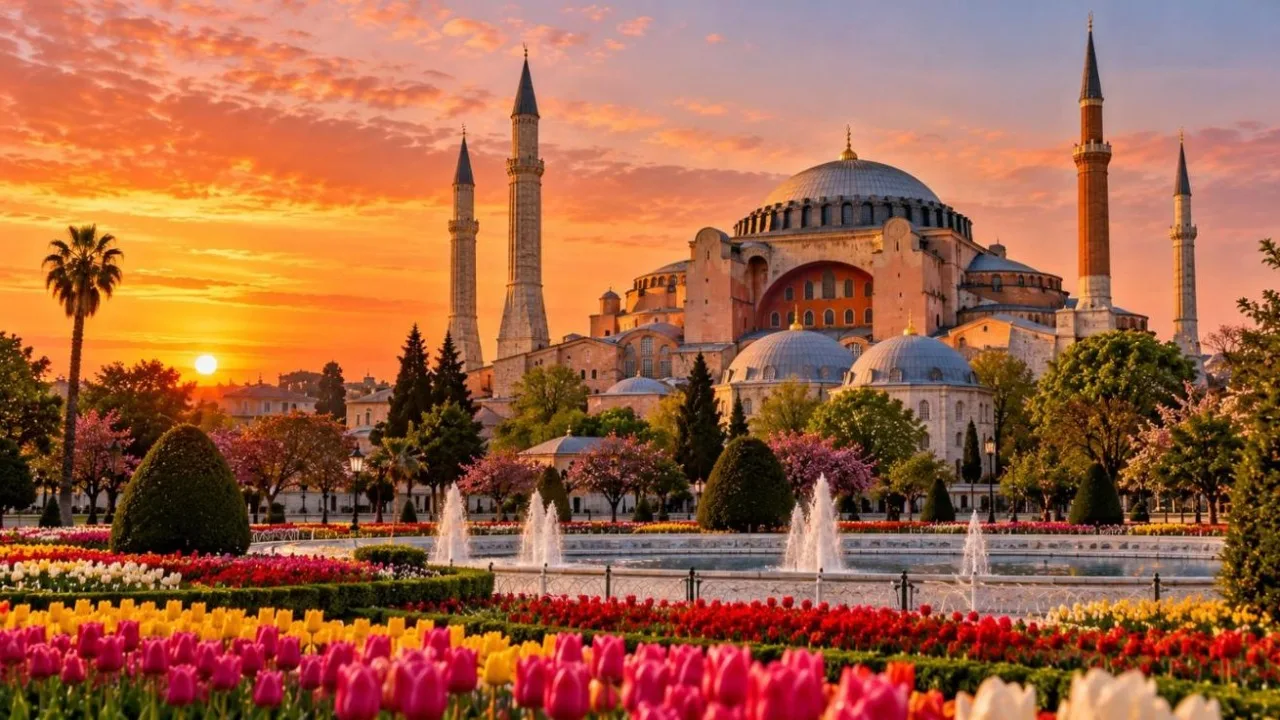
For nearly 1,500 years, the great dome of Hagia Sophia has dominated Istanbul's skyline. Built as the cathedral of the Byzantine Empire, converted to a mosque by the Ottomans, turned into a museum by the Turkish Republic and made a mosque again in 2020, it is one of the most important buildings in the history of both Christianity and Islam. In Part 19 of World Landmarks, we tell its story and explain the visiting rules introduced for tourists in 2024.
Hagia Sophia at a glance
| Fact | Detail |
|---|---|
| Location | Sultanahmet, Istanbul, Türkiye |
| Built | 532–537 under Emperor Justinian I |
| Architects | Anthemius of Tralles and Isidore of Miletus |
| Status | Mosque since July 2020 |
| UNESCO | Part of "Historic Areas of Istanbul", listed 1985 |
| Entry for foreign visitors | €25 (tourist gallery route) |
A short history
The present building is the third church on the site. After riots destroyed its predecessor in 532, Emperor Justinian I ordered a replacement of unprecedented scale. Remarkably, it was completed in just five years and inaugurated in December 537. According to a later tradition, Justinian exclaimed on entering: "Solomon, I have surpassed thee."
Its architects, Anthemius of Tralles and Isidore of Miletus, were mathematicians as well as builders. Their vast dome seemed to float on a ring of windows. An earthquake brought down part of it in 558, and it was rebuilt with a higher profile and completed in 562. UNESCO notes that Hagia Sophia became a model for an entire family of churches and later mosques.
For more than 900 years it was the greatest church in Christendom. After the Ottoman conquest of Constantinople on 29 May 1453, Sultan Mehmed II converted it into a mosque; minarets were added, and many mosaics were plastered over. In 1934 the Turkish Republic decided to make it a museum, and it opened to visitors in 1935. In July 2020, a Turkish court annulled the museum status and it was reconverted into a mosque, with the first Friday prayers held on 24 July 2020.
Visiting in 2026: how it works
Since 15 January 2024, foreign tourists and worshippers use separate entrances:
- Foreign visitors pay an entry fee and follow a dedicated route through the upper galleries, where the famous Byzantine mosaics are displayed, viewing the prayer hall from above. Visitors exit beneath the mosaic of Emperors Justinian and Constantine in the southwest vestibule.
- Worshippers and Turkish citizens enter the ground-floor prayer hall free of charge through a separate entrance.
Most of the ground floor, including the Imperial Gate and the Omphalion (the marble coronation square), is no longer on the tourist route. The apse mosaic of the Virgin and Child has been covered with drapes since the 2020 reconversion.
Entry fee
The fee for foreign visitors was set at €25 when introduced in 2024 and is still widely reported at that level, though one 2026 source quotes a higher figure. Tickets are sold at the booth by the visitor entrance; beware of reseller websites charging extra. An audio guide is available, as professional tour guides are no longer permitted inside.
Opening hours and prayer times
- The tourist route is generally open from about 9:00 am into the early evening, but hours are not officially published in detail.
- It closes to tourists during Friday midday prayers (roughly noon to 2:30 pm), and access can be restricted during the five daily prayers, Ramadan and religious holidays.
- A visit takes about 45–60 minutes.
Dress code and etiquette
- Cover shoulders and knees.
- Women must cover their hair with a headscarf before entering.
- Remove shoes in carpeted prayer areas if required, and keep voices low: this is an active mosque.
The great restoration
In April 2025, Turkey launched what officials called the largest and most extensive restoration of the main dome in its history, aimed at strengthening it against earthquakes. By September 2026, a temporary steel roof had been completed over the dome and work had moved to the eastern semi-dome, considered the most vulnerable part of the building. The mosque remains open, but visitors may walk under scaffolding. Most work is expected to finish in 2027.
Best time to visit
Arrive at opening time or in the late afternoon, and avoid Friday midday. Queues at the ticket booth can be long in peak season.
Getting there
Take the T1 tram to Sultanahmet stop. The Blue Mosque, Topkapı Palace and the Basilica Cistern are all within walking distance.
Entering Türkiye
Many nationalities can visit Türkiye visa-free; others use the official e-Visa at evisa.gov.tr. Requirements vary, and for some nationalities, including India, the e-Visa is conditional on holding certain other visas. Always check official sources before travel.
For another of the world's great churches, see Part 18: St Peter's Basilica.
Frequently asked questions
Is Hagia Sophia free to visit?
It is free for worshippers and Turkish citizens. Foreign tourists pay a fee (€25 when introduced) to follow the gallery route.
Can tourists enter the main prayer hall?
Not on the tourist route. Foreign visitors view the prayer hall from the upper galleries.
Do women need a headscarf?
Yes. Women must cover their hair, and all visitors should cover shoulders and knees.
Is Hagia Sophia open on Fridays?
Yes, but the tourist route closes during Friday midday prayers.
Sources
- UNESCO World Heritage Centre – Historic Areas of Istanbul
- Hürriyet Daily News – Hagia Sophia visitors to pay entrance fee (Jan 2024)
- Smithsonian Magazine – Hagia Sophia introduces entry fee for foreign tourists
- Lonely Planet – Istanbul Hagia Sophia entry rules
- Daily Sabah – Hagia Sophia restoration turns to its most vulnerable area (Sep 2026)
World Landmarks: the full series
- Part 1: Eiffel Tower
- Part 2: Acropolis of Athens
- Part 3: Angkor Wat
- Part 4: Great Wall of China
- Part 5: Chichén Itzá
- Part 6: Stonehenge
- Part 7: Alhambra
- Part 8: Sagrada Família
- Part 9: Statue of Liberty
- Part 10: Christ the Redeemer
- Part 11: Neuschwanstein Castle
- Part 12: Tower of London
- Part 13: Forbidden City
- Part 14: Terracotta Army
- Part 15: Sydney Opera House
- Part 16: Pompeii
- Part 17: Palace of Versailles
- Part 18: Vatican and Sistine Chapel
- Part 19: Hagia Sophia (you are here)
- Part 20: Louvre Museum
Prices, opening hours and entry rules in this guide were checked against official sources in October 2026. They change often, so always confirm on the official website before you travel.