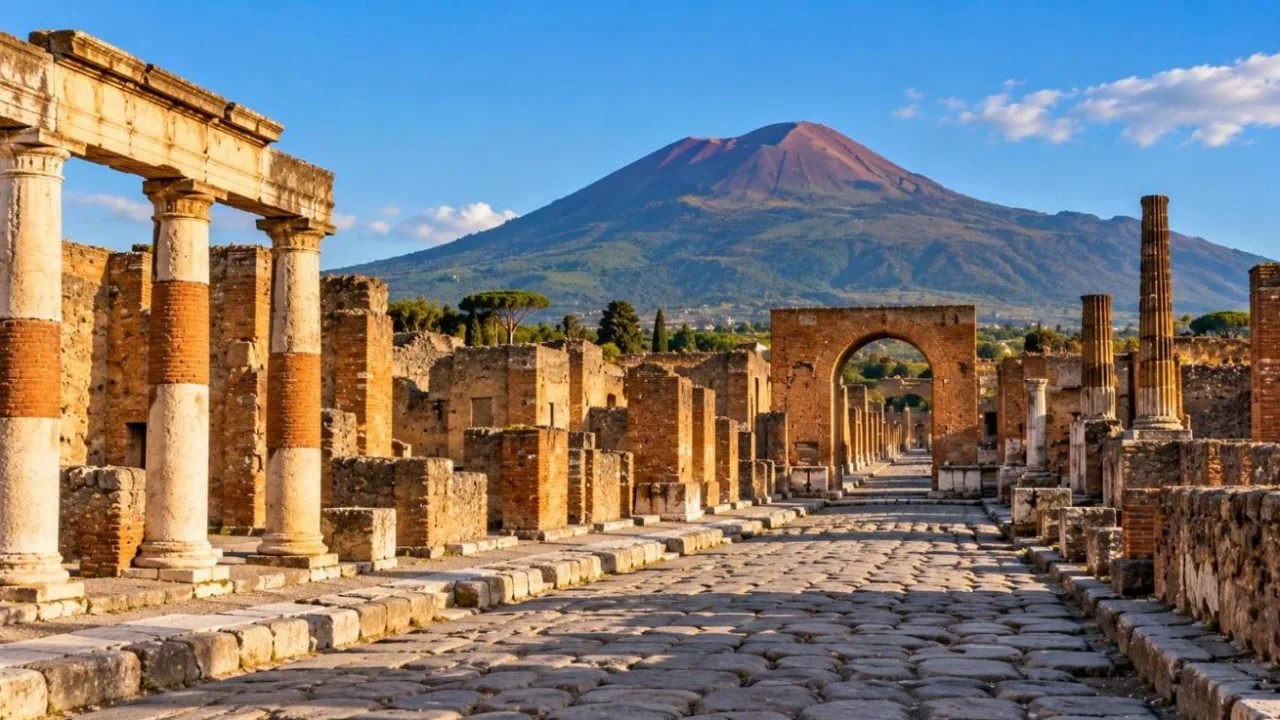
In AD 79, Mount Vesuvius erupted and buried the Roman town of Pompeii under metres of ash and pumice. The catastrophe froze daily life in an instant: bakeries with bread in the ovens, graffiti on the walls, and the hollow shapes of people caught as they fled. Rediscovered in the 18th century, Pompeii is the most complete picture of a Roman city anywhere. In Part 16 of World Landmarks, we explain its history and the new ticket rules for 2026.
Pompeii at a glance
| Fact | Detail |
|---|---|
| Location | Near Naples, Campania, Italy |
| Destroyed | AD 79, by the eruption of Vesuvius |
| Rediscovered | Systematic excavation from 1748 |
| Area | About 66 hectares, of which about 44 excavated |
| UNESCO | Listed 1997 with Herculaneum and Oplontis |
| Ticket (2026) | From €20 |
| Daily visitor cap | 20,000 |
The eruption, and the date debate
Pompeii was a prosperous town of merchants, farmers and wealthy villa owners. The only eyewitness account of its destruction comes from Pliny the Younger, who watched from across the Bay of Naples and described the death of his uncle, Pliny the Elder, who sailed to help. Clouds of ash and then deadly pyroclastic flows engulfed the town.
The traditional date is 24 August AD 79. In 2018, a charcoal inscription found in the new excavations reading "17 October" led some archaeologists to argue for an autumn date. Later studies of the oldest manuscripts of Pliny's letter support August, while some finds still hint at autumn. The safest answer: traditionally 24 August, but the debate is unresolved.
Rediscovery and the famous casts
Systematic exploration began in 1748 under the Bourbon king Charles III. In the 19th century, archaeologist Giuseppe Fiorelli organised the site into numbered regions and blocks and developed the technique of pouring plaster into the voids left by decomposed bodies in the ash. The resulting casts, showing people in their final moments, remain among the most moving sights in archaeology.
What to see
- The Forum: the civic and religious centre, with Vesuvius looming behind.
- House of the Vettii: a wealthy merchants' home with spectacular frescoes.
- The Lupanar: an ancient brothel with surviving wall paintings.
- The Amphitheatre: the oldest surviving stone amphitheatre of its kind.
- Garden of the Fugitives: plaster casts of victims.
- Villa of the Mysteries: just outside the walls, famous for its enigmatic red frescoes.
- Thermopolia: Roman street-food counters.
Recent discoveries
Excavations continue to make headlines. Between 2023 and early 2025, digs in Regio IX uncovered a bakery, a laundry and a lavish house with a black-walled dining hall, a private bathhouse and a shrine painted in Egyptian blue, probably owned by a local politician, Aulus Rustius Verus. In November 2025, an Egyptian-style glass vase was found reused as a cooking pot in a Regio V street-food shop.
Tickets 2026
New prices took effect on 12 January 2026:
| Ticket | Full | Reduced | Includes |
|---|---|---|---|
| Pompeii Express | €20 | €2 | The ancient city only |
| Pompeii+ | €25 | €2 | City, suburban villas, Villa Regina and shuttle |
| Pompeii Plus 3-day | €30 | €2 | Also Oplontis, Stabiae and Boscoreale |
| MyPompeii annual card | €45 | €10 | Unlimited visits for a year |
- The €2 reduced rate is for EU citizens aged 18 to 24.
- Free on the first Sunday of every month (expect huge crowds).
- Tickets are named, and the park has a daily cap of 20,000 visitors. From mid-March to mid-October, entry is split into morning and afternoon time bands.
- Buy on the official ticket website linked from pompeiisites.org; summer weekend slots can sell out days ahead.
- No re-entry once you leave.
Opening hours
| Season | Hours | Last entry |
|---|---|---|
| 16 March – 14 October | 9:00 am – 7:00 pm | 5:30 pm |
| 15 October – 15 March | 9:00 am – 5:00 pm | 3:30 pm |
Pompeii is closed on 25 December and 1 January. Allow at least half a day for the highlights, or a full day to include the Villa of the Mysteries.
Best time to visit
Spring (April–June) and September–October are the most pleasant. Summer is very hot with little shade, so start at opening time, carry water and wear a hat. Pompeii welcomed more than 4 million visitors in 2023.
Getting there
Take the Circumvesuviana train on the Naples–Sorrento line to Pompei Scavi–Villa dei Misteri station, right by the Porta Marina entrance. From Napoli Garibaldi it takes about 40 minutes.
Rules and accessibility
- Bags larger than 30 × 30 × 15 cm are not allowed; paid luggage storage is available at the entrances.
- Wear sturdy shoes: Roman paving stones are uneven.
- The "Pompeii for All" route, over 3.5 km long, offers a more accessible path along the main streets, though some slopes and uneven sections remain.
Nearby
Visit Herculaneum, smaller but even better preserved, and hike to the crater of Vesuvius. For more of the ancient world, see Part 2: the Acropolis.
Frequently asked questions
How much does Pompeii cost in 2026?
€20 for the Pompeii Express ticket, or €25 for Pompeii+ including the suburban villas.
Do I need to book Pompeii in advance?
It is strongly recommended. Tickets are named and daily numbers are capped at 20,000.
When did Vesuvius destroy Pompeii?
Traditionally on 24 August AD 79, although some evidence points to October.
Pompeii or Herculaneum?
Pompeii is larger and more famous; Herculaneum is compact and better preserved. Many visitors see both.
Sources
- Pompeii Archaeological Park – Timetables and tickets (official)
- Pompeii Archaeological Park – Pompeii for All (official)
- UNESCO World Heritage Centre – Archaeological Areas of Pompei, Herculaneum and Torre Annunziata
- Finestre sull’Arte – Zuchtriegel reopens debate on Pompeii’s eruption date
- Wanted in Rome – Pompeii caps tourist numbers, new ticket system
- Apollo Magazine – Pompeii’s extraordinary recent discoveries
World Landmarks: the full series
- Part 1: Eiffel Tower
- Part 2: Acropolis of Athens
- Part 3: Angkor Wat
- Part 4: Great Wall of China
- Part 5: Chichén Itzá
- Part 6: Stonehenge
- Part 7: Alhambra
- Part 8: Sagrada Família
- Part 9: Statue of Liberty
- Part 10: Christ the Redeemer
- Part 11: Neuschwanstein Castle
- Part 12: Tower of London
- Part 13: Forbidden City
- Part 14: Terracotta Army
- Part 15: Sydney Opera House
- Part 16: Pompeii (you are here)
- Part 17: Palace of Versailles
- Part 18: Vatican and Sistine Chapel
- Part 19: Hagia Sophia
- Part 20: Louvre Museum
Prices, opening hours and entry rules in this guide were checked against official sources in October 2026. They change often, so always confirm on the official website before you travel.