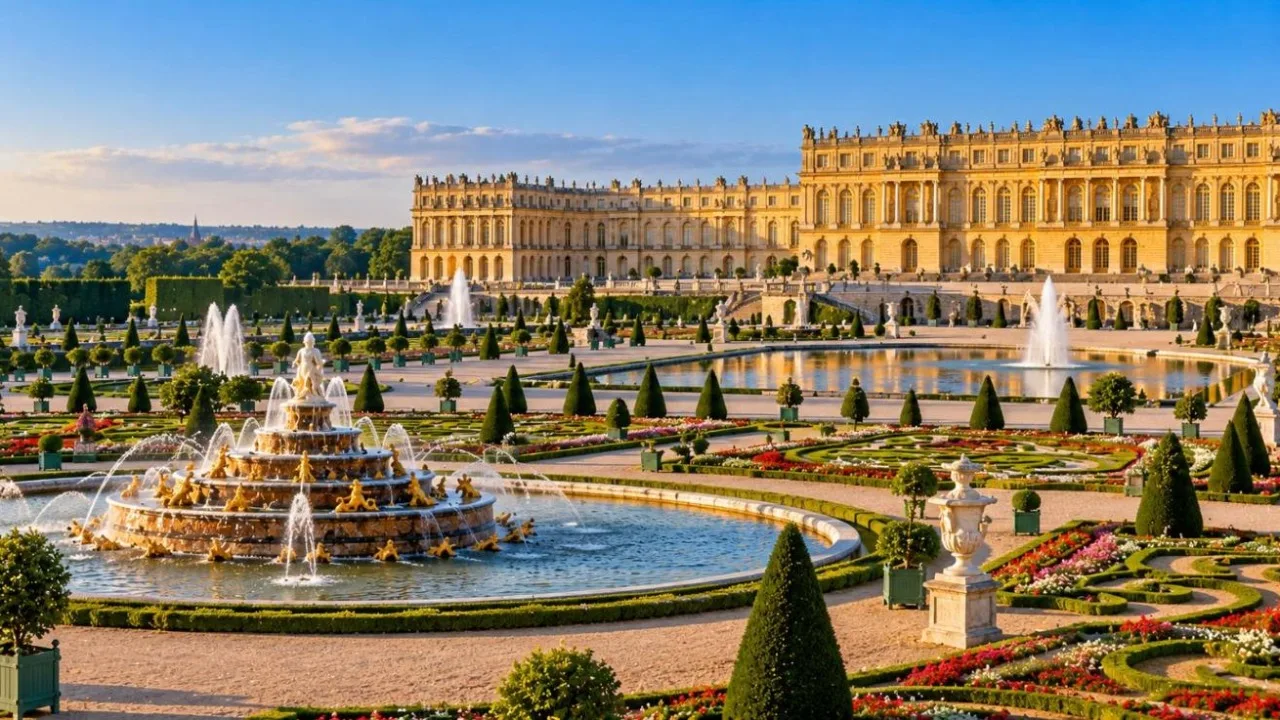
Just outside Paris, the Palace of Versailles is the ultimate symbol of royal power. Louis XIV transformed a modest hunting lodge into the most dazzling court in Europe, a model copied by kings from Russia to Bavaria. A century later, the Revolution drove the monarchy out, and in 1919 the treaty that formally ended the First World War was signed in its Hall of Mirrors. In Part 17 of World Landmarks, we tell its story and explain the new 2026 ticket rules.
Versailles at a glance
| Fact | Detail |
|---|---|
| Location | Versailles, about 20 km southwest of central Paris |
| Origins | Louis XIII’s hunting lodge, 1623 |
| Seat of government | From 6 May 1682 to 1789 |
| Hall of Mirrors | Built 1678–1684; 73 m long, 357 mirrors |
| UNESCO | World Heritage Site since 1979 |
| Passport ticket (2026) | €35 high season / €25 low season (non-EEA) |
A short history
In 1623, Louis XIII built a hunting lodge on a hill above the village of Versailles, later replacing it with a small château. His son, Louis XIV, the "Sun King", had far grander ambitions. From the 1660s, architects Louis Le Vau and later Jules Hardouin-Mansart enlarged the palace, painter Charles Le Brun directed the decoration, and André Le Nôtre designed the gardens.
On 6 May 1682, Louis XIV moved the court and government to Versailles. Thousands of nobles lived there under the king's eye, competing for favour in an elaborate etiquette that kept them away from plotting in the provinces. The palace became the centre of French political life until 1789.
The end came with the Revolution. The Estates-General opened at Versailles on 5 May 1789, and on 6 October 1789 a crowd forced Louis XVI, Marie-Antoinette and their children to leave for Paris. They never returned. In 1837, King Louis-Philippe turned the palace into a museum dedicated to "all the glories of France".
The Hall of Mirrors later witnessed two defining moments in European history: the proclamation of the German Empire on 18 January 1871, and the signing of the Treaty of Versailles on 28 June 1919.
What to see
- Hall of Mirrors: 73 metres long, with 357 mirrors in 17 arches facing 17 windows over the gardens, and ceiling paintings by Le Brun celebrating Louis XIV's reign.
- King's and Queen's State Apartments: lavish rooms of marble, gilt and painted ceilings.
- Royal Chapel and Royal Opera.
- The Gardens: Le Nôtre's formal masterpiece of terraces, groves, fountains and the Grand Canal.
- Grand Trianon: Louis XIV's pink-marble retreat.
- Petit Trianon and the Queen's Hamlet: Marie-Antoinette's private world, including a mock rustic village built in the 1780s.
Ticket prices 2026
From 14 January 2026, Versailles introduced higher prices for visitors from outside the European Economic Area (EEA). Seasons: high season 1 April–31 October; low season 1 November–31 March.
| Ticket | Low season (standard / EEA) | High season (standard / EEA) |
|---|---|---|
| Passport (whole estate) | €25 / €22 | €35 / €32 |
| Late-entry Passport | €18 / €15 | €28 / €25 |
| Estate of Trianon | €15 / €12 | €15 / €12 |
| Musical Gardens or Fountains show (online) | Gardens free | €15 / €12 |
- Palace entry comes with the Passport, which includes a timed entry slot to the palace.
- Free for under-18s, EEA nationals or residents under 26, and disabled visitors plus a companion. Free visitors must still book a timed slot online.
- Free first Sunday of the month from December to March, with a timed slot required.
- The gardens are free on days without fountain or music shows.
Fountain and garden shows
In 2026, the Musical Fountains Shows run on weekends from 4 April to 1 November (plus some Tuesdays in May and June), the Musical Gardens on weekdays from April to October, and the Night Fountains on Saturday evenings in summer. Some displays have been affected by drought restrictions, so check the official site.
Opening hours
| Site | High season | Low season |
|---|---|---|
| Palace | 9:00 am – 6:30 pm | 9:00 am – 5:30 pm |
| Trianon | 12:00 – 6:30 pm | 12:00 – 5:30 pm |
| Gardens | 7:00 am – 8:30 pm | 8:00 am – 6:00 pm |
The palace and Trianon are closed on Mondays, 1 January, 1 May and 25 December. The gardens open daily. The walk from the palace to the Trianon takes about 30 minutes. Allow at least half a day, ideally a full day.
Getting there from Paris
| Train | Station | Walk to palace |
|---|---|---|
| RER C | Versailles Château – Rive Gauche | About 10 minutes |
| SNCF from Montparnasse | Versailles Chantiers | About 18 minutes |
| SNCF from Saint-Lazare | Versailles Rive Droite | About 17 minutes |
You need a ticket valid to Versailles (or a suitable Navigo or Paris Visite pass), not a standard metro ticket.
Tips
- Book the earliest palace slot, and enter through the Chapel Gate in high season, as the palace advises.
- Visit the palace in the morning and the Trianon and gardens in the afternoon.
- Rent a bike or golf cart to explore the vast park, or take the little train.
- Left luggage is temporarily suspended, so travel light.
Combine Versailles with the Eiffel Tower (Part 1) and the Louvre (Part 20).
Frequently asked questions
How much is Versailles in 2026?
The Passport costs €35 in high season for non-EEA visitors (€32 for EEA visitors) and €25 in low season.
Is Versailles closed on Mondays?
Yes, the palace and Trianon are closed on Mondays; the gardens remain open.
How long do you need at Versailles?
At least half a day for the palace and gardens, and a full day to include the Trianon and Marie-Antoinette's estate.
Can I visit Versailles for free?
Under-18s and EEA residents under 26 enter free, and everyone enters free on the first Sunday from December to March.
Sources
- Château de Versailles – 2026 ticketing (official)
- Château de Versailles – Practical information (official)
- Château de Versailles – Hall of Mirrors (official)
- Château de Versailles – Musical Fountains Shows and Musical Gardens (official)
- UNESCO World Heritage Centre – Palace and Park of Versailles
- Sortiraparis – Versailles raises ticket prices for international visitors
World Landmarks: the full series
- Part 1: Eiffel Tower
- Part 2: Acropolis of Athens
- Part 3: Angkor Wat
- Part 4: Great Wall of China
- Part 5: Chichén Itzá
- Part 6: Stonehenge
- Part 7: Alhambra
- Part 8: Sagrada Família
- Part 9: Statue of Liberty
- Part 10: Christ the Redeemer
- Part 11: Neuschwanstein Castle
- Part 12: Tower of London
- Part 13: Forbidden City
- Part 14: Terracotta Army
- Part 15: Sydney Opera House
- Part 16: Pompeii
- Part 17: Palace of Versailles (you are here)
- Part 18: Vatican and Sistine Chapel
- Part 19: Hagia Sophia
- Part 20: Louvre Museum
Prices, opening hours and entry rules in this guide were checked against official sources in October 2026. They change often, so always confirm on the official website before you travel.