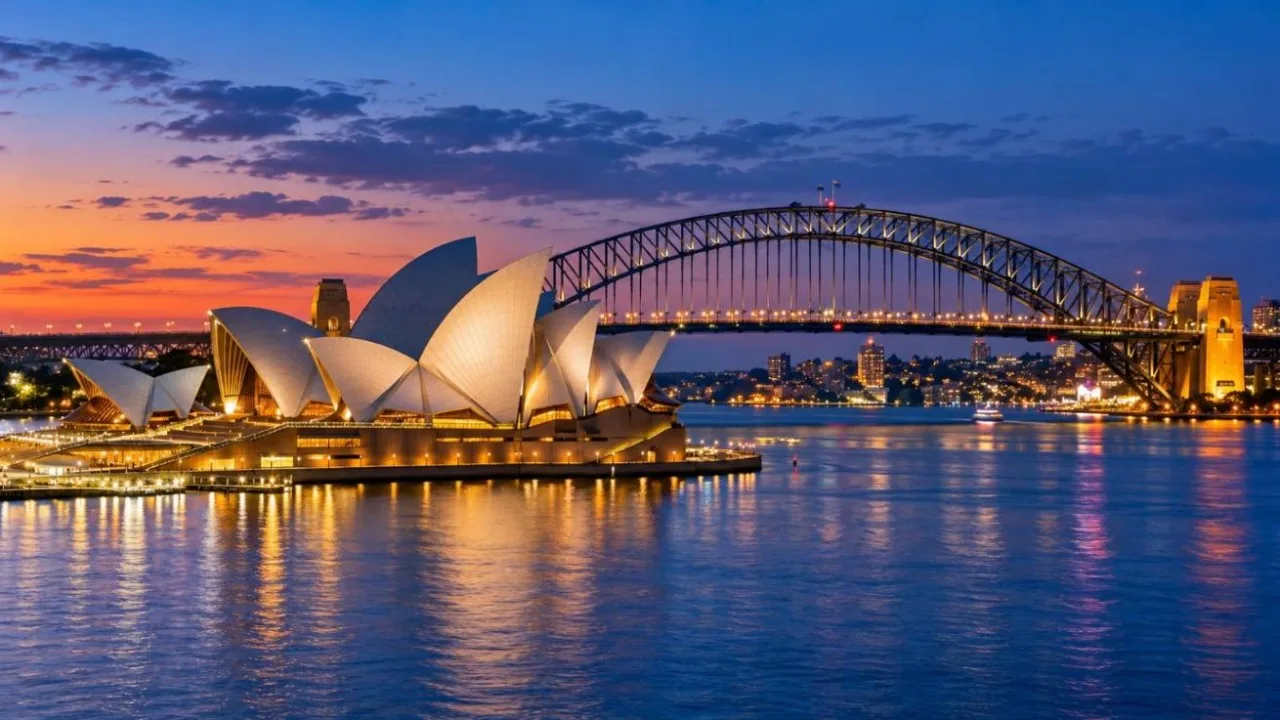
Its white sails rising from Sydney Harbour have made the Sydney Opera House one of the most recognisable buildings of the 20th century. Today, 20 October 2026, marks exactly 53 years since Queen Elizabeth II opened it. Behind the beauty lies one of architecture's most dramatic stories: a young Danish architect, an "impossible" roof, huge cost overruns and a bitter resignation. In Part 15 of World Landmarks, we tell that story and explain how to experience the building.
Sydney Opera House at a glance
| Fact | Detail |
|---|---|
| Location | Bennelong Point, Sydney Harbour |
| Architect | Jørn Utzon (Denmark) |
| Construction | 2 March 1959 – 1973 |
| Opened | 20 October 1973 by Queen Elizabeth II |
| Roof tiles | 1,056,006 Swedish-made tiles |
| Cost | A$102 million (original estimate A$7 million) |
| UNESCO | World Heritage Site since 2007 |
A short history
In 1955 the New South Wales government launched an international design competition for a national opera house. It attracted 233 entries from 32 countries. In 1957 the jury chose the bold design of a little-known 38-year-old Danish architect, Jørn Utzon, whose sketches showed a series of white shells rising above a massive platform.
Building it was another matter. Construction began on 2 March 1959, before the engineering of the roof had been solved. Engineers rejected at least a dozen ways of building the shells between 1957 and 1963, and the project was among the first in the world to use computers to analyse structural forces. The breakthrough came when Utzon found a way to derive all the shells from the surface of a single sphere, allowing them to be built from standard prefabricated parts.
Costs soared and politics intervened. After disputes with a new state government over design changes and unpaid fees, Utzon resigned in February 1966 and left Australia, never to return. A team of Australian architects completed the interiors. The building finally opened on 20 October 1973, ten years late, at a cost of A$102 million, more than 14 times the original estimate.
Utzon's reputation was later restored. He won architecture's top award, the Pritzker Prize, in 2003, and in 2004 the Utzon Room, the first interior rebuilt to his design, opened in his honour. In 2007 the Opera House became a UNESCO World Heritage Site, described as a masterpiece of 20th-century architecture.
The roof: facts and figures
- 1,056,006 tiles in glossy white and matte cream, made in Sweden and arranged in a chevron pattern.
- UNESCO describes the roof as three groups of interlocking vaulted "shells".
What to see and do
- See a performance: venues include the Concert Hall, Joan Sutherland Theatre, Drama Theatre, Playhouse and Studio. The Concert Hall reopened in 2022 after a major acoustic renewal.
- Take a guided tour (see below).
- Walk around the outside: the forecourt, the Northern Boardwalk and the steps are free to explore.
- Eat and drink at the bars and restaurants with harbour views.
Guided tours
| Tour | Duration | Notes |
|---|---|---|
| Sydney Opera House Tour | 60 minutes | Daily; in English and several other languages; about 300 stairs, no lift |
| Backstage Tour | About 135 minutes | Early morning, behind the scenes, with breakfast; ages 10+ |
| Mobility Access Tour | 60 minutes | Step-free route; Auslan and audio description on request |
| Architectural Tour | About 75 minutes | Focus on Utzon’s design |
Standard tour prices are around A$48–50 for adults according to recent travel listings, with the Backstage Tour considerably more. Prices vary, so check and book on the official website, up to two months ahead.
Best views
- Mrs Macquarie's Chair: the classic photo of the Opera House with the Harbour Bridge behind.
- Kirribilli and Cremorne Point: views across the harbour.
- The Harbour Bridge: walk across or visit the Pylon Lookout.
- From a ferry: the Manly ferry passes right by.
During Vivid Sydney, usually in May and June, the sails become a giant canvas for light projections.
Getting there
The Opera House is a 7–10 minute walk from Circular Quay, Sydney's main ferry and train hub. Parking is available at a Wilson car park on site, with discounts for advance booking.
Accessibility
The standard tour involves many stairs, but a dedicated step-free Mobility Access Tour is offered, and Companion Cards are accepted. Contact the venue for performance access needs.
Entering Australia
All visitors except New Zealand citizens need a visa or electronic authority before travelling. Many nationalities can apply for an Electronic Travel Authority (ETA, subclass 601) or eVisitor visa; others, including Indian citizens, apply for a Visitor visa (subclass 600). Check the Department of Home Affairs website.
For another icon of modern design, see Part 8: the Sagrada Família.
Frequently asked questions
Can you go inside the Sydney Opera House without a ticket?
The best way to see the interiors is on a guided tour or by attending a performance. The forecourt, steps and boardwalk outside are free to explore.
How long is the Sydney Opera House tour?
The standard tour lasts about one hour.
Did Jørn Utzon see the finished building?
No. He left Australia in 1966 and never returned to see it completed, although he was later involved in redesigning interiors from abroad.
How many tiles are on the roof?
1,056,006.
Sources
- UNESCO World Heritage Centre – Sydney Opera House
- Sydney Opera House – Our story (official)
- Sydney Opera House – Sydney Opera House Tour (official)
- Google Arts & Culture – Sydney Opera House story
- Australian Department of Home Affairs – Electronic Travel Authority (subclass 601)
World Landmarks: the full series
- Part 1: Eiffel Tower
- Part 2: Acropolis of Athens
- Part 3: Angkor Wat
- Part 4: Great Wall of China
- Part 5: Chichén Itzá
- Part 6: Stonehenge
- Part 7: Alhambra
- Part 8: Sagrada Família
- Part 9: Statue of Liberty
- Part 10: Christ the Redeemer
- Part 11: Neuschwanstein Castle
- Part 12: Tower of London
- Part 13: Forbidden City
- Part 14: Terracotta Army
- Part 15: Sydney Opera House (you are here)
- Part 16: Pompeii
- Part 17: Palace of Versailles
- Part 18: Vatican and Sistine Chapel
- Part 19: Hagia Sophia
- Part 20: Louvre Museum
Prices, opening hours and entry rules in this guide were checked against official sources in October 2026. They change often, so always confirm on the official website before you travel.