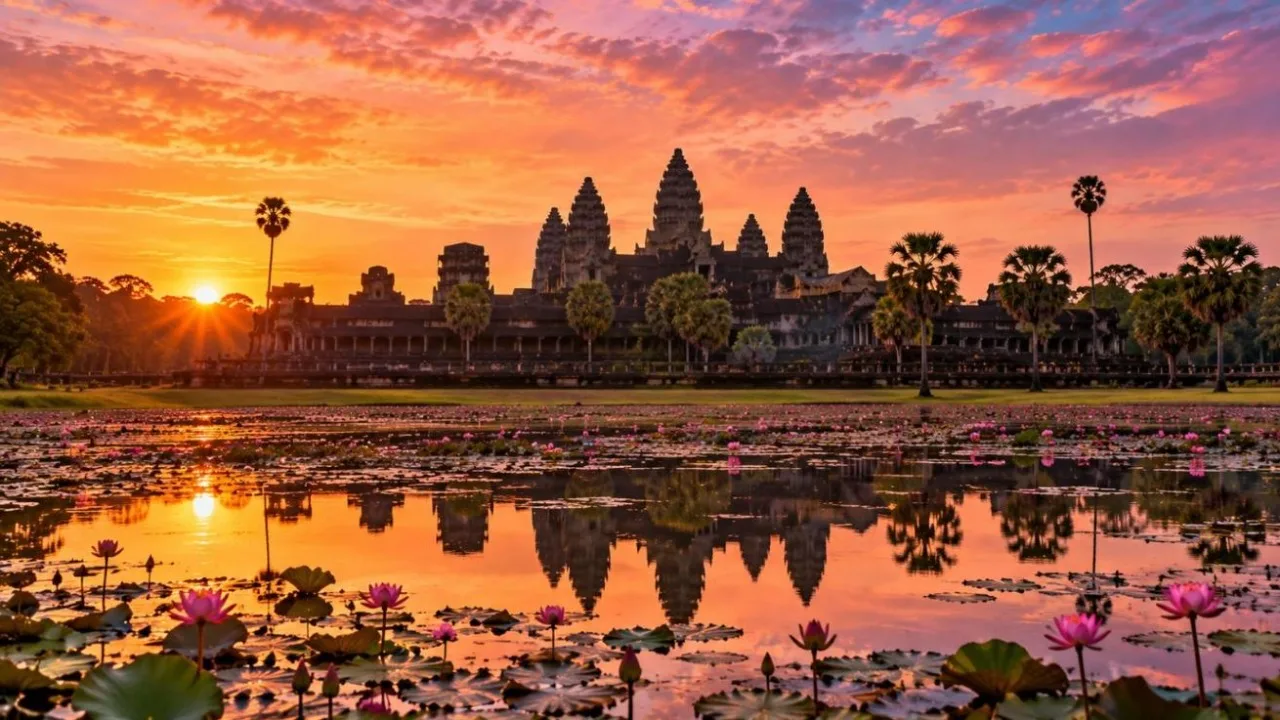
Few sights match the moment the five towers of Angkor Wat emerge from the darkness at sunrise. Built in the 12th century as a Hindu temple and later a Buddhist one, it is the largest religious monument in the world and the centrepiece of an archaeological park of more than 400 square kilometres. It is so central to Cambodian identity that it appears on the national flag. In Part 3 of World Landmarks, we look at Angkor's history and explain everything you need to visit.
Angkor at a glance
| Fact | Detail |
|---|---|
| Location | Near Siem Reap, northwest Cambodia |
| Built by | King Suryavarman II (reigned 1113 to about 1150) |
| Original dedication | The Hindu god Vishnu; later Buddhist |
| UNESCO | World Heritage Site since 1992 (park of about 400 km²) |
| Angkor Pass (2026) | US$37 (1 day), US$62 (3 days), US$72 (7 days) |
| Opening hours | 5:00 am to 6:30 pm |
A short history
From the 9th to the 15th century, Angkor was the capital of the Khmer Empire, which at its height controlled much of mainland Southeast Asia. Successive kings built temples, reservoirs and canals, creating one of the largest pre-industrial urban areas in the world.
Angkor Wat was built in the first half of the 12th century by King Suryavarman II and dedicated to Vishnu. Unusually, it faces west, while most Khmer temples face east, which has led scholars to link it with funerary symbolism. Its design represents Mount Meru, home of the gods in Hindu cosmology: the central tower is the mountain's peak, the walls are the edge of the world, and the moat is the cosmic ocean.
The scale is staggering. The moat is about 190 metres wide and more than 5 kilometres around, and the central tower rises 65 metres. Millions of sandstone blocks were quarried at Phnom Kulen, around 40 kilometres away, and carved into roughly 1,000 square metres of bas-reliefs depicting Hindu epics, battles and celestial dancers.
Over the following centuries, Angkor Wat gradually became a Theravada Buddhist temple, which it remains. It was never truly "lost": monks continued to live there. But the French explorer Henri Mouhot's writings in the 1860s made it famous in the West. Restoration began in the early 20th century, halted under the Khmer Rouge in the 1970s, and resumed with international help. Angkor was on UNESCO's World Heritage in Danger list from 1992 to 2004 and was removed after successful conservation.
Temples you should not miss
| Temple | Why go |
|---|---|
| Angkor Wat | The largest and best-preserved temple; sunrise over the west causeway and reflecting pools |
| Angkor Thom and the Bayon | A walled royal city; the Bayon is famous for its giant smiling stone faces |
| Ta Prohm | Temple ruins wrapped in huge tree roots, made famous by film |
| Banteay Srei | Small temple of pink sandstone with exceptionally fine carving, about 32 km from the main group |
| Preah Khan and Neak Poan | Highlights of the "grand circuit" |
| Pre Rup and Srah Srang | Popular sunset and sunrise spots |
| Phnom Bakheng | Hilltop sunset viewpoint with a visitor cap |
Angkor Pass prices 2026
Every foreign visitor needs an Angkor Pass. The official prices are:
| Pass | Price | Validity |
|---|---|---|
| 1-day pass | US$37 | One day |
| 3-day pass | US$62 | Use on any 3 days within 7 days |
| 7-day pass | US$72 | Use on any 7 days within 30 days |
- Passes cover more than 50 temples. Koh Ker (US$15), Beng Mealea (US$10) and Kbal Spean (US$5) need separate tickets.
- Buy on the official website angkorenterprise.gov.kh, through the official Angkor Pass app, or at the ticket centre near Siem Reap. Avoid unofficial resellers.
- Multi-day passes carry a photo of the holder; keep your pass with you, as it is checked at temples.
- Cambodian citizens enter free. Children are commonly reported to enter free up to age 12 with proof of age; confirm when buying.
Opening hours and itineraries
The park is open 5:00 am to 6:30 pm. Some temples open later or close earlier, and the steep upper level of Angkor Wat has shorter hours and closes on Buddhist holy days.
A popular three-day plan:
- Day 1: sunrise at Angkor Wat, then Angkor Thom, the Bayon and Ta Prohm (the "small circuit").
- Day 2: the "grand circuit" of Preah Khan, Neak Poan and Pre Rup at sunset.
- Day 3: Banteay Srei and Kbal Spean, or the jungle ruins of Beng Mealea.
Best time to visit
The cooler, dry months from November to February are the most comfortable and the busiest. April and May are extremely hot, and the rainy season (roughly June to October) brings green landscapes, fuller moats and fewer visitors. Crowds have thinned considerably in 2026: official figures show ticket sales from January to August were down about 29% on the previous year. To dodge the remaining crowds, visit the main temples around midday when sunrise groups have left, or do the grand circuit in reverse.
Getting there and around
Siem Reap is served by the new Siem Reap-Angkor International Airport, opened in October 2023 about 50 kilometres from the city, so allow around an hour for transfers. The town is a short drive from the temples. Most visitors hire a tuk-tuk or car with driver for the day; bicycles and e-bikes are popular for the small circuit.
Important: land border crossings with Thailand have been closed since 2025 because of a border conflict, so flying in is the practical option. The US State Department rates Cambodia at Level 2 overall but advises against travel within 50 km of the Thai border. Check your own government's advice before travelling.
Visas
Most visitors need a visa, available as an e-visa through the official Cambodian government portal (evisa.gov.kh) or, for many nationalities, on arrival. Fees are reported at around US$30–36. Beware of lookalike websites, and complete the free official e-Arrival card before you land.
Rules and etiquette
- Dress code: shoulders and knees must be covered at the temples. Visitors in shorts or sleeveless tops can be refused entry to some areas.
- No smoking in temples, no climbing on fragile structures, and be respectful when photographing monks.
- Drones require prior permission from the APSARA National Authority.
- Many temples involve steep, uneven steps that are challenging for people with limited mobility.
For another vast ancient site, see Part 14: the Terracotta Army, or compare with the Maya pyramids in Part 5: Chichén Itzá.
Frequently asked questions
How many days do I need at Angkor?
Two to three days lets you see the major temples without rushing. One day covers the highlights, with a very early start.
Can I see sunrise with a 1-day pass?
Yes. The park opens at 5:00 am. Many visitors also buy a pass the afternoon before and use the evening for sunset; check the current rules when you buy.
Is Angkor Wat Hindu or Buddhist?
Both. It was built as a Hindu temple to Vishnu and gradually became a Buddhist temple, which it still is today.
Is it safe to visit Angkor in 2026?
Siem Reap remains a popular destination, but border tensions with Thailand have affected travel. Fly in rather than crossing by land, and check official travel advisories before you go.
Sources
- Angkor Enterprise – Available tickets (official Angkor Pass site)
- UNESCO World Heritage Centre – Angkor
- Encyclopaedia Britannica – Angkor Wat
- US State Department – Cambodia travel advisory
- The Star / ANN – Angkor ticket sales down one-third (1 Sep 2026)
World Landmarks: the full series
- Part 1: Eiffel Tower
- Part 2: Acropolis of Athens
- Part 3: Angkor Wat (you are here)
- Part 4: Great Wall of China
- Part 5: Chichén Itzá
- Part 6: Stonehenge
- Part 7: Alhambra
- Part 8: Sagrada Família
- Part 9: Statue of Liberty
- Part 10: Christ the Redeemer
- Part 11: Neuschwanstein Castle
- Part 12: Tower of London
- Part 13: Forbidden City
- Part 14: Terracotta Army
- Part 15: Sydney Opera House
- Part 16: Pompeii
- Part 17: Palace of Versailles
- Part 18: Vatican and Sistine Chapel
- Part 19: Hagia Sophia
- Part 20: Louvre Museum
Prices, opening hours and entry rules in this guide were checked against official sources in October 2026. They change often, so always confirm on the official website before you travel.