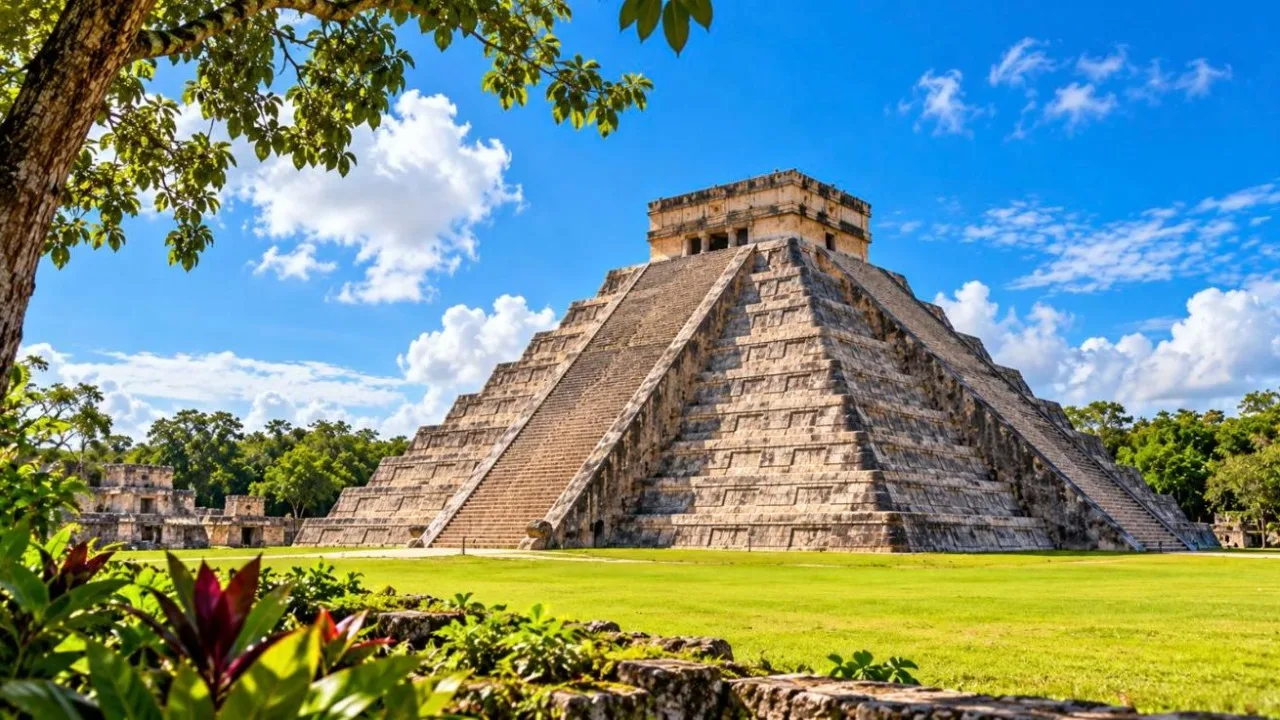
In the flat jungle of Mexico's Yucatán Peninsula stands one of the most famous pyramids in the Americas. Chichén Itzá was a powerful Maya city whose stepped pyramid, El Castillo, is a giant calendar in stone. At the spring and autumn equinoxes, the sinking sun creates the illusion of a serpent slithering down its staircase. In Part 5 of World Landmarks, we explain the history and the practicalities, including the new single ticket introduced in 2026.
Chichén Itzá at a glance
| Fact | Detail |
|---|---|
| Location | Yucatán state, Mexico |
| Founded | Around the 5th–6th century AD |
| Area | About 10 km² |
| UNESCO | World Heritage Site since 1988 |
| New 7 Wonders | Named 7 July 2007 |
| Entry for foreigners (2026) | About 676–697 MXN (single ticket) |
| Hours | 8:00 am – 4:00 pm (last entry) |
A short history
The name means "at the mouth of the well of the Itzá", a reference to the natural sinkholes, or cenotes, that provided water in a land without rivers. According to UNESCO, the city developed in two main phases. From the 6th to the 10th century, Maya builders created the "Old Chichén" area in the Puuc style. From the 10th century, influences from central Mexico, traditionally linked to the Toltecs and the feathered-serpent god Kukulcán (Quetzalcóatl), produced a striking fusion of styles.
Chichén Itzá became one of the largest and most powerful cities of the late Maya world. No major new buildings were added after the 13th century, and the city declined by the mid-15th century, although the Sacred Cenote remained a pilgrimage site. Archaeological exploration began in the 19th century.
El Castillo and the equinox serpent
The Temple of Kukulcán, known as El Castillo, is about 24 metres tall. Each of its four staircases has 91 steps; together with the top platform they total 365, one for each day of the solar year.
At the spring and autumn equinoxes, the afternoon sun casts a series of seven triangles of light and shadow along the north staircase. Joined with the carved serpent head at its base, they look like a serpent descending the pyramid. Mexico's National Institute of Anthropology and History (INAH) says the effect is best seen roughly between 3 and 5 pm, and is also visible on the days around the equinox. Expect huge crowds: around 33,000 people visited during the spring 2025 equinox.
What to see
- El Castillo: the iconic pyramid (viewing only).
- Great Ball Court: the largest known in Mesoamerica, used for a ritual ball game.
- Temple of the Warriors and the Group of the Thousand Columns.
- Tzompantli: a platform carved with rows of skulls.
- El Caracol: a round building believed to have served as an observatory.
- Sacred Cenote: a natural well where offerings were made.
- The Nunnery and Akab Dzib: older Puuc-style buildings in the south.
Ticket prices 2026
Until 2026, visitors queued twice to pay a federal INAH fee and a separate Yucatán state fee. Since 27 March 2026, there is a single ticket sold at one office in the visitor centre (CATVI), with the two authorities sharing the revenue.
| Visitor | INAH fee | State fee | Total (MXN) |
|---|---|---|---|
| Foreign visitors | 105 | 571 | 676 |
| Mexican nationals | 105 | 198 | 303 |
| Yucatán residents | 105 | — | 105 |
These figures were published for 2026 by the local newspaper Por Esto. Other reports put the foreign total at 697 MXN after the single ticket began, so budget about 700 MXN (roughly US$35–40). Parking costs 124 MXN. Mexican nationals and foreign residents enter free on Sundays (subject to some fees). Bring both a card and cash.
An evening sound-and-light show, Noches de Kukulcán, is sold separately through its official site.
Opening hours
The site opens daily from 8:00 am, and ticket sales and entry close at 4:00 pm. Allow three to four hours. Note that the site was closed from 19 May to 1 June 2026 during a dispute with vendors, so check the latest news before you travel.
Best time to visit
- Arrive at 8:00 am, before the heat and the tour buses from Cancún. UNESCO counts at least 3,500 visitors a day, rising to 8,000 in high season.
- Wear sunscreen, a hat and light clothing: there is little shade.
- The dry season (roughly November to April) is most comfortable.
- If you want to see the equinox serpent, be prepared for very large crowds and restricted areas.
How to get there
| From | Approx. distance | Options |
|---|---|---|
| Valladolid | About 40 km | Car, bus, colectivo, Tren Maya |
| Mérida | About 120 km | Car, ADO bus, Tren Maya |
| Cancún | About 200 km | Car, ADO bus, tours, Tren Maya |
The Tren Maya has a Chichén Itzá station near Pisté, opened in February 2024, on the Mérida–Cancún line; a shuttle connects the station with the ruins. Fares changed in 2026, so check trenmaya.gob.mx for current prices.
Rules
- Climbing El Castillo is banned (since 2008). A tourist who climbed it in 2023 was detained and fined.
- Drones are prohibited, and professional photo or video equipment requires an INAH permit.
- Enter only through the visitor centre.
Nearby
Cool off at Ik Kil cenote, a few minutes away, where you can swim in a sinkhole about 40 metres deep, or spend the night in the colourful colonial town of Valladolid. For another great ancient city, see Part 3: Angkor Wat.
Frequently asked questions
How much does Chichén Itzá cost for foreigners?
About 676–697 MXN in 2026, paid as a single ticket at the visitor centre.
Can you climb the pyramid at Chichén Itzá?
No. Climbing El Castillo has been banned since 2008 to protect the structure.
When is the equinox serpent visible?
Around the spring equinox (about 20–21 March) and autumn equinox (about 22–23 September), in the late afternoon, and on nearby days.
Is Chichén Itzá a day trip from Cancún?
Yes, but it is a long one. Staying in Valladolid lets you arrive at opening time before the crowds.
Sources
- UNESCO World Heritage Centre – Pre-Hispanic City of Chichen-Itza
- INAH – Boletín 105 (2026 equinox operation)
- Por Esto – Chichén Itzá entry cost 2026
- Diario de Yucatán – Single ticket introduced (March 2026)
- Expansión – Closure and reopening, hours (June 2026)
- New7Wonders – Lisbon announcement, 7 July 2007
World Landmarks: the full series
- Part 1: Eiffel Tower
- Part 2: Acropolis of Athens
- Part 3: Angkor Wat
- Part 4: Great Wall of China
- Part 5: Chichén Itzá (you are here)
- Part 6: Stonehenge
- Part 7: Alhambra
- Part 8: Sagrada Família
- Part 9: Statue of Liberty
- Part 10: Christ the Redeemer
- Part 11: Neuschwanstein Castle
- Part 12: Tower of London
- Part 13: Forbidden City
- Part 14: Terracotta Army
- Part 15: Sydney Opera House
- Part 16: Pompeii
- Part 17: Palace of Versailles
- Part 18: Vatican and Sistine Chapel
- Part 19: Hagia Sophia
- Part 20: Louvre Museum
Prices, opening hours and entry rules in this guide were checked against official sources in October 2026. They change often, so always confirm on the official website before you travel.