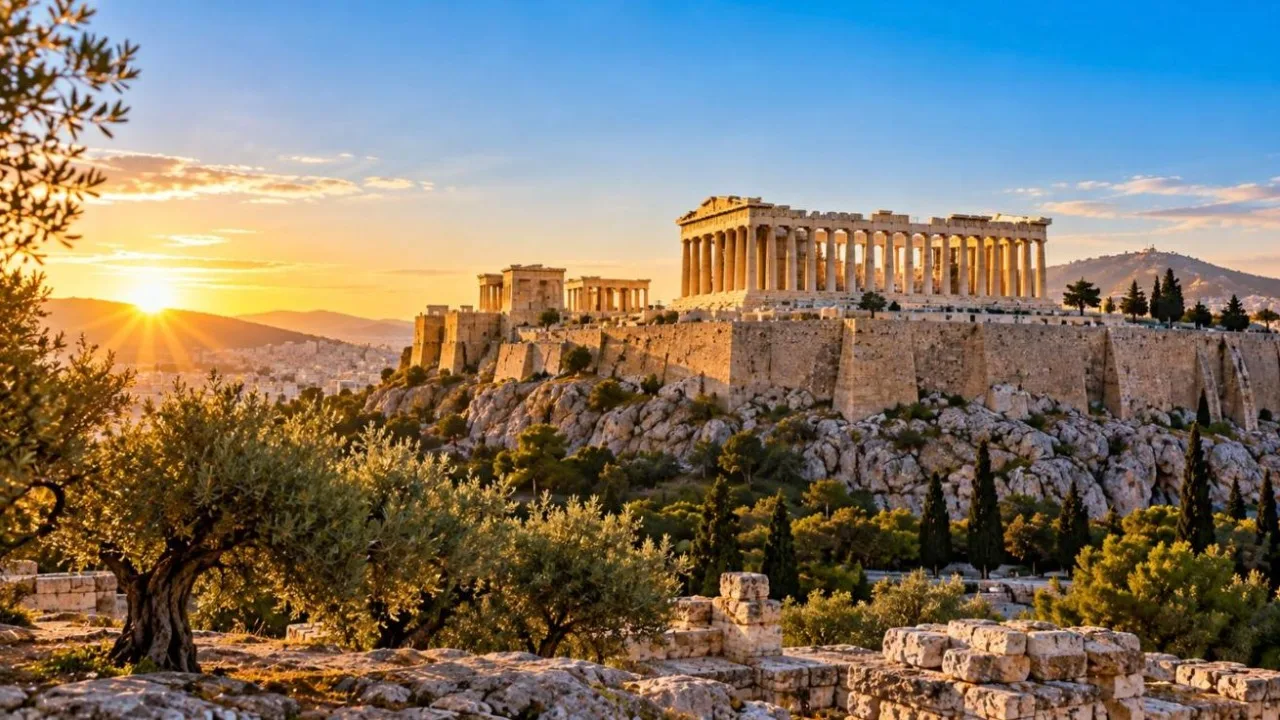
Rising above modern Athens, the rocky hill of the Acropolis carries the most influential buildings of the ancient world. The Parthenon, its marble temple to the goddess Athena, has inspired architects for 2,500 years, from Roman temples to government buildings around the globe. In Part 2 of World Landmarks, we explore the Acropolis's history and explain how to visit, including the 2026 ticket rules that catch many travellers out.
The Acropolis at a glance
| Fact | Detail |
|---|---|
| Location | Central Athens, Greece |
| Main monuments built | Mid-5th century BC under Pericles |
| Parthenon built | 447–432 BC |
| Architects | Iktinos and Kallikrates; sculpture led by Pheidias |
| UNESCO | World Heritage Site since 1987 |
| Standard ticket (2026) | €30 (reduced €15) |
A short history
People lived on the Acropolis from the Neolithic period. By the 13th century BC it was a fortified Mycenaean citadel, and from the 8th century BC it became a sacred precinct dedicated mainly to Athena. Under the ruler Peisistratos in the 6th century BC, the great Panathenaic festival was established and the first monumental temples appeared.
In 480 BC the invading Persians sacked the site and burned its temples. After the Greek victory, the statesman Pericles launched an ambitious rebuilding programme in the mid-5th century BC, the golden age of Athens. It produced the monuments we see today:
| Monument | Built | What it is |
|---|---|---|
| Parthenon | 447–432 BC | Doric temple of Athena Parthenos, with 8 columns at each end and 17 on each side |
| Propylaia | 437–432 BC | The monumental gateway, designed by Mnesikles |
| Temple of Athena Nike | 427–424 BC | Small Ionic temple on the western bastion |
| Erechtheion | 421–406 BC | Complex temple famous for its porch of the Caryatids (sculpted maidens) |
The Parthenon once housed a colossal gold-and-ivory statue of Athena by Pheidias. Over the centuries the building became a church (dedicated to the Holy Mother of Athens in 1205) and, after the Ottoman capture of Athens in 1460, a mosque with a minaret.
Its worst moment came in 1687. During a Venetian siege, the Ottomans stored gunpowder inside the Parthenon; Venetian fire ignited it, and the explosion tore the building apart. In the early 1800s, agents of Lord Elgin removed many sculptures, including 15 metopes, 56 blocks of the frieze and 18 pediment statues, most of which remain in the British Museum and are the subject of a long-running return campaign by Greece.
Restoration began in the 19th century, and since 1975 a dedicated committee has overseen careful conservation. Scaffolding is still a regular sight: this is a working archaeological site.
What to see
- Propylaia: the grand entrance on the west side.
- Temple of Athena Nike: a jewel-like temple to the right of the entrance.
- Parthenon: walk around all four sides; you cannot enter the temple itself.
- Erechtheion: look for the Caryatid porch; the figures on the building are copies, and originals are displayed in the Acropolis Museum.
- The slopes: the Theatre of Dionysus, birthplace of Greek drama, and the Odeon of Herodes Atticus, still used for summer concerts.
- The views: across Athens to the sea and to Lycabettus Hill.
Tickets 2026
Since April 2025 the Acropolis has a single year-round price. Tickets are sold for a specific entry time slot, part of measures introduced to manage crowds.
| Ticket | Price |
|---|---|
| Acropolis and slopes, full | €30 |
| Reduced | €15 |
| Acropolis Museum (separate) | €20 (reduced €10) |
| Ancient Agora | €20 |
| Temple of Olympian Zeus | €20 |
| Roman Agora, Hadrian’s Library, Kerameikos | €10 each |
- Free entry for EU citizens under 25 and non-EU children under 18, with ID.
- Book officially at tickets.hh.gr (Hellenic Heritage). Booked tickets are generally non-refundable.
- The old combined seven-site ticket has been withdrawn, so each site now needs its own ticket.
- Free-entry days include 6 March, 18 April, 18 May, the last weekend of September and 28 October, plus some winter Sundays. These days are extremely busy.
Prices quoted are based on official announcements and recent reports; check the official ticket site before booking.
Opening hours
| Period | Hours |
|---|---|
| 1 April – 31 August | 8:00 – 20:00 |
| 1–15 September | 8:00 – 19:30 |
| 16–30 September | 8:00 – 19:00 |
| 1–15 October | 8:00 – 18:30 |
| 16–31 October | 8:00 – 18:00 |
| 1 November – 31 March | 8:00 – 17:00 |
The site closes on 1 January, 25 March, 1 May, Easter Sunday and 25–26 December. Last entry is usually about 30 minutes before closing. During extreme heatwaves, authorities close the Acropolis in the middle of the day (roughly noon to 5 pm), as happened in July 2024 and July 2025. Allow two to three hours for the hill and slopes.
Best time to visit
- Book the 8:00 am slot or go in the last two hours before closing. Summer morning slots can sell out days ahead.
- Choose spring (April–May) or autumn (September–October) for milder weather.
- In summer, carry water and a hat; there is very little shade.
How to get there
Take Metro Line 2 (red) to Akropoli station; the main entrance on Dionysiou Areopagitou is a short uphill walk. From Athens airport, take Metro Line 3 (blue) to Syntagma and change to Line 2 for one stop, about 45 minutes in total. The airport metro fare is €9.
Rules and accessibility
- Wear shoes with good grip: the ancient marble is polished smooth and slippery.
- Large bags and strollers are not allowed; tripods, selfie sticks and drones are banned. Only water may be brought in.
- A lift on the north slope serves wheelchair users and people with reduced mobility, but it does not run in bad weather and has been affected by works. Contact the site in advance.
Don't miss the Acropolis Museum
At the foot of the hill, the modern Acropolis Museum displays original sculptures from the site, including five of the Caryatids, with a top-floor gallery laid out to match the Parthenon. It is open daily (late on Fridays) and is the perfect complement to the hill, especially in the afternoon heat.
Nearby you can explore the Ancient Agora with its Temple of Hephaestus, Areopagus Hill for sunset views, and the Plaka and Anafiotika neighbourhoods. For another great ancient site, see Part 16: Pompeii.
Frequently asked questions
How much does it cost to visit the Acropolis?
A standard ticket costs €30 in 2026, with a €15 reduced rate and free entry for EU citizens under 25 and non-EU children under 18.
Do I need to book a time slot?
Yes. Tickets are issued for a specific entry time, and popular summer slots sell out, so book online in advance.
Can you go inside the Parthenon?
No. Visitors walk around the outside of the temple; the interior is closed for conservation.
How long should I spend at the Acropolis?
About two to three hours for the hill and slopes, plus two hours or more for the Acropolis Museum.
Sources
- UNESCO World Heritage Centre – Acropolis, Athens
- Hellenic Ministry of Culture (Odysseus) – Acropolis of Athens
- Acropolis Restoration Service (YSMA) – The Parthenon
- Hellenic Ministry of Culture – Acropolis Museum
- Al Jazeera – Acropolis closes as Greece sizzles under another severe heatwave (July 2025)
World Landmarks: the full series
- Part 1: Eiffel Tower
- Part 2: Acropolis of Athens (you are here)
- Part 3: Angkor Wat
- Part 4: Great Wall of China
- Part 5: Chichén Itzá
- Part 6: Stonehenge
- Part 7: Alhambra
- Part 8: Sagrada Família
- Part 9: Statue of Liberty
- Part 10: Christ the Redeemer
- Part 11: Neuschwanstein Castle
- Part 12: Tower of London
- Part 13: Forbidden City
- Part 14: Terracotta Army
- Part 15: Sydney Opera House
- Part 16: Pompeii
- Part 17: Palace of Versailles
- Part 18: Vatican and Sistine Chapel
- Part 19: Hagia Sophia
- Part 20: Louvre Museum
Prices, opening hours and entry rules in this guide were checked against official sources in October 2026. They change often, so always confirm on the official website before you travel.