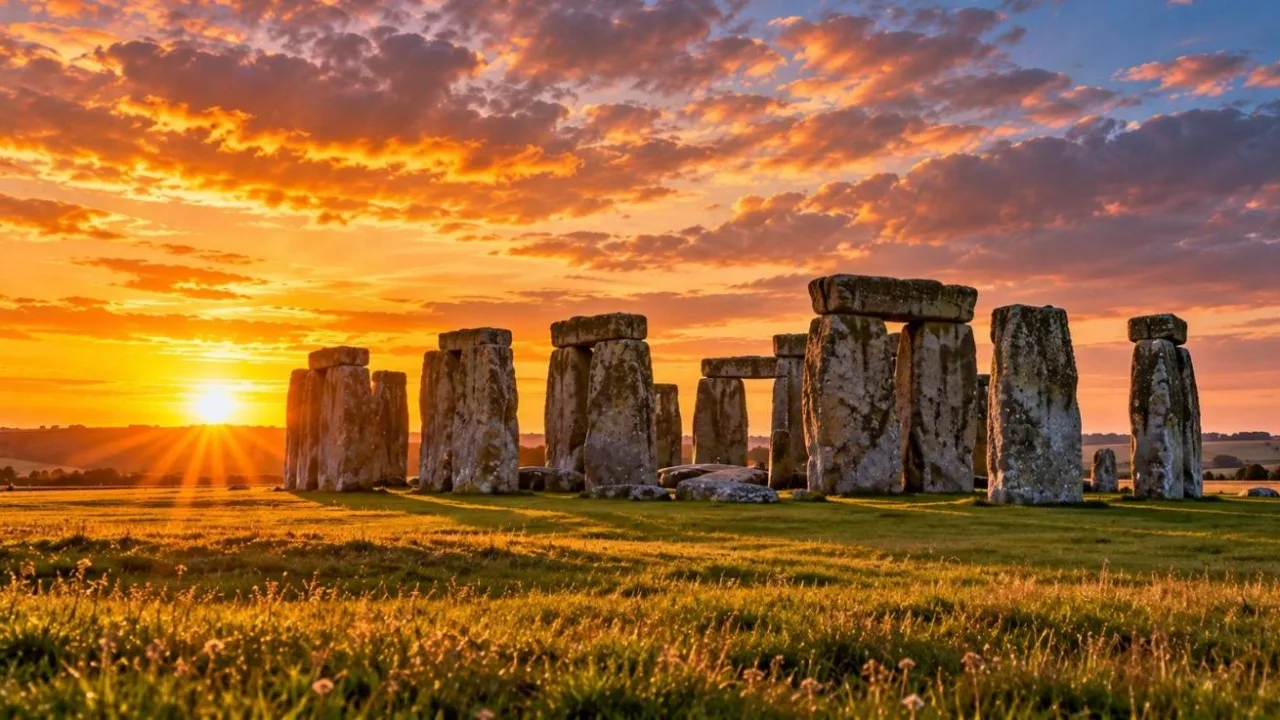
On a windswept plain in southern England, a ring of colossal stones has kept its secrets for 5,000 years. Stonehenge is the most famous prehistoric monument in Europe, and in recent years science has transformed what we know about it, tracing its stones to distant quarries and even to the far north of Scotland. In Part 6 of World Landmarks, we explain how it was built, what it may have been for, and how to visit.
Stonehenge at a glance
| Fact | Detail |
|---|---|
| Location | Salisbury Plain, Wiltshire, England |
| First built | About 3000 BC (earthwork); stones raised about 2500 BC |
| Managed by | English Heritage |
| UNESCO | "Stonehenge, Avebury and Associated Sites", listed 1986 |
| Adult ticket | From about £24–29 depending on date (2026/27 rates) |
| Hours | 9:30 am – 5 pm or 6 pm depending on season |
How Stonehenge was built
Stonehenge was not built in one go but over many centuries. According to English Heritage:
| Period | What happened |
|---|---|
| About 3000 BC | A circular ditch and bank about 100 m across, with 56 "Aubrey Holes"; cremated human remains were buried here |
| About 2500 BC | The giant sarsen stones were raised in an outer circle and inner horseshoe, with smaller bluestones between them |
| Around 200–300 years later | The bluestones were rearranged, and the Avenue to the River Avon was built |
| 1800–1500 BC | The last known activity: rings of pits that may have been meant for another rearrangement |
The sarsens, typically weighing around 20 tonnes and up to 7 metres tall, came mostly from West Woods near Marlborough, about 15 miles (25 km) to the north. The builders shaped them and joined them with woodworking-style joints, which English Heritage says makes Stonehenge the most architecturally sophisticated prehistoric stone circle in the world.
The smaller bluestones travelled even further, from the Preseli Hills in southwest Wales, more than 150 miles (250 km) away. How Neolithic people moved them remains unknown.
The Altar Stone surprise
In August 2024 a study in the journal Nature revealed that the six-tonne Altar Stone, long assumed to be Welsh, actually came from the Orcadian Basin in northeast Scotland, at least 700 km away. It is the longest known journey for a monument stone of that era and suggests remarkable organisation and long-distance contacts across prehistoric Britain.
What was it for?
Nobody knows for certain, and English Heritage is careful to say so. The stones are aligned on the midsummer sunrise and midwinter sunset, which suggests a solar temple or calendar for marking the seasons. The cremation burials show it was also a place of the dead. It may have been all of these, a ceremonial centre whose meaning changed over the centuries.
What you will see
- The stone circle: on a normal visit you walk a path around the stones, getting as close as about 5 metres.
- The visitor centre: an exhibition including the reconstructed face of a man who lived 5,500 years ago, plus a café and shop.
- Neolithic houses: reconstructed homes based on excavations nearby, and a chance to try moving a replica sarsen.
- The landscape: Stonehenge sits within a wider World Heritage landscape of burial mounds and earthworks.
A shuttle bus runs from the visitor centre to the stones in 5–10 minutes, or you can walk (about 25–40 minutes).
Ticket prices 2026
English Heritage uses dynamic pricing with three tiers, and booking online in advance (by midnight the day before) is cheaper than buying on the day. Its official 2026/27 list prices for groups give a good guide to the range:
| Tier | Adult | Concession | Child (5–17) |
|---|---|---|---|
| Super Saver (off-peak weekdays) | £24.65 | £22.35 | £12.32 |
| Saver | £27.03 | £24.65 | £13.51 |
| Standard (summer weekends, bank holidays) | £29.32 | — | £14.62 |
- Free entry for under-5s, English Heritage members (and National Trust, Cadw and Historic Scotland members as affiliates), carers of disabled visitors and local residents with a pass.
- Entry is by timed ticket. Tickets are non-refundable; book on the official English Heritage website.
- Parking costs £4 for non-members.
- Stone Circle Experience: special one-hour visits inside the circle, early morning or evening, from £70 for adults (£40 for ages 5–17). They are limited to small groups and not run in October and November.
Opening hours
For 2026/27, English Heritage lists opening from 9:30 am, closing at 6 pm in spring and summer and 5 pm in autumn and winter, with last admission well before closing. Stonehenge is closed on 25 December. Allow at least two hours.
Solstice gatherings
Stonehenge offers free managed access to the stones at the summer and winter solstices, when thousands gather to watch the sunrise. The winter solstice in 2026 falls on 22 December. Rules ban alcohol, glass, drones and large bags. Check English Heritage's website for details.
How to get there
- By train: the nearest station is Salisbury, about 12 miles (19 km) away, with regular trains from London Waterloo.
- Stonehenge Tour bus: runs from Salisbury station and city centre via Old Sarum to the visitor centre, about every 30 minutes in summer.
- By car: the site is near Amesbury (postcode SP4 7DE), signposted from the A303 and A360.
Rules and accessibility
- Stay on the visitor path. Touching or climbing the stones is not allowed.
- Dogs are not allowed on the shuttle or in the stone field (assistance dogs excepted).
- The shuttles are accessible, wheelchairs can be borrowed, and carers go free.
Nearby
Visit Old Sarum, the site of the original Salisbury; Salisbury Cathedral, with England's tallest spire; and Avebury, part of the same World Heritage Site and home to the largest prehistoric stone circle. In London, the Tower of London (Part 12) makes a great pairing.
Frequently asked questions
How old is Stonehenge?
Its earliest earthwork dates to about 3000 BC, and the great stones were raised around 2500 BC.
Can you touch the stones?
No. Even on the special Stone Circle Experience, touching the stones is not allowed.
Where did the stones come from?
The big sarsens came from near Marlborough, about 15 miles away; the bluestones from the Preseli Hills in Wales; and the Altar Stone from northeast Scotland.
Is the Stonehenge road tunnel going ahead?
No. The UK government cancelled the planned A303 tunnel in 2024 and formally revoked its planning consent in 2026.
Sources
- English Heritage – Stonehenge (official visitor page)
- English Heritage – History of Stonehenge
- English Heritage – Group admission prices and opening times 2026/27 (PDF)
- English Heritage – Stone Circle Experience
- UNESCO World Heritage Centre – Stonehenge, Avebury and Associated Sites
- UCL News – Stonehenge Altar Stone came from Scotland, not Wales (Aug 2024)
World Landmarks: the full series
- Part 1: Eiffel Tower
- Part 2: Acropolis of Athens
- Part 3: Angkor Wat
- Part 4: Great Wall of China
- Part 5: Chichén Itzá
- Part 6: Stonehenge (you are here)
- Part 7: Alhambra
- Part 8: Sagrada Família
- Part 9: Statue of Liberty
- Part 10: Christ the Redeemer
- Part 11: Neuschwanstein Castle
- Part 12: Tower of London
- Part 13: Forbidden City
- Part 14: Terracotta Army
- Part 15: Sydney Opera House
- Part 16: Pompeii
- Part 17: Palace of Versailles
- Part 18: Vatican and Sistine Chapel
- Part 19: Hagia Sophia
- Part 20: Louvre Museum
Prices, opening hours and entry rules in this guide were checked against official sources in October 2026. They change often, so always confirm on the official website before you travel.