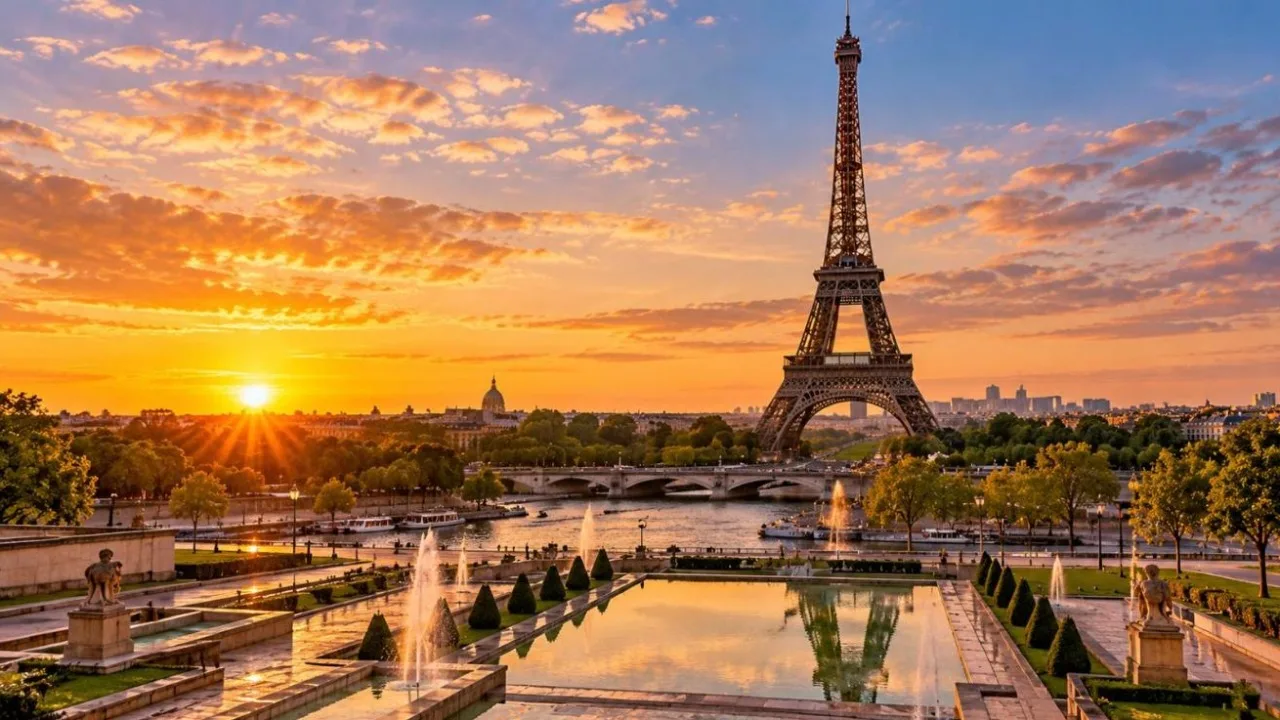
No structure says "Paris" quite like the Eiffel Tower. Built as a temporary showpiece for a world's fair, it was attacked by critics, nearly dismantled, and then embraced as the symbol of a nation. Today almost 7 million people visit each year, about three-quarters of them from abroad. In Part 1 of World Landmarks, we cover the tower's history, what you will see on each level, and the practical details you need, with prices and times checked on the official website in October 2026.
Eiffel Tower at a glance
| Fact | Detail |
|---|---|
| Location | Champ de Mars, 7th arrondissement, Paris |
| Built | 26 January 1887 to 31 March 1889 |
| Built for | The 1889 Exposition Universelle (World’s Fair) |
| Height | 330 m with antennas (312 m without) |
| Weight | About 10,100 tonnes in total |
| Visitors | Almost 7 million a year; nearly 300 million since 1889 |
| UNESCO | Part of "Paris, Banks of the Seine", listed 1991 |
A short history
The idea came not from Gustave Eiffel himself but from two engineers in his company, Maurice Koechlin and Émile Nouguier, who sketched a giant metal pylon in June 1884. Architect Stephen Sauvestre refined its look, adding the decorative arches at the base. Eiffel registered a patent in September 1884 and championed the project.
The tower was the star of the 1889 World's Fair, held to mark the centenary of the French Revolution. Construction began on 26 January 1887. Even before the first floor rose, a group of artists and writers, including the composer Charles Gounod, the writer Guy de Maupassant and Charles Garnier, architect of the Paris Opera, published a letter of protest in the newspaper Le Temps attacking the "useless and monstrous" tower.
The builders pressed on. The first floor was finished in April 1888, the second in August 1888, and the tower was complete on 31 March 1889, just two years, two months and five days after work began. It used 18,038 iron parts held together by 2.5 million rivets. About 2 million people visited during the fair alone.
The tower was originally given a limited permit, but its value for radio and later television transmission helped secure its future. A navigation beacon was added in 1947, and in 1985 the tower was lit with 336 golden spotlights. Since 2000 it has sparkled with 20,000 bulbs for five minutes every hour after dark.
What to see on each level
| Level | Height | Highlights |
|---|---|---|
| Esplanade | Ground | Shops, information desk, views up through the giant iron legs |
| First floor | 57 m | Glass floor, Madame Brasserie restaurant, history trail |
| Second floor | 116 m | The best panoramic views of Paris, macaron bar, Le Jules Verne restaurant (separate access) |
| Summit | 276 m | Champagne bar and a reconstruction of Gustave Eiffel’s office |
Many visitors find the second floor the sweet spot: high enough for sweeping views, but close enough to pick out landmarks such as the Arc de Triomphe, Montmartre and the Louvre. The summit is breathtaking on a clear day but can close in bad weather or when it gets too crowded.
Ticket prices 2026
These are the official prices on the operator's website in October 2026. Youth tickets cover ages 12–24, and child tickets ages 4–11 (the child rate also applies to visitors with disabilities).
| Ticket | Adult | Youth (12–24) | Child (4–11) |
|---|---|---|---|
| Second floor by lift | €23.50 | €11.80 | €6.00 |
| Summit by lift | €36.70 | €18.40 | €9.20 |
| Second floor by stairs | €14.80 | €7.40 | €3.80 |
| Stairs to 2nd floor + lift to summit | €28.00 | €14.00 | €7.00 |
- Under-4s go free but still need a ticket.
- Book only on the official website, toureiffel.paris. Tickets go on sale up to two months ahead, and you cannot add the summit after purchase.
- Stairs tickets must now be booked in advance (since 29 September 2026), and groups of more than nine have a separate booking system.
- Prices will change: the operator says new fares apply from 11 January 2027, so check before you book if you are travelling next year.
Opening hours
In October 2026 the tower opens from 9:30 am to 11 pm, with last ascents around 10:45 pm (earlier for the summit). Hours are longer in summer. The summit closes for annual maintenance for a few weeks each winter (5 January to 6 February in 2026), and strikes occasionally close the whole tower, as happened on 2 October 2025. Check the official site on the day.
Best time to visit
- Quietest times: according to the operator, 9–11 am and 8–10:30 pm. The busiest window is 11 am to 5 pm.
- For the sparkle: be on the second floor just before the hour after dark.
- Going down: in peak season, walking down the stairs from the second floor is often quicker than queuing for the lift.
- For photos from outside: the Trocadéro gardens across the river and the Champ de Mars give the classic views.
How to get there
| Transport | Stop | Walk |
|---|---|---|
| Metro line 6 | Bir-Hakeim | Under 10 minutes |
| Metro line 9 | Trocadéro | About 15 minutes |
| Metro line 8 | École Militaire | About 15 minutes |
| RER C | Champ de Mars–Tour Eiffel | About 5 minutes |
| Batobus | Tour Eiffel stop | On the riverbank |
The address is 5 avenue Anatole France, 75007 Paris. Buses 30, 42, 69, 72, 82 and 86 also stop nearby.
Rules and accessibility
- All bags are checked at security, and large luggage is not allowed. There is no left-luggage office.
- Pets are not allowed, except assistance dogs.
- The first and second floors are reachable by lift. The summit and the stairs are not suitable for people with reduced mobility.
Nearby attractions
Combine your visit with the Trocadéro and Palais de Chaillot, a walk on the Champ de Mars, the Musée du quai Branly or a Seine cruise. The Louvre is covered in Part 20, and the Palace of Versailles, an easy day trip, in Part 17.
Frequently asked questions
How tall is the Eiffel Tower?
It stands 330 metres including its antennas, or 312 metres to the top of the structure. The highest visitor platform is at 276 metres.
Is it worth going to the summit?
On a clear day, yes, but the second floor often gives better views of individual landmarks. If you are on a budget, the second floor by stairs is the cheapest way up.
How many steps are there?
The stairs only go as far as the second floor; the summit can only be reached by lift. Expect several hundred steps, so it is a good workout rather than a stroll.
Can I visit without booking?
Some tickets are sold on site, but booking online on the official site is strongly recommended, and stairs tickets now require advance booking.
When does the Eiffel Tower sparkle?
For five minutes on the hour, every hour after dark until late evening. Times vary by season, so check on the day.
Sources
- Official Eiffel Tower website – Prices and opening times
- Official Eiffel Tower website – Key figures
- Official Eiffel Tower website – The Eiffel Tower at night
- UNESCO World Heritage Centre – Paris, Banks of the Seine
World Landmarks: the full series
- Part 1: Eiffel Tower (you are here)
- Part 2: Acropolis of Athens
- Part 3: Angkor Wat
- Part 4: Great Wall of China
- Part 5: Chichén Itzá
- Part 6: Stonehenge
- Part 7: Alhambra
- Part 8: Sagrada Família
- Part 9: Statue of Liberty
- Part 10: Christ the Redeemer
- Part 11: Neuschwanstein Castle
- Part 12: Tower of London
- Part 13: Forbidden City
- Part 14: Terracotta Army
- Part 15: Sydney Opera House
- Part 16: Pompeii
- Part 17: Palace of Versailles
- Part 18: Vatican and Sistine Chapel
- Part 19: Hagia Sophia
- Part 20: Louvre Museum
Prices, opening hours and entry rules in this guide were checked against official sources in October 2026. They change often, so always confirm on the official website before you travel.