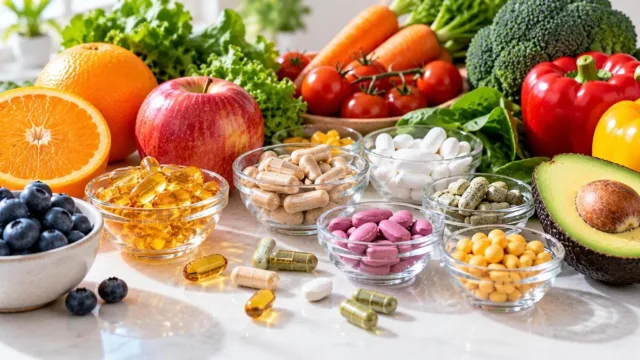
Few nutrients have a public-health success story as clear as folate. When governments started adding folic acid to flour and grain products, the number of babies born with serious spine and brain defects fell. Yet folate is still misunderstood: people mix up "folate" and "folic acid", wonder whether they need "methylfolate", and rarely know that taking too much can hide a vitamin B12 problem. In Part 9 of Vitamins and Minerals Explained, we cover all of it.
Folate vs folic acid: what is the difference?
Folate is a B vitamin (sometimes called vitamin B9) that occurs naturally in foods such as leafy greens, beans and liver. Folic acid is the synthetic form used in fortified foods and most supplements. Your body handles them a little differently: folic acid is absorbed more efficiently than the folate in food. That is why recommendations are written in micrograms of dietary folate equivalents (mcg DFE), a unit that adjusts for absorption.
The conversion is simple once you see it: about 240 mcg of folic acid equals 400 mcg of food folate, and both count as 400 mcg DFE. Supplement labels in the US now show folate in mcg DFE, sometimes with the folic acid amount in brackets.
A third form, methylfolate (5-MTHF or L-methylfolate), is the active form your body actually uses, and it is sold in some supplements.
What does folate do?
Folate is needed to make DNA and other genetic material, and for cells to divide. That makes it especially important wherever cells multiply quickly: in a developing baby, in the bone marrow that makes red blood cells, and in the lining of the gut. Folate also works with vitamin B12 and vitamin B6 to process homocysteine, an amino acid that, at high levels, has been linked to heart disease.
How much folate do you need?
The NIH Office of Dietary Supplements lists these Recommended Dietary Allowances (RDAs):
| Life stage | Recommended amount (mcg DFE/day) |
|---|---|
| Birth to 6 months | 65 |
| Infants 7–12 months | 80 |
| Children 1–3 years | 150 |
| Children 4–8 years | 200 |
| Children 9–13 years | 300 |
| Teens 14–18 years | 400 |
| Adults 19+ | 400 |
| Pregnant teens and women | 600 |
| Breastfeeding teens and women | 500 |
There is one extra recommendation that matters more than the table: all women and teenage girls who could become pregnant should get 400 mcg of folic acid a day from supplements, fortified foods or both, on top of the folate in a normal diet.
Folic acid and pregnancy
The neural tube is the structure that becomes a baby's brain and spinal cord. It closes in the first weeks of pregnancy, often before a woman knows she is pregnant. When it does not close properly, the result is a neural tube defect such as spina bifida or anencephaly.
Taking folic acid before conception and in early pregnancy sharply reduces this risk. This is why the advice targets everyone who could become pregnant, not only those planning a pregnancy: roughly half of pregnancies are unplanned, and the critical window is so early.
In 1998 the US Food and Drug Administration made it mandatory to add folic acid to enriched bread, flour, cornmeal, pasta and rice. Folic acid intake rose and neural tube defect rates fell. Many other countries, including Canada and Australia, fortify flour for the same reason, and the UK has legislated to do the same. Prenatal vitamins usually contain 400–800 mcg of folic acid; women with a previous pregnancy affected by a neural tube defect are often advised by their doctor to take a much higher dose, which should only be done under medical supervision.
Best food sources of folate
Here are selected foods from the NIH health professional fact sheet. The Daily Value (DV) used on US food labels is 400 mcg DFE.
| Food | Serving | mcg DFE | % DV |
|---|---|---|---|
| Beef liver, braised | 3 oz | 215 | 54% |
| Spinach, boiled | ½ cup | 131 | 33% |
| Black-eyed peas, boiled | ½ cup | 105 | 26% |
| Fortified breakfast cereal (25% DV) | 1 serving | 100 | 25% |
| White rice, enriched, cooked | ½ cup | 90 | 22% |
| Asparagus, boiled | 4 spears | 89 | 22% |
| Brussels sprouts, boiled | ½ cup | 78 | 20% |
| Spaghetti, enriched, cooked | ½ cup | 74 | 19% |
| Romaine lettuce, shredded | 1 cup | 64 | 16% |
| Avocado, sliced | ½ cup | 59 | 15% |
| Spinach, raw | 1 cup | 58 | 15% |
| Broccoli, cooked | ½ cup | 52 | 13% |
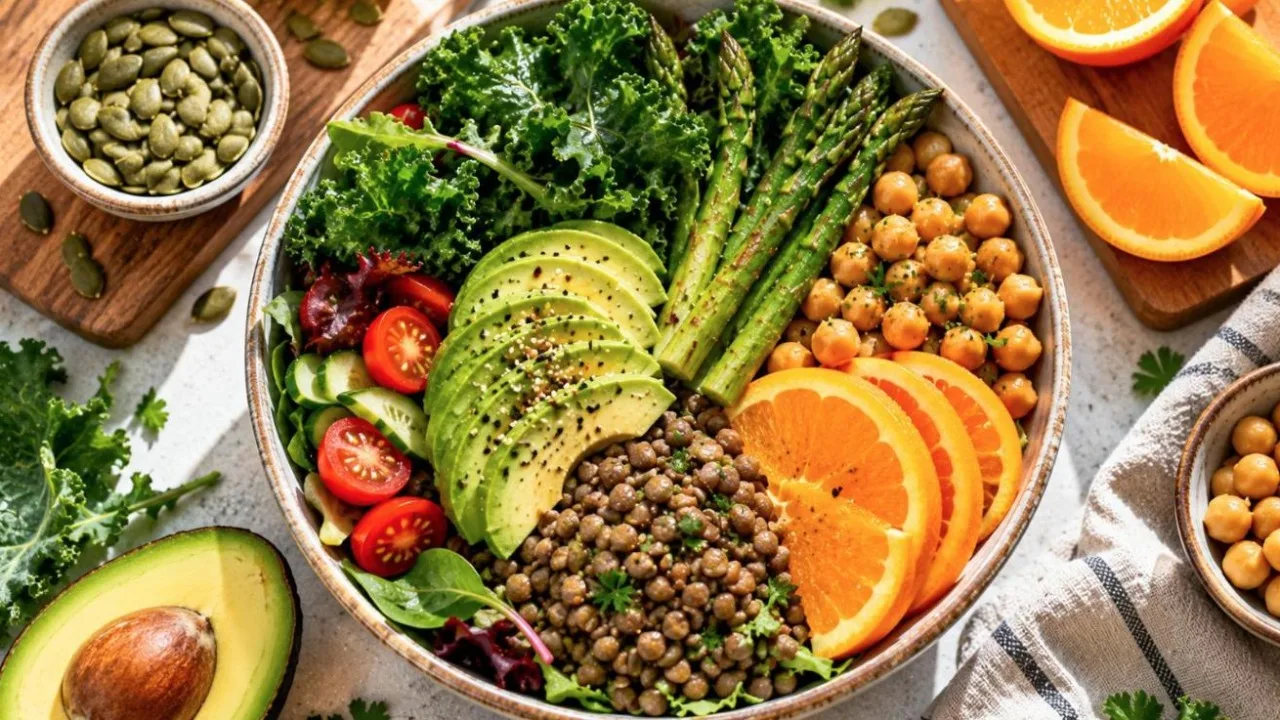
Other good sources include oranges and orange juice, peanuts, kidney beans, chickpeas, lentils and mustard greens. The name itself comes from the Latin folium, meaning leaf, a useful reminder of where to find it.
Folate in food is fragile. It is destroyed by long cooking and leaches into water, so steaming or quick cooking keeps more than boiling for a long time. Eating some greens raw also helps.
Who is at risk of low folate?
Outright deficiency is uncommon in countries that fortify grains, but some groups are more likely to fall short:
- Teenage girls and young women, who often get less than recommended, at the age when it matters most for pregnancy.
- People with alcohol use disorder. Alcohol reduces folate absorption and increases its loss, and heavy drinkers often eat poorly.
- People with conditions that reduce absorption, such as coeliac disease and inflammatory bowel disease.
- People with an MTHFR gene variant (MTHFR C677T), which makes it harder to convert folate into its active form.
- People taking certain medicines (see interactions below).
Signs of folate deficiency
The classic result of folate deficiency is megaloblastic anaemia: the bone marrow produces large, immature red blood cells that cannot carry oxygen well. Symptoms include:
- Weakness and fatigue
- Difficulty concentrating, irritability and headache
- Heart palpitations and shortness of breath
- Open sores on the tongue and inside the mouth
- Changes in the colour of skin, hair or fingernails
In pregnancy, low folate raises the chance of neural tube defects and may also increase the risk of premature birth and low birth weight. Because vitamin B12 deficiency causes the same type of anaemia (see Part 2 on vitamin B12), doctors usually test both.
Can you take too much? The B12 masking problem
Folate from food is not considered harmful. The upper limits apply only to folic acid from supplements and fortified foods:
| Age | Upper limit (mcg folic acid/day) |
|---|---|
| Children 1–3 | 300 |
| Children 4–8 | 400 |
| Children 9–13 | 600 |
| Teens 14–18 | 800 |
| Adults 19+ | 1,000 |
The main reason for the limit is an interaction with vitamin B12. High doses of folic acid can correct the anaemia caused by B12 deficiency, but not the nerve damage. The blood test looks normal, so the B12 deficiency can go unnoticed while it causes permanent damage to the brain, spinal cord and nerves. This matters most for older adults, vegans and people on metformin or acid-reducing drugs, who are already at higher risk of low B12.
There is also some concern about cancer. Folate is needed for healthy cell division, but research suggests that high doses of folic acid taken after pre-cancerous changes have started, particularly in the colon, might speed their growth. The evidence is not settled, but the NIH advises caution with doses above 1,000 mcg a day, especially for people with a history of colorectal adenomas (polyps).
What about methylfolate and MTHFR?
Many websites suggest that people with an MTHFR variant must take methylfolate instead of folic acid. The NIH fact sheet notes that 5-MTHF may be a better choice for people with the MTHFR C677T variant, but it also says clearly that people who could become pregnant should still take 400 mcg of folic acid daily, because folic acid is the form proven in trials to prevent neural tube defects. If you have been told you carry an MTHFR variant, discuss the options with your doctor rather than switching on your own.
What does the research say about other benefits?
- Heart disease and stroke: folic acid lowers homocysteine, but trials have not shown that it directly reduces heart disease. Combined with other B vitamins, it may help prevent stroke, particularly in places without grain fortification.
- Depression: low folate is linked with depression and possibly a weaker response to antidepressants. Supplements, especially methylfolate, may help some people, but the evidence is unclear.
- Memory and dementia: folic acid does not appear to improve thinking skills or prevent dementia or Alzheimer's disease.
- Autism: some studies suggest that taking recommended amounts before and early in pregnancy may lower the risk of autism spectrum disorder, but the results are inconclusive.
Medicine interactions
- Methotrexate (used for cancer and rheumatoid arthritis) works partly by blocking folate. Folate supplements may interfere with it when used for cancer; for arthritis, doctors often prescribe folic acid to reduce side effects.
- Anti-seizure drugs such as phenytoin, carbamazepine and valproate can lower folate levels, and folate can lower the levels of these drugs.
- Sulfasalazine, used for ulcerative colitis, can reduce folate absorption.
Practical tips
- Aim for a daily serving of leafy greens, plus beans or lentils several times a week.
- If you could become pregnant, take 400 mcg of folic acid daily, even if you are not planning a pregnancy.
- Steam or quickly cook vegetables to keep more folate.
- Avoid high-dose folic acid products unless a doctor recommends them, and make sure your B12 status is known if you take more than 1,000 mcg.
Frequently asked questions
Is folate the same as vitamin B9?
Yes. "Vitamin B9" is an informal name for folate. Folic acid is the synthetic form of the same vitamin.
When should I start taking folic acid before pregnancy?
Ideally at least one month before conception, and continue through the first trimester. Because so many pregnancies are unplanned, health agencies advise anyone who could become pregnant to take it daily.
Can men benefit from folic acid?
Men need 400 mcg DFE a day like women, but most get enough from a varied diet and fortified grains. Supplements are not routinely needed.
Does cooking destroy folate?
Partly. Folate is sensitive to heat and dissolves into cooking water, so long boiling can remove a large share. Steaming, microwaving and eating some vegetables raw keep more of it.
Sources
- NIH Office of Dietary Supplements – Folate (consumer fact sheet)
- NIH Office of Dietary Supplements – Folate (health professional fact sheet)
Vitamins and Minerals Explained: the full series
- Part 1: Vitamin D
- Part 2: Vitamin B12
- Part 3: Iron
- Part 4: Magnesium
- Part 5: Vitamin C
- Part 6: Calcium
- Part 7: Zinc
- Part 8: Omega-3 Fatty Acids
- Part 9: Folate and Folic Acid (you are here)
- Part 10: Vitamin A
- Part 11: Vitamin E
- Part 12: Vitamin K
- Part 13: Potassium
- Part 14: Iodine
- Part 15: Biotin
- Part 16: Do You Need Supplements?
This article is for general information only and is not medical advice. Recommended amounts shown are US figures from the NIH Office of Dietary Supplements; guidance in other countries may differ slightly. Talk to a doctor or pharmacist before starting supplements, especially if you are pregnant, take medicines or have a health condition.