Vitamin K gets far less attention than vitamins C or D, yet without it a small cut could keep bleeding. It is the reason every newborn in many countries receives an injection in the first hours of life, and the reason people taking the blood thinner warfarin are told to watch their salad intake. In Part 12 of Vitamins and Minerals Explained, we explain vitamin K, the difference between K1 and K2, and what the research says about bones and the heart.
What is vitamin K?
Vitamin K is a group of fat-soluble compounds. The "K" comes from Koagulation, the German word for clotting, used by the Danish scientist who discovered it in the 1930s. There are two main natural forms:
- Vitamin K1 (phylloquinone) is made by plants and found mainly in green leafy vegetables. It is the main form in most diets.
- Vitamin K2 (menaquinones) is a family of compounds labelled MK-4 to MK-13. They are made by bacteria and found in fermented foods and some animal foods. Bacteria in the human gut also produce some menaquinones.
Supplements contain K1 (sometimes called phytonadione), MK-4 or MK-7.
What does vitamin K do?
- Blood clotting: the liver needs vitamin K to make several clotting factors (including prothrombin). Without enough, blood clots slowly and bleeding is harder to stop.
- Bone health: vitamin K activates osteocalcin, a protein that helps bind calcium into the bone matrix.
- Blood vessels: it activates matrix Gla protein, which helps prevent calcium from building up in the walls of arteries. This is why researchers are interested in vitamin K and heart disease.
How much vitamin K do you need?
There is not enough evidence to set an RDA, so experts have set an Adequate Intake (AI) instead:
| Life stage | Adequate Intake (mcg/day) |
|---|---|
| Birth to 6 months | 2.0 |
| Infants 7–12 months | 2.5 |
| Children 1–3 years | 30 |
| Children 4–8 years | 55 |
| Children 9–13 years | 60 |
| Teens 14–18 years | 75 |
| Men 19+ | 120 |
| Women 19+ | 90 |
| Pregnancy/breastfeeding (teens) | 75 |
| Pregnancy/breastfeeding (adults) | 90 |
Best food sources of vitamin K
The US Daily Value is 120 mcg. Values below are for K1 unless noted.
| Food | Serving | mcg | % DV |
|---|---|---|---|
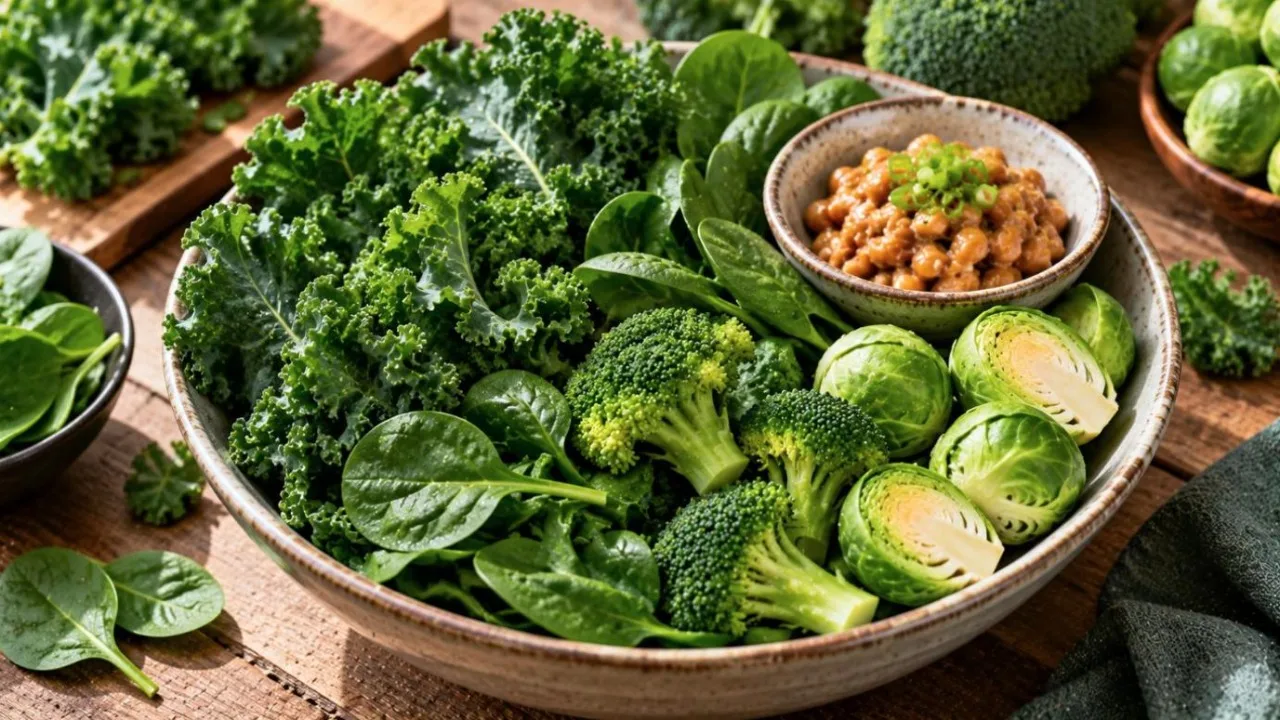
| Natto (as K2, MK-7) | 3 oz | 850 | 708% |
| Collard greens, boiled | ½ cup | 530 | 442% |
| Turnip greens, boiled | ½ cup | 426 | 355% |
| Spinach, raw | 1 cup | 145 | 121% |
| Kale, raw | 1 cup | 113 | 94% |
| Broccoli, boiled | ½ cup | 110 | 92% |
| Soybeans, roasted | ½ cup | 43 | 36% |
| Carrot juice | ¾ cup | 28 | 23% |
| Soybean oil | 1 tbsp | 25 | 21% |
| Edamame, prepared | ½ cup | 21 | 18% |
| Pumpkin, canned | ½ cup | 20 | 17% |
| Pomegranate juice | ¾ cup | 19 | 16% |
Green leafy vegetables are so rich in vitamin K that a single side of greens can supply several days' worth. Other sources include lettuce, Brussels sprouts, cabbage, blueberries, figs, vegetable oils, and smaller amounts in meat, cheese and eggs.
Natto, a traditional Japanese dish of fermented soybeans, is the standout source of K2. Hard and soft cheeses, egg yolks and chicken provide smaller amounts of menaquinones, although data on K2 in foods are still limited.
Because vitamin K is fat-soluble, eating greens with some oil or fat (a dressing, for example) improves absorption.
Vitamin K for newborns
Babies are born with very low vitamin K levels. Little vitamin K crosses the placenta, the newborn gut has not yet been colonised by bacteria that make it, and breast milk is low in vitamin K. This puts newborns at risk of vitamin K deficiency bleeding (VKDB).
VKDB can occur in the first week (early VKDB) or at around 2 to 12 weeks (late VKDB), and the late form is more common in exclusively breastfed babies. It can cause bleeding from the umbilical cord stump, gut, skin or nose, and most dangerously sudden bleeding in the brain, which has a high death rate. For this reason the American Academy of Pediatrics recommends a single injection of 0.5 to 1 mg of vitamin K1 at birth, and similar policies exist in many countries. The injection is a simple, highly effective way to prevent a rare but devastating condition.
Vitamin K deficiency in adults
Deficiency is rare in healthy adults, because most people get enough from food and gut bacteria contribute too. When it does occur, the main sign is easy bruising and bleeding, such as nosebleeds, bleeding gums, blood in urine or stool, or heavy menstrual periods. Low vitamin K may also weaken bones and raise the risk of osteoporosis.
People more likely to be low include:
- Newborns who do not receive the vitamin K injection
- People with conditions that reduce fat absorption, such as cystic fibrosis, coeliac disease, ulcerative colitis and short bowel syndrome
- People who have had weight-loss (bariatric) surgery
- People who take antibiotics for long periods, which can reduce vitamin K-producing gut bacteria
Vitamin K and warfarin
This is the single most important practical fact about vitamin K. Warfarin (brand name Coumadin) is an anticoagulant that works by blocking the recycling of vitamin K in the body, which slows clotting. Vitamin K in food works against it.
That does not mean people on warfarin must avoid green vegetables. The advice is to keep vitamin K intake consistent from day to day. A sudden increase (a big kale smoothie, a new supplement) can make warfarin less effective and raise the risk of clots. A sudden decrease can make the blood too thin and cause dangerous bleeding. Anyone on warfarin who plans to change their diet or start a supplement containing vitamin K should talk to their doctor or anticoagulation clinic first.
Newer anticoagulants, such as apixaban and rivaroxaban, work differently and are not affected by vitamin K in the same way.
Other medicine interactions
- Antibiotics taken for more than a few weeks can reduce vitamin K production by gut bacteria.
- Bile acid sequestrants (cholesterol drugs such as cholestyramine and colestipol) can reduce vitamin K absorption.
- Orlistat (Alli, Xenical), a weight-loss drug, reduces absorption of fat-soluble vitamins including vitamin K.
What does the research say?
Bone health
Higher vitamin K intake from food is linked with stronger bones and fewer hip fractures in observational studies. Supplement trials are mixed: some found better bone strength and fewer fractures, while others did not. In Japan, a high-dose form of MK-4 is used as a prescription treatment for osteoporosis, but more research is needed before vitamin K supplements can be recommended for bone health in general.
Heart disease
Researchers are studying whether low vitamin K levels contribute to calcium build-up in arteries, which stiffens and narrows the vessels that feed the heart. The theory is plausible, but it is not yet clear whether supplements help prevent heart disease.
K2 supplements
K2, especially MK-7, is heavily marketed as a partner to vitamin D and calcium for bones and arteries. MK-7 stays in the blood longer than K1, which is an interesting property, but large trials proving clear health benefits for healthy people are still lacking. Calcium and vitamin D are covered in Part 6 and Part 1.
Is vitamin K safe?
Natural vitamin K from food or supplements has not been shown to cause harm, and no upper limit has been set. The main safety concern is the interaction with warfarin. A synthetic form called menadione (vitamin K3), which is no longer used in human supplements, did cause toxicity.
Practical tips
- Eat a serving of green leafy vegetables most days, with a little healthy fat.
- Try fermented foods such as natto or aged cheeses if you want some K2.
- If you take warfarin, keep your vitamin K intake steady and tell your doctor before starting any supplement.
- Accept the vitamin K injection for newborns; it prevents a rare but life-threatening bleeding disorder.
Frequently asked questions
Is K2 better than K1?
They have different sources and stay in the body for different lengths of time. K1 from greens is the main form in most diets and is well proven for clotting. K2 is being studied for bones and arteries, but there is not enough evidence to say it is better for healthy people.
Can I eat spinach if I am on warfarin?
Usually yes, as long as you eat similar amounts consistently and your doctor adjusts your warfarin dose to your normal diet. Avoid sudden large changes.
Why do babies need a vitamin K shot?
Newborns have very little vitamin K and cannot get enough from breast milk in the first weeks. The injection prevents vitamin K deficiency bleeding, which can cause bleeding in the brain.
Do I need a vitamin K supplement?
Most healthy adults get enough from food. Supplements may be useful for people with absorption problems, but only under medical advice.
Sources
- NIH Office of Dietary Supplements – Vitamin K (consumer fact sheet)
- NIH Office of Dietary Supplements – Vitamin K (health professional fact sheet)
Vitamins and Minerals Explained: the full series
- Part 1: Vitamin D
- Part 2: Vitamin B12
- Part 3: Iron
- Part 4: Magnesium
- Part 5: Vitamin C
- Part 6: Calcium
- Part 7: Zinc
- Part 8: Omega-3 Fatty Acids
- Part 9: Folate and Folic Acid
- Part 10: Vitamin A
- Part 11: Vitamin E
- Part 12: Vitamin K (you are here)
- Part 13: Potassium
- Part 14: Iodine
- Part 15: Biotin
- Part 16: Do You Need Supplements?
This article is for general information only and is not medical advice. Recommended amounts shown are US figures from the NIH Office of Dietary Supplements; guidance in other countries may differ slightly. Talk to a doctor or pharmacist before starting supplements, especially if you are pregnant, take medicines or have a health condition.