A century ago, swollen necks were a common sight in the Alps, the Himalayas and the American Midwest, a region once nicknamed the "goitre belt". The cause was a lack of iodine in the soil and therefore in the food. Adding a tiny amount of iodine to table salt, starting in Switzerland and the United States in the 1920s, made goitre rare in many countries within a generation. Yet iodine deficiency has not disappeared, and it is quietly returning in some groups. In Part 14 of Vitamins and Minerals Explained, we look at this small but vital mineral.
What does iodine do?
Iodine has essentially one job, but it is a crucial one: it is an essential building block of the thyroid hormones thyroxine (T4) and triiodothyronine (T3). The numbers in their names refer to how many iodine atoms each molecule carries.
Thyroid hormones control the body's metabolism: how fast cells use energy, body temperature, heart rate and many other processes. They are also essential for the development of the brain and skeleton in an unborn baby and in infancy. That is why iodine matters most in pregnancy.
How much iodine do you need?
| Life stage | Recommended amount (mcg/day) |
|---|---|
| Birth to 6 months | 110 (AI) |
| Infants 7–12 months | 130 (AI) |
| Children 1–8 years | 90 |
| Children 9–13 years | 120 |
| Teens and adults 14+ | 150 |
| Pregnancy | 220 |
| Breastfeeding | 290 |
These are tiny amounts: 150 micrograms is 0.00015 grams. Over a whole lifetime, a person needs only about a teaspoon of iodine in total, but it must arrive in a steady daily trickle, because the body cannot store much of it.
Best food sources of iodine
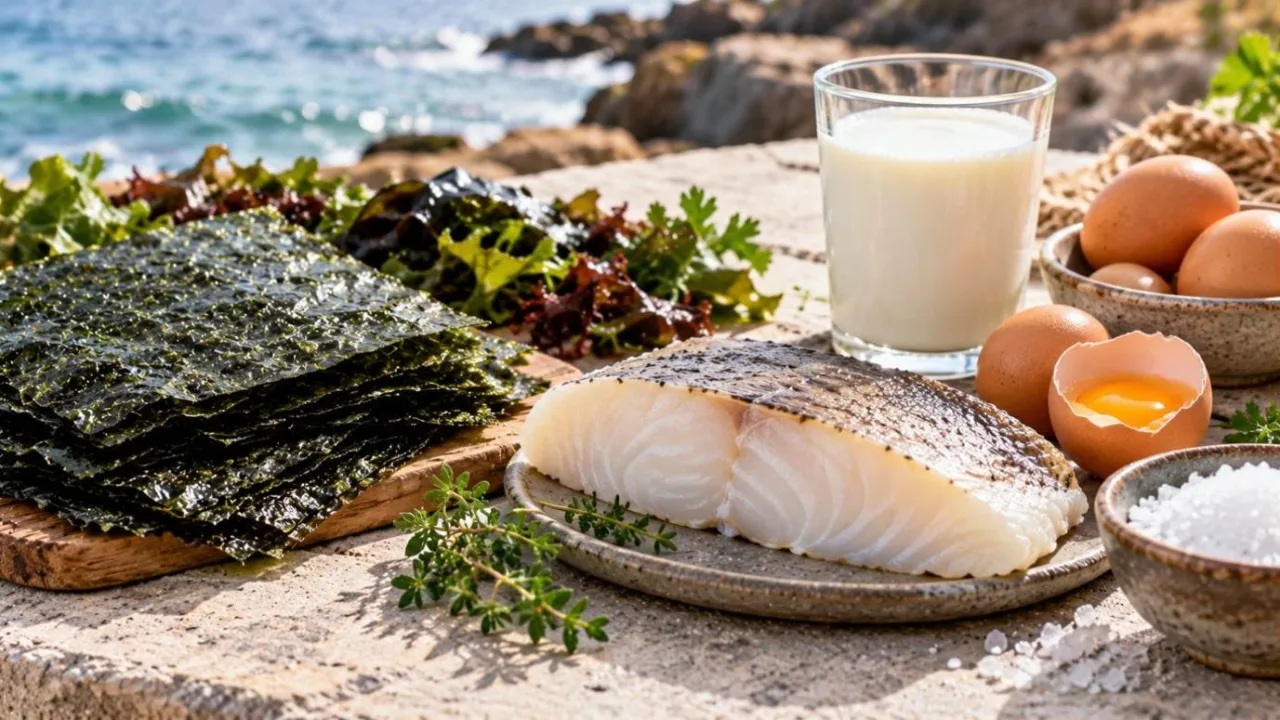
The iodine content of plants depends on the soil they grew in, which varies hugely. The most reliable sources are seafood, dairy, eggs and iodized salt. The US Daily Value is 150 mcg.
| Food | Serving | mcg | % DV |
|---|---|---|---|
| White bread made with iodate dough conditioner | 2 slices | 296 | 197% |
| Cod, baked | 3 oz | 146 | 97% |
| Nori seaweed, dried | 2 tbsp | 116 | 77% |
| Oysters, cooked | 3 oz | 93 | 62% |
| Greek yoghurt, plain, nonfat | ¾ cup | 87 | 58% |
| Milk, nonfat | 1 cup | 84 | 56% |
| Iodized table salt | ¼ tsp | 78 | 52% |
| Fish sticks, cooked | 3 oz | 57 | 38% |
| Egg, hard-boiled | 1 large | 31 | 21% |
| Pasta boiled in iodized salt water | 1 cup | 30 | 20% |
| Chocolate ice cream | ⅔ cup | 28 | 19% |
Why is dairy a good source? Partly because cows are given iodine-fortified feed, and partly because iodine-containing disinfectants are used to clean milking equipment. As a result, milk iodine content varies between countries and seasons, and plant-based milks usually contain little unless they are fortified.
Iodized salt
In the US, iodized salt contains 45 mcg of iodine per gram, so a quarter teaspoon supplies about half the daily need. But there is a catch: most of the salt people eat comes from processed and restaurant foods, which are usually made with non-iodized salt. Sea salt, Himalayan pink salt and kosher salt are generally not iodized either. So cutting back on salt (a good idea for blood pressure) and switching to speciality salts can both lower iodine intake. If you use salt at home, choosing iodized salt is a simple safeguard. Salt iodization is widely regarded as one of the most cost-effective public health measures ever introduced.
Seaweed
Seaweed is the most variable source of all. Commercial seaweed products have been measured at anywhere from 16 to almost 3,000 mcg of iodine per gram. Kelp in particular can contain very high amounts, so eating large quantities of seaweed or taking kelp supplements can push intake well above the safe limit.
Iodine deficiency
When iodine runs short, the thyroid gland works harder to capture what it can and enlarges, forming a goitre, a swelling in the front of the neck. This is usually the first visible sign. If intake falls very low (below roughly 10–20 mcg a day), the thyroid cannot make enough hormone, causing hypothyroidism: tiredness, weight gain, feeling cold, dry skin, constipation and slowed thinking.
The most serious effects happen before birth. Severe deficiency in pregnancy can cause miscarriage, stillbirth and permanent damage to the baby's brain. In its most extreme form, called cretinism, children have severe intellectual disability and stunted growth. For these reasons, iodine deficiency is described as the most common preventable cause of intellectual disability in the world.
Who is at risk?
- Pregnant and breastfeeding women, whose needs rise by roughly half or more. Surveys suggest many pregnant women in the US have borderline intakes.
- People who do not use iodized salt, including those who prefer sea salt or rock salt.
- Vegans and people who avoid dairy, eggs and seafood, which removes the most reliable natural sources.
- People living in regions with iodine-poor soil, typically mountainous areas and river valleys prone to flooding, where salt is not iodized.
- People with borderline iodine intake who eat large amounts of goitrogens, compounds in foods such as cassava, soy and cruciferous vegetables that can interfere with thyroid iodine uptake. For people with adequate iodine, normal amounts of these foods are not a concern.
Iodine in pregnancy: the supplement question
Because the baby's brain depends on the mother's thyroid hormones early in pregnancy, several organisations recommend supplements. The American Thyroid Association advises that women who are planning a pregnancy, pregnant or breastfeeding take a supplement containing 150 mcg of iodine a day as potassium iodide. The World Health Organization recommends 250 mcg a day for pregnant and breastfeeding women in places where salt iodization is incomplete.
Despite this, many prenatal vitamins contain no iodine at all. In one US analysis, only 34 of 59 best-selling prenatal products included it, and only about 18% of pregnant women reported using an iodine-containing supplement. If you are pregnant or planning to be, check your prenatal vitamin label and ask your doctor or midwife whether you need iodine. More is not better here either: one study linked doses of 200 mcg a day or more in pregnancy to a higher chance of raised TSH, a sign of thyroid stress.
Can you get too much iodine?
| Age | Upper limit (mcg/day) |
|---|---|
| Children 1–3 | 200 |
| Children 4–8 | 300 |
| Children 9–13 | 600 |
| Teens 14–18 | 900 |
| Adults 19+ | 1,100 |
Surprisingly, too much iodine can cause many of the same problems as too little: goitre, raised thyroid-stimulating hormone (TSH), and either an underactive or overactive thyroid. High intakes are also associated with thyroid inflammation (thyroiditis) and papillary thyroid cancer. People with existing thyroid disease, especially autoimmune conditions such as Hashimoto's thyroiditis, can be affected at intakes that are safe for others. Common causes of excess include kelp tablets and large amounts of seaweed.
Iodine tablets and radiation emergencies
You may have heard of potassium iodide tablets being distributed after nuclear accidents. In a radiation emergency, radioactive iodine can be released into the air and absorbed by the thyroid, raising the risk of thyroid cancer, especially in children. Taking a large dose of stable potassium iodide (16–130 mg, depending on age) fills the thyroid so that it does not take up the radioactive form. These tablets should only be taken when public health authorities advise it; they offer no benefit in normal circumstances and the doses are hundreds of times the daily requirement.
Medicine interactions
- Anti-thyroid drugs such as methimazole: high doses of iodine may add to their effect and cause hypothyroidism.
- ACE inhibitors and potassium-sparing diuretics: potassium iodide supplements add potassium and may raise the risk of high potassium levels (see Part 13 on potassium).
- Anyone taking thyroid medication should talk to their doctor before starting iodine or kelp supplements.
Practical tips
- Use iodized salt when you salt food at home, but keep total salt moderate.
- Include dairy, eggs or seafood regularly; if you are vegan, consider fortified foods or a supplement providing around 150 mcg.
- If you are pregnant or planning a pregnancy, check that your prenatal vitamin contains iodine.
- Avoid kelp supplements and very large amounts of seaweed.
Frequently asked questions
Is sea salt or pink salt a good source of iodine?
No. Unless the label says iodized, these salts contain only trace amounts. They are not a reliable source.
Can iodine supplements help with weight loss or tiredness?
Only if you are actually iodine-deficient. In people with normal iodine levels, extra iodine does not speed metabolism and can harm the thyroid.
Do vegans need an iodine supplement?
Many do, because the main natural sources are animal foods and seafood. Fortified foods or a supplement providing about 150 mcg a day are common options; avoid high-dose kelp.
How is iodine status tested?
Iodine is usually measured in urine, which works well for populations but varies a lot from day to day in individuals. A thyroid blood test (TSH) shows how the thyroid is working but is not a sensitive test for iodine deficiency.
Sources
- NIH Office of Dietary Supplements – Iodine (consumer fact sheet)
- NIH Office of Dietary Supplements – Iodine (health professional fact sheet)
Vitamins and Minerals Explained: the full series
- Part 1: Vitamin D
- Part 2: Vitamin B12
- Part 3: Iron
- Part 4: Magnesium
- Part 5: Vitamin C
- Part 6: Calcium
- Part 7: Zinc
- Part 8: Omega-3 Fatty Acids
- Part 9: Folate and Folic Acid
- Part 10: Vitamin A
- Part 11: Vitamin E
- Part 12: Vitamin K
- Part 13: Potassium
- Part 14: Iodine (you are here)
- Part 15: Biotin
- Part 16: Do You Need Supplements?
This article is for general information only and is not medical advice. Recommended amounts shown are US figures from the NIH Office of Dietary Supplements; guidance in other countries may differ slightly. Talk to a doctor or pharmacist before starting supplements, especially if you are pregnant, take medicines or have a health condition.