Potassium is the mineral most people think of in connection with bananas, and not much else. Yet health agencies in the US list it as a nutrient of public health concern, because most adults eat far less than recommended, and low potassium combined with high salt is a recipe for high blood pressure. In Part 13 of Vitamins and Minerals Explained, we cover what potassium does, how much you need, the best foods, and why some people must be careful not to get too much.
What does potassium do?
Potassium is the most abundant positively charged mineral (cation) inside your cells, while sodium dominates outside them. The difference between the two creates an electrical gradient across every cell membrane, a kind of battery that powers some of the body's most important functions:
- Nerve signals: nerves fire by letting sodium and potassium move across their membranes.
- Muscle contraction, including the heart. This is why both very low and very high potassium can cause dangerous heart rhythm problems.
- Fluid balance: potassium controls the volume of fluid inside cells, while sodium controls the fluid outside.
- Kidney function and the balance of acids in the blood.
- Blood pressure: potassium helps the kidneys excrete sodium and relaxes the walls of blood vessels.
How much potassium do you need?
US guidelines give Adequate Intakes (AIs) rather than RDAs:
| Age | Men (mg/day) | Women (mg/day) |
|---|---|---|
| Birth to 6 months | 400 | 400 |
| 7–12 months | 860 | 860 |
| 1–3 years | 2,000 | 2,000 |
| 4–8 years | 2,300 | 2,300 |
| 9–13 years | 2,500 | 2,300 |
| 14–18 years | 3,000 | 2,300 |
| 19+ years | 3,400 | 2,600 |
| Pregnancy (19–50) | — | 2,900 |
| Breastfeeding (19–50) | — | 2,800 |
The Daily Value used on US food labels is higher, at 4,700 mg. In US national surveys, men ate on average about 3,000 mg a day and women about 2,300 mg, below the AIs, and well below what is found in diets rich in fruit and vegetables.
These recommendations do not apply to people with kidney disease or those taking medicines that reduce potassium excretion (see below).
Best food sources of potassium
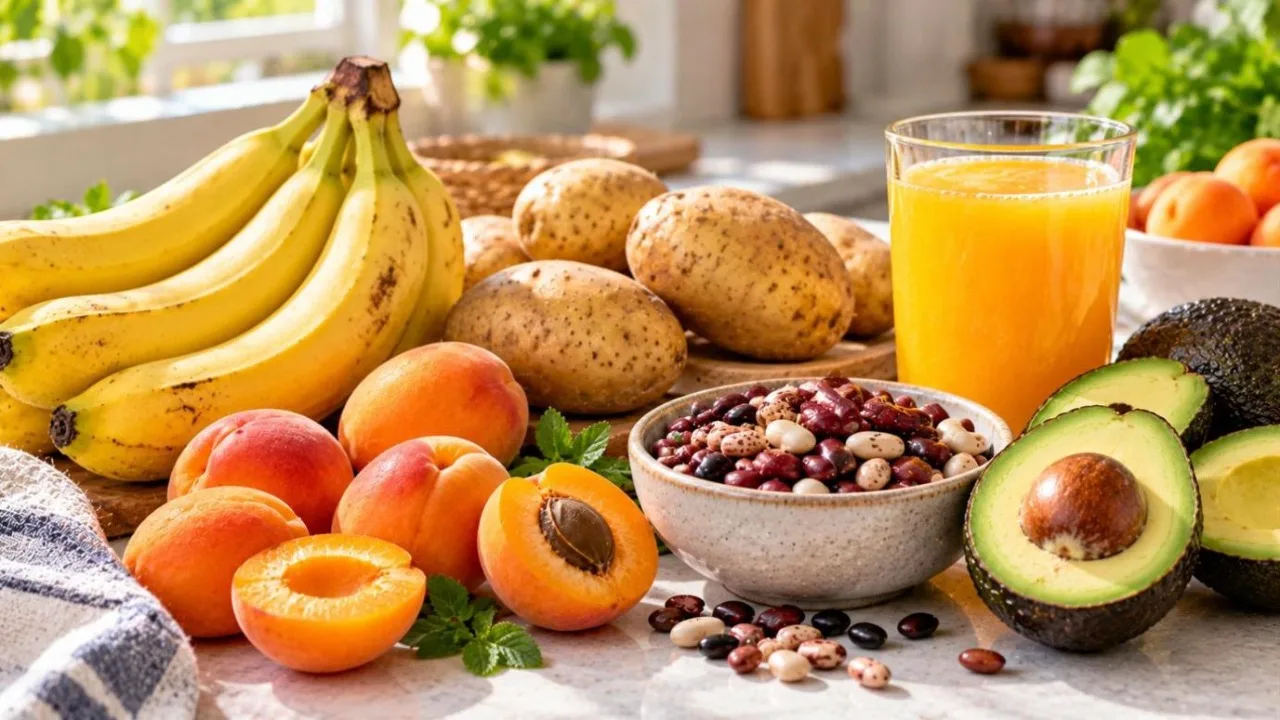
Bananas are a decent source, but plenty of everyday foods contain more per serving:
| Food | Serving | mg | % DV |
|---|---|---|---|
| Dried apricots | ½ cup | 755 | 16% |
| Lentils, cooked | 1 cup | 731 | 16% |
| Acorn squash, mashed | 1 cup | 644 | 14% |
| Prunes, dried | ½ cup | 635 | 14% |
| Raisins | ½ cup | 618 | 13% |
| Potato, baked, flesh only | 1 medium | 610 | 13% |
| Kidney beans, canned | 1 cup | 607 | 13% |
| Orange juice | 1 cup | 496 | 11% |
| Soybeans, boiled | ½ cup | 443 | 9% |
| Banana | 1 medium | 422 | 9% |
| Milk, 1% | 1 cup | 366 | 8% |
| Spinach, raw | 2 cups | 334 | 7% |
Other good sources include tomatoes, avocados, yoghurt, salmon, chicken, sweet potatoes, coconut water and most beans. The pattern is clear: fruit, vegetables, beans and dairy are the backbone of a potassium-rich diet. Heavily processed foods tend to be low in potassium and high in sodium, which is the opposite of what the body needs.
Potassium dissolves into water, so boiling vegetables loses some of it. Baking, steaming or using the cooking liquid in soups keeps more.
Potassium and blood pressure
This is where potassium has the strongest evidence. The DASH eating plan (Dietary Approaches to Stop Hypertension), rich in fruit, vegetables and low-fat dairy and therefore in potassium, lowered systolic blood pressure by about 5.5 mmHg in a landmark trial. A 2017 analysis of trials in people with high blood pressure found that potassium supplements lowered systolic pressure by about 4.5 mmHg and diastolic pressure by about 3 mmHg, although a Cochrane review of only the highest-quality trials found smaller, statistically uncertain effects.
The effect is strongest when salt intake is high. In practice, it is the balance between sodium and potassium that matters: eating less salt and more potassium-rich foods works better than either change alone.
Stroke, kidney stones and bones
- Stroke: higher potassium intake is linked to lower stroke risk. One analysis found that each additional 1,640 mg a day was associated with a 21% lower risk. Evidence for other heart outcomes is less consistent.
- Kidney stones: people who eat more potassium tend to form fewer stones. Potassium citrate is used as a treatment to prevent some types of stones, though the citrate rather than the potassium may be doing most of the work.
- Bones: potassium-rich diets are linked to higher bone density, possibly because the alkaline salts in fruit and vegetables reduce calcium loss. Trial results are mixed.
- Type 2 diabetes: low potassium is associated with higher diabetes risk in observational studies, but trial evidence is limited.
Low potassium (hypokalaemia)
Because potassium is in so many foods, a low blood level is rarely caused by diet alone. It usually results from losing potassium:
- Vomiting or diarrhoea
- Diuretics ("water pills") such as furosemide and thiazides
- Overuse of laxatives
- Heavy sweating
- Low magnesium, which makes the kidneys waste potassium (see Part 4 on magnesium)
- Inflammatory bowel disease
Mild hypokalaemia causes fatigue, muscle weakness, cramps and constipation. Severe hypokalaemia can cause paralysis, breathing problems and life-threatening heart rhythm disturbances. It is common in hospital, affecting up to about one in five patients.
High potassium (hyperkalaemia): who needs to be careful
In healthy people, the kidneys easily remove extra potassium from food, so no upper limit has been set. The picture changes for people whose kidneys cannot excrete it properly:
- People with chronic kidney disease
- People taking ACE inhibitors (such as lisinopril or benazepril) or ARBs (such as losartan) for blood pressure or heart failure
- People taking potassium-sparing diuretics such as spironolactone or amiloride
For these groups, even normal dietary amounts can push blood potassium too high. Symptoms of hyperkalaemia include muscle weakness, tingling, palpitations and dangerous heart rhythms, sometimes with little warning. If you have kidney disease, follow your doctor's or dietitian's advice on potassium rather than general recommendations.
Potassium supplements and salt substitutes
In the US, most over-the-counter potassium supplements contain 99 mg or less per serving, only about 2% of the Daily Value. This is because high-dose potassium chloride tablets were linked to damage to the small bowel, so higher doses are available only on prescription. Food is a far better way to raise intake.
Salt substitutes replace some or all of the sodium chloride with potassium chloride, and can contain between 440 and 2,800 mg of potassium per teaspoon. They can help lower blood pressure in healthy people, but they are risky for anyone with kidney disease or taking the medicines listed above. Check with a doctor before using them.
Practical tips
- Aim for at least five portions of fruit and vegetables a day, including potatoes, beans and leafy greens.
- Choose dried apricots, raisins or a banana instead of salty snacks.
- Cook more from scratch to cut sodium and raise potassium at the same time.
- If you take blood pressure medicine or have kidney problems, ask before using potassium supplements or salt substitutes.
Frequently asked questions
How many bananas a day do I need for potassium?
You do not need to rely on bananas. One medium banana has about 420 mg; a mix of vegetables, beans, fruit and dairy across the day is a better way to reach 2,600–3,400 mg.
Can you eat too many bananas?
For a healthy person with normal kidneys, it is very difficult to get dangerously high potassium from food. People with kidney disease are the exception.
What are signs of low potassium?
Muscle weakness, cramps, fatigue and constipation are common. Palpitations or an irregular heartbeat need prompt medical attention.
Are sports drinks a good source of potassium?
Most contain modest amounts. Coconut water, milk, orange juice and whole fruit usually provide more potassium with fewer additives.
Sources
- NIH Office of Dietary Supplements – Potassium (consumer fact sheet)
- NIH Office of Dietary Supplements – Potassium (health professional fact sheet)
Vitamins and Minerals Explained: the full series
- Part 1: Vitamin D
- Part 2: Vitamin B12
- Part 3: Iron
- Part 4: Magnesium
- Part 5: Vitamin C
- Part 6: Calcium
- Part 7: Zinc
- Part 8: Omega-3 Fatty Acids
- Part 9: Folate and Folic Acid
- Part 10: Vitamin A
- Part 11: Vitamin E
- Part 12: Vitamin K
- Part 13: Potassium (you are here)
- Part 14: Iodine
- Part 15: Biotin
- Part 16: Do You Need Supplements?
This article is for general information only and is not medical advice. Recommended amounts shown are US figures from the NIH Office of Dietary Supplements; guidance in other countries may differ slightly. Talk to a doctor or pharmacist before starting supplements, especially if you are pregnant, take medicines or have a health condition.