In the 1990s vitamin E was one of the best-selling supplements in the world. Observational studies suggested that people with high vitamin E intakes had less heart disease, and the antioxidant theory made it sound like a natural way to slow ageing. Then the large randomised trials arrived, and the story changed. In Part 11 of Vitamins and Minerals Explained, we look at what vitamin E really does, the best foods, and what the research says about supplements.
What is vitamin E?
Vitamin E is not one compound but a family of eight fat-soluble molecules: four tocopherols and four tocotrienols. The only form the human body maintains in the blood, and the only one that counts towards requirements, is alpha-tocopherol. Other forms, such as gamma-tocopherol (common in soybean and corn oil), are present in food but are broken down and excreted more quickly.
What does vitamin E do?
- Antioxidant: its main job is protecting cell membranes from damage by free radicals, unstable molecules formed during normal metabolism and from exposures such as cigarette smoke and pollution. Because it is fat-soluble, it sits inside the fatty membranes of cells and stops chain reactions that would damage them.
- Immune function: it supports the activity of immune cells, which may be especially relevant in older adults.
- Blood vessels: it helps widen blood vessels and reduces the tendency of blood to clot inside them. This useful property is also the reason high-dose supplements can increase bleeding risk.
- Cell signalling and gene expression: it is involved in communication between cells.
How much vitamin E do you need?
| Life stage | Recommended amount (mg/day) |
|---|---|
| Birth to 6 months | 4 |
| Infants 7–12 months | 5 |
| Children 1–3 years | 6 |
| Children 4–8 years | 7 |
| Children 9–13 years | 11 |
| Teens 14–18 years | 15 |
| Adults | 15 |
| Pregnancy | 15 |
| Breastfeeding | 19 |
Surveys in the US suggest that most people eat less than 15 mg a day from food. Yet clinical deficiency is extremely rare in healthy people, which suggests the body copes well with intakes below the recommendation.
Best food sources of vitamin E
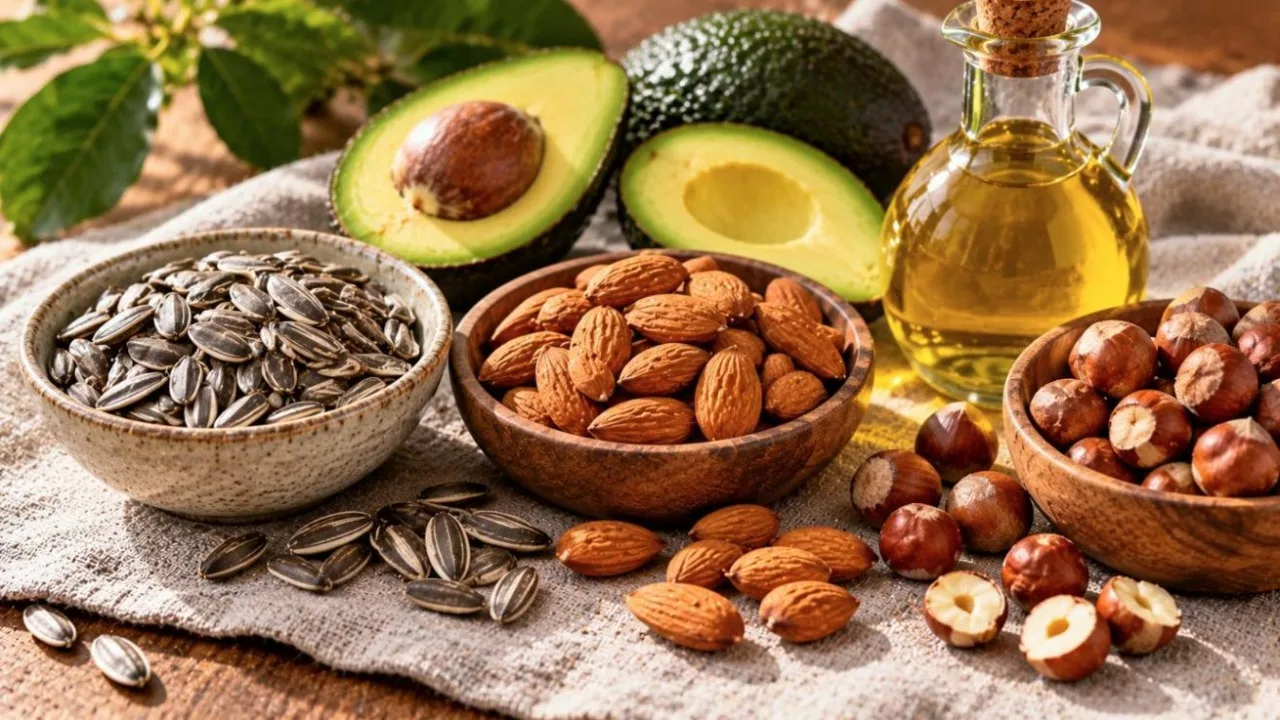
Nuts, seeds and plant oils are the richest sources. The US Daily Value is 15 mg.
| Food | Serving | mg | % DV |
|---|---|---|---|
| Wheat germ oil | 1 tbsp | 20.3 | 135% |
| Sunflower seeds, dry roasted | 1 oz | 7.4 | 49% |
| Almonds, dry roasted | 1 oz | 6.8 | 45% |
| Sunflower oil | 1 tbsp | 5.6 | 37% |
| Safflower oil | 1 tbsp | 4.6 | 31% |
| Hazelnuts, dry roasted | 1 oz | 4.3 | 29% |
| Peanut butter | 2 tbsp | 2.9 | 19% |
| Peanuts, dry roasted | 1 oz | 2.2 | 15% |
| Corn oil | 1 tbsp | 1.9 | 13% |
| Spinach, boiled | ½ cup | 1.9 | 13% |
| Broccoli, boiled | ½ cup | 1.2 | 8% |
| Soybean oil | 1 tbsp | 1.1 | 7% |
A handful of almonds or sunflower seeds plus a spoonful of sunflower oil in cooking gets most people close to the target. Avocado, kiwi, mango, tomato and fortified cereals also contribute. Vitamin E is sensitive to heat and light, so oils lose some of it with repeated frying and long storage.
Natural vs synthetic vitamin E
Supplement labels can be confusing because there are two kinds of alpha-tocopherol:
- Natural vitamin E is labelled d-alpha-tocopherol (or RRR-alpha-tocopherol).
- Synthetic vitamin E is labelled dl-alpha-tocopherol (or all-rac-alpha-tocopherol). It is a mixture of eight versions of the molecule, and only some of them are active.
As a result, the body gets about twice as much benefit from the natural form: 1 mg of d-alpha-tocopherol equals 1 mg of vitamin E, while 2 mg of dl-alpha-tocopherol equal 1 mg. In International Units, 1 IU of natural vitamin E is 0.67 mg, and 1 IU of synthetic vitamin E is 0.45 mg. A typical once-daily multivitamin supplies around 13.5 mg; vitamin E-only supplements often contain 67 mg (100 IU) or much more.
Vitamin E deficiency
Deficiency almost never happens because of a poor diet alone. It usually occurs in people who cannot absorb fat properly, for example people with Crohn's disease or cystic fibrosis, and in rare genetic conditions such as abetalipoproteinaemia and ataxia with vitamin E deficiency (AVED). Premature, very low birth weight babies can also be affected.
Because vitamin E protects nerve cells, deficiency mainly damages the nerves and muscles. Symptoms include loss of feeling in the arms and legs, poor control of body movements, muscle weakness, vision problems and a weakened immune system.
What does the research say?
Heart disease
Early observational studies were encouraging: people who took vitamin E supplements had lower rates of coronary heart disease. But people who take supplements also tend to exercise more, smoke less and eat better. When large randomised trials tested vitamin E directly, the best research found no benefit. According to the NIH, vitamin E supplements do not appear to prevent heart disease, reduce its severity or affect the risk of death from it.
Cancer
Most research shows that vitamin E supplements do not prevent cancer, and in one important case they may cause harm. In a large trial, men who took 400 IU (180 mg) of synthetic vitamin E daily for several years had a higher risk of prostate cancer. Middle-aged adults taking 300–400 IU on average showed no protection against any type of cancer. Large doses also did not consistently reduce colon or breast cancer risk.
Eye disease
Studies on whether vitamin E prevents cataracts or age-related macular degeneration (AMD) are inconsistent. However, in people already at high risk of advanced AMD, a combination of high-dose vitamin E with other antioxidants, zinc and copper (the AREDS formula) helped slow vision loss.
Memory and Alzheimer's disease
There is little evidence that vitamin E supplements help healthy people keep their minds sharp, or prevent mild cognitive problems from progressing to Alzheimer's disease.
Is vitamin E safe?
Vitamin E from food is not harmful and does not need to be limited. Supplements are a different matter. The upper limits apply to supplemental vitamin E:
| Age | Upper limit (mg/day from supplements) |
|---|---|
| Children 1–3 | 200 |
| Children 4–8 | 300 |
| Children 9–13 | 600 |
| Teens 14–18 | 800 |
| Adults 19+ | 1,000 |
For adults, 1,000 mg equals about 1,500 IU of natural or 1,100 IU of synthetic vitamin E. High doses can increase the risk of bleeding and of haemorrhagic stroke (bleeding in the brain). As the prostate cancer finding shows, some harm may occur even well below the upper limit.
Medicine interactions
- Blood thinners such as warfarin, and antiplatelet drugs: vitamin E supplements can add to their effect and increase bleeding risk.
- Statins and niacin: in one study, vitamin E combined with other antioxidants reduced the benefit of these cholesterol-lowering drugs.
- Chemotherapy and radiation: antioxidant supplements might change how well these treatments work, so people having cancer treatment should check with their oncologist.
- Stop vitamin E supplements before surgery if your surgeon advises it, because of the bleeding risk.
Practical tips
- Eat a small handful of nuts or seeds most days.
- Use sunflower, safflower or rapeseed (canola) oil in cooking and dressings.
- Do not take high-dose vitamin E supplements for heart disease or cancer prevention.
- If you have a fat-absorption condition, ask your doctor whether you need monitoring.
For another antioxidant vitamin, see Part 5 on vitamin C.
Frequently asked questions
Does vitamin E oil help scars?
Applying vitamin E oil to scars is popular, but studies have not shown a consistent benefit, and some people develop skin irritation or allergic reactions. Sunscreen and silicone gels have better evidence.
Is vitamin E good for skin and hair?
Vitamin E helps protect skin cells from oxidative damage, and it is common in skincare. But there is little good evidence that oral supplements improve skin or hair in healthy people who are not deficient.
Should I choose natural or synthetic vitamin E?
If you take a supplement, natural d-alpha-tocopherol is about twice as potent per milligram. For most people, though, food is enough and a supplement is unnecessary.
Can I get too much vitamin E from nuts?
No. Vitamin E in food is not harmful. The concern applies only to high-dose supplements.
Sources
- NIH Office of Dietary Supplements – Vitamin E (consumer fact sheet)
- NIH Office of Dietary Supplements – Vitamin E (health professional fact sheet)
Vitamins and Minerals Explained: the full series
- Part 1: Vitamin D
- Part 2: Vitamin B12
- Part 3: Iron
- Part 4: Magnesium
- Part 5: Vitamin C
- Part 6: Calcium
- Part 7: Zinc
- Part 8: Omega-3 Fatty Acids
- Part 9: Folate and Folic Acid
- Part 10: Vitamin A
- Part 11: Vitamin E (you are here)
- Part 12: Vitamin K
- Part 13: Potassium
- Part 14: Iodine
- Part 15: Biotin
- Part 16: Do You Need Supplements?
This article is for general information only and is not medical advice. Recommended amounts shown are US figures from the NIH Office of Dietary Supplements; guidance in other countries may differ slightly. Talk to a doctor or pharmacist before starting supplements, especially if you are pregnant, take medicines or have a health condition.