The phone in your pocket has more computing power than all the computers of the 1960s combined. In Part 8 of Inventions That Changed Everything, we trace how the computer went from an idea on paper to a machine that runs almost every part of modern life.
Mechanical beginnings
People have used tools for calculation for thousands of years, from the abacus to mechanical calculators built by Blaise Pascal and Gottfried Leibniz in the 1600s.
In the 1800s, English mathematician Charles Babbage designed the Difference Engine to calculate mathematical tables, and later the Analytical Engine, a general-purpose machine with a memory and a "mill" for processing, programmed with punched cards. It was never fully built in his lifetime. Ada Lovelace wrote notes describing how the Analytical Engine could follow a sequence of instructions, and she is often called the first computer programmer.
Turing's universal machine
In 1936, British mathematician Alan Turing described a theoretical "universal machine" that could carry out any calculation if given the right instructions. This idea underpins all modern computers. During World War II, Turing worked at Bletchley Park, where codebreakers used machines to help break German Enigma messages. The Colossus machines at Bletchley, built from 1943 to 1944, were among the first programmable electronic computers.
ENIAC and the electronic era
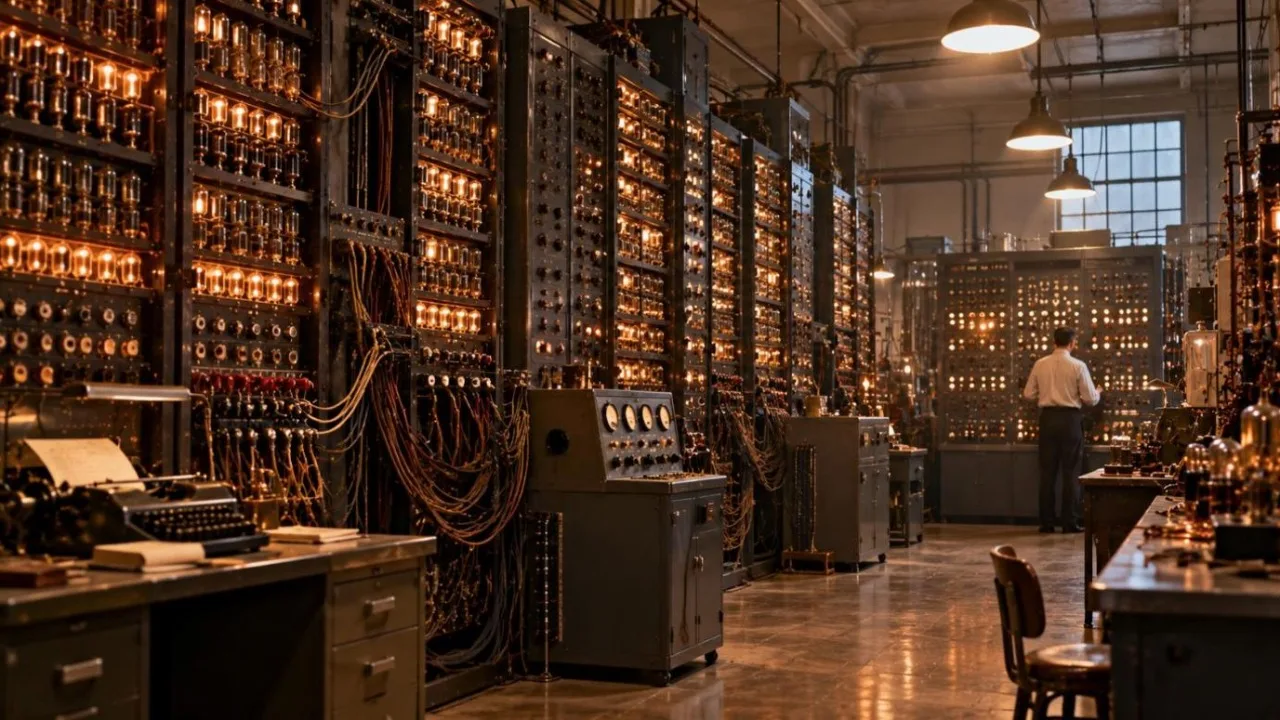
In the US, ENIAC was completed in 1945 and unveiled in 1946. It used around 18,000 vacuum tubes, weighed about 30 tonnes and filled a large room. It could perform thousands of calculations per second, far faster than humans. Soon after, designs that stored programs in memory, associated with John von Neumann and others, became the standard architecture.
The transistor and the microchip
Vacuum tubes were large, hot and unreliable. In 1947, John Bardeen, Walter Brattain and William Shockley at Bell Labs invented the transistor, a tiny switch made from semiconductor material. It won them the Nobel Prize in Physics.
In 1958 and 1959, Jack Kilby at Texas Instruments and Robert Noyce at Fairchild Semiconductor independently developed the integrated circuit, placing many transistors on a single chip. In 1971, Intel released the 4004, one of the first commercial microprocessors, putting a computer's central processing unit on a single chip.
Moore's law
In 1965, Gordon Moore observed that the number of transistors on a chip was doubling at a regular pace, later stated as roughly every two years. This trend, known as Moore's law, drove decades of rapid improvement in computing power and falling costs.
Computers for everyone
In the 1970s and 1980s, personal computers such as the Apple II, the IBM PC and others brought computing into homes, schools and offices. Graphical interfaces with windows and a mouse made computers easier to use. Laptops, then smartphones and tablets, made computing portable.
How computers changed the world
- Work: word processing, spreadsheets and automation transformed offices and factories.
- Science: simulations, data analysis and modelling, from weather to genetics.
- Finance and business: instant transactions and global markets.
- Daily life: games, music, photography, navigation and communication.
- Artificial intelligence: modern AI systems run on powerful computer chips.
Why it still matters
Computers are now embedded in cars, appliances and infrastructure. Their power also brings challenges around privacy, security and jobs.
In Part 9, we look at the invention that connected all these computers: the internet.
Inventions That Changed Everything: the full series
- Part 1: The Printing Press
- Part 2: The Steam Engine
- Part 3: Electricity and the Light Bulb
- Part 4: The Telephone
- Part 5: Penicillin and Antibiotics
- Part 6: The Aeroplane
- Part 7: Radio and Television
- Part 8: The Computer (you are here)
- Part 9: The Internet
- Part 10: The Mobile Phone
Dates and figures are commonly cited historical values and may vary slightly between sources, as many inventions had several contributors.