Flip a switch and the room fills with light. It feels ordinary today, but for most of human history, nights were lit only by fire, candles and oil lamps. In Part 3 of Inventions That Changed Everything, we look at how electricity, and the light bulb in particular, transformed the world.
Understanding electricity
People knew about static electricity and lightning for centuries, but using electricity required steady current. In 1800, Italian scientist Alessandro Volta built the first battery, the voltaic pile, from stacked metal discs and brine-soaked cloth. For the first time, scientists had a continuous electric current to experiment with.
In 1831, English scientist Michael Faraday discovered electromagnetic induction: moving a magnet near a coil of wire produces electricity. This principle is behind nearly every electric generator in the world today.
The race for light
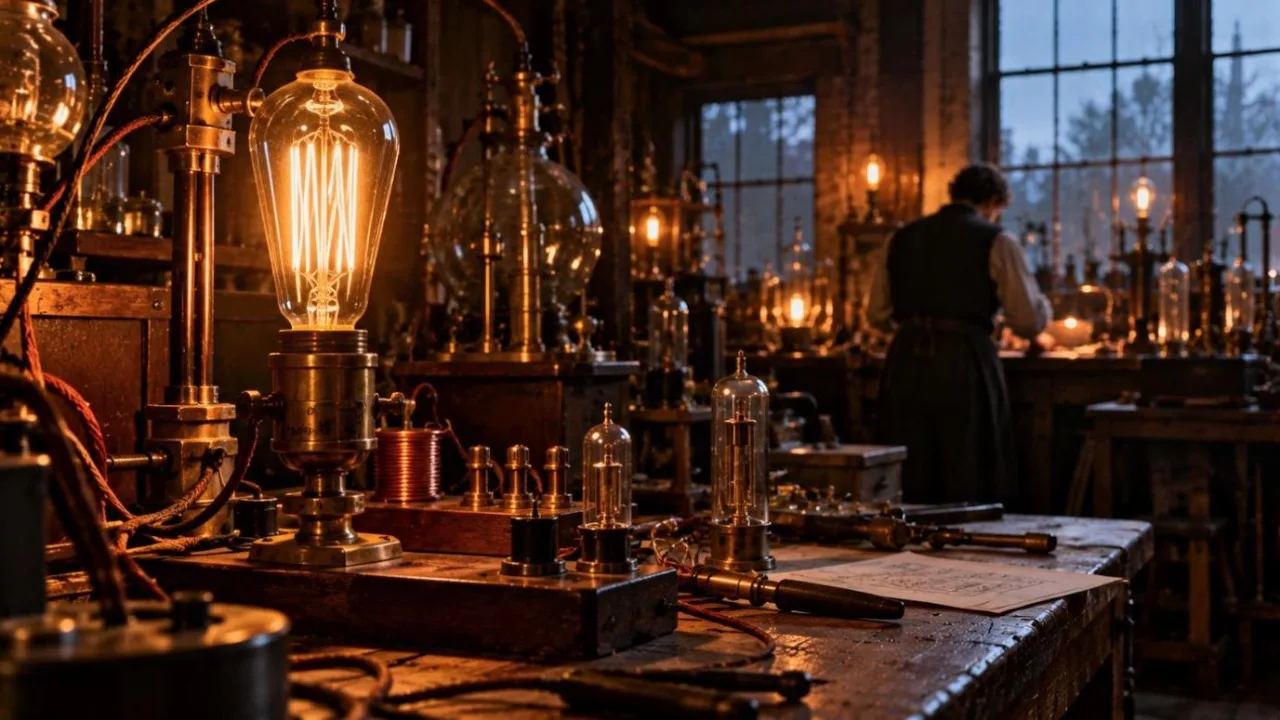
Arc lamps, which create bright light from a spark between carbon rods, were used for street lighting in the 1800s, but they were too harsh and dangerous for homes. Inventors raced to make a small, safe, long-lasting incandescent bulb, where a thin filament glows when heated by current.
In England, Joseph Swan demonstrated carbon filament bulbs around 1878 to 1880. In the US, Thomas Edison and his team at Menlo Park tested thousands of materials. In 1879 they produced a carbon filament bulb that could glow for many hours, and later versions lasted much longer. Edison and Swan eventually merged their British companies.
Edison's real breakthrough: the system
Edison's genius was not just the bulb. He built a complete electricity system: generators, wiring, switches, fuses and meters. In 1882 his Pearl Street Station in New York began supplying electricity to customers in lower Manhattan.
The war of the currents
Edison's system used direct current (DC), which could not travel far efficiently. Nikola Tesla, a Serbian-American inventor, developed alternating current (AC) systems that could use transformers to change voltage and send power over long distances. Businessman George Westinghouse backed AC.
The rivalry between DC and AC became known as the "war of the currents." AC won. In the 1890s, AC was used to light the 1893 Chicago World's Fair, and a major hydroelectric plant at Niagara Falls began sending power to Buffalo in 1896.
How electricity changed life
- Light: safer, cleaner and brighter homes, streets and workplaces, extending the useful day.
- Industry: electric motors replaced belts and shafts in factories, making production more flexible.
- Home appliances: refrigerators, washing machines, irons and fans changed household work.
- Communication: electricity powered telegraphs, telephones, radio, television and later computers.
- Health: hospitals gained better lighting, refrigeration and electrical medical equipment.
From bulbs to LEDs
Incandescent bulbs waste most of their energy as heat. Fluorescent lamps and then light-emitting diodes (LEDs) have largely replaced them in many countries, using far less energy for the same light.
Why it still matters
Electricity is the foundation of modern life. Yet hundreds of millions of people worldwide still lack reliable access to it, and generating it cleanly is one of the biggest challenges of our time.
In Part 4, we look at the invention that let people talk across distances: the telephone.
Inventions That Changed Everything: the full series
- Part 1: The Printing Press
- Part 2: The Steam Engine
- Part 3: Electricity and the Light Bulb (you are here)
- Part 4: The Telephone
- Part 5: Penicillin and Antibiotics
- Part 6: The Aeroplane
- Part 7: Radio and Television
- Part 8: The Computer
- Part 9: The Internet
- Part 10: The Mobile Phone
Dates and figures are commonly cited historical values and may vary slightly between sources, as many inventions had several contributors.