People dreamed of flying for thousands of years. Then, in just over a century, humans went from a 12-second hop above a sand dune to millions of passengers flying across the world every day. In Part 6 of Inventions That Changed Everything, we look at how the aeroplane was invented and how it changed travel, trade and war.
Before the aeroplane
Hot air balloons carried people aloft from 1783, and gliders flew in the 1800s. German engineer Otto Lilienthal made around 2,000 glider flights in the 1890s before dying in a crash. The challenge was to build a heavier-than-air machine that could take off under its own power and, crucially, be controlled.
The Wright brothers
Wilbur and Orville Wright ran a bicycle shop in Dayton, Ohio. They had no university degrees, but they were careful, practical engineers. They studied birds and realised that control, not just power, was the key problem.
Their answer was "wing warping", twisting the wings to roll the aircraft, combined with a movable rudder and elevator. They also built a small wind tunnel and tested many wing shapes, correcting errors in earlier data. Because no suitable engine existed, their mechanic Charlie Taylor built a lightweight one.
17 December 1903
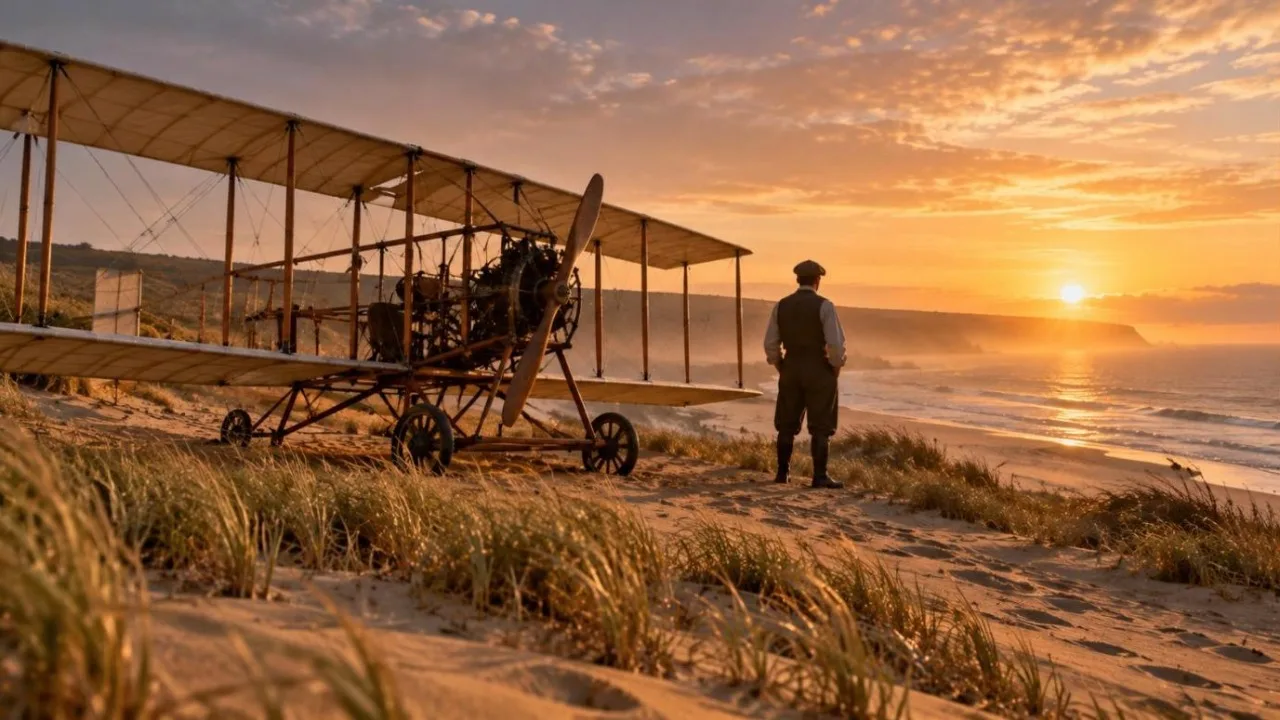
At Kill Devil Hills near Kitty Hawk, North Carolina, chosen for its steady winds and soft sand, Orville made the first powered, controlled flight on 17 December 1903. It lasted about 12 seconds and covered about 120 feet (37 metres). That day they made four flights; Wilbur's last flight covered about 852 feet in 59 seconds.
Few people believed them at first. By 1908, public demonstrations in France and the US made them famous.
Rapid progress
- 1909: Louis Blériot flew across the English Channel.
- 1914 to 1918: World War I accelerated aircraft design for reconnaissance and combat.
- 1919: John Alcock and Arthur Brown made the first non-stop transatlantic flight.
- 1927: Charles Lindbergh's solo non-stop flight from New York to Paris made aviation a public sensation.
- 1930s: metal airliners such as the Douglas DC-3 made passenger flights more practical.
The jet age
Jet engines were developed independently in the 1930s by Frank Whittle in Britain and Hans von Ohain in Germany. After World War II, jets transformed passenger travel. The de Havilland Comet became the first commercial jet airliner in 1952, and the Boeing 707 from 1958 helped make jet travel common. The Boeing 747 "jumbo jet" from 1970 made long-haul flights more affordable for many more people.
How aeroplanes changed the world
- Travel and tourism: journeys that took weeks by ship take hours.
- Trade: air cargo moves high-value and urgent goods worldwide.
- Families and migration: people can live far from home and still visit.
- Emergency response: air ambulances and humanitarian flights save lives.
- War: air power reshaped military conflict, often with devastating effect.
Why it still matters
Aviation connects the world but also contributes to climate change. The next chapter of flight may depend on cleaner fuels, more efficient aircraft and new technologies such as electric planes for short routes.
In Part 7, we look at radio and television, which brought news and entertainment into every home.
Inventions That Changed Everything: the full series
- Part 1: The Printing Press
- Part 2: The Steam Engine
- Part 3: Electricity and the Light Bulb
- Part 4: The Telephone
- Part 5: Penicillin and Antibiotics
- Part 6: The Aeroplane (you are here)
- Part 7: Radio and Television
- Part 8: The Computer
- Part 9: The Internet
- Part 10: The Mobile Phone
Dates and figures are commonly cited historical values and may vary slightly between sources, as many inventions had several contributors.