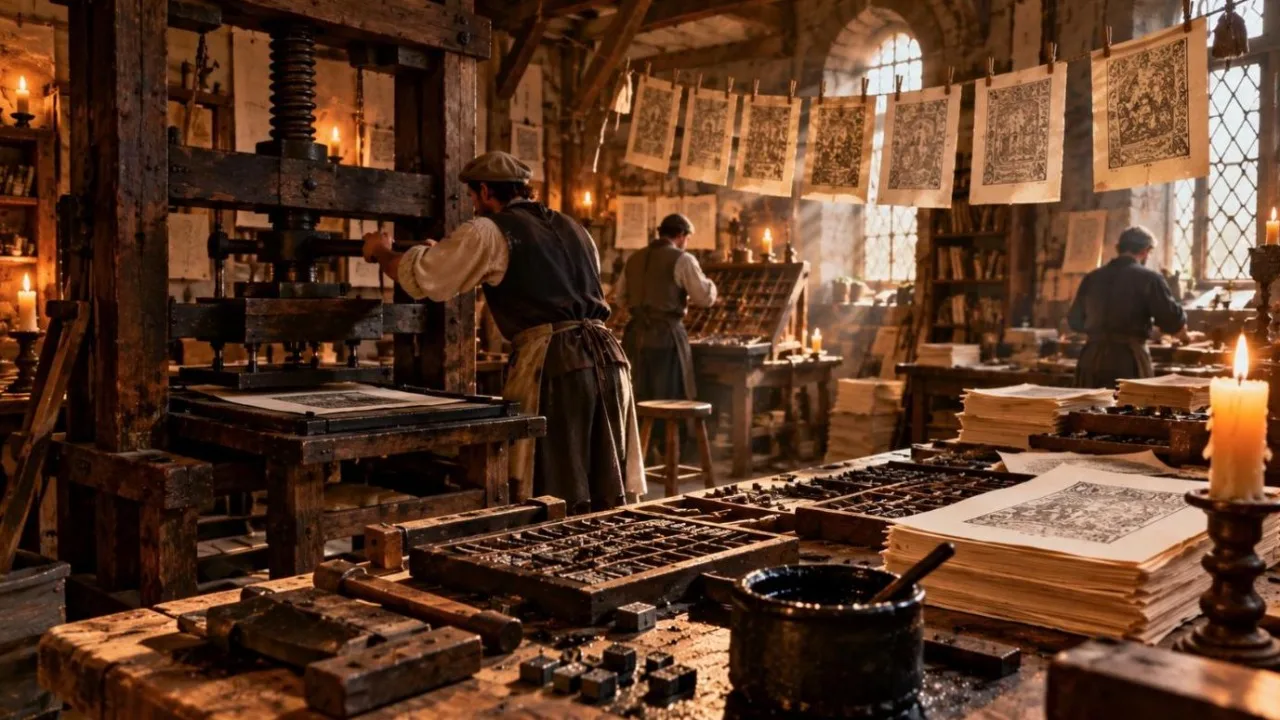
Some inventions make life easier. A few change the course of human history. In our new series, Inventions That Changed Everything, we look at ten breakthroughs that transformed how people live, work and think. We begin with the invention that made all the others easier to share: the printing press.
Life before printing
For most of history, books were copied by hand. In medieval Europe, monks and professional scribes could spend months producing a single copy. Books were rare, expensive and mostly owned by churches, universities and the wealthy. Mistakes crept in with every copy, and ideas spread slowly.
Early printing in Asia
Printing did not begin in Europe. Chinese printers used carved wooden blocks to print texts more than a thousand years ago; the Diamond Sutra, dated 868 CE, is often called the oldest dated printed book. Around 1040, the Chinese inventor Bi Sheng created movable type from baked clay. In Korea, metal movable type was used to print the Buddhist text Jikji in 1377, decades before Gutenberg.
However, Chinese has thousands of characters, which made movable type less practical than in languages with small alphabets.
Gutenberg's breakthrough
Around 1440 in Mainz, in today's Germany, goldsmith Johannes Gutenberg brought together several technologies into an efficient system:
- Metal type cast in a hand mould, so letters could be made quickly and identically.
- An oil-based ink that stuck well to metal.
- A screw press adapted from wine and paper presses.
The famous Gutenberg Bible was completed around 1455. Its quality was so high that it rivalled handwritten manuscripts. For a deeper look at Gutenberg himself, see our article on Gutenberg and the information revolution.
An explosion of books
Printing spread with remarkable speed. Within about 50 years, presses were operating in hundreds of European towns, and historians estimate that millions of books had been printed by 1500. Prices fell, more people learned to read, and books in local languages became common rather than only Latin.
How printing changed the world
Religion
In 1517, Martin Luther's arguments against the Church spread quickly through printed pamphlets. Printed Bibles in local languages let people read scripture themselves. The Reformation might have stayed local without the press.
Science
Scientists could share identical copies of diagrams, data and findings. Works such as Copernicus's 1543 book on the movement of the planets reached scholars across Europe, who could check, criticise and build on them. This helped fuel the Scientific Revolution.
Politics and news
Pamphlets, newspapers and, later, books of political ideas spread arguments to wider audiences. The first regular newspapers appeared in Europe in the early 1600s.
Language and education
Printing helped standardise spelling and grammar in many languages, and cheaper books made schooling more widespread over the following centuries.
Why it still matters
The printing press began a pattern we see again with the internet: when the cost of sharing information falls, knowledge spreads, authority is challenged and society changes. It also brought new problems, from propaganda to misinformation, which sound very familiar today.
In Part 2, we look at the invention that powered the Industrial Revolution: the steam engine.
Inventions That Changed Everything: the full series
- Part 1: The Printing Press (you are here)
- Part 2: The Steam Engine
- Part 3: Electricity and the Light Bulb
- Part 4: The Telephone
- Part 5: Penicillin and Antibiotics
- Part 6: The Aeroplane
- Part 7: Radio and Television
- Part 8: The Computer
- Part 9: The Internet
- Part 10: The Mobile Phone
Dates and figures are commonly cited historical values and may vary slightly between sources, as many inventions had several contributors.