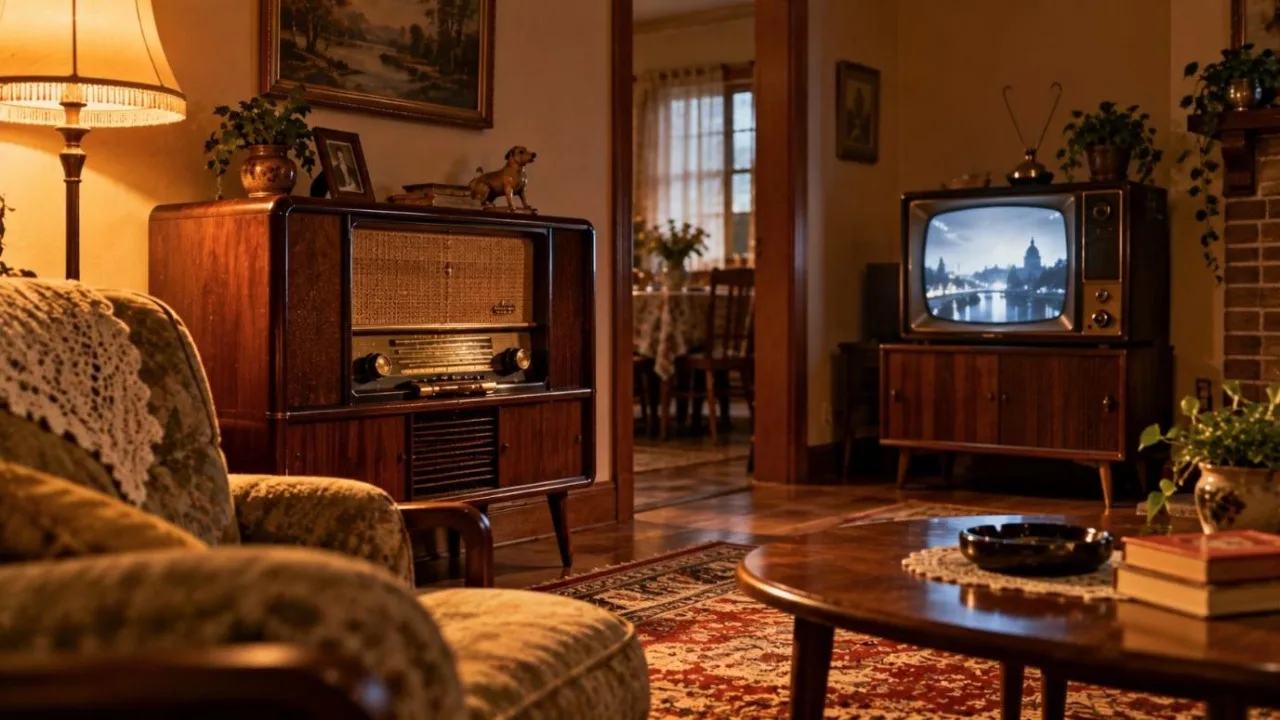
For most of history, news travelled at the speed of a horse, a ship or a printed page. Radio and then television allowed millions of people to hear and see the same events at the same moment. In Part 7 of Inventions That Changed Everything, we look at how broadcasting was born and how it reshaped culture and politics.
Invisible waves
In the 1860s, Scottish physicist James Clerk Maxwell predicted that electromagnetic waves could travel through space. In the late 1880s, German physicist Heinrich Hertz proved it by producing and detecting radio waves in his laboratory. The unit of frequency, the hertz, is named after him.
Marconi and wireless telegraphy
Italian inventor Guglielmo Marconi turned these waves into a communication system. In the 1890s he sent wireless telegraph signals over increasing distances, and in December 1901 he reported receiving a signal sent across the Atlantic from Cornwall in England to Newfoundland. Other scientists, including Nikola Tesla and Jagadish Chandra Bose, also made important contributions to radio technology.
Wireless quickly proved its value at sea. When the Titanic sank in 1912, its wireless distress calls brought rescue ships, and the disaster led to new rules requiring ships to keep radio watch around the clock.
From messages to broadcasting
Early radio sent Morse code. Transmitting voices and music required new technology, such as vacuum tubes that could amplify signals. In 1906, Canadian inventor Reginald Fessenden is credited with broadcasting speech and music on Christmas Eve to ships at sea.
Regular public broadcasting began in the early 1920s. Station KDKA in Pittsburgh broadcast the 1920 US presidential election results, and the British Broadcasting Company, later the BBC, began in 1922. Within a decade, radio sets were common in homes across many countries.
The power of radio
- News: people heard events as they happened, from elections to wars.
- Politics: leaders spoke directly to citizens, such as Franklin D. Roosevelt's "fireside chats".
- Entertainment: music, comedy, drama and sports commentary reached huge audiences.
- Propaganda: radio was also used to spread propaganda in the 1930s and 1940s.
Television arrives
In 1926, Scottish inventor John Logie Baird demonstrated a mechanical television system in London, showing moving images. In the US, Philo Farnsworth demonstrated an all-electronic television system in 1927, and Vladimir Zworykin and others developed electronic camera tubes. Electronic systems soon won out.
The BBC began a regular high-definition (for the time) television service in 1936. After World War II, television spread rapidly, especially in the 1950s. Colour television became widespread in the 1960s and 1970s.
Moments the world watched together
Television created shared global moments. In July 1969, an estimated 600 million people watched the Apollo 11 Moon landing live. Coronations, royal weddings, Olympic Games and World Cup finals drew enormous audiences, and television news coverage shaped public opinion on wars and social movements.
Why it still matters
Radio remains one of the most widely available media worldwide, especially in emergencies. Television has evolved into streaming and on-demand video. The idea of broadcasting, one source reaching millions, laid the foundation for today's digital media.
In Part 8, we look at how computers went from room-sized machines to the devices on our desks.
Inventions That Changed Everything: the full series
- Part 1: The Printing Press
- Part 2: The Steam Engine
- Part 3: Electricity and the Light Bulb
- Part 4: The Telephone
- Part 5: Penicillin and Antibiotics
- Part 6: The Aeroplane
- Part 7: Radio and Television (you are here)
- Part 8: The Computer
- Part 9: The Internet
- Part 10: The Mobile Phone
Dates and figures are commonly cited historical values and may vary slightly between sources, as many inventions had several contributors.