For thousands of years, work was powered by people, animals, wind and flowing water. Then came a machine that turned fire and water into motion. In Part 2 of Inventions That Changed Everything, we look at the steam engine, the engine of the Industrial Revolution.
A problem in the mines
By the 1600s, Britain's coal and tin mines were going deeper, and they kept flooding. Pumping water out with horses was slow and expensive. Inventors began experimenting with steam to create a vacuum that could lift water.
In 1698, Thomas Savery patented a steam pump. In 1712, Thomas Newcomen built a more practical atmospheric engine. Steam filled a cylinder, cold water condensed it, and air pressure pushed a piston down, moving a beam that worked a pump. Newcomen engines were used in mines for decades, though they burned huge amounts of coal.
James Watt's improvement
In the 1760s, Scottish instrument maker James Watt was repairing a model Newcomen engine at the University of Glasgow. He realised that heating and cooling the same cylinder wasted most of the energy.
His solution, patented in 1769, was a separate condenser, so the main cylinder could stay hot. It made the engine far more efficient. Watt partnered with businessman Matthew Boulton, and from 1775 the firm of Boulton & Watt built and sold engines. Watt later added a way to turn the up-and-down motion into rotation, so engines could drive machines, not just pumps. The unit of power, the watt, is named after him.
Factories anywhere
Before steam, factories had to be built beside rivers to use water wheels. Steam engines let factories be built in towns and cities, near workers and coal. Textile mills in Britain grew rapidly, and production of cloth soared.
This was the heart of the Industrial Revolution: mechanised production, factories and a shift of people from farms to cities.
Railways shrink the world
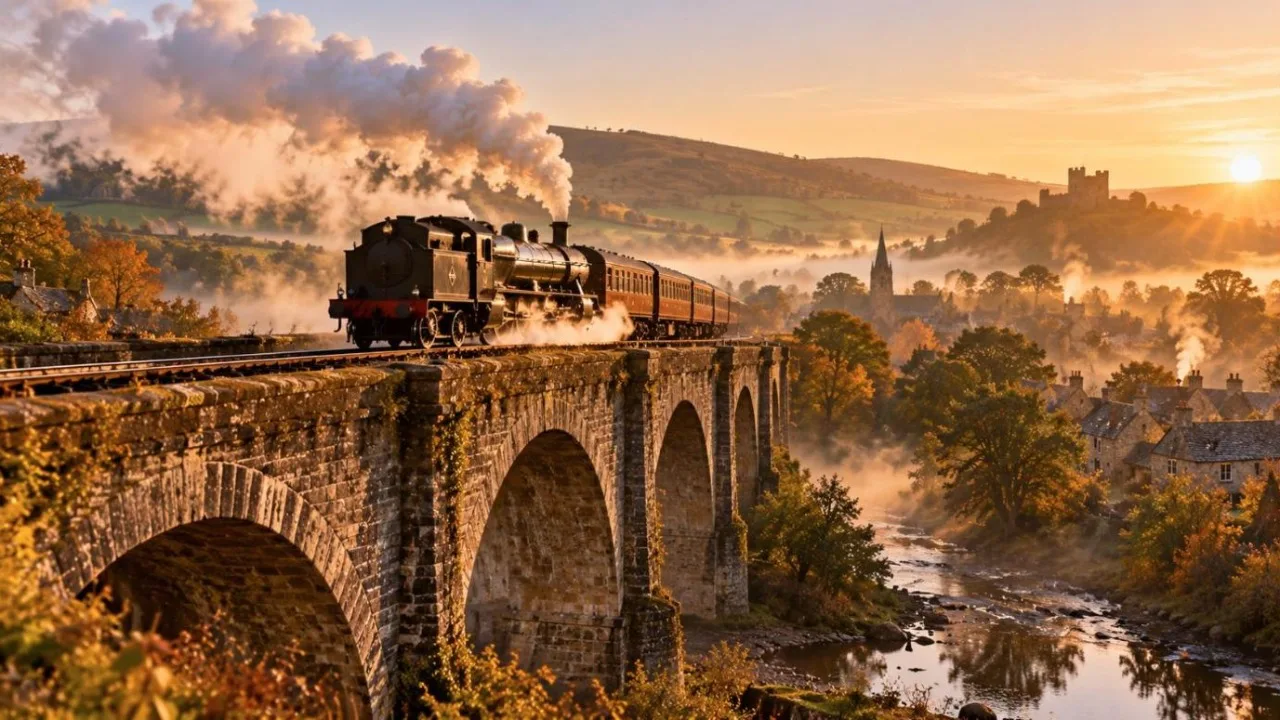
Richard Trevithick built an early steam locomotive in 1804. George Stephenson and his son Robert developed practical locomotives, and their Rocket won the Rainhill Trials in 1829. In 1830 the Liverpool and Manchester Railway opened as one of the first intercity railways using steam locomotives.
Railways spread across Britain, Europe, North America and beyond. Journeys that took days by horse took hours by train. Time zones were eventually standardised partly because railways needed consistent timetables.
Steam at sea
Steamships freed sea travel from depending on the wind. By the late 1800s, steamships carried goods and millions of migrants across oceans faster and more reliably than sailing ships.
The downsides
The steam age also brought hard factory work, child labour, crowded and polluted cities, and the large-scale burning of coal, beginning the rise in carbon emissions that drives climate change today.
Why it still matters
Steam engines are rare now, but their principle lives on. Many power stations, whether coal, gas or nuclear, still heat water into steam to spin turbines that generate electricity. The steam engine showed that machines could multiply human power, changing economies forever.
In Part 3, we look at how electricity and the light bulb lit up the world.
Inventions That Changed Everything: the full series
- Part 1: The Printing Press
- Part 2: The Steam Engine (you are here)
- Part 3: Electricity and the Light Bulb
- Part 4: The Telephone
- Part 5: Penicillin and Antibiotics
- Part 6: The Aeroplane
- Part 7: Radio and Television
- Part 8: The Computer
- Part 9: The Internet
- Part 10: The Mobile Phone
Dates and figures are commonly cited historical values and may vary slightly between sources, as many inventions had several contributors.