This is Part 24 of HorizonDesk's chronological series on Tamil history, from prehistory to modern Tamil Nadu. The previous instalment was Part 23: The Later Cholas, from Kulothunga I to the Decline of the Dynasty.
The last few parts followed Chola kings, wars and assemblies. This one turns to the people the inscriptions rarely name: the sculptors, metal-casters, painters and masons who worked for the dynasty between about 850 and 1279. What they made is the main reason the Cholas are known outside India today. A Chola bronze of Shiva dancing stands in almost every major museum of Asian art, and three Chola temples are on UNESCO's World Heritage List.
Chola art was not made for galleries. Nearly all of it served temples: stone shrines where a deity lived, and metal images that left the shrine on festival days to be carried through the streets.
Chola art at a glance
| Medium | What survives | Best-known examples |
|---|---|---|
| Stone architecture | Hundreds of temples across the Kaveri delta and beyond | Thanjavur, Gangaikonda Cholapuram, Darasuram, Thirubhuvanam |
| Stone sculpture | Wall-niche deities, friezes, guardian figures | Dakshinamurti, Lingodbhava and Durga niches; Darasuram's Nayanmar friezes |
| Bronze (metal) images | Processional icons, many now in museums | Nataraja, Somaskanda, Uma, Rama with Sita, saints |
| Painting | Rare; the finest set is at Thanjavur | Murals in the passage around the Thanjavur sanctum |
From brick to granite: the early Chola temples
The Pallavas of Kanchipuram had already shown that a free-standing stone temple was possible, most famously at the Kailasanathar temple in Kanchi. The early Cholas, after Vijayalaya's revival at Thanjavur around 850, took that idea and spread it across the Kaveri delta in modest, beautifully proportioned shrines.
Some of the earliest landmarks:
- Vijayalaya Cholisvaram, Narthamalai (Pudukkottai district, 9th century): a small temple with a circular sanctum and dome, which the scholar S. R. Balasubrahmanyam called a bold experiment with no precedent. The name linking it to Vijayalaya is conventional; an inscription suggests a local chief built it, so the attribution is debated.
- Koranganatha temple, Srinivasanallur (near Tiruchirappalli, early 10th century): a compact shrine with crisp, lifelike niche sculptures. It is usually placed in Parantaka I's reign, though some scholars date it a little earlier.
- Brahmapurisvara temple, Pullamangai (near Thanjavur, early 10th century): famous for its miniature friezes, some only a few centimetres high.
- Muvar Kovil, Kodumbalur: twin surviving shrines built by the Irukkuvel chiefs, Chola allies, around the late 9th or 10th century.
These temples set a lasting pattern. The sanctum (garbhagriha) sits under a stepped tower, the vimana. Its outer walls have niches (koshtas) holding a fixed set of deities: Ganesha, Dakshinamurti (Shiva as teacher) facing south, Lingodbhava (Shiva emerging from a pillar of fire) at the back, and Brahma and Durga on the north.
Sembiyan Mahadevi, the queen who built in stone
The single most important patron of the tenth century was a widow. Sembiyan Mahadevi was the queen of Gandaraditya (reigned 949–957) and mother of Uttama Chola. For decades after her husband's death she paid for temples to be rebuilt in stone, among them the Uma Maheswara temple at Konerirajapuram. She also commissioned bronzes so fine that art historians speak of a "Sembiyan Mahadevi style", with slender, elegant figures and calm faces. A village near Nagapattinam is named after her.
Rajaraja's great experiment: Thanjavur
Everything changed with Rajaraja I. His Rajarajesvaram at Thanjavur, today called the Brihadisvara or Big Temple, was begun around 1003–1004 and consecrated in his 25th regnal year, 1009–1010, according to UNESCO's summary of the inscriptions.
Its scale was new to South India:
- the granite vimana rises about 60 metres (UNESCO gives 59.82 m; the popular figure of 66 m or 216 feet is often quoted) in 13 storeys, topped by an octagonal dome;
- the dome is said to be a single block weighing around 80 tonnes, though that figure is traditional rather than measured, and how it was lifted is still argued over;
- inscriptions call the temple Dakshina Meru, the "Meru of the south", after the mythical mountain at the centre of the universe;
- 81 of the 108 karanas (classical dance poses described in the Natya Shastra) are carved on the upper storey around the sanctum, the only temple known to show so many.
The temple was also an archive. On the 20th day of his 26th year, Rajaraja ordered that every gift made by him, his elder sister Kundavai, his queens and other donors be engraved on its walls. They list gold, jewels, land, lamps and staff, including hundreds of dancers.
The hidden murals
In April 1931, S. K. Govindaswami, a young history lecturer at Annamalai University, was examining the dark passage around the sanctum by the light of a "Baby Petromax" lamp. Behind flaking 17th-century Nayak paintings he found a much older layer: Chola murals painted when the temple was built. He wrote to The Hindu, which published his letter on 11 April.
The murals show Shiva as Tripurantaka, destroyer of the three demon cities; the saint Sundarar and the Chera king Cheraman Perumal riding to Mount Kailasa; and dancers and devotees. Govindaswami thought one panel portrayed Rajaraja himself; later scholars rejected that reading, and identifications of royal figures remain cautious. In the 1960s ASI conservators lifted the Nayak layer off and mounted it separately. Whether the Chola murals are true fresco (painted on wet plaster) or tempera is still debated.
After Thanjavur: Gangaikonda Cholapuram, Darasuram and Thirubhuvanam
Rajaraja's son Rajendra I built a new capital and temple at Gangaikonda Cholapuram, completed around 1035. Its vimana, about 53 metres high, has recessed corners and gently curving sides, softer than Thanjavur's straight, severe tower. Its sculptures include a celebrated panel of Shiva garlanding the devotee Chandesvara, which some read as a hint at the king's own devotion, and UNESCO singles out its bronzes of Bhogasakti and Subrahmanya.
In the twelfth century the later Cholas built smaller but even richer temples:
- Airavatesvara temple, Darasuram (Rajaraja II): its front hall is shaped as a stone chariot with wheels and horses, and tiny labelled friezes tell the stories of the 63 Nayanmar saints. Its vimana is about 24 metres high.
- Kampaharesvara temple, Thirubhuvanam (Kulothunga III): the last of the four great royal Chola temples.
In 2004 UNESCO extended Thanjavur's listing to include Gangaikonda Cholapuram and Darasuram as the Great Living Chola Temples. "Living" matters: worship continues in all three.
A slow shift was under way. Over the 12th and 13th centuries, building energy moved from the central vimana to the gateway towers (gopurams) of the enclosure walls, the trend that would produce the towering gopurams of later Tamil temples.
The bronzes: gods who leave the temple
Why they were made
The stone deity in a sanctum never moves. But the Agamas, the ritual texts of Tamil temple worship, call for festivals in which the god visits the town. For that, temples needed portable processional images (utsava murti). Chola metal images were dressed in silk, hung with jewels and garlands, and carried on poles; many bases still have the holes or lugs for those poles. Museums show them bare; their makers expected them to be seen clothed, lamp-lit and moving.
The Thanjavur inscriptions show how valued they were. They list dozens of metal images given by Rajaraja, Kundavai, the queens and officials, with their size, number of arms and the jewels given to each. Kundavai even set up an image of her own mother. Gold for these gifts was weighed with a stone standard named Adavallan, "the good dancer", a name of Nataraja.
How they were made
Chola bronzes were cast by the lost-wax method, called madhuchishta vidhana in Sanskrit texts:
- The sculptor models the complete image in a mix of beeswax and resin, following set proportions.
- The wax model is coated in layers of fine clay, leaving channels.
- The mould is heated; the wax melts and runs out.
- Molten metal is poured into the hollow.
- Once it cools, the mould is broken and the image is chased, engraved and polished.
Because the mould is destroyed, every image is unique. Metal images are often called panchaloha ("five metals"). But the metallurgist Sharada Srinivasan analysed about 130 South Indian images and found most were leaded bronze (copper and tin) and the rest brass; gold and silver appeared only in traces, probably as ritual additions. The craft survives at Swamimalai near Kumbakonam, where hereditary sthapatis (icon-makers) still cast this way; "Swamimalai Bronze Icons" is a registered Geographical Indication.
Nataraja, Lord of the Dance
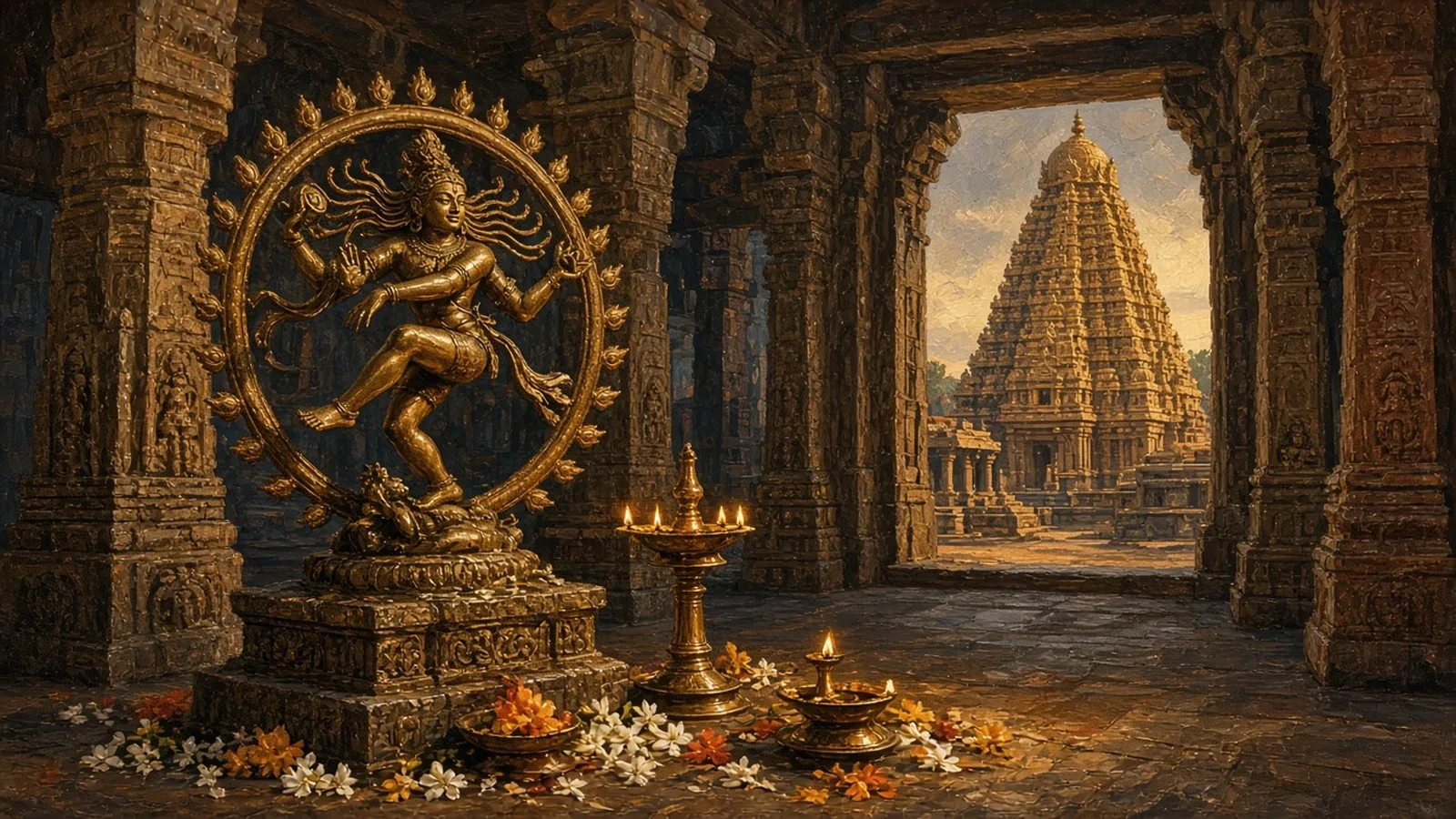
The image the world knows best is Shiva Nataraja. Dancing Shivas appear in Indian sculpture centuries earlier, but the classic form, in which Shiva dances inside a ring of fire, took shape in Chola bronze from the tenth century, closely tied to the temple at Chidambaram, where Shiva is worshipped as the dancer.
How to read it:
- Upper right hand: a small drum (damaru), the sound of creation.
- Upper left hand: fire (agni), destruction.
- Lower right hand: the gesture of reassurance (abhaya), "do not fear".
- Lower left arm: swung across the body, pointing to the raised left foot, a promise of refuge.
- Right foot: planted on a dwarf figure, Apasmara, ignorance or illusion.
- Flying locks: the energy of the dance, often with the river goddess Ganga caught in them.
Ananda Coomaraswamy's 1918 essay "The Dance of Shiva" introduced this reading to Western readers; today a Nataraja statue given by India stands at CERN in Geneva.
Other masterpieces
Chola workshops also made Somaskanda groups (Shiva, Uma and their child Skanda), Shiva as Vrishabhavahana (rider of the bull), Rama with Sita and Lakshmana, Kali, and the saints Appar, Sundarar and Sambandar. The Government Museum, Chennai holds a Nataraja from Tiruvalangadu (11th century, 115 cm high) and an Ardhanarishvara, Shiva as half-man, half-woman, from Tiruvenkadu (about 11th century, 101 cm). In Washington, the Freer Gallery's tall 10th-century goddess may be a portrait of Sembiyan Mahadevi herself. The Smithsonian notes that this is not certain.
Theft and return
Their beauty made Chola bronzes targets for theft. Three famous cases:
- The Sivapuram Nataraja reached the Norton Simon collection in California; a 1976 settlement recognised India's title, and it returned in 1986.
- The Pathur Nataraja, smuggled out of a Thanjavur-district village temple in 1976, was recovered after a long case in London. The archaeologist R. Nagaswamy testified as an expert witness, and the case ended in India's favour in 1991.
- The Sripuranthan Nataraja, bought by the National Gallery of Australia from the dealer Subhash Kapoor, was handed back to India in 2014.
Tamil Nadu's Idol Wing police still trace temple bronzes in foreign collections.
Timeline
| Date | Event | Certainty |
|---|---|---|
| 9th century | Vijayalaya Cholisvaram, Narthamalai | Approximate; builder debated |
| Early 10th century | Koranganatha (Srinivasanallur) and Pullamangai temples | Approximate |
| c. 950s–1000 | Sembiyan Mahadevi's temples and bronzes | Fairly firm |
| c. 1003–1010 | Rajarajesvaram, Thanjavur, built and consecrated | Firm |
| c. 1011 | Rajaraja orders gifts engraved on the temple walls (26th year) | Firm |
| c. 1035 | Gangaikonda Cholapuram temple completed | Fairly firm |
| 12th century | Darasuram (Rajaraja II) | Firm |
| c. 1178–1218 | Thirubhuvanam (Kulothunga III) | Fairly firm |
| 1931 | Chola murals discovered at Thanjavur | Firm |
| 1987, 2004 | UNESCO lists Thanjavur, then adds two more temples | Firm |
What we can say with confidence
- Confident: Chola bronzes were cast by the lost-wax method as processional images; Thanjavur was consecrated around 1010; the Thanjavur murals belong to the Chola period; the three Great Living Chola Temples date from the 11th and 12th centuries.
- Debated: who built some early temples, such as Narthamalai; whether particular bronzes or painted figures are royal portraits; the exact dates of many undated bronzes, which are placed by style; how the Thanjavur dome was raised; and fresco versus tempera technique.
Next part
Part 25, The Later Pandyas (Second Empire): Jatavarman Sundara Pandyan, returns to politics: how the Pandyas of Madurai, the power that ended Chola rule, built the last great Tamil empire of the medieval age.
Sources
- UNESCO World Heritage Centre, Great Living Chola Temples (construction dates, vimana heights, karanas, bronzes)
- South Indian Inscriptions, Vol. II, Rajaraja's order to engrave the gifts, Rajarajesvara temple, Thanjavur
- South Indian Inscriptions, Vol. II, Kundavai's gifts to the images she set up at Thanjavur
- S. R. Balasubrahmanyam, Early Chola Temples, the Vijayalaya period and Narthamalai and bronzes of the Sembiyan Mahadevi era
- K. A. Nilakanta Sastri, The Colas (2nd ed., University of Madras, 1955), chapter on art and architecture
- Government Museum, Chennai, Nataraja from Tiruvalangadu and Ardhanarishvara from Tiruvenkadu
- Smithsonian National Museum of Asian Art, Queen Sembiyan Mahadevi as the Goddess Parvati (F1929.84)
- The Hindu, An exciting discovery and a 1931 scoop for The Hindu and Murals at Thanjavur
- Frontline, Lost treasures (the bronzes listed in the Thanjavur inscriptions)
- The Hindu, How a Chola era bronze idol was retrieved from the U.K. (Pathur Nataraja)
- National Gallery of Australia, Questions and answers: Shiva as Lord of the Dance (PDF)
- Ananda K. Coomaraswamy, The Dance of Siva: Fourteen Indian Essays (1918)
- Sharada Srinivasan, "The Art and Science of Chola Bronzes", Orientations (2006); Vidya Dehejia, Art of the Imperial Cholas (1990) and The Thief Who Stole My Heart (2021); C. Sivaramamurti, South Indian Bronzes (1963)