This is Part 20 of HorizonDesk's chronological series on Tamil history, from prehistory to modern Tamil Nadu. The previous instalment was Part 19: Vijayalaya and the Revival of the Chola Dynasty.
After defeat at Takkolam in 949 and three decades of succession quarrels, the Chola kingdom needed a strong ruler. In mid-985 a prince named Arunmozhivarman (Arulmozhi Varman) came to the throne at Thanjavur and took the name Rajaraja, "king of kings". In 29 years he turned a regional kingdom into the strongest power in south India, sent fleets to Sri Lanka and the islands of the Indian Ocean, and raised a granite temple whose tower still dominates the Kaveri delta a thousand years later.
Rajaraja is unusually well documented: he was probably the first south Indian king to open his inscriptions with a list of his victories, and he had every gift to his temple carved on its walls. These are official voices, though, so this part notes where historians still argue.
Rajaraja I at a glance
| Question | Short answer |
|---|---|
| Birth name | Arunmozhivarman, second son of Sundara Chola (Parantaka II) and Vanavan Mahadevi |
| Reign | 985 to 1014 CE (accession fixed by astronomy to June–July 985) |
| Throne title | Rajakesari; later titles include Mummudi Chola, Sivapadasekhara and Jayangonda |
| Capital | Thanjavur (Tanjore) |
| Main conquests | Kandalur Salai, the Pandya and Kerala countries, northern Sri Lanka, Gangavadi and other Karnataka provinces, Vengi, the "12,000 islands" |
| Great monument | Rajarajeswaram, the Brihadisvara or "Big Temple", Thanjavur, consecrated around 1010 |
| Main sources | Stone inscriptions (above all at Thanjavur), the Tiruvalangadu and Larger Leiden copper plates, Chalukya and Sri Lankan records |
The road to the throne
Rajaraja's elder brother, Aditya II Karikala, was the expected heir and a successful soldier who fought the Pandyas. Around 969 he was murdered. An inscription of Rajaraja's second year at Udaiyarkudi orders the property of the men held guilty, a group of officials, to be confiscated. Who stood behind them is not recorded. Nilakanta Sastri suspected that Uttama Chola, Rajaraja's uncle, profited from the crime; other historians find the evidence too thin to accuse him.
Uttama Chola ruled from about 970 to 985. The Tiruvalangadu plates, written for Rajaraja's son, say Arunmozhi refused the throne while his uncle wanted it and agreed to wait as heir. It is a court version, but when Uttama died the succession passed smoothly.
Kalki's Tamil novel Ponniyin Selvan, and the recent films based on it, dramatise these years; they are fiction, not history.
A decade of conquest
Rajaraja's inscriptions open with a Tamil preamble (meykeerthi, "true fame") beginning Tirumagal pola, "as the goddess of fortune...". It grew as each victory was added, so it helps to date his wars.
Kandalur Salai and the south
His first boast is that he "destroyed the kalam at Kandalur Salai", near Thiruvananthapuram in Kerala, around 988. Kalam can mean ships, and salai was also a famous school, so scholars still debate whether this was a naval raid, an attack on a fortified college, or both.
The Tiruvalangadu plates add that he captured the Pandya king Amarabhujanga, that his general took the port of Vizhinjam, and that he stormed Udagai in the western hills. By the late 990s he claimed the title Mummudi Chola, "the Chola of three crowns", in other words master of the Chera and Pandya countries as well as his own. Kollam and Kodungallur on the Kerala coast also appear in his lists.
Sri Lanka
With the Anuradhapura kingdom in turmoil under Mahinda V, a Chola army crossed the strait, sacked Anuradhapura and made Polonnaruwa, renamed Jananathamangalam, the seat of a new Chola province. Sastri dates the invasion to about 993; Hultzsch preferred 1001–1004. The Tiruvalangadu plates boast that Rajaraja outdid Rama, who needed monkeys to build a causeway, because his army simply crossed the sea in ships. A Chola-period Shiva temple still stands at Polonnaruwa; the south of the island held out until Rajendra I.
The Deccan and Vengi
Before his 14th year (998–999) Rajaraja's armies took Gangapadi, Nulambapadi and Tadigaipadi in modern Karnataka, which brought the Cholas face to face with the Western Chalukyas of Kalyani. Around 1006 Crown Prince Rajendra led a huge raid into Chalukya territory. A Chalukya inscription at Hottur gives the enemy's view, accusing "Rajendra" of bringing 900,000 troops and killing women, children and Brahmins; the figure is surely inflated. Rajaraja gave gold flowers from the booty to his new temple.
In the east, Rajaraja put Saktivarman I on the throne of the Eastern Chalukya kingdom of Vengi (coastal Andhra), and his daughter Kundavai married the next king, Vimaladitya. Two generations later this alliance would bring a Vengi prince to the Chola throne as Kulottunga I. Kalinga (Odisha) also appears in the lists; the campaign there may have been led by Rajendra.
The "12,000 islands"
Late in the reign, inscriptions add the conquest of "the 12,000 ancient islands of the sea" (munnir palantivu pannirayiram). Most historians identify them with the Maldives, perhaps with the Lakshadweep, the islands that sit on the sea route to Arabia. What "conquest" meant there, whether lasting rule or a punitive expedition, is unclear. Today the Maldives is better known for beaches than for Chola fleets.
Running an empire
Rajaraja's lasting achievement may be administrative.
- Land survey. Around his 16th year (about 1001) a revenue survey measured holdings down to tiny fractions of a veli, the standard unit of land. The officer associated with it, Kuravan Ulagalandan, bore a title meaning "he who measured the world".
- Valanadus. Provinces were divided into new districts (valanadu) named after the king's titles.
- Records. Before a shrine at Tirumalavadi was rebuilt, he ordered its wall inscriptions copied into a book and re-engraved afterwards.
- Religious tolerance. Rajaraja was a devout Shaiva, but he granted the village of Anaimangalam to the Buddhist Chudamani Vihara at Nagapattinam, built by the Sailendra king of Srivijaya. The grant is recorded in the Larger Leiden plates. Jain villages appear in his tax orders alongside Brahmin ones.
Tradition also credits him with recovering the Tevaram hymns of the Shaiva saints (see Part 18): a later work, the Tirumurai Kanda Puranam, says a king Rajaraja and the scholar Nambiyandar Nambi found the palm leaves in a sealed room at Chidambaram. That is sacred legend, and some scholars link it to a later king, but the Thanjavur inscriptions do show the hymns being sung daily by paid singers in Rajaraja's temple.
The Big Temple: Rajarajeswaram
Building a mountain in stone
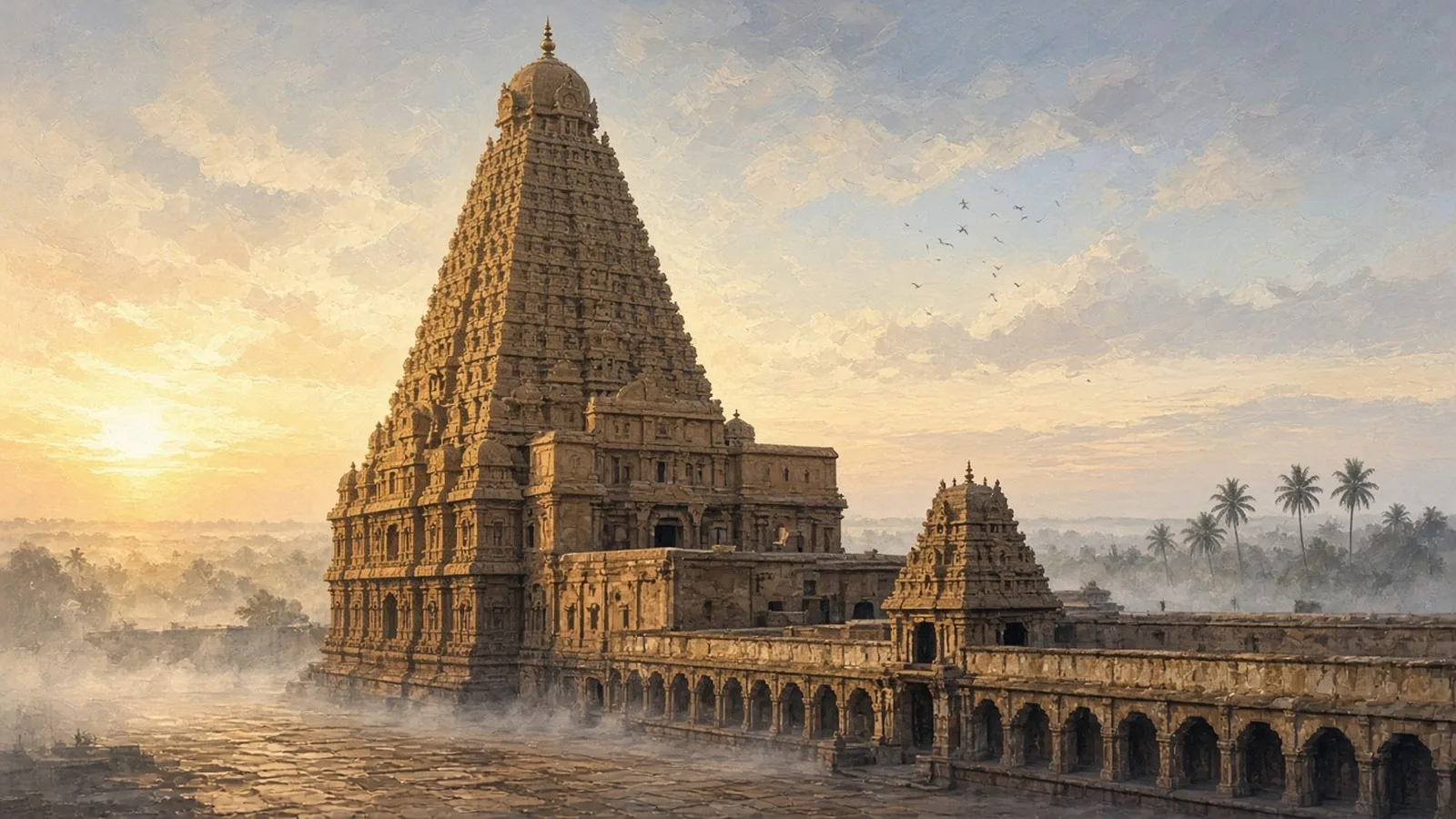
The temple Rajaraja called Rajarajeswaram, "the lord of Rajaraja", is known today as the Brihadisvara or Peruvudaiyar temple, or simply the Periya Kovil, the Big Temple. Its inscriptions also call it Dakshina Meru, the Meru (the cosmic mountain) of the south.
Work probably began around his 19th regnal year (1003–1004), when the title "Rajaraja" first appears. On the 275th day of his 25th year, around 1010, the king handed over the gilded copper finial (stupi) for the top of the tower, the last step in finishing the main shrine. Unlike many south Indian temples, it was planned and built as one complex.
Key facts, as given by UNESCO and the Archaeological Survey of India:
- The vimana (the tower over the sanctum) rises 59.82 metres; popular accounts often say 66 metres or 216 feet, depending on where you measure from.
- It has 13 storeys (tala) topped by an octagonal dome (sikhara).
- The shrine is surrounded by a two-storey passage; on the upper level, 81 of the 108 classical dance poses (karanas) are carved.
- The whole structure is granite. No hill lies near Thanjavur, so the stone had to be hauled from quarries perhaps 50 km or more away.
Two popular claims need care. The dome is often said to be a single block of about 80 tonnes; some experts argue it is built of several stones. And the idea that the tower's shadow never falls on the ground is simply untrue. The great Nandi (sacred bull) and its pavilion in the courtyard belong to the 16th-century Nayak rulers, not to Rajaraja.
The temple's own records
The temple is a library in stone. Its longest inscription, 107 paragraphs long, records how the king, sitting in his palace bathing hall, ordered that every gift "by us, by our elder sister, by our queens and by other donors" to "the sacred stone temple which we caused to be built" be engraved on the tower's base. His elder sister Kundavai is named right after him, a sign of her standing.
Other records list:
- the names of 400 temple dancers brought from other temples, each given a house on the temple streets;
- singers, drummers, accountants, goldsmiths, carpenters, washermen, astrologers and watchmen, with their pay;
- dozens of bronze images with their exact measurements, and jewellery described gem by gem;
- villages, some in Sri Lanka, that paid revenue to the temple.
One record names the chief builder, Kunjara Mallan Rajaraja Perunthachan (perunthachan means "master carpenter"), assisted by two other master craftsmen. Medieval Indian architects are rarely named at all.
The hidden paintings
In April 1931 S. K. Govindaswami, a young history lecturer at Annamalai University, was examining the dark passage around the sanctum by lamplight. Behind flaking 17th-century Nayak paintings he found an older layer: Chola murals from about the early 1000s. They show Shiva as Tripurantaka, destroyer of the three cities, the saint Sundarar riding a white elephant to Kailasa, and a king and his family worshipping Nataraja at Chidambaram. A pair of figures is often labelled "Rajaraja and his guru Karuvurar"; some art historians argue they are simply devotees.
The temple was inscribed as a UNESCO World Heritage Site in 1987. In 2004 the listing was extended as the Great Living Chola Temples, adding Gangaikondacholapuram and Darasuram. It is still a working temple. The Pallava king Rajasimha's Kailasanathar temple at Kanchi shows the earlier tradition that Rajaraja's builders took to a new scale.
Last years and legacy
Rajaraja made Rajendra co-ruler in 1012 and died early in 1014. A spot at Udaiyalur near Kumbakonam is locally believed to be his resting place, which is unproven. The monthly festivals he endowed on the Sadayam star suggest it was his birth star, and Thanjavur still celebrates Sadhaya Vizha for him each year in the Tamil month of Aippasi (October–November).
Timeline
| Date (approx.) | Event | How firm? |
|---|---|---|
| c. 969 | Murder of Aditya II Karikala | Approximate |
| c. 970–985 | Reign of Uttama Chola | Fairly firm |
| June–July 985 | Accession of Rajaraja I | Firm |
| c. 988 | Kandalur Salai campaign | Approximate; meaning debated |
| c. 993 (or 1001–1004) | Conquest of northern Sri Lanka | Date debated |
| By 998–999 | Gangapadi, Nulambapadi, Tadigaipadi, Vengi | Fairly firm |
| c. 1003–1004 | Work on the Thanjavur temple probably begins | Inferred |
| c. 1006 | Rajendra's raid on the Western Chalukyas; Chudamani Vihara grant | Fairly firm |
| c. 1010 | Finial placed on the vimana | Firm (25th regnal year) |
| 1012 | Rajendra becomes co-ruler | Firm |
| Early 1014 | Death of Rajaraja I | Firm |
What we can say with confidence
- Confident: Rajaraja came to the throne in 985; he conquered the Pandya and Kerala countries and northern Sri Lanka, fought the Western Chalukyas and placed an ally on the Vengi throne; he built the Rajarajeswaram, finished around 1010, and endowed it on an enormous scale.
- Uncertain: who was behind Aditya II's murder; what happened at Kandalur Salai; the exact date of the Sri Lankan campaign; what the conquest of the "12,000 islands" meant in practice; whether Rajaraja himself recovered the Tevaram; the method used to raise the vimana's top.
Next part
Part 21, Rajendra Chola I: Gangaikonda Cholapuram and Srivijaya, follows his son, who marched to the Ganges, built a new capital to celebrate it and sent a fleet across the Bay of Bengal to strike the kingdom of Srivijaya in Southeast Asia.
Sources
- K. A. Nilakanta Sastri, The Colas (2nd ed., University of Madras, 1955), chapter on Rajaraja I
- K. A. Nilakanta Sastri, A History of South India
- South Indian Inscriptions II (Rajarajesvara temple inscriptions at Thanjavur): Introduction on the reign of Rajaraja I
- S. R. Balasubrahmanyam, Middle Chola Temples: Rajaraja I to Kulottunga I (1975)
- UNESCO World Heritage Centre, Great Living Chola Temples
- The Hindu, Written in stone: Big Temple's inscriptions reveal a king's passion
- The Hindu, Big Temple – up close (inscriptions on the architect and temple staff)
- The Hindu, An exciting discovery and a 1931 scoop for The Hindu (the Chola murals)
- Frontline, Photographic feat (ASI documentation of the murals)
- The Hindu, Murals at Thanjavur (the debate over the "Rajaraja and his guru" panel)
- Tamil Virtual Academy, The imperial Cholas (Tamil)