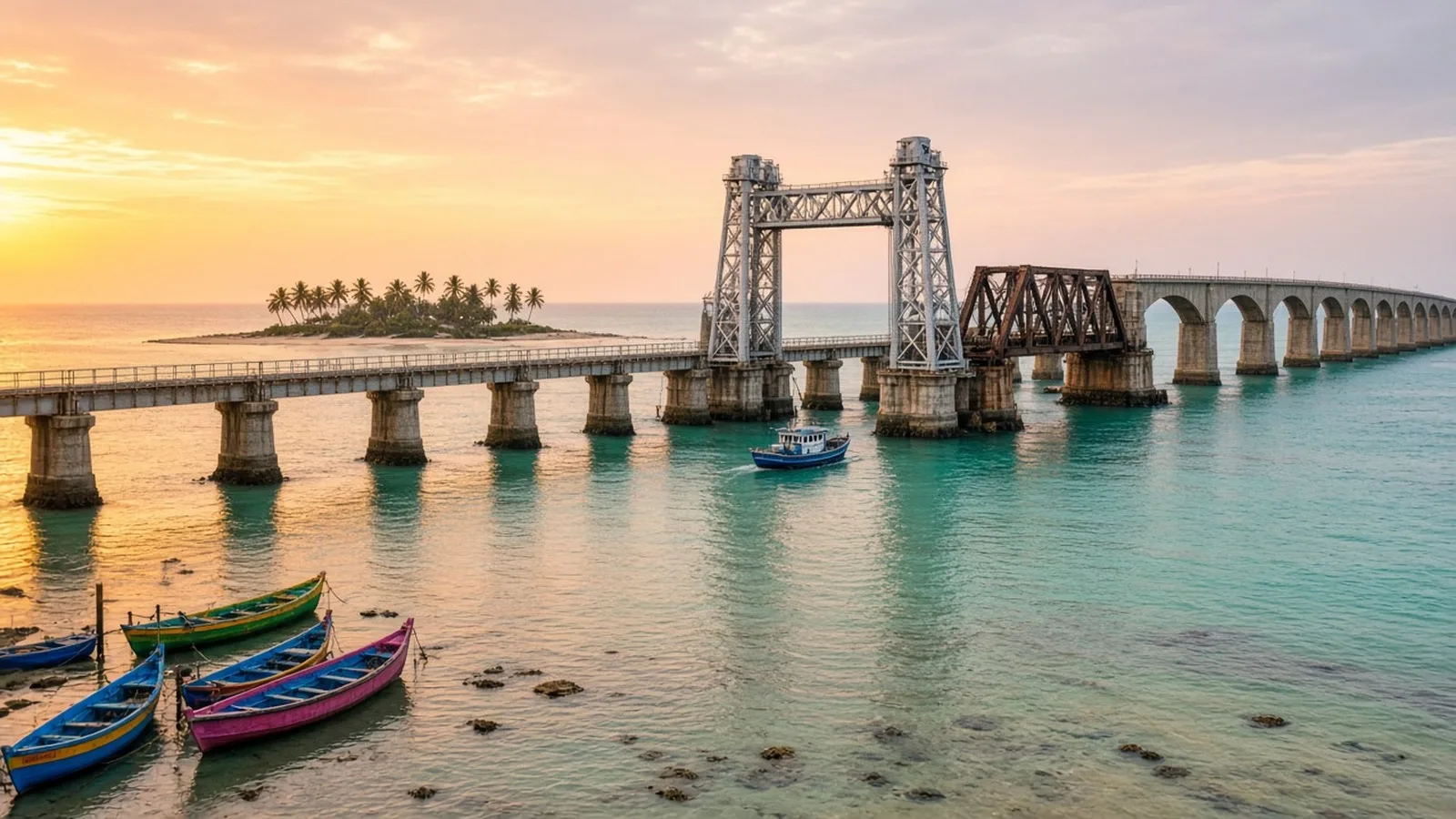
A few minutes after the train to Rameswaram leaves Mandapam, the land outside the window simply disappears. For a stretch of about two kilometres, there is nothing on either side but shallow blue sea. For more than a century, that short crossing has been provided by the Pamban Bridge. Opened in 1914, it is widely described as India's first sea bridge, and it remained the country's longest sea bridge until Mumbai's Bandra-Worli Sea Link opened in 2010. The original bridge survived storms, salt winds and relentless corrosion before it was finally retired. Right beside it, India's first vertical-lift sea rail bridge opened in 2025.
This is the full story of the Pamban Bridge. It starts with why a small island needed a link to the mainland. It then covers the catastrophic 1964 cyclone, the record-speed restoration that followed, the 1988 road bridge, the conversion to broad gauge, and the engineering behind the new bridge.
Rameswaram Island and the Pamban Channel: Why a Bridge Was Needed
Where the island sits
The temple town of Rameswaram stands on Pamban Island, also called Rameswaram Island, in today's Ramanathapuram district of Tamil Nadu. A stretch of sea roughly two kilometres wide separates the island from Mandapam on the mainland. To the north lies Palk Bay and to the south the Gulf of Mannar. The narrow Pamban channel that joins them allowed small ships and boats to travel between India's east and west coasts without sailing all the way around Sri Lanka. From the very beginning, any bridge here had one non-negotiable condition: it could not block shipping.
At the island's south-eastern tip lies Dhanushkodi. Talaimannar in Sri Lanka is only about 22 miles (roughly 35 km) away. Between the two runs a chain of sandbanks and shoals known as Adam's Bridge or Ram Setu. In the Ramayana tradition, Dhanushkodi is where the bridge to Lanka began, which makes the area deeply sacred to pilgrims visiting the Ramanathaswamy Temple.
Ceylon trade and plantation workers
In the late nineteenth century, the British expanded tea and coffee plantations in Ceylon (now Sri Lanka), and large numbers of workers were recruited from Tamil Nadu to work on them. The main route at the time was a train from Madras to Thoothukudi (Tuticorin), followed by a long sea voyage to Colombo. The colonial administration began to look at linking the railway networks of the two colonies, to shorten journeys and make it easier to move passengers and cargo.
How the 1914 Rail Bridge Came About
Plans and postponements
The idea of linking India and Ceylon by rail across Adam's Bridge was discussed as early as the 1870s. According to a summary in The Hindu, it was studied in 1876. In 1894, F.J. Waring, Chief Resident Engineer of the Ceylon Railway, proposed bridging the 22-mile gap along Adam's Bridge. The estimate ran into crores of rupees, far too much for the expected traffic, and the plan was dropped.
A practical compromise followed. A railway would run from Madurai across Rameswaram Island to Dhanushkodi. A steamer ferry would cross from there to Talaimannar in Ceylon, and the Ceylon Government Railway would extend its line to Talaimannar. The survey was finalised in 1906. In November 1908 the decision was taken to build a viaduct across the sea between Mandapam and Pamban, with a central Scherzer rolling-lift span that could open for ships. The estimated cost of the Rameswaram-Dhanushkodi line and ferry link, including the bridge, is usually given as about ₹70 lakh.
Building in the middle of the sea
Sources differ slightly on when construction began. Some reports citing railway records give August 1910; others say June or August 1911. Either way, there is broad agreement that most of the work took place over about 30 months, from 1911 to December 1913. The steelwork was fabricated in England and shipped out. Work on the central Scherzer lift span reportedly began in July 1913 and took about six months.
The finished bridge was built to metre gauge and was about 2,065 metres long (some sources say 2.05 km). It had 145 steel girder spans of about 12.2 metres (40 feet) each, plus the central lift span. Sources variously give the number of spans as 143, 144, 145 or 146. The difference depends on whether they count piers or spans, and whether the lift span is included.
24 February 1914: the opening
The bridge was opened on 24 February 1914 by Neville Priestley, Agent and Managing Director of the South Indian Railway Company, and trains began running that month. Some historians note that the ceremony was really the opening of the India-Ceylon rail-and-ferry connection, and that the bridge itself had been ready a little earlier. As it happens, 1914 was also the year the First World War broke out. You can read how the German cruiser SMS Emden shelled Madras that September in our World Wars series article on the Emden raid.
The Scherzer Rolling-Lift Span: A Century-Old Engineering Marvel
The signature feature of the old Pamban Bridge was its double-leaf lift span in the middle. The design was patented by the American engineer William Donald Scherzer. The Scherzer Rolling Lift Bridge Company of Chicago, which carried his name, designed the Pamban span, and Head Wrightson & Co. of Teesside, England, built it. Scherzer himself died in 1893, so his company carried out the Pamban work. The span is still known as the "Scherzer span".
How it worked
A conventional bascule bridge pivots on a fixed axle. In a Scherzer design, the base of each leaf is a curved rocker that rolls backwards along a track as the leaf rises. This makes it possible to lift a very heavy structure with relatively little force. At Pamban the two leaves met in the middle. When a ship approached, each leaf rose to about 81 degrees, opening the channel like a pair of scissors.
Sources give the length of the span as 225 feet (112.5 feet per leaf), or about 65.23 metres. Each leaf is said to have weighed about 415 tonnes. There were no electric motors. Staff operated the leaves by hand, turning levers connected to a spur-gear system. Some accounts say opening and closing the bridge could take up to 45 minutes.
The Boat Mail and Dhanushkodi: A Sea-and-Rail Route to Ceylon
As soon as the bridge opened, the famous Boat Mail, also known as the Indo-Ceylon Express, began running. The train left Madras Egmore and ran via Madurai, Ramanathapuram, Mandapam and the Pamban Bridge to the pier at Dhanushkodi. There, passengers boarded a steamer for the roughly 22-mile crossing to Talaimannar, where another train took them on to Colombo.
According to an article in Scroll, tickets were printed in three languages: English, Tamil and Sinhala. In the 1950s, the roughly 675 km journey from Egmore to Dhanushkodi took a little over 19 hours, and the sea crossing about three and a half hours.
The link turned Dhanushkodi into a busy frontier town. It had a railway station, a customs office, a post and telegraph office, hospitals, a school and port offices. The line split at Pamban Junction, with one branch going to Rameswaram and the other to Dhanushkodi.
The December 1964 Cyclone: The Destruction of Dhanushkodi
An unprecedented storm
In December 1964, a depression that formed over the southern Andaman Sea intensified rapidly into a powerful cyclone. On the night of 22-23 December it struck northern Ceylon, then crossed the Palk Strait to hit Rameswaram Island and the Tamil Nadu coast. Later estimates suggest its winds may have reached about 240 km/h. It is known as the Rameswaram cyclone or the Dhanushkodi cyclone. The storm surge at Dhanushkodi is widely quoted as about 7 metres (23-25 feet). That figure is an estimate, not a precise measurement.
The tragedy of Train No. 653
That night, the No. 653 Pamban-Dhanushkodi Passenger, with six coaches, was travelling from Pamban to Dhanushkodi. As it neared Dhanushkodi station, a huge wave swept the entire train into the sea. The storm was so violent that staff at Dhanushkodi and Rameswaram Road could not go out to find out what had happened. Only on the morning of 24 December, when the engine's chimney was spotted sticking out of the water, did the fate of the train become clear.
The death toll is still disputed. The official accident report by the Commissioner of Railway Safety, based on figures from the Assistant Station Master at Pamban, says the train carried about 100 to 110 passengers and 18 railway staff, and that there were no survivors. The same report admits that the exact number is not known. Other accounts say 110 passengers and 5 staff, some say about 200, and some estimates go as high as 250. The safest statement is that well over a hundred people died on the train.
Dhanushkodi becomes a ghost town
Dhanushkodi was almost completely destroyed: its station, church, houses, port buildings and railway line were all wrecked. The ruined church and station still stand, and a few fishing families live there today. Contemporary reports put the cyclone's total death toll at about 1,800. That figure is often quoted as "1,800 dead in Dhanushkodi", but in reports published on 28 December 1964 it was the combined toll for India and Ceylon. Some reports said at least 800 died in Dhanushkodi alone, so the exact number is still uncertain. The Madras government later declared Dhanushkodi unfit for habitation, and the Dhanushkodi line and station were closed for good.
Acts of courage were recorded too. An old article in The Hindu says four radio operators at Dhanushkodi risked their lives to keep transmitting during the storm. It also says two railway staff patrolling the Pamban Bridge survived by clinging to the bridge's frame for about 12 hours.
Damage to the bridge
The Pamban Bridge was badly damaged. According to The Hindu, 103 steel girder spans of 12.2 metres each were washed away, and 21 prestressed concrete girders and two piers were toppled. Other sources, such as The Indian Express, say 126 of the 146 spans were swept away. Whatever the exact count, every source agrees on one thing: the central Scherzer lift span survived.
The Restoration: E. Sreedharan's Record
E. Sreedharan, later famous as India's "Metro Man" for the Konkan Railway and the Delhi Metro, was then a young engineer with Southern Railway. The Railways gave six months to rebuild the bridge, and the General Manager cut that to three. Sreedharan has said in many interviews that his team finished the job in just 46 days; one account says 45. A summary in The Hindu says the restoration was completed in March 1965, in "a little over two months".
Local fishermen were a big reason for the speed. While officials were planning to bring new girders from across the country, a fisherman reported seeing a girder lying on the seabed. A large operation followed to find and recover the girders that had fallen into the sea. The recovered girders were repaired and refitted, and some were replaced with new ones. Sreedharan has recalled that Kerala's "Mappila khalasis", renowned for moving heavy loads with ropes and pulleys, also worked on the job.
1988: The Annai Indira Gandhi Road Bridge
After the 1964 cyclone, there was a growing feeling that a single rail link to the island was not enough. Work on a road bridge parallel to the rail bridge began in 1974. About 14 years later, on 2 October 1988, Prime Minister Rajiv Gandhi opened it, and it was named the Annai Indira Gandhi Bridge. It is about 2.345 km long. It stands on tall piers with an arched profile, so ships can pass beneath it freely. When it opened it was considered India's longest sea road bridge.
From Metre Gauge to Broad Gauge
Under the national Unigauge policy, the Madurai-Rameswaram line had to be converted to broad gauge. That raised the question of whether a 100-year-old bridge could carry heavier broad-gauge trains. A new bridge was considered. Some reports say that President A.P.J. Abdul Kalam, himself from Rameswaram, recommended strengthening the existing bridge instead. After expert advice, the bridge was strengthened.
All the piers were reinforced. Fifteen of the concrete girders that had survived the 1964 cyclone were replaced with steel girders, and extra counterweight was added to the Scherzer span. A former railway official told The Hindu that railway staff from across South India fitted about four lakh (400,000) rivets. The Union Railway Ministry told the Lok Sabha that the Manamadurai-Rameswaram broad-gauge line, including the Pamban Bridge, opened to passenger traffic on 12 August 2007.
In 2009 the bridge was strengthened further for freight trains. In January 2013 a navy barge struck it, causing minor damage to the piers. In January 2014 Dr Kalam inaugurated the bridge's centenary celebrations. He recalled crossing it many times as a boy while delivering newspapers. In December 2018 a crack was found in one span, and rail traffic was suspended until March 2019. For more railway milestones from the region, see our article on Chennai's firsts, from the first flight to early trains.
The Old Bridge Retires
Pamban sits in one of the harshest marine corrosion environments in the world; railway officials describe it as the second most corrosive zone on the planet. Despite constant maintenance, the steel gradually weakened, and trains were limited to about 10 km/h on the bridge. With help from IIT Madras, sensors were installed to monitor its condition.
On 23 December 2022, the sensors raised a red alert after vibrations exceeded safe limits while a train was crossing. Rail traffic was halted the same day, and trains to Rameswaram terminated at Mandapam. After inspections by experts from IIT Madras and the RDSO (Research Designs and Standards Organisation), Southern Railway announced in early 2023 that train services on the old bridge would stop permanently. After about 108 years of service, the bridge was retired. Reports in 2025 said a tender had been floated to dismantle the Scherzer span, so the old leaves would no longer have to be raised every time a vessel passed the new bridge. The Hindu also reported the Southern Railway General Manager as saying parts of the bridge would be preserved as a memorial.
The New Pamban Bridge: India's Vertical-Lift Sea Bridge
From foundation stone to opening
Prime Minister Narendra Modi laid the foundation stone for a new bridge alongside the old one at an event in Kanyakumari on 1 March 2019. The project was executed by Rail Vikas Nigam Limited (RVNL), a public sector company under the Railway Ministry. A consortium including Spain's TYPSA Group designed the moving span. Construction at sea began in 2019; an RVNL official says February, while TYPSA says November. Work stopped for about eight months because of COVID-19, and rough seas and design changes added further delays.
Work was completed in November 2024. The Commissioner of Railway Safety (CRS) inspected the bridge that month and approved operations with some recommendations. On Ram Navami, 6 April 2025, Prime Minister Modi opened the new bridge on his return from a visit to Sri Lanka. At the same event he flagged off a new Rameswaram-Tambaram train service. The lift span was raised and a Coast Guard vessel sailed beneath it.
Cost figures vary from source to source. The Hindu has given both ₹531 crore and ₹535 crore, and Business Standard about ₹550 crore. The Prime Minister's Office said "over ₹700 crore", which may include the connecting works.
Engineering details
- Length: about 2.08 km (2.07 to 2.10 km, depending on the source).
- Spans: 99 fixed spans of 18.3 metres and one vertical-lift span of 72.5 metres.
- Lift height: the lift span rises by up to 17 metres, reportedly giving about 22 metres of clearance above sea level.
- Weight and timing: an RVNL official has said the lift span weighs about 660 metric tonnes and takes about 5 to 5.5 minutes to rise fully. The old bridge was worked by hand; the new one uses electric motors at the top of its towers, with wire ropes and counterweights.
- Foundations: 333 tubular piles according to the PMO, or 336 according to the RVNL official. Stainless steel reinforcement is used to resist corrosion.
- Corrosion protection: a three-layer system of zinc metallising, epoxy and polysiloxane paint, which is said to avoid the need for repainting for several decades.
- Future-ready: the substructure is designed for double track and electrification, and the deck sits a few metres higher than the old bridge.
- Speed: trains were limited to 10 km/h on the old bridge. The new one has reportedly been cleared for 75 km/h, and trial runs were held at higher speeds.
Why not simply build a tall bridge?
The obvious question is why the railway did not build a high bridge, like the road bridge, that big ships could pass under. According to the RVNL official, average daily wind speeds here are about 40 km/h, which could be dangerous for coaches running very high above the sea. And because the road bridge already crosses above the shipping channel, a rail bridge taller than that was not practical. A low bridge with a central span that rises only when needed was judged the best solution.
Timeline
| Year / date | Event |
|---|---|
| 1870s | First discussion of an India-Ceylon rail link |
| 1894-95 | Full rail link across Adam's Bridge proposed; dropped because of cost |
| 1906-1908 | Plan for a line to Dhanushkodi, a ferry service and a Scherzer lift bridge finalised |
| 1910/1911-1913 | Construction of the Pamban rail bridge (start date varies by source) |
| 24 February 1914 | Bridge opens; Boat Mail link from Madras via Dhanushkodi to Talaimannar begins |
| 22-23 December 1964 | Rameswaram cyclone; Train No. 653 swept away; Dhanushkodi destroyed; most of the bridge damaged |
| Early 1965 | Bridge restored in about 46 days under E. Sreedharan (some sources: March 1965) |
| 1974 | Work begins on the road bridge |
| 2 October 1988 | Annai Indira Gandhi road bridge opens |
| 12 August 2007 | Passenger trains begin on the broad-gauge Manamadurai-Rameswaram line, including the Pamban Bridge |
| January 2014 | Dr Abdul Kalam inaugurates the centenary celebrations |
| 1 March 2019 | Foundation stone laid for the new Pamban Bridge |
| 23 December 2022 | Sensor alert halts trains on the old bridge; later stopped permanently |
| November 2024 | New bridge completed; CRS approval |
| 6 April 2025 | New vertical-lift sea bridge opened; Rameswaram-Tambaram train flagged off |
Tips for Visitors
Getting there
The Pamban Bridge is about 160-170 km by road from Madurai, and Madurai is the nearest airport. There are direct trains to Rameswaram from cities including Chennai and Madurai, and crossing the sea by train on the new bridge is an experience in itself. Rameswaram town is about 10-12 km from Pamban, and the Ramanathaswamy Temple, the Dhanushkodi ruins and the Dr A.P.J. Abdul Kalam National Memorial make easy add-ons. The road to Dhanushkodi is sometimes closed in bad weather.
Best viewpoints and timing
- From the road bridge: the best spot to see both rail bridges and the sea in one view. Stopping vehicles on the bridge can disrupt traffic and police restrictions may apply, so follow local rules.
- Pamban shore: the Pamban fishing harbour area is good for photographs of the bridge with colourful boats.
- Time of day: sunrise and evening are ideal for photography. Trains and road traffic can be disrupted during the north-east monsoon (October-December) and during cyclone warnings, so check the weather before you travel.
- Seeing the lift span rise: the bridge is raised only when vessels need to pass, and there is no fixed timetable, so catching it is a matter of luck.
Frequently Asked Questions
When was the Pamban Bridge opened?
The old Pamban rail bridge opened on 24 February 1914. The new vertical-lift rail bridge opened on 6 April 2025.
Is the Pamban Bridge India's first sea bridge?
Yes. Many sources, including tourism authorities, describe the 1914 Pamban rail bridge as India's first sea bridge. It was also India's longest sea bridge until 2010.
How many people died in the 1964 cyclone?
The exact number is not known. The official report says Train No. 653 carried about 100-110 passengers and 18 staff; other estimates are higher. Contemporary reports put the cyclone's total toll at about 1,800, a figure that covered both India and Ceylon.
What happened to the old bridge?
Because of severe corrosion, train services on it stopped on 23 December 2022 and were later ended permanently. Reports in 2025 said a tender had been issued to dismantle its Scherzer span.
Conclusion
The Pamban Bridge story is about more than steel and concrete. It takes in a trade route that once joined two countries, a great natural disaster, a record restoration made possible by local fishermen, a future President's childhood memories, and a new chapter of modern engineering. The next time you travel to Rameswaram, think of that century of history during the few minutes your train runs over the sea.
Sources
- The Hindu: All you need to know about Pamban rail bridge (2025)
- The Hindu: PM inaugurates new Pamban rail bridge (6 April 2025)
- PMO: New Pamban Rail Bridge announcement (4 April 2025)
- PIB: Broad gauge conversion of Rameswaram rail link (16 August 2007)
- Railway Accident Report on the wash-away of No. 653 Pamban-Dhanushkodi Passenger, 23 December 1964
- The Indian Express: The new Pamban Bridge and the 1964 cyclone
- The Hindu: E. Sreedharan on the 1964 restoration
- The Indian Express: Interview with RVNL on the new lift span (2025)
- TYPSA: New vertical lift bridge at Pamban Island
- The Hindu: Rail traffic on old Pamban bridge permanently stopped
- The Hindu: Scherzer span to be dismantled (2025)
- The Hindu: Facelift for Pamban road bridge
- Scroll: Boat Mail to Sri Lanka
- Wikipedia: 1964 Rameswaram cyclone (with contemporary press citations)