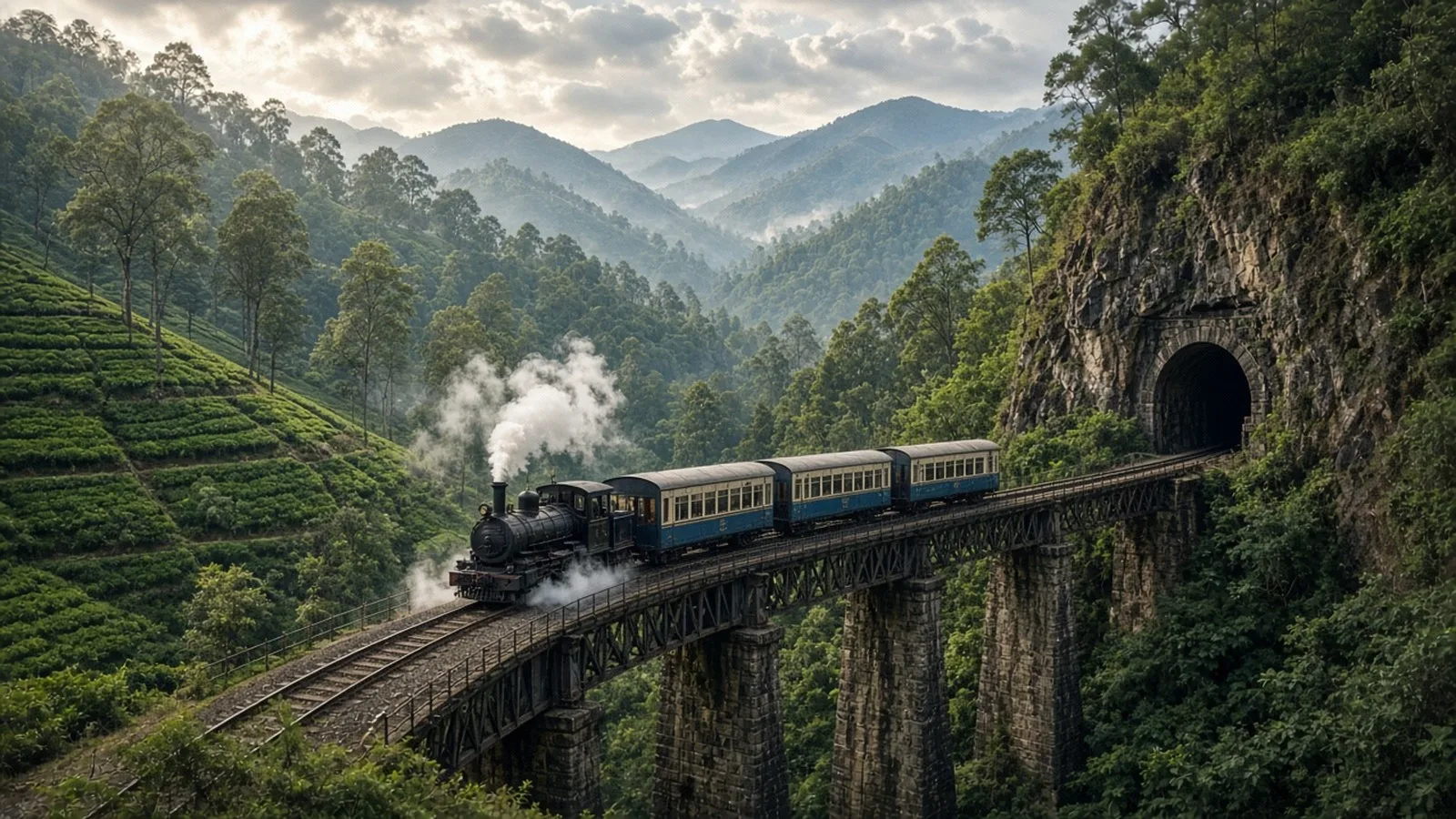
At ten past seven in the morning at Mettupalayam station, a steam engine hisses behind a short rake of little blue-and-cream coaches. Over the next five hours, that train will climb roughly 1,900 metres from the plains into the clouds and arrive in Ooty. This is the Nilgiri Mountain Railway, affectionately called the "Ooty toy train". The line opened to Coonoor in 1899 and to Ooty in 1908, and it is regarded as India's only rack-and-pinion railway. In 2005 it was added to the UNESCO World Heritage List. Here is the full story of a train that has been running through forests, tea gardens, tunnels and viaducts for more than a century, along with practical tips for making the journey yourself.
Why the Hills Needed a Railway
Nilgiri means "Blue Mountains", a name said to come from the bluish haze the hills show when seen from the plains. Until the early nineteenth century, dense forests and steep slopes kept these hills largely cut off from the plains, and they were home mainly to Indigenous communities such as the Todas. British settlement began in the 1820s. Gradually Udhagamandalam, which the British called Ootacamund, became the summer capital of the Madras Presidency. According to UNESCO documentation, by the 1870s the entire Presidency government was moving up to the hills for the summer.
Getting there was not easy. The journey meant days by bullock cart or on horseback. The Government of India's nomination dossier to UNESCO says that before the railway, reaching Ooty could take more than ten days. Meanwhile, tea plantations were spreading across the slopes. Planters needed reliable transport to bring tea and other produce down and to carry officials and families up. The cordite (explosives) factory at Aruvankadu added to the railway's importance.
From Plans to Construction (1854–1908)
The first proposals
UNESCO notes that the first proposal for a mountain railway from Mettupalayam into the Nilgiris was made as early as 1854. Once the Mettupalayam branch of the Madras-Coimbatore broad-gauge line opened in 1873, talk of a line up the mountain grew more serious. J.L.L. Morant, the Nilgiris District Engineer, proposed a rack railway.
The Swiss engineer Niklaus Riggenbach, inventor of the Rigi mountain railway system, offered to build the line. The Hindu, quoting railway officials, dates this to 1876, while the UNESCO evaluation document gives 1882. Riggenbach may have submitted proposals more than once. The first attempt was rejected for financial reasons. Another scheme put forward in 1877 was also dropped, because hauling passengers up such a steep slope was considered dangerous.
The Nilgiri Railway Company
The Nilgiri Railway Company was registered on 30 September 1885. A Southern Railway Salem Division document says the contract with the government was signed in February 1886. Lord Wenlock, Governor of Madras, launched the work in August 1891. Financial difficulties meant the company was wound up in the mid-1890s, and a newly formed company carried the work forward.
The work was gruelling. Workers cut through thick forest, blasted rock and bridged deep ravines, and most of this hard labour was done by workers brought up from the plains. Some railway-enthusiast sources say the line opened once in 1898, was damaged by heavy rain, and reopened after repairs in 1899. The accepted official opening date is 15 June 1899, and the line's 125th anniversary was celebrated in 2024.
From Coonoor up to Ooty
The government bought the line in January 1903. From 1903 to 1907 the Madras Railway Company operated it on the government's behalf, and from 1 January 1908 it was handed to the South Indian Railway Company. The government itself built the extension beyond Coonoor. According to Salem Division records, the Coonoor-Fernhill section (17.48 km) opened on 15 September 1908 and the Fernhill-Udhagamandalam section (1.79 km) on 15 October 1908. When Southern Railway was formed in 1951, the Nilgiri line became part of it, and today it is run by the Salem Railway Division.
The Abt Rack System: How the Train Climbs the Mountain
Why an ordinary train cannot make the climb
Ordinary trains rely on adhesion, the friction between wheel and rail. On very steep slopes that friction is not enough, and wheels slip, especially on wet rails. Salem Division gives the ruling gradient on the Kallar-Coonoor section as 1 in 12.28. In other words, for every 12.28 metres the train travels, it climbs about one metre, a gradient of about 8 per cent. Many sources round this to "1 in 12" (8.33%). For comparison, ordinary railway lines are built to gradients many times gentler.
How the Abt system works
The answer was the rack system devised by Swiss engineer Roman Abt. Between the two running rails, two toothed steel rack bars are laid side by side. According to UNESCO documentation, they sit 44 mm apart and 64 mm above the running rails. The teeth are staggered, so that a tooth on one bar faces a gap on the other, and the tooth pitch is 120 mm. Pinions (cog wheels) under the engine mesh with these teeth and haul the train up, rather like climbing a ladder. Because the teeth are staggered, the pinions keep a smooth, secure grip even on curves.
The same system keeps the train safe on the way down. As well as ordinary friction brakes on the wheels, there is a separate braking system that works through the pinions. Brakesmen riding in each coach operate the brakes by hand in response to whistle signals from the driver. This is also why the engine is always at the downhill end of the train, on the Mettupalayam side. On the climb, it pushes the coaches from behind.
One interesting footnote: the Nilgiri line was not India's first rack railway. A Salem Division document says the Abt system was used briefly in 1888-89 on a short stretch of the Bolan Pass line in what is now Pakistan. But the Nilgiri line is the only rack railway still operating in the country today.
Steam Locomotives: From the Swiss X Class to Indian-Built Engines
The early engines
When the line opened, it used small rack engines built by Beyer, Peacock of England. Sources say "Double Fairlie" engines were also brought in around 1907. Neither type had enough power for growing traffic.
The Swiss X class
The answer was the famous X class. These engines were built by the Swiss Locomotive and Machine Works (SLM) of Winterthur, Switzerland. The first batch arrived between 1914 and 1925 and a second in 1952. Some sources say the first engines came in 1914, while the UNESCO evaluation says the design was introduced in 1920. They are complex machines that drive the ordinary wheels and the rack pinions through separate cylinders. When the UNESCO team inspected the line in 2004, eight SLM engines were at Coonoor. The evaluation called this the largest and most authentic collection of steam rack locomotives in the world.
Oil firing and Indian-built engines
Sparks from coal-fired engines created a risk of forest fires, and coal supply was also a problem. From 2002, some engines were converted to oil firing. Later, the Golden Rock railway workshop at Ponmalai, Tiruchirappalli, began building complete new X class engines based on the original Swiss design. Four oil-fired engines arrived between 2011 and 2014. They are reported to have been named "Neela Kurinji", "Betta Queen", "Nilgiri Queen" and "Nilgiri Flycatcher".
In August 2021, Golden Rock rolled out the first Indian-built coal-fired X class engine, X-37400. Officials said some parts for which no drawings existed were made by reverse-engineering old engines. In September 2022 came X-37401, the first to burn high-speed diesel (HSD) as boiler fuel. It weighs about 50.3 tonnes, is 10.38 metres long and cost about ₹9.3 crore. On the Coonoor-Ooty section, where no rack is needed, diesel locomotives also run. On the rack section, steam engines still do the work.
The Route: Stations, Curves, Tunnels and Bridges
Three sections
UNESCO documentation divides the line into three sections:
- Mettupalayam-Kallar (about 7-8 km): the plains section. It runs through areca nut plantations and crosses the Bhavani river, working by ordinary adhesion on a gradient of about 1 in 40.
- Kallar-Coonoor (about 19 km): the rack section. In 19 km it climbs about 1,330 metres through thick forest, past rock walls and over ravines. The top speed is about 13 km/h.
- Coonoor-Udhagamandalam (about 18-19 km): it runs through eucalyptus and tea gardens on gradients of 1 in 23, with no rack.
The numbers: why sources disagree
Many places, including Tamil Nadu Tourism, quote "16 tunnels, 250 bridges and 208 curves" for the Nilgiri Mountain Railway. But the figures vary slightly from source to source:
- Length: UNESCO gives 45.88 km and the Salem Division document 46.61 km. It is usually described as "about 46 km".
- Elevation: Mettupalayam is about 326 metres and Udhagamandalam about 2,203 metres (UNESCO). Salem Division rounds these to 330 and 2,200.
- Curves: 208 is the common figure, but some sources say 209 or 218.
- Bridges: usually 250; a 2024 article in The Hindu says 257. UNESCO says about 27 of these are major viaducts, the rest smaller bridges and culverts. Notable ones include the Kallar bridge, the Adderly viaduct and the Burliar bridge.
- Tunnels: 16 is the usual figure. The UNESCO document describes 13 tunnels and one "half tunnel" (a cutting enclosed by rock on three sides) on the rack section, plus three tunnels on the upper section. The longest, about 282 metres, is on the Coonoor-Ooty section.
Stations
The distances and elevations below are approximate. Railway timetables and documents may show slightly different figures.
| Station | Distance from Mettupalayam (approx.) | Elevation (approx.) | Notes |
|---|---|---|---|
| Mettupalayam (MTP) | 0 km | 326 m | Starting point; carriage workshop; NMR museum |
| Kallar | 8 km | 384 m | Start of the rack section; no passenger stop |
| Adderly | 13 km | 728 m | Water stop |
| Hillgrove (HLG) | 18 km | 1,091 m | Water stop; refreshments |
| Runneymede | 21 km | 1,406 m | Water stop |
| Kateri Road | 25 km | 1,545 m | No regular stop at present |
| Coonoor (ONR) | 27-28 km | 1,712 m | Main intermediate station; loco shed; end of the rack section |
| Wellington (WEL) | 29 km | 1,769 m | Military cantonment |
| Aruvankadu (AVK) | 32 km | 1,873 m | Cordite factory area |
| Ketti (KXT) | 38 km | 2,092 m | Valley views |
| Lovedale (LOV) | 42 km | 2,134 m | Last stop before Ooty |
| Fernhill | 44 km | - | Closed; converted into a railway rest house |
| Udhagamandalam (UAM) | 46 km | 2,203 m | Terminus; 1908 building |
UNESCO World Heritage Site (2005)
The Darjeeling Himalayan Railway was inscribed as a UNESCO World Heritage Site in 1999. In July 2005 the Nilgiri Mountain Railway was added as an extension, and the property was renamed "Mountain Railways of India". The Kalka-Shimla Railway joined it in 2008. The listing was made under criteria (ii) and (iv), recognising the railways as outstanding examples of the interchange of technology and of the impact of an innovative transport system on the social and economic development of mountain regions. You can read about all three lines in our Wonders of India guide to the Mountain Railways of India.
The 2005 evaluation by ICOMOS, which advises UNESCO, described the Nilgiri line as one of the most authentic and largest rack railways in the world. It pointed out that the 1890s stations, the original signalling, the Neale's tablet block system, Edmondson card tickets and wooden coaches built in 1931-32 had survived largely unchanged. The document also mentions at least two songs that the Toda people sang in the early twentieth century to celebrate the coming of the railway. Local journalists recall that in the 1960s the line faced closure as unprofitable, and that heritage status helped secure its future.
The Nilgiri Train on Screen
The Nilgiri train's most famous screen appearance is the song "Chaiyya Chaiyya" from Mani Ratnam's Dil Se (1998). Shah Rukh Khan, Malaika Arora and a troupe of dancers performed on the roof of the moving train, and the song, with music by A.R. Rahman, became a global hit. Choreographer Farah Khan has said that when the team first asked to shoot at Ooty station, the authorities refused to close it for four hours. Mani Ratnam then suggested shooting on top of a moving train instead, and a special train was arranged between Ooty and Coonoor.
Cinematographer Santosh Sivan has said he used a light only inside a tunnel and shot everything else in natural light. He has also said the background dancers wore safety harnesses, while Shah Rukh and Malaika danced without them. Interviews differ on whether the shoot took two days or four, and some film magazines say the train was painted brown for the song. The Nilgiri train and its stations have appeared in many other Tamil and Indian films as well.
Rain and Landslips: Frequent Disruptions
The line's biggest challenge is the monsoon. During the north-east monsoon (October-December) in particular, falling rocks, landslips and toppled trees are common on the Kallar-Coonoor section. UNESCO documentation says the worst damage in the line's history came on 11 November 1993. That day 333 mm of rain fell, about 200 metres of track was washed away, and landslides caused loss of life. Services were suspended for three months.
It still happens. In October 2025, landslips between Hillgrove and Adderly suspended services for five days. On 2 January 2026, all trains were cancelled because of heavy rain. And in early November 2026, as this article was written, reports on 1 November said Mettupalayam-Ooty services had been cancelled until 4 November because of continuing landslips between Adderly and Hillgrove. Always check Southern Railway and Salem Division announcements before you travel.
Travel Information: Timings, Fares and Booking
Note: the timings and fares below are based on sources available in early November 2026 and may change. Special trains, seasonal services and cancellations are announced often, so check the IRCTC or Indian Railways website before you travel.
Timings (regular schedule)
- Mettupalayam → Ooty (56136): departs 7:10 am and reaches Ooty at about 12:00 noon (about 4 hours 50 minutes), with a stop of about 10 minutes at Coonoor.
- Ooty → Mettupalayam (56137): departs 2:00 pm and reaches Mettupalayam at about 5:35 pm (about 3 hours 35 minutes).
- Coonoor-Ooty: additional trains run on this section every day. A one-way trip takes about 1 hour 10-20 minutes.
- Extra special trains are often announced for the summer holidays and festivals, sometimes under special numbers such as "06136".
Fares (from 21 February 2026)
The New Indian Express reported that Southern Railway raised base fares on regular trains by 5% from 21 February 2026. The new fares announced, including reservation charges and GST, are:
| Journey | Second class (2S) | First class (FC) |
|---|---|---|
| Mettupalayam - Ooty | ₹310 | ₹630 |
| Mettupalayam - Coonoor | ₹200 | ₹465 |
| Coonoor - Ooty | ₹160 | ₹365 |
Fares for special trains and charter services may differ.
Booking tips
- Seats are very limited, and tickets sell out fast, especially during the summer holidays and at weekends. Book on the IRCTC website or app on the day reservations open.
- The uphill journey (Mettupalayam → Ooty) gives you the full rack-section experience. If you are short of time, ride just the Coonoor-Ooty section.
- For the morning train from Mettupalayam, it is easiest to stay the night before in Mettupalayam or Coimbatore. The Nilagiri Express from Chennai usually reaches Mettupalayam early in the morning, but check its timing in advance.
- UNESCO documentation says the coaches were modified in 1992 to give views from both sides, so there is good scenery from either side. A window seat is a bonus.
Best season
The weather is generally pleasant from March to June and from late September to early October, but April and May are extremely crowded. From October to December, the north-east monsoon raises the risk of landslips and cancellations. December and January can bring hard cold and frost in Ooty. If you love deep green scenery and mist, the south-west monsoon months of July and August are beautiful too, but keep an eye on weather warnings. If you are planning a winter trip to the hills, see our guide to the best hill stations to see snow in India this winter.
Timeline
| Year / date | Event |
|---|---|
| 1854 | First proposal for a mountain railway to the Nilgiris |
| 1873 | Coimbatore-Mettupalayam broad-gauge branch opens |
| 1876 / 1882 | Riggenbach's rack railway proposal (year varies by source) |
| 30 September 1885 | Nilgiri Railway Company registered |
| August 1891 | Governor Lord Wenlock launches construction |
| 15 June 1899 | Mettupalayam-Coonoor line opens |
| 1903 | Government buys the line |
| 15 September 1908 | Coonoor-Fernhill opens |
| 15 October 1908 | Fernhill-Udhagamandalam opens; line complete |
| 1914-1925, 1952 | Swiss SLM X class engines arrive |
| 1951 | Becomes part of Southern Railway |
| 11 November 1993 | Major rain damage; services suspended for three months |
| July 2005 | UNESCO World Heritage listing ("Mountain Railways of India") |
| 2011-2014 | Four oil-fired X class engines built at Golden Rock |
| August 2021 | First Indian-built coal-fired X class engine (X-37400) |
| September 2022 | First HSD-fired X class engine (X-37401) |
| June 2024 | 125th anniversary of the Mettupalayam-Coonoor service |
| 21 February 2026 | Fares raised by 5% |
Fascinating Facts
- India's slowest train: it takes nearly five hours to cover 46 km, so it is often called India's slowest train. The average speed is about 10 km/h.
- Asia's steepest line? With a maximum gradient of about 8.33%, it is often described as the steepest railway line in Asia, though no firm official comparison is available.
- Card tickets: UNESCO documentation notes that old Edmondson card tickets were kept in use at some stations to preserve the heritage.
- Water stops: the train halts at stations such as Adderly, Hillgrove and Runneymede to refill the steam engine with water, giving passengers time to step out and take photographs.
- Two museums: there is an NMR museum at Mettupalayam and a heritage museum at Udhagamandalam.
- A century-old weighing scale: an old weighing scale dating from 1907 is said to still stand at Udhagamandalam station.
- Rack teeth: a full rack bar has 26 teeth for every 3.12 metres.
For more railway history from the region, read our article on Chennai's firsts, including the first trains of Madras.
Frequently Asked Questions
When did the Nilgiri Mountain Railway open?
The Mettupalayam-Coonoor section opened on 15 June 1899. Coonoor-Fernhill opened on 15 September 1908 and the line reached Ooty on 15 October 1908.
How long is the line?
About 46 km. UNESCO gives 45.88 km and one railway document 46.61 km.
Why is the engine at the back?
For safety on the steep gradient, the engine always stays at the downhill end (the Mettupalayam side). It pushes the coaches on the way up and holds them back on the way down.
Is the whole journey steam-hauled?
X class steam engines work the Mettupalayam-Coonoor rack section. The Coonoor-Ooty section is mostly worked by diesel locomotives.
Where can I book tickets?
On the IRCTC website or app, or at railway station reservation counters. Seats are limited, so book early.
Was "Chaiyya Chaiyya" really filmed on this train?
Yes. Choreographer Farah Khan and cinematographer Santosh Sivan have both said the Dil Se song was filmed on the roof of the Nilgiri Mountain Railway train, on the Ooty-Coonoor section.
Final Thoughts
The Nilgiri Mountain Railway is more than a way to get up a hill. It is a living museum that brings together Swiss engineering, colonial history, the labour of thousands of workers from the plains, the songs of the Toda people and the skill of a modern workshop in Tiruchirappalli. Skip the faster road for a day and climb the mountain to the slow rhythm of this train. Just remember to check the weather and railway announcements before you go.
Sources
- UNESCO World Heritage Centre: Mountain Railways of India
- ICOMOS evaluation: Nilgiri Railway (India), No 944 bis (2005)
- Tamil Nadu Tourism: Toy Train Ride
- The Hindu: The Nilgiri Mountain Railway completes 125 years (2024)
- Times of India: Golden Rock rolls out 4th oil-fired locomotive (2014)
- Times of India: First indigenous coal-fired X class loco (2021)
- The Hindu: New X class HSD-fired loco X-37401 reaches Mettupalayam (2022)
- The New Indian Express: NMR fares up 5% (February 2026)
- Wikipedia: Nilgiri Mountain Railway (stations, elevations)
- Wikipedia: Nilgiri Mountain Railway X class
- BBC Travel: The slowest train journey in India (2023)
- DT Next: Landslips continue, NMR services cancelled till November 4 (1 November 2026)
- DT Next: Nilgiri train services resume after 5 days (October 2025)
- The Hindu: Landslips, NMR services cancelled (January 2026)
- The Indian Express: Farah Khan on shooting Chaiyya Chaiyya
- The Hollywood Reporter India: Santosh Sivan on filming Chaiyya Chaiyya
Note: the company registration, the section-by-section opening dates, the 46.61 km length, the 1 in 12.28 gradient and the Bolan Pass detail come from a 2021 Southern Railway Salem Division information document that is no longer available online.