This is Part 23 of HorizonDesk's chronological series on Tamil history, from prehistory to modern Tamil Nadu. The previous instalment was Part 22: Chola Administration, the Uthiramerur Inscriptions and Village Assemblies.
In 1070 the Chola throne at Gangaikonda Cholapuram stood empty: Athirajendra, the last king in Vijayalaya's direct male line, had died amid unrest within months of his coronation. The man who filled the gap came from Vengi, the Eastern Chalukya kingdom in today's Andhra Pradesh. A Chalukya prince by his father, he was a grandson of Rajendra Chola I. He took the name Kulothunga ("exalter of the dynasty").
His line, the Chalukya-Cholas, ruled for about two centuries. It built some of South India's finest temples and patronised a golden age of Tamil literature, but it also saw shrinking frontiers, powerful local chiefs and, by about 1279, the end of Chola rule.
The later Chola kings at a glance
| King | Reign (approx.) | Key events |
|---|---|---|
| Kulothunga I | 1070–1120 | Union of the Chola and Vengi crowns, abolition of tolls, Kalinga war, loss of Sri Lanka |
| Vikrama Chola | 1118–1135 | Partial recovery of Vengi, gifts to Chidambaram |
| Kulothunga II | 1133–1150 | Expansion of Chidambaram; poets Ottakoothar and Sekkizhar |
| Rajaraja II | 1146–1173 | Airavatesvara temple at Darasuram |
| Rajadhiraja II | 1163–1178 | Pandya civil war and clashes with Sri Lankan forces |
| Kulothunga III | 1178–1218 | Victories in Madurai, Thirubhuvanam temple, Pandya counter-invasion |
| Rajaraja III | 1216–c. 1256 | Captured by a feudatory, rescued by the Hoysalas |
| Rajendra III | 1246–c. 1279 | A last revival, then defeat by the Pandyas |
Reigns overlap because kings crowned their heirs as co-rulers, and inscriptions count regnal years from that point.
A Chalukya-Chola union
Three generations of marriages tied the Cholas to Vengi. Rajaraja I's daughter Kundavai married the Chalukya prince Vimaladitya; their son Rajaraja Narendra married Rajendra I's daughter Ammangadevi; and their son, born Rajendra, became Kulothunga I.
Historians disagree on whether Chola ministers invited him in to end a succession crisis or he seized an opening. Either way, he was crowned in 1070, and the Chola heartland and Vengi had one king.
Kulothunga I (1070–1120)
The king who abolished tolls
Kulothunga's most famous title is Sungam thavirtha Cholan, "the Chola who abolished tolls" (sungam were duties on goods in transit). An inscription at Pallavaram calls him "Sungandavirtta Kulottunga", and the poem Kalingattuparani praises the same act.
What exactly was abolished, and where, is unclear; it may have applied only to the Chola heartland. Most historians read it as a bid to boost trade and win popularity for a king from outside the old line.
Losing Sri Lanka
Northern Sri Lanka had been Chola territory since Rajaraja I. After a long resistance, Vijayabahu I took Polonnaruwa around 1070, ending Chola rule on the island. Kulothunga made little effort to win it back and later made peace; one of his daughters married a Sinhalese prince.
The Kalinga war and the Kalingattuparani
Two Chola invasions of Kalinga (coastal Odisha and northern Andhra) took place in Kulothunga's reign. The second, around 1110, was led by the general Karunakara Thondaiman against the Eastern Ganga king Anantavarman Chodaganga.
It is celebrated in the Kalingattuparani by the poet Jayankondar. A parani is a Tamil genre honouring a hero who has killed a thousand elephants in battle; this one is admired for vivid scenes such as ghouls cooking a feast on the battlefield. As court poetry, it probably exaggerates the campaign.
A land survey, an embassy to China and links with Srivijaya
In his 16th regnal year (around 1086) Kulothunga ordered a fresh land survey, updating the revenue records first compiled under Rajaraja I; inscriptions mention another in his 40th year.
Chinese Song dynasty records describe a 72-member mission from "Chulien" (Chola) arriving in 1077 under a king called "Ti-hua-kia-lo". The historian K. A. Nilakanta Sastri thought this might be a garbled form of Kulothunga's name, but that is uncertain. The mission was essentially a trading venture, exchanging glassware, camphor and ivory for copper cash. The Smaller Leiden copper plates of 1090 show Kulothunga confirming gifts to a Buddhist monastery at Nagapattinam at the request of the king of Kadaram (Srivijaya): relations across the Bay of Bengal had turned peaceful.
Losses on the frontiers
Late in the reign Vengi slipped to Kulothunga's lifelong rival, the Western Chalukya king Vikramaditya VI, and around 1116 the Hoysala king Vishnuvardhana took Talakad and the Gangavadi province in southern Karnataka. The Kaveri delta heartland, however, stayed secure.
Vikrama Chola (1118–1135)
Kulothunga's son Vikrama, a hero of the first Kalinga war, recovered much of Vengi after Vikramaditya VI died in 1126 and spent lavishly on the Nataraja temple at Chidambaram. The court poet Ottakoothar celebrated him in the Vikrama Cholan Ula.
Kulothunga II: Chidambaram and the poets
Kulothunga II (1133–1150), a devout Shaiva, extended and gilded the Chidambaram temple. Ottakoothar's three ulas (processional poems) for Vikrama, Kulothunga II and Rajaraja II are known together as the Moovar Ula.
Sekkizhar and the Periya Puranam
The Periya Puranam, the Tamil hagiography of the 63 Shaiva saints known as the Nayanmars (see Part 18), was written by Sekkizhar of Kundrathur, traditionally a Chola minister. Its patron "Anapaya" is usually identified with Kulothunga II, though some argue for Kulothunga I or Vikrama; "mid-twelfth century" is the safest date.
The "Krimikanta Chola" story
Later Vaishnava traditions say a Chola king persecuted the philosopher Ramanuja, forcing him to flee to Melkote in Karnataka, and died of a festering neck sore, earning the name Krimikanta ("worm-necked"). He is also said to have thrown the Govindaraja (Vishnu) image at Chidambaram into the sea, an act Ottakoothar credits to Kulothunga II. The persecutor has been identified as Kulothunga I, Athirajendra or Kulothunga II; since Ramanuja's own chronology is uncertain, Nilakanta Sastri warned against dogmatism. It is best treated as tradition.
Rajaraja II and Darasuram
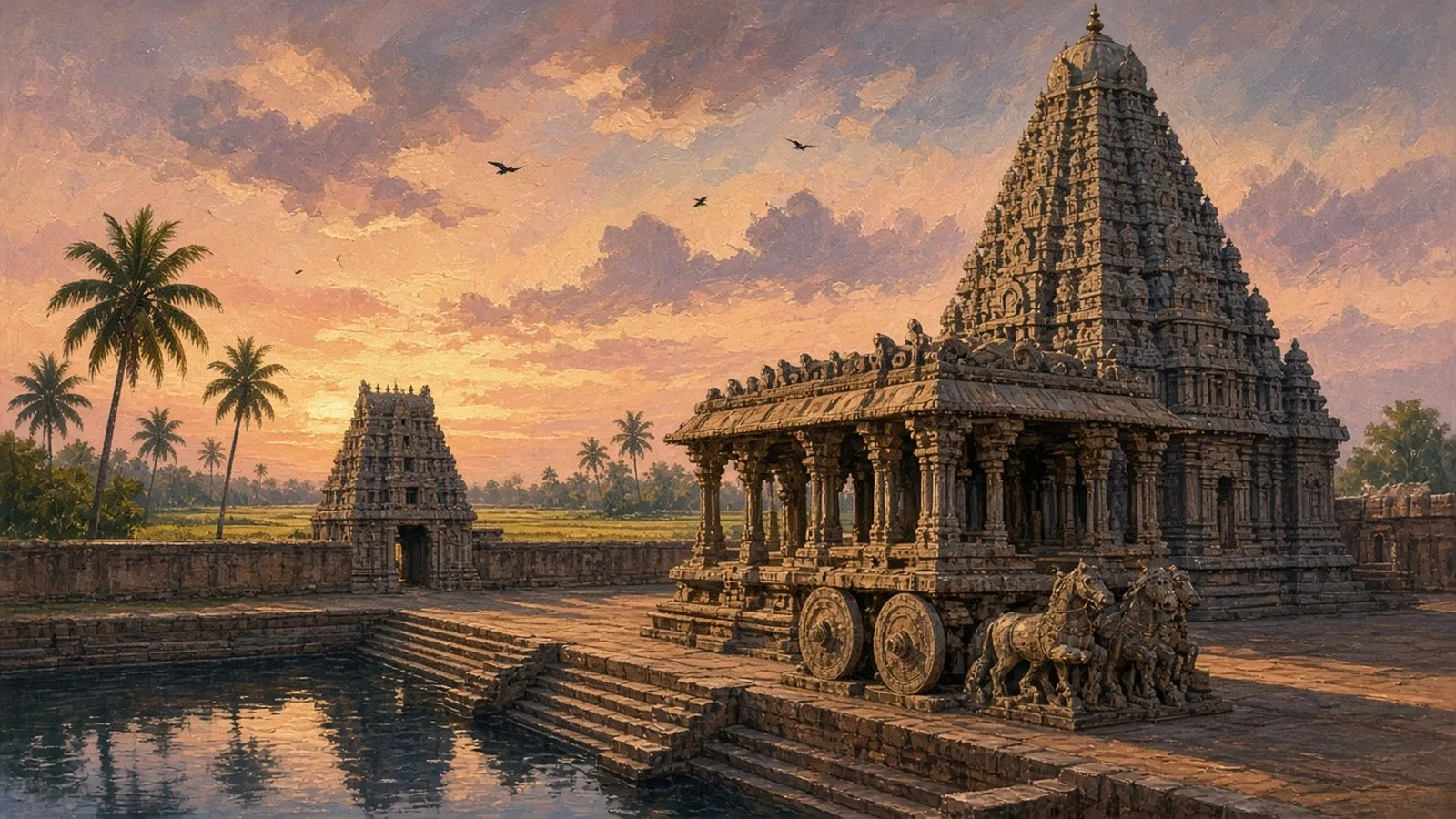
The largely peaceful reign of Rajaraja II (1146–1173) is remembered for the Airavatesvara temple at Darasuram near Kumbakonam, called Rajarajesvaram in its inscriptions. Smaller than the temples at Thanjavur and Gangaikonda Cholapuram, it is even richer in fine carving. Its front hall is built as a stone chariot with wheels and horses, and miniature friezes tell the stories of the Nayanmars.
In 2004 UNESCO added Darasuram and Gangaikonda Cholapuram to the Thanjavur temple's World Heritage listing, under the name Great Living Chola Temples.
Rajadhiraja II and the Pandya civil war
Rajadhiraja II (1163–1178), a grandson of Vikrama Chola through a daughter, was drawn into a succession war in the Pandya kingdom of Madurai (c. 1169–1177) between Parakrama Pandya and Kulasekhara Pandya. Parakrama appealed to Parakramabahu I of Sri Lanka, who sent an army under his general Lankapura. The Cholas backed Kulasekhara.
An inscription at Arpakkam near Kanchipuram, from Rajadhiraja's fifth year, records the Sri Lankan army alarming the Chola country before it withdrew. Chola commanders drove the Lankans back, but Kulasekhara later switched sides and the Cholas backed a rival prince. The Sri Lankan chronicle Culavamsa and the Chola inscriptions each claim victory; the truth probably lies between them.
Kulothunga III, the last great Chola king
Kulothunga III (1178–1218), the last strong ruler of the line, invaded the Pandya country three times, held a victor's coronation (virabhishekam) in Madurai and demolished the Pandya coronation hall. His inscriptions also claim victories over Sri Lanka, the Cheras and rebellious Telugu Chodas.
His finest legacy is the Kampaharesvara temple at Thirubhuvanam near Kumbakonam, named Tribhuvanaviresvaram after his title Tribhuvanavira, the last of the four great royal Chola temples. A Sanskrit inscription there also lists his work at Chidambaram, Kanchipuram, Madurai, Tiruvidaimarudur and Tiruvarur. But his harshness towards the Pandyas came at a price.
The Pandyas strike back
Maravarman Sundara Pandya I, crowned in Madurai in 1216, came from the branch that had suffered most at Kulothunga's hands. His court eulogy claims he burned "Tanjai and Urandai" (Thanjavur and Uraiyur), razed palaces and halls, ploughed the land with donkeys, and held a virabhishekam in the Chola coronation hall at Ayirattali (Mudikonda Cholapuram). He then restored the kingdom to the submissive Chola king.
Eulogies exaggerate, but Pandya inscriptions in the Chola country confirm the invasion. Whether the defeated king was the aged Kulothunga III or Rajaraja III is debated.
The rise of the feudatories
Chola power rested on the loyalty of chiefly families, and by the late twelfth century many were acting on their own:
- the Kadavarayas, who claimed Pallava descent and ruled from Sendamangalam (in today's Viluppuram district);
- the Sambuvarayars around Kanchipuram and the Palar valley;
- the Telugu Chodas around Nellore;
- the Banas, Malaiyamans and Adigaimans in the north and west of Tamil country.
Kopperunjinga and the Hoysala rescue
The crisis peaked under Rajaraja III (1216–c. 1256). Around 1231, driven from his capital by another Pandya attack, he set out to join his Hoysala allies, but the Kadava chief Kopperunjinga intercepted him at Tellaru and held the king, his queens and ministers prisoner at Sendamangalam.
The rescuers were the Hoysalas of Karnataka, best known today for the temples of Belur and Halebidu. Vira Narasimha II sent his generals into Kadava territory, and as they closed on Sendamangalam, Kopperunjinga released the Chola king, as an inscription of Rajaraja III's 16th year at Tiruvendipuram records.
The price was dependence: the Hoysala prince Someshvara set up a base at Kannanur Koppam near Srirangam. Kopperunjinga declared himself an independent king around 1243.
Rajendra III and the end of the dynasty
Rajendra III, co-ruler from 1246, attempted a last revival, claiming victories over two Pandya kings. But the Pandyas under Jatavarman Sundara Pandya I (1251–1268) became the strongest power in the south. He made the Chola a tributary and killed the Hoysala Someshvara near Kannanur in 1264.
Rajendra III's last known inscription is dated in his 33rd regnal year, about 1279. Around then Maravarman Kulasekara Pandya I defeated both him and the Hoysala ruler Ramanatha. No later Chola king appears in the records. The empire Vijayalaya had founded at Thanjavur around 850 faded away, and the Chola country became part of the Pandya realm.
Why did the Cholas decline?
There is no single cause. Historians point to several:
- Autonomous feudatories with their own land and armies.
- Pandya revival, fuelled by Kulothunga III's harshness.
- Hoysala balancing: they protected the Cholas but never let them grow strong again.
- Lost revenue from Sri Lanka, Gangavadi and Vengi.
- Structure: Burton Stein argued the Chola state was always loosely "segmentary", so local powers rose once the centre weakened; Noboru Karashima's work on inscriptions shows land concentrating in fewer hands and local chiefs gaining strength.
Timeline
| Year | Event | Certainty |
|---|---|---|
| 1070 | Kulothunga I crowned; Vijayabahu I takes Polonnaruwa | Firm / fairly firm |
| 1077 | Chola mission reaches the Song court in China | Firm (king's identity uncertain) |
| c. 1086 | Land resurvey (16th regnal year) | Fairly firm |
| c. 1110 | Second Kalinga war; Kalingattuparani | Approximate |
| c. 1116 | Hoysalas capture Talakad | Approximate |
| 1146–1173 | Rajaraja II; Darasuram temple | Fairly firm |
| c. 1169–1177 | Pandya civil war and Sri Lankan intervention | Approximate |
| 1178–1218 | Kulothunga III; Thirubhuvanam temple | Fairly firm |
| c. 1216–1218 | Maravarman Sundara Pandya I burns Thanjavur and Uraiyur | Approximate |
| c. 1231 | Kopperunjinga captures Rajaraja III; Hoysala rescue | Fairly firm |
| 1264 | Jatavarman Sundara Pandya I kills the Hoysala Someshvara | Fairly firm |
| c. 1279 | Last inscription of Rajendra III; end of Chola rule | Approximate |
What we can say with confidence
- Confident: the Chalukya-Chola line began in 1070; Kulothunga I was remembered for abolishing tolls; Darasuram and Thirubhuvanam date from Rajaraja II and Kulothunga III; Chola rule ended around 1279.
- Debated: how Kulothunga took the throne; who "Krimikanta Chola" was; the dates of Sekkizhar and of the poet Kamban (Sastri and many others say twelfth century, but a ninth-century date from a traditional verse has supporters); the dates and outcomes of several wars.
Next part
Part 24, Chola Bronzes, Art and Temple Architecture, turns from kings to craftsmen: the bronze Nataraja, the great temples and Chola murals.
Sources
- K. A. Nilakanta Sastri, The Colas (2nd ed., University of Madras, 1955), chapters on Kulothunga I to Rajendra III
- K. A. Nilakanta Sastri, A History of South India
- South Indian Inscriptions, Vol. III, introduction to the inscriptions of Kulottunga I (the toll-abolisher title, the Kalinga war)
- South Indian Inscriptions, Sanskrit inscription of Kulottunga III at the Kampaharesvara temple, Tribhuvanam (A.R. 190 of 1907)
- H. Sarkar, The Kampaharesvara Temple at Tribhuvanam (Tamil Digital Library, PDF)
- S. R. Balasubrahmanyam, Later Chola Temples, chapter on Rajaraja III
- UNESCO World Heritage Centre, Great Living Chola Temples
- The Hindu, Temple architecture: Aesthetics, carved in stone (Darasuram)
- The Hindu, Breathing life into stone (review of a book on the three Great Living Chola Temples)
- BBC News Tamil, Kopperunjinga, the chief who imprisoned Rajaraja III (Tamil)
- Tamil Virtual Academy, The line of Kulothunga I (Tamil)