This is Part 21 of HorizonDesk's chronological series on Tamil history, from prehistory to modern Tamil Nadu. The previous instalment was Part 20: Rajaraja Chola I, His Conquests and the Big Temple of Thanjavur.
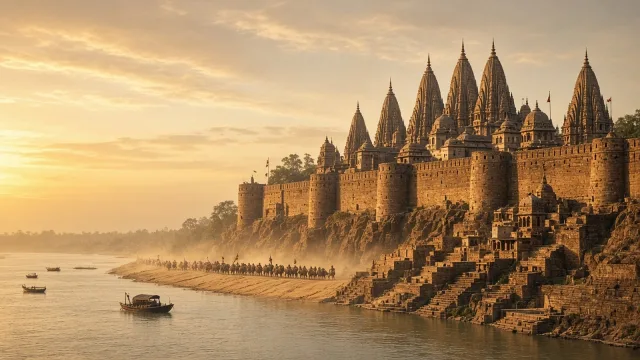
Rajendra I took the kingdom his father Rajaraja built and made it bigger than any south Indian state before it. In his reign (1012–1044) Chola troops took the whole of Sri Lanka, beat the Western Chalukyas of the Deccan, and marched up the east coast to the Ganges. He built a new capital and named it after that march. Then, around 1025, a Chola fleet crossed the Bay of Bengal and attacked Srivijaya, the trading empire that controlled the Strait of Malacca.
Most of what we know comes from Rajendra's own records: the meykeerthi (formal eulogies that open his Tamil inscriptions) and two huge sets of copper plates. They are official boasts, so this part separates what is firm from what is claimed.
Rajendra I at a glance
| Question | Short answer |
|---|---|
| Parents | Son of Rajaraja I and Queen Vanavan Mahadevi |
| Reign | Co-ruler from 1012; sole ruler from 1014 until his death in 1044 |
| Throne title | Parakesari; later titles include Mudigonda Chola, Gangaikonda Chola and Kadaram Kondan ("taker of Kadaram") |
| Capitals | Thanjavur, then Gangaikonda Cholapuram (in today's Ariyalur district) |
| Main campaigns | Sri Lanka (c. 1017–18), the Western Chalukyas (c. 1021), the Ganges (c. 1019–23), Srivijaya and the Malay world (c. 1025) |
| Great monument | Gangaikondacholisvaram temple, completed around 1035 |
| Main sources | Tamil meykeerthi inscriptions, the Tiruvalangadu and Karandai copper plates, Sri Lankan, Chalukya and Chinese records |
A prince already at war
Rajendra came to the throne an experienced soldier. As a prince he had led his father's army into the Western Chalukya country around 1006. In 1012 Rajaraja made him co-ruler, and Rajendra counted his regnal years from that date, between late March and early July 1012. His birth star, Tiruvathirai (Ardra), is still celebrated at Gangaikonda Cholapuram in the Tamil month of Aadi.
His Tamil eulogy, which begins Thirumanni valara, grew longer every year from about 1014 to 1025 as new victories were added. That lets historians date his campaigns fairly closely. In 1018 he named his son Rajadhiraja as heir, and from then on the princes did much of the fighting.
Building the largest south Indian empire
Sri Lanka
Rajaraja had taken only the north of the island. Around 1017–18 Rajendra's army took the south as well. The Tamil records say he seized the crowns of the Sinhala king and queen. He also took the Pandya crown and regalia that an earlier Pandya ruler had left in Lanka for safekeeping. The Sri Lankan chronicle Culavamsa gives the other side of the story. King Mahinda V was captured and taken to the Chola country, where he died about 12 years later. The southern region of Rohana slipped out of Chola control within a decade or two.
The Pandya and Kerala countries
Rajendra then made the old Pandya land into a viceroyalty. His son ruled it from Madurai with the new title Jatavarman Sundara Chola-Pandya. Kerala was also brought back under Chola control.
The Western Chalukyas and Vengi
In the Deccan the old rivalry with the Western Chalukyas went on. Around 1021 Rajendra's forces defeated Jayasimha II at Musangi (Muyangi), a place usually identified with Maski in Karnataka. The inscriptions claim the Cholas took the whole of "Rattapadi seven and a half lakh" (the Chalukya country). That is an exaggeration, because a Chalukya grant of 1024 shows Jayasimha still holding his core lands. Rajendra did keep Vengi, in coastal Andhra, under friendly rule. His nephew Rajaraja Narendra was crowned there in August 1022 and married Rajendra's daughter Ammanga. Their son would later become the Chola emperor Kulottunga I.
The march to the Ganges
Rajendra's most famous land campaign was led by a general, not the king, and appears in inscriptions by about 1023. According to the eulogy, the army passed through Chakrakottam (in today's Bastar) and Odda (Odisha). It then defeated several rulers in Bengal, including Mahipala I of the Pala dynasty, and reached the Ganges. Rajendra came north to meet his returning general on the banks of the Godavari.
What was it for? The Sanskrit Tiruvalangadu plates say the defeated kings had to carry Ganges water on their heads to the Chola country. Nilakanta Sastri called this a "boast without foundation". Most historians now see a digvijaya, a traditional show of a king's power across the four quarters, carried out as a fast raid of less than two years. It brought prestige and plunder, not provinces.
Rajendra had a great tank dug at his new capital and called it Cholagangam. The plates describe it as a "liquid pillar of victory" made of Ganges water. A reservoir now known as Ponneri, a few kilometres from the temple, is usually identified with it.
Gangaikonda Cholapuram: a new capital
To mark the campaign, Rajendra took the title Gangaikonda Chola, "the Chola who took the Ganges", and built a city named after it: Gangaikonda Cholapuram, about 70 km north-east of Thanjavur. The date is debated: the city is not named in his inscriptions before about 1027–29, and most writers place its founding in the years after 1023. It stayed the Chola capital for roughly 250 years.
The palace that survived only in brick
The palace is gone. Excavations by the Tamil Nadu archaeology department at Maligaimedu ("palace mound"), about 2 km from the temple, have exposed brick walls and foundations. Finds include tiles, ivory objects and Chinese celadon pottery, a sign of trade links with China.
Gangaikondacholisvaram
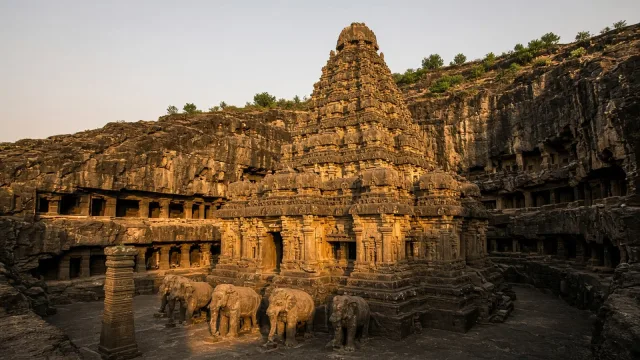
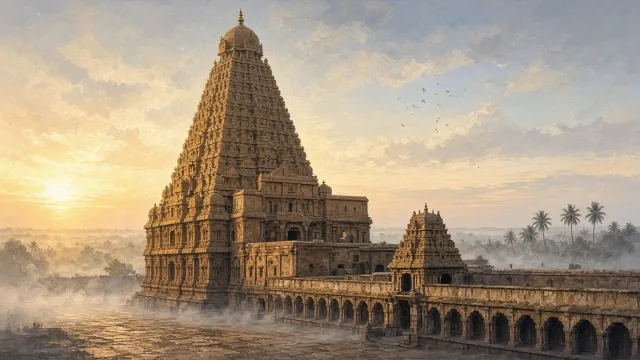
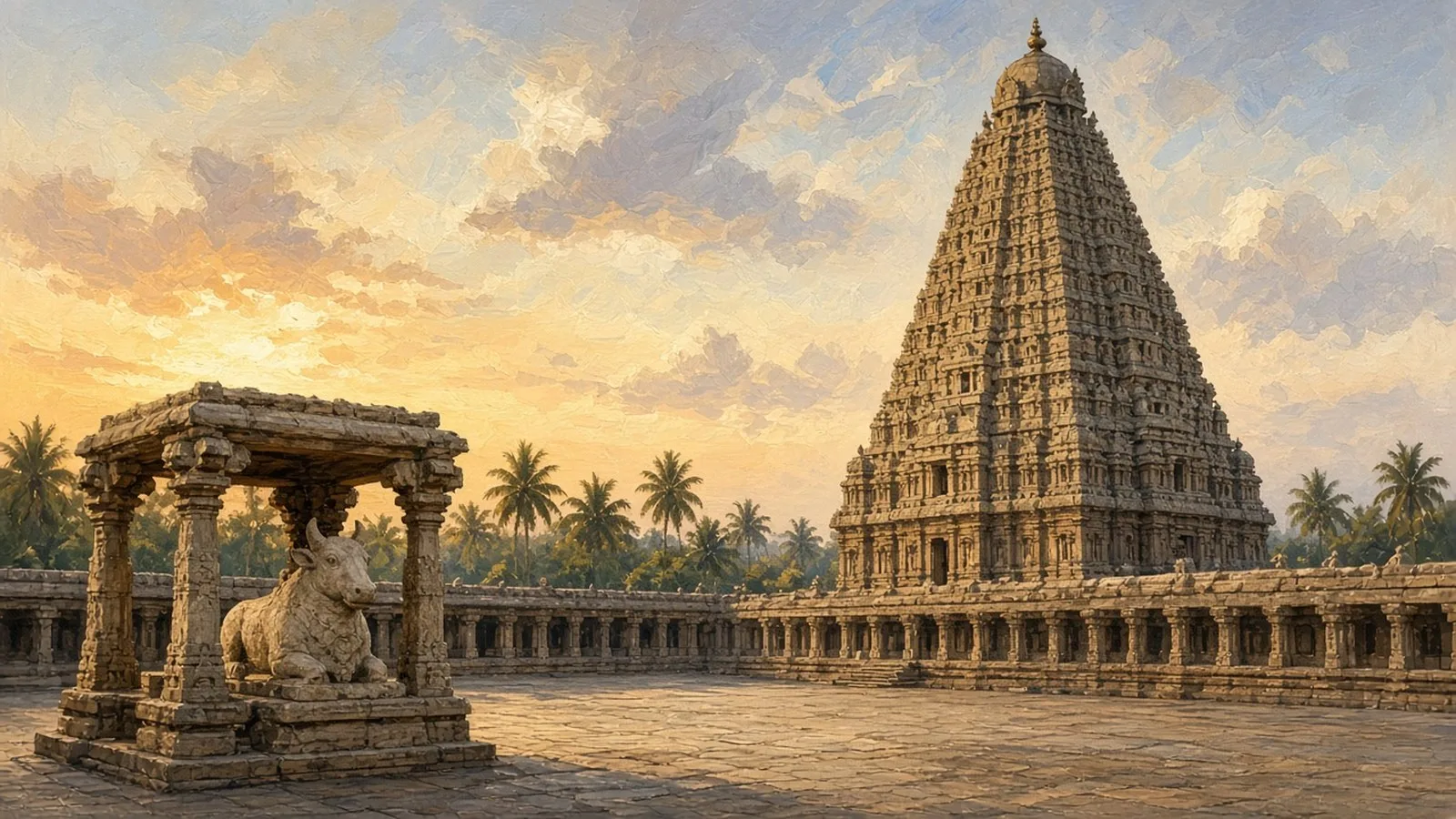
The city's great temple, dedicated to Shiva, was probably completed around 1035. A copper-plate grant of 1036 (the Esalam plates) credits Rajendra with building it. Its vimana (tower over the shrine) is about 53 metres tall, a little lower than Thanjavur's. Unlike Thanjavur's straight-sided pyramid, its sides curve gently inward and its corners are recessed. The art historian Percy Brown called it the "feminine counterpart" of the Big Temple. A large Nandi sits in the courtyard, and local tradition holds that a lion-mouthed well there once held Ganges water.
One famous sculpture shows Shiva garlanding the devotee Chandesa as a reward for his loyalty. Scholars such as C. Sivaramamurti have read this as a hint at the king himself, though that remains a guess. Other figures appear to be war trophies brought back from the Chalukya country and from Kalinga and Bengal. Much of the outer enclosure wall was taken down in the 1830s to build the Lower Anicut dam across the Kollidam (Coleroon) river. Since 2004 the temple has been part of UNESCO's "Great Living Chola Temples" site, together with Thanjavur and Darasuram.
The naval expedition to Srivijaya
Who was Srivijaya?
Srivijaya was a Buddhist maritime kingdom with its main centre near Palembang in southern Sumatra. It controlled ports on both sides of the Strait of Malacca, including Kadaram (Kedah, in today's Malaysia). Ships sailing between India, the Middle East and Song China passed through its waters. For decades it had been friendly with the Cholas. A Srivijayan king had paid for the Chudamani Vihara, a Buddhist monastery at Nagapattinam, which Rajaraja endowed and Rajendra confirmed.
What the inscriptions claim
From around 1025 (his 14th regnal year), Rajendra's eulogy adds a new section. It says he sent ships across the "moving sea" and captured Sangrama Vijayottunga-varman, king of Kadaram, along with his elephants and his treasure. It also claims the jewelled "Vidyadhara gate" of his city. It then lists the places taken. The table follows the identifications made by the French scholar George Coedès and accepted by most scholars; several are still disputed.
| Name in the inscription | Probable location |
|---|---|
| Srivijaya | Palembang, southern Sumatra |
| Pannai | Panai, east coast of Sumatra |
| Malaiyur | Melayu (Jambi, Sumatra), or the southern Malay Peninsula |
| Mayirudingam | Central Malay Peninsula |
| Ilangasogam | Langkasuka, Malay Peninsula |
| Mappappalam | Near the Isthmus of Kra (once thought to be in Myanmar) |
| Talaittakkolam | Takkola, near Takua Pa in southern Thailand |
| Madamalingam | Tambralinga (Nakhon Si Thammarat region) |
| Ilamuridesam | Lamuri, northern Sumatra (Aceh) |
| Manakkavaram | The Nicobar Islands |
| Kadaram | Kedah, Malaysia |
Two further names, Mevilimbangam and Valaippanduru, have no agreed identification.
Why attack a friend?
The inscriptions give no reason, and historians do not agree:
- Trade: Nilakanta Sastri and later Hermann Kulke suggested Srivijaya had been obstructing Chola merchants on the route to China, and the raid was meant to keep the strait open.
- Diplomacy with China: Tansen Sen links it to competition for status with the Song court. Chola embassies reached China in 1015 and 1033, and Sen argues there may even have been an earlier clash around 1017.
- Prestige and plunder: Others, such as George Spencer, see it as a seaborne version of the Ganges raid, a royal show of strength paid for with loot.
What is clear is that the Cholas did not set up lasting rule. Srivijaya recovered. Virarajendra intervened at Kadaram again around 1068, apparently on a local prince's request. Tamil merchant guilds went on trading in Sumatra, where a Tamil inscription of 1088 has been found. Rajendra's Karandai plates also say a king of Kambhoja, probably the Khmer ruler Suryavarman I, whose successors later built Angkor Wat, sent him a chariot to seek his friendship.
A millennium remembered
In July 2025, during the Aadi Thiruvathirai festival at Gangaikonda Cholapuram, the Government of India released a commemorative ₹1,000 coin. It marked a thousand years since the naval expedition, a round figure rather than an exact anniversary.
The copper-plate archives
Two sets of plates are key sources. The Tiruvalangadu plates (31 plates, his 6th year) give a long Sanskrit genealogy and a Tamil grant. The Karandai plates (57 plates, his 8th year, c. 1020) record a huge gift of land to more than a thousand Brahmins. Strung on a bronze ring with the royal seal, they weigh over 100 kg, among the largest copper-plate charters found in India.
Last years and legacy
Rajendra died in 1044; one of his queens, Viramadevi, seems to have died with him by sati. Rajadhiraja, long since a seasoned commander, succeeded without trouble.
Rajendra's empire was the high point of Chola power. But much of it rested on raids rather than rule. Bengal and Southeast Asia were struck, not governed. The lasting gains were the southern core, a fleet that could reach Sumatra, merchant networks that tied Tamil ports to China, and a temple that still stands in open fields where a capital once stood.
Timeline
| Date (approx.) | Event | How firm? |
|---|---|---|
| c. 1006 | Prince Rajendra leads the raid on the Western Chalukyas | Fairly firm |
| 1012 | Becomes co-ruler with Rajaraja I | Firm |
| 1014 | Death of Rajaraja; Rajendra rules alone | Firm |
| c. 1017–18 | Conquest of southern Sri Lanka; Mahinda V captured | Fairly firm |
| 1018 | Rajadhiraja named heir | Firm |
| c. 1019–23 | Ganges expedition | Approximate |
| c. 1020 | Karandai copper plates issued | Firm (8th regnal year) |
| c. 1021 | Victory over Jayasimha II at Musangi | Approximate |
| August 1022 | Rajaraja Narendra crowned in Vengi | Firm |
| c. 1025 | Naval expedition to Srivijaya and Kadaram | Approximate; one raid or two is debated |
| c. 1023–29 | Gangaikonda Cholapuram founded | Debated |
| c. 1035 | Gangaikondacholisvaram completed | Fairly firm |
| 1044 | Death of Rajendra I | Firm |
What we can say with confidence
- Confident: Rajendra ruled from 1012 to 1044; he conquered all of Sri Lanka for a time and held the Pandya and Kerala countries; he sent an army that reached the Ganges; he founded Gangaikonda Cholapuram and built its great temple; a Chola fleet attacked Kadaram and other Srivijayan ports around 1025.
- Uncertain: why he attacked Srivijaya, and whether there was one expedition or two; how far the Ganges army really went and what it achieved; the exact founding date of the capital; where several places in the eulogy were.
Next part
Part 22, Chola Administration: Uthiramerur Inscriptions and Village Assemblies, looks at how the Chola state worked on the ground, down to the village councils whose election rules were carved on a temple wall at Uthiramerur.
Sources
- K. A. Nilakanta Sastri, The Colas (2nd ed., University of Madras, 1955), chapter on Rajendra I
- K. A. Nilakanta Sastri, A History of South India
- C. Sivaramamurti, The Great Chola Temples: Thanjavur, Gangaikondacholapuram, Darasuram (Archaeological Survey of India)
- Hermann Kulke, The Naval Expeditions of the Cholas in the Context of Asian History, in Kulke, Kesavapany and Sakhuja (eds.), Nagapattinam to Suvarnadwipa (ISEAS, 2009)
- Tansen Sen, Rajendra Chola and the Chola-Srivijaya-China Triangle, in the same volume
- UNESCO World Heritage Centre, Great Living Chola Temples
- Ariyalur District Administration, Gangaikonda Cholapuram
- Tamil Nadu State Department of Archaeology, Gangaikondacholapuram excavation
- The Hindu, Chola palace remains unearthed at Gangaikondacholapuram
- The Hindu, PM Modi releases coin commemorating millenary of King Rajendra Chola's naval expedition (July 2025)
- Prime Minister's Office, PM addresses the Aadi Thiruvathirai Festival at Gangaikonda Cholapuram
- Tamil Virtual Academy, The imperial Cholas (Tamil)