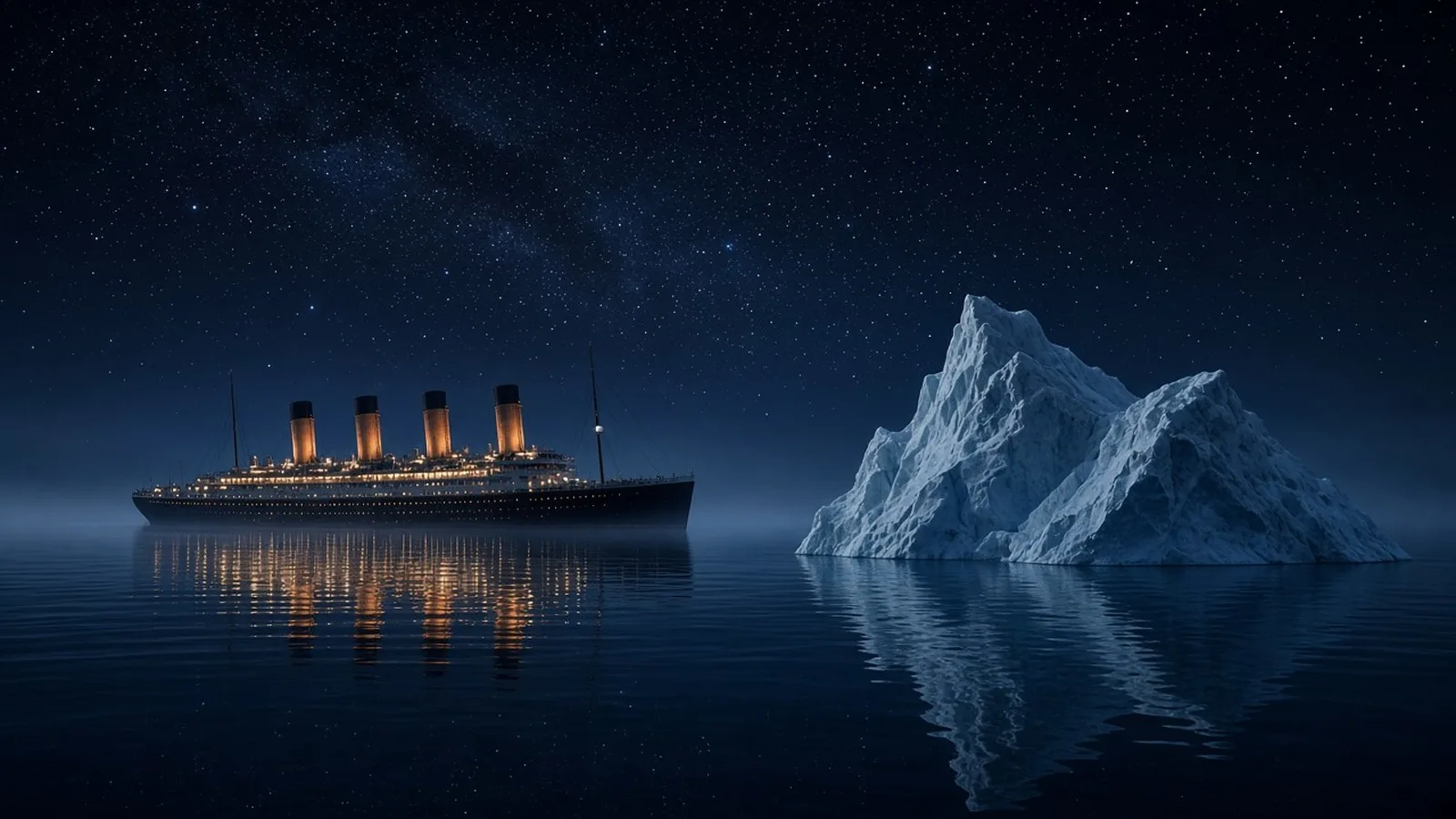
It was the night of 14 April 1912. The North Atlantic lay flat as glass, and with no moon, only the stars lit the sky. RMS Titanic, one of the largest and most luxurious passenger liners in the world, was steaming fast towards New York on her maiden voyage. At 11:40 pm, the lookout in the crow's nest called out: "Iceberg, right ahead!" Seconds later the ship scraped along the ice. Over the next two hours and forty minutes, the liner people had called "unsinkable" disappeared beneath the sea, and about 1,500 lives were lost. This is the full story of the Titanic, told with sources.
Background: A Race Across the Atlantic
In the early twentieth century, the Atlantic crossing between Europe and America was an extremely profitable business. The wealthy travelled in luxury, while hundreds of thousands of European emigrants crossed in search of a new life. Two great British companies competed fiercely for that trade: the White Star Line and the Cunard Line.
In 1907 Cunard introduced two fast liners, Lusitania and Mauretania, which set speed records on the Atlantic. In response, White Star chairman J. Bruce Ismay worked with Lord William Pirrie, chairman of the Belfast shipbuilders Harland and Wolff, on a new plan. Instead of competing on speed, they would build three ships that would astonish the world with their size, luxury and comfort. These were the Olympic class: Olympic, Titanic and Britannic. It was also an era when the European powers were locked in a naval arms race, a background explored in our World Wars series article on Europe before 1914.
Construction: The Giant of Belfast
From keel to sea trials
Titanic's keel was laid on 31 March 1909, about three months after work began on Olympic. Harland and Wolff built a special gantry so the two giant ships could be constructed side by side. The ship's chief designer was Thomas Andrews of Harland and Wolff, and thousands of workers were employed on her. The empty hull was launched on 31 May 1911. About ten months of fitting out followed, with engines installed and interiors completed. Sea trials were finished in early April 1912, and the ship was declared fit to sail.
Size and facilities
According to Encyclopaedia Britannica, Titanic was about 269 metres (882.5 feet) long and about 28.2 metres (92.5 feet) wide. Her gross registered tonnage was 46,328, and her displacement fully loaded was more than 52,000 tons. She had four funnels, and the fourth is widely said to have been mainly for ventilation and appearance. The US Senate inquiry report says she had accommodation for 2,599 passengers and 903 officers and crew.
First-class passengers had a vast dining saloon, four lifts, a swimming pool, a gymnasium and the famous Grand Staircase. Second-class facilities were comparable to first class on other ships.
"Unsinkable": Who Actually Said It?
Titanic had 16 watertight compartments, and the doors between them could be closed from the bridge. Her builders said she would float even if as many as four of the forward compartments flooded. But the bulkheads separating the compartments were not sealed at the top. If one compartment filled, water would spill over the bulkhead into the next, much as water fills an ice-cube tray one cell at a time.
So where did "unsinkable" come from? In 1911 the trade journal The Shipbuilder described the Olympic-class ships as "practically unsinkable". A 1910 White Star brochure was similarly qualified, saying they were designed to be unsinkable as far as possible. But newspapers and the public dropped the qualifiers, "practically" and "as far as possible".
The Maiden Voyage: Southampton, Cherbourg, Queenstown
At noon on Wednesday 10 April 1912, Titanic left Southampton, England, on her maiden voyage under Captain Edward John Smith. As she pulled away, the suction from her hull snapped the mooring lines of the nearby SS New York, which was drawn towards Titanic. A collision was avoided by only a few feet. That evening the ship called at Cherbourg in France to pick up passengers. At midday on Thursday 11 April she called at Queenstown (today's Cobh) in Ireland, took on mail and passengers, and headed out into the Atlantic for New York.
White Star chairman Ismay and designer Thomas Andrews were also sailing. The number of people on board varies by source: the British inquiry gave 2,201 and the US Senate inquiry 2,223, while organisations such as the US Coast Guard use 2,224.
Ice Warnings
That April, more icebergs than usual had drifted south into the North Atlantic shipping lanes. Throughout 14 April, from daytime into the night, Titanic's wireless room received ice warnings from ships including Caronia, Baltic, Amerika, Californian and Mesaba, usually counted as five or six in all. Only some reached the captain. The important warning from Mesaba, which reported heavy ice directly in Titanic's path, is believed never to have reached the bridge.
Wireless operators at the time were employees of the Marconi company, and their main job was sending passengers' private messages. At around 11 pm, when the nearby Californian, stopped in the ice, sent a warning, Titanic's busy operator Jack Phillips is said to have cut it off sharply. Despite all the warnings, the ship continued at about 21-22 knots (about 40 km/h). This was normal practice at the time, but the British inquiry later found that excessive speed contributed to the disaster.
11:40 pm: Collision with the Iceberg
At about 11:40 pm ship's time, lookout Frederick Fleet saw an iceberg dead ahead and rang the warning bell. Orders were given to turn the ship and stop the engines. Titanic began to swing away, which avoided a head-on collision, but her starboard (right-hand) bow scraped along the iceberg.
For a long time it was believed the iceberg had torn one long gash in the ship's side. Studies of the wreck later showed that there was no single large gash, but a series of narrow openings and separated plate seams. Water entered at least five of the forward compartments. Since the design could survive only four flooded, Thomas Andrews told the captain the ship would certainly sink. There is also speculation that poor-quality steel or weak rivets made the damage worse, though this is still debated.
The Two Hours and Forty Minutes
The call for help
At around 12:15 am, Titanic began transmitting the distress call "CQD". The newer "SOS" signal was also used later. Distress rockets were fired from the deck; according to the British inquiry, about eight were launched.
The final minutes
As the bow slowly sank, the stern rose out of the water. By about 2 am the bow was completely underwater, and within minutes the lights went out. Under the strain, the ship broke in two between the third and fourth funnels. That break was disputed for years and was confirmed only when the wreck was found in 1985. At about 2:20 am on 15 April 1912, the stern stood almost vertical and then vanished beneath the sea.
The water was below freezing, at about −2°C. Hundreds of people in the water died within minutes of the cold, even though they were wearing lifejackets. Most of the lifeboats did not go back to help, fearing that the crowd in the water would swamp them. Records say only one boat returned and rescued a few people.
Too Few Lifeboats, and the Class Divide
Not enough boats
Titanic carried only 20 lifeboats: 14 large wooden boats, 2 emergency cutters and 4 collapsible Engelhardt boats. The British inquiry put their total capacity at 1,178 people and the US inquiry at 1,176, enough for only about half of those on board. This was fully within the British Board of Trade rules of the day. Those rules were badly out of date and were based on a ship's size, not on the number of people it carried. The US report notes that the ship's davits could have handled up to 48 boats.
Worse, even the boats she had were not filled. At first many passengers did not believe they were in danger and thought the great ship was safer than a small boat on a cold sea. One emergency boat with room for 40 was lowered with only about 12 people aboard. With many boats leaving half empty, hundreds of seats went unused.
"Women and children first"
The sea tradition of "women and children first" was followed, but survival rates varied enormously by class. According to the British inquiry's figures:
| Group | Saved | Survival rate (approx.) | Note |
|---|---|---|---|
| First class | 203 of 325 | 62% | 140 of 144 first-class women (97%) survived |
| Second class | 118 of 285 | 41% | Only 14 of 168 second-class men (8%) survived |
| Third class | 178 of 706 | 25% | More than half of third-class children died |
| Crew | 212 of 885 | 24% |
Third-class passengers were quartered on the lower decks and towards the stern, and the route from there to the boat deck was long and confusing. There were also barriers between the classes, required by US immigration rules of the time, and many third-class passengers spoke no English. The British inquiry found no evidence that third-class passengers were deliberately held back. Many historians believe, though, that these structural obstacles are what lowered their chances of survival.
Californian and Carpathia: Two Ships, Two Stories
The Californian: close by, but never came
The Leyland Line's SS Californian had stopped for the night among the ice. Her only wireless operator, Cyril Evans, had switched off his set and gone to bed shortly before Titanic began sending distress calls, so none of them were heard. Her officers did, however, see about eight rockets between 12:30 and 1:40 am. Captain Stanley Lord took no action.
The British inquiry concluded that the Californian "could have reached" Titanic if she had acted when the first rocket was seen, and that she "made no attempt". The distance between the two ships is still disputed, and Captain Lord contested the verdict for the rest of his life. In 1992 the UK's Marine Accident Investigation Branch (MAIB) reappraised the evidence. Its report also put forward the view that even if the Californian had hurried, she was unlikely to have arrived before Titanic sank. The debate has never been fully settled.
The Carpathia's heroic dash
Cunard's RMS Carpathia was sailing from New York towards the Mediterranean. At 12:25 am her wireless operator, Harold Cottam, picked up Titanic's distress call. The Carpathia was about 58 miles away. Captain Arthur Rostron turned his ship at once and raced at full speed through the ice field. She arrived shortly after 4 am, more than an hour and a half after Titanic had gone down. By 8:30 am, everyone in the lifeboats had been picked up. On the night of 18 April 1912, the Carpathia reached New York with 705 survivors.
The Death Toll: Why the Numbers Differ
The exact number of people who died on Titanic is still not known for certain. Counts differ because of passengers who travelled without tickets, people who cancelled at the last minute, and individuals recorded under two names. The US Senate inquiry counted 1,517 deaths. The British inquiry report gives 1,490, but 1,503 is also widely quoted as the British figure, for example by the International Maritime Organization (IMO). Most historians therefore say "about 1,490 to 1,517", or simply "about 1,500". There were roughly 705-712 survivors.
Key Numbers at a Glance
| Detail | Figure | Note |
|---|---|---|
| Length | About 269 m (882.5 ft) | Britannica |
| Beam | About 28.2 m (92.5 ft) | Britannica |
| Gross registered tonnage | 46,328 | Displacement fully loaded over 52,000 tons |
| Watertight compartments | 16 | Could survive 4 flooding; at least 5 were breached |
| People on board | About 2,201-2,224 | Varies by inquiry and source |
| Lifeboats | 20 | Total capacity about 1,176-1,178 |
| Deaths | About 1,490-1,517 | US inquiry 1,517; British figure 1,490 / 1,503 |
| Survivors | About 705-712 | Carpathia carried 705 to New York |
| Collision to sinking | About 2 hours 40 minutes | 11:40 pm to 2:20 am |
| Wreck depth | About 3,800 m (12,500 ft) | About 600-740 km from Newfoundland |
| Carpathia's distance | About 58 miles | Arrived shortly after 4 am |
The Inquiries and SOLAS 1914
Two major inquiries followed the disaster. One was the US Senate inquiry chaired by Senator William Alden Smith. The other was the British Wreck Commissioner's inquiry under Lord Mersey, held from 2 May to 3 July 1912. They pointed to excessive speed, too few lifeboats, the lack of a round-the-clock wireless watch and the inaction of the Californian.
As a direct result, delegates from 13 nations met in London from November 1913. On 20 January 1914 they adopted the International Convention for the Safety of Life at Sea (SOLAS). Its rules included a lifeboat place for everyone on board, emergency drills on every voyage, a continuous wireless watch and moderate speed at night when ice was reported. The convention also created the International Ice Patrol to monitor icebergs in the North Atlantic, which the US Coast Guard still runs today. Because the First World War broke out, the 1914 convention never fully came into force. But its later versions (1929, 1948, 1960 and 1974) remain the foundation of shipping safety worldwide. For a sense of how dangerous the seas became later that year, read how the German cruiser Emden raided Madras in our World Wars article on SMS Emden in 1914.
1985: Robert Ballard's Discovery
For 73 years nobody knew exactly where Titanic lay, and several searches failed. In 1985 Robert Ballard of the Woods Hole Oceanographic Institution (WHOI) in the United States and Jean-Louis Michel of France's IFREMER led a joint expedition. From the US Navy research ship Knorr they lowered Argo, a remotely operated camera sled, into the deep. In the early hours of 1 September 1985, at a depth of about 3,800 metres, one of Titanic's huge boilers appeared on screen. The ship lay upright in two large pieces. The bow was in relatively good condition, while the stern was badly crushed. Britannica puts the two sections about 600 metres apart, and the BBC about 800 metres. Ballard later revealed that the search was partly tied to a secret US Navy mission.
The Wreck Today: A Ship Slowly Dissolving
The wreck is slowly disappearing. Iron-eating microbes are breaking down the ship's metal and forming icicle-like formations of rust called "rusticles". One species of bacterium was first identified on the wreck itself and was named Halomonas titanicae.
During a July-August 2024 expedition by RMS Titanic Inc., the company that holds legal salvage rights to the wreck, a large section of the famous railing around the bow was found to have fallen to the seabed. The section is about 4.5 metres (about 15 feet) long. In 2022 it had been bent but still attached. Some experts predict that recognisable parts of the ship could collapse within a few decades, while estimates of how long the whole wreck will take to disappear vary widely.
For a wreck more than 3,000 years older, see our article on the world's oldest shipwreck, found off Kekova in Turkey.
1997: James Cameron's "Titanic"
It was James Cameron's Titanic, released in December 1997, that carried the story to a new generation. The film set the fictional romance of Jack and Rose against the real disaster. Its budget of about $200 million made it the most expensive film ever made at the time. It became the first film to gross more than $1 billion worldwide, and its 11 Oscars equalled the record held by Ben-Hur. Before shooting, Cameron made several deep-sea dives to the real wreck to film it.
2023: The Titan Submersible Disaster
The wreck became the scene of another tragedy. On 18 June 2023, OceanGate's small submersible Titan dived with five people aboard to visit the wreck. Contact was lost about an hour and three-quarters into the dive. After a multinational search, debris was found on 22 June about 1,600 feet (488 metres) from Titanic's bow. The carbon-fibre hull had imploded under the deep-sea pressure, killing all five aboard instantly, including the company's chief executive. A US Coast Guard Marine Board of Investigation report published in August 2025 concluded that the disaster was preventable. It found that the main cause was the company's failure to follow engineering safety practices.
Timeline
| Date / time | Event |
|---|---|
| 1907 | White Star plans the Olympic-class ships in response to Cunard |
| 31 March 1909 | Titanic's keel laid in Belfast |
| 31 May 1911 | Hull launched |
| Early April 1912 | Sea trials; ship declared fit to sail |
| 10 April 1912, noon | Maiden voyage from Southampton; Cherbourg that evening |
| 11 April 1912 | Queenstown (Cobh), Ireland; Atlantic crossing begins |
| 14 April 1912, day to night | Ice warnings from several ships |
| 14 April, 11:40 pm | Collision with the iceberg |
| 15 April, 12:15-12:25 am | Distress calls; Carpathia picks up the call |
| 15 April, 2:20 am | Titanic sinks |
| 15 April, after 4 am | Carpathia arrives; rescue complete by 8:30 am |
| 18 April 1912 | Carpathia reaches New York with 705 survivors |
| April-July 1912 | US Senate and British inquiries |
| 20 January 1914 | First SOLAS convention adopted in London; International Ice Patrol |
| 1 September 1985 | Ballard-Michel team finds the wreck |
| December 1997 | James Cameron's Titanic released |
| 18 June 2023 | Titan submersible implodes; five killed |
| July-August 2024 | Part of the bow railing found to have fallen |
Myths and Facts
- Myth: White Star advertised that "God himself could not sink this ship". Fact: there is no reliable evidence of any such advertisement. The recorded wording was qualified: "practically unsinkable" and "designed to be unsinkable as far as possible".
- Myth: the iceberg ripped a 300-foot gash in the hull. Fact: studies of the wreck show a series of small openings and separated plate seams.
- Myth: the ship sank in one piece. Fact: that was believed for years, but the 1985 discovery confirmed that she broke in two, as some survivors had said all along.
- Myth: third-class passengers were deliberately locked below. Fact: the inquiries found no evidence of a deliberate plan to hold them back. Barriers, confusing routes, language problems and late information hit them hard, however.
- Myth: it is certain the band's last tune was "Nearer, My God, to Thee". Fact: the musicians led by Wallace Hartley played to the end, and all of them died. But survivors' accounts differ on what the last piece was.
- Myth: Titanic was the first ship to send an SOS. Fact: SOS had been introduced some years earlier. Titanic used SOS alongside CQD, but hers was not the "first SOS".
Fascinating Facts
- Three sisters: Olympic served until 1935 and earned the nickname "Old Reliable". Britannic was converted into a hospital ship in the First World War and sank after hitting a mine in the Aegean in 1916.
- Enough lifebelts: there were too few boats, but there were 3,560 lifebelts, enough for everyone. In the freezing water, though, they did not save lives.
- Honour for the Carpathia's captain: Captain Rostron was awarded a Congressional Gold Medal by the US Congress and was later knighted.
- The last message: according to the British inquiry, Titanic's last wireless signal was sent at 2:17 am, and it was heard faintly by the Virginian.
Frequently Asked Questions
When did the Titanic sink?
She struck the iceberg at 11:40 pm on 14 April 1912 and sank completely at about 2:20 am on 15 April (ship's time).
How many people died?
The exact number is not known. The US inquiry gives 1,517, and British figures 1,490 or 1,503. It is usually given as "about 1,500".
Why did so many people die?
The lifeboats had room for only about half of those on board, and many were lowered half empty. The water was below freezing, the nearby Californian did not come to help, and the Carpathia was 58 miles away.
Where is the Titanic wreck?
In the North Atlantic, about 600-740 km from Newfoundland, Canada, at a depth of about 3,800 metres, lying in two main pieces.
Could the Titanic ever be raised?
No. The ship is broken in two and so weakened by more than a century of corrosion that it is extremely fragile. It is also regarded as a memorial to the people who died, and international agreements protect it.
Were Jack and Rose from the film real people?
No, they are fictional. But many characters, including Captain Smith, Thomas Andrews, Bruce Ismay and Molly Brown, are based on real people.
Final Thoughts
The Titanic story is not just the story of a ship that sank. In a single night it laid bare overconfidence in technology, ignored warnings, social inequality, and human courage and sacrifice. The SOLAS rules born from the lessons of that night still protect everyone who travels by sea today. The ship may be slowly dissolving in the depths of the Atlantic, but its memory and its lessons will endure.
Sources
- Encyclopaedia Britannica: Titanic
- British Wreck Commissioner's Inquiry: Persons saved by class (Titanic Inquiry Project)
- British Inquiry: Life-saving appliances
- British Inquiry: Means taken to procure assistance
- United States Senate Inquiry report
- Titanic Inquiry Project: Carpathia
- UK MAIB (1992): Reappraisal of evidence, SS Californian
- IMO: SOLAS Convention history
- UK National Archives: The Convention for the Safety of Life at Sea
- IMO: Surviving disaster, the Titanic and SOLAS
- RMS Titanic, Inc.: The Titanic wreck site
- US Coast Guard: International Ice Patrol
- Woods Hole Oceanographic Institution: 1985 discovery of RMS Titanic
- BBC News: Images reveal Titanic's slow decay (2024)
- BBC Future: What will happen as the Titanic wreck disintegrates
- Snopes: Was the Titanic advertised as unsinkable?
- Wikipedia: Titanic (1997 film)
- US Coast Guard: Titan submersible investigation report (2025)
- CBS News: Titan debris found 1,600 feet from Titanic bow (2023)