This is Part 16 of HorizonDesk's chronological series on Tamil history, from prehistory to modern Tamil Nadu. The previous instalment was Part 15: Narasimhavarman I and the Monuments of Mamallapuram.
Narasimhavarman I had taken the war to the Chalukya capital, Vatapi. His successors spent two centuries learning that the Deccan could strike back and that new rivals were rising in the south. This was also the age when the Pallavas stopped carving temples out of rock and began building them stone by stone. The finest of these, the Kailasanathar temple at Kanchipuram, still stands as the signature of one king, Rajasimha. This part follows the Pallavas from Paramesvaravarman I to the last king, Aparajita. The dates are estimates; some reigns vary by ten or twenty years between scholars.
The later Pallavas at a glance
| Question | Short answer |
|---|---|
| Period | c. 670 to c. 897 CE |
| Capital | Kanchipuram (Kanchi) |
| Great builders | Rajasimha (Kailasanathar, Shore Temple); Nandivarman II (Vaikuntha Perumal) |
| Main rivals | Chalukyas of Vatapi, then Rashtrakutas of the Deccan; Pandyas of Madurai |
| Key texts | Kuram, Kasakudi, Udayendiram and Velurpalaiyam copper plates; temple inscriptions; the Tamil poem Nandikkalambakam |
| End | Aditya I Chola defeats Aparajita and takes Tondaimandalam, c. 897 |
Paramesvaravarman I and the Chalukya counter-attack
After the short reign of Mahendravarman II, his son Paramesvaravarman I (c. 670–700) faced a Chalukya king determined to avenge Vatapi. Vikramaditya I, son of Pulakeshin II, marched deep into Pallava territory. His Gadval plates of 674 CE were issued from a camp at Uragapura, usually identified with Uraiyur near Tiruchirappalli.
The Pallava version is in the Kuram copper plates, issued by Paramesvaravarman himself. They say he routed Vikramaditya's army in the battle of Peruvalanallur, generally placed near Tiruchirappalli. Chalukya records claim victory for Vikramaditya; neither side won for good. The Kuram plates also record a Shiva temple the king built at Kuram near Kanchi.
Rajasimha: the builder king
Paramesvaravarman's son Narasimhavarman II, best known by his title Rajasimha, "lion among kings", ruled from about 700 to 728 (some scholars start his reign around 690). His reign seems to have been largely peaceful, and he spent it building.
- Kailasanathar, Kanchipuram: his greatest work, named in his own inscriptions Rajasimha-Pallavesvara or Rajasimhesvara.
- Shore Temple, Mamallapuram: the twin shrines on the beach, among the earliest major structural temples in south India (see our guide to the Mahabalipuram monuments).
- Talagirisvara, Panamalai: a hill temple in today's Villupuram district. A sub-shrine there keeps the faded remains of a Pallava painting of a dancing Shiva watched by Parvati, which The Hindu reported in 2023 was in danger of disappearing.
- Smaller Kanchi shrines such as Iravatanesvara and Piravatanesvara are also credited to him.
An embassy to Tang China
Chinese records collected by K. A. Nilakanta Sastri say that in 720 CE a king of South India called Shri Narasimha sent envoys to the Tang court. He offered war elephants and cavalry to help against the Arabs and Tibetans and asked the emperor to name his army. The emperor called it "the army which cherishes virtue" and conferred the title of king on him. The king also built a temple on China's behalf, which the emperor named. This Narasimha is usually identified as Rajasimha. The episode fits a wider web of India–China trade, explored in our piece on the Silk Road.
Poets and saints
Tradition places the Sanskrit writer Dandin at Rajasimha's court. The Tamil Periyapuranam tells how Shiva asked a Kadava (Pallava) king to postpone the consecration of his great stone temple at Kanchi, because the god was entering the temple the poor devotee Pusalar had built only in his mind at Tiruninravur. The king is often taken to be Rajasimha, but the text does not name him, so this is tradition, not history.
The Kailasanathar temple
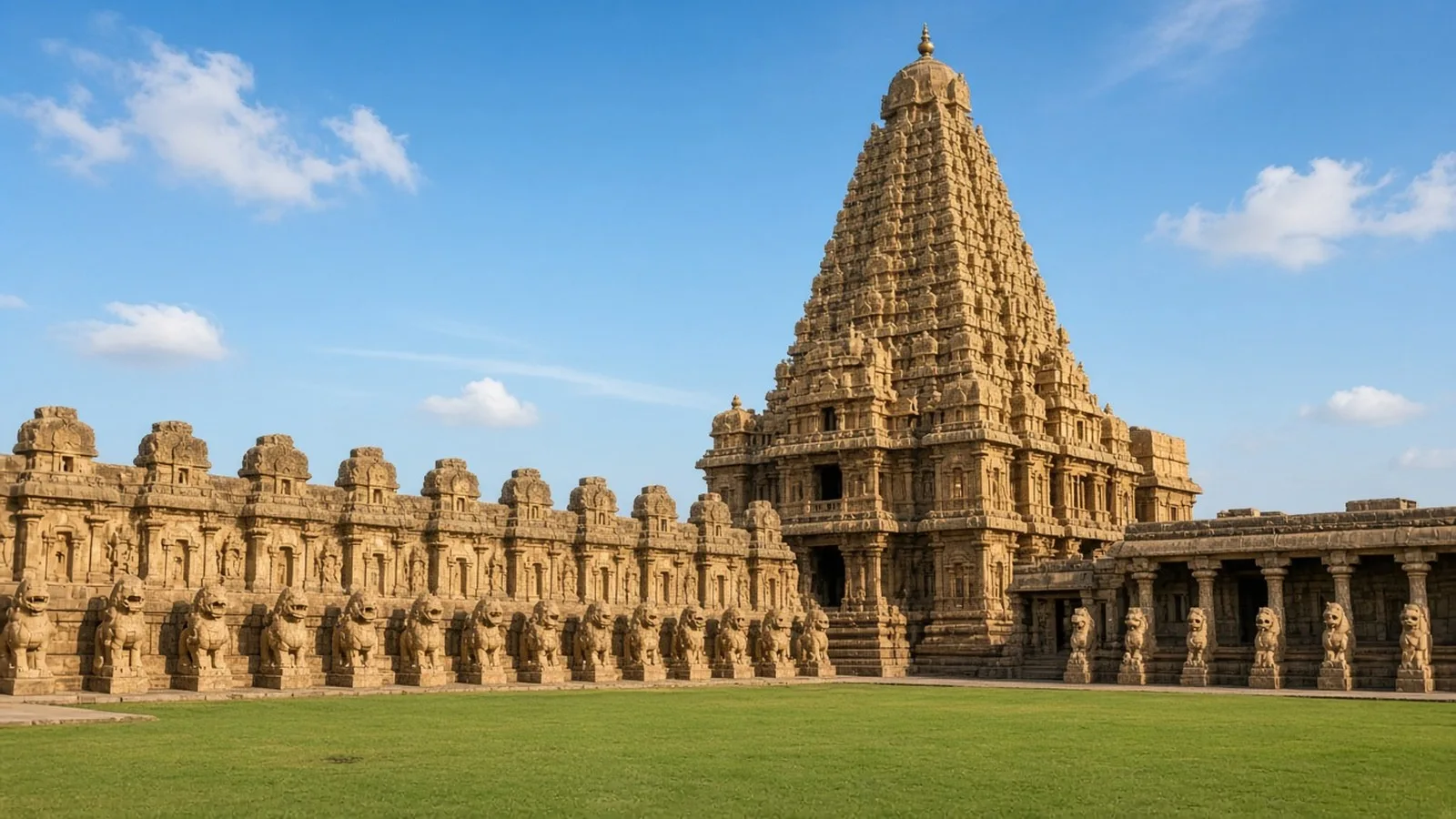
Kailasanathar is unusual in Tamil Nadu because most of it is sandstone, laid on a granite base. The Archaeological Survey of India (ASI) began stripping later accretions and restoring it in 1999; Frontline quoted an ASI official calling it the biggest sandstone temple in the world. In 2021 India put it at the head of a group of eleven "Temples of Kanchipuram" on UNESCO's tentative list for World Heritage status.
What to look for
- The vimana: a tall pyramidal tower over the main shrine, which holds a sixteen-sided linga with a Somaskanda panel (Shiva, Uma and the child Skanda) on the wall behind it. It recurs so often in Rajasimha's temples that it is treated as his signature.
- The enclosure: the courtyard is ringed by 58 small sub-shrines (devakulikas), whose walls still carry traces of painting.
- Yalis: rearing lion-like yalis form the pilasters, a hallmark of Rajasimha's style.
- The birudas: the king's titles are cut in several hundred short Sanskrit inscriptions in four tiers around the temple. Among them are Atyantakama, Sribhara, Ranajaya and Kshatriyasimha. A foundation inscription names the temple Rajasimhesvara.
- Mahendravarmesvara: a smaller shrine in front, added by Rajasimha's son Mahendravarman III, whose inscription calls him the grandson of Lokaditya, that is, Paramesvaravarman I.
- Rangapataka's shrine: a niche shrine founded by Rajasimha's queen, Rangapataka, according to its inscription.
The temple had a long afterlife. A Vijayanagara-period inscription of 1364 CE says it had been closed and its lands sold under a Chola king named Kulottunga, and records its reopening.
Its influence travelled too. UNESCO's tentative-list entry says it is "quite certain" that the builders of the Virupaksha temple at Pattadakal were influenced by Kailasanathar, a story told in our guide to the Pattadakal temples.
A succession crisis and a twelve-year-old king
Mahendravarman III seems to have died before his father, so the throne passed to another son, Paramesvaravarman II (c. 728–731). Chalukya records say the crown prince Vikramaditya (later Vikramaditya II) forced Kanchi to pay tribute, and Paramesvaravarman II is thought to have died fighting the Ganga king Sripurusha, though the evidence is indirect.
He left no adult heir, and the main line of Simhavishnu ended. What happened next is told in stone. Label inscriptions on the panels of the Vaikuntha Perumal temple say that a deputation went to Hiranyavarman, who came from a branch of the family descended from Simhavishnu's younger brother, Bhimavarman. Of his sons, only the twelve-year-old Pallavamalla agreed to go, and he was crowned as Nandivarman II with the support of ministers, a merchant guild and local chiefs.
The Kasakudi plates, issued in his 22nd regnal year, say Nandivarman was "chosen by the subjects". Their editor, E. Hultzsch, suspected he was in effect a usurper. The Udayendiram plates add that his general Udayachandra rescued him when Tamil princes besieged him at Nandipura, and killed a rival claimant called Chitramaya. Who Chitramaya was is not certain; he may have been a son of Paramesvaravarman II.
Nandivarman II Pallavamalla
Nandivarman II (c. 731–796) ruled for about 65 years if the usual dates are right, one of the longest reigns in south Indian history.
Vikramaditya II in Kanchi
Around the 740s the Chalukya Vikramaditya II took Kanchi itself. Chalukya plates boast that he entered the city "without destroying it". He left a striking record in the Kailasanathar temple: an Old Kannada inscription on a pillar of the hall in front of the main shrine says that he did not confiscate the temple's wealth but returned it to the god. It is undated, but its attribution to Vikramaditya II, based on his copper plates, is widely accepted.
Dantidurga and the Rashtrakutas
In the 750s the Chalukyas were overthrown by Dantidurga, founder of the Rashtrakuta dynasty. His Dasavatara cave inscription at Ellora (see our Ajanta and Ellora guide) claims a victory at Kanchi. Peace seems to have followed: Nandivarman II is generally thought to have married a Rashtrakuta princess, Reva, and their son was named Dantivarman, perhaps after Dantidurga.
The Vaikuntha Perumal temple
Nandivarman II's great monument is the Vishnu temple called Paramesvara Vinnagaram, today Vaikuntha Perumal, also built of sandstone. Its tower holds three sanctums, one above another, with Vishnu seated, reclining and standing. The cloister walls carry long sculpted panels that, according to their label inscriptions, narrate the history of the dynasty down to the coronation of Nandivarman himself. C. Minakshi studied these panels in 1941; Dennis Hudson later read the whole temple as a map of Bhagavata theology. The Vaishnava saint Tirumangai Alvar sang of the temple, and the Kasakudi plates record Nandivarman's gift of a village to a learned Brahmin.
Dantivarman and Nandivarman III
Under Dantivarman (c. 796–846) the Rashtrakuta Govinda III raided Kanchi and the Pandyas of Madurai pushed north.
His son Nandivarman III (c. 846–869; older books date him to 825–850) restored Pallava prestige. He defeated the Pandyas at Tellaru, near Vandavasi, and took the title Tellarrerinda Nandivarman, "Nandivarman who fought at Tellaru". The date of the battle is still debated. He married Sankha, a daughter of the Rashtrakuta king Amoghavarsha I.
He is also the hero of the Nandikkalambakam, an anonymous Tamil poem in the kalambakam style, which mixes many metres and moods. It praises his victories at Tellaru and elsewhere. A popular legend that the king died after hearing it sung has no historical support. A Tamil inscription found at Takuapa in southern Thailand mentions a tank named Avaninaranam, one of Nandivarman III's titles, and a merchant guild, a sign of how far Pallava-era traders reached.
The end: Nripatunga, Aparajita and Sripurambiyam
Nandivarman III's son Nripatunga (c. 869–880s) fought the Pandyas on the Arisil river near Kumbakonam, according to his Bahur plates. The Pandya Srimara, for his part, claimed a victory at Kudamukku (Kumbakonam). Nripatunga's relationship to the last king, Aparajita, is not clear.
The decisive battle came at Sripurambiyam (Tiruppirambiyam, near Kumbakonam), around 885 CE (some say 880). Aparajita, his Ganga ally Prithivipati I and, probably, the Chola Aditya I defeated the Pandya king Varaguna II. The Udayendiram plates of the Ganga king Prithivipati II say his grandfather made Aparajita's name ("the unconquered") meaningful, but lost his life in the battle.
The real winner was Aditya I Chola. The later Tiruvalangadu plates say he conquered the Pallava Aparajita and took his country. By about 897 CE Tondaimandalam, the Pallava heartland around Kanchi, belonged to the Cholas, and the Pallava line ended as an imperial power. Chiefs claiming Pallava descent survived; one, the Kadava Kopperunjinga, troubled the Cholas in the 13th century.
Timeline
| Date (approx.) | Development | How firm? |
|---|---|---|
| c. 670 CE | Accession of Paramesvaravarman I | Scholarly estimate |
| 674 CE | Vikramaditya I camps at Uragapura (Gadval plates) | Firm |
| c. 670s–680s | Battle of Peruvalanallur | Fairly firm; result disputed |
| c. 700–728 CE | Rajasimha; Kailasanathar and Shore Temple | Fairly firm |
| 720 CE | Embassy of "Shri Narasimha" to the Tang court | Firm (Chinese record); identity probable |
| c. 728–731 CE | Paramesvaravarman II; succession crisis | Scholarly estimate |
| c. 731 CE | Nandivarman II crowned at about 12 | Fairly firm |
| c. 740s | Vikramaditya II enters Kanchi; Kannada inscription | Fairly firm |
| c. 750s | Dantidurga's raid on Kanchi | Debated |
| c. 796–846 CE | Dantivarman; Rashtrakuta raids | Scholarly estimate |
| c. 830s–850s | Battle of Tellaru | Date debated |
| c. 885 CE | Battle of Sripurambiyam | Fairly firm; year debated |
| c. 897 CE | Aditya I Chola takes Tondaimandalam | Scholarly estimate |
| 1999 onwards | ASI restoration of Kailasanathar | Firm |
| 2021 | "Temples of Kanchipuram" on UNESCO tentative list | Firm |
What we can say with confidence
- Confident: Rajasimha built the Kailasanathar (Rajasimhesvara) temple and Mahendravarman III added the shrine in front; the Kailasanathar and Vaikuntha Perumal temples are largely sandstone; Nandivarman II came from a collateral branch after a succession crisis; Vikramaditya II occupied Kanchi and left a Kannada inscription; Nandivarman III won at Tellaru; Aditya I Chola ended Pallava rule after Sripurambiyam.
- Uncertain: exact reigns; who won at Peruvalanallur; how Paramesvaravarman II died; who Chitramaya was; whether Nandivarman II married Reva; the dates of Tellaru and Sripurambiyam; the Rajasimha of the Pusalar legend and Dandin's court.
Next part
Part 17, The Early Pandyas of Madurai (First Empire), turns to the Pandya kings who fought the Pallavas at Tellaru and Sripurambiyam, and to their copper plates, temples and wars.
Sources
- UNESCO World Heritage Centre, Temples of Kanchipuram (tentative list, 2021); Incredible India, Kailasanatha Temple
- E. Hultzsch, Inscriptions of the Kailasanatha temple and A Pallava grant from Kuram, South Indian Inscriptions I
- SII II: Kasakudi and Udayendiram plates of Nandivarman II (nos. 72–74); Udayendiram plates of Prithivipati II (nos. 75–76); Velurpalaiyam plates of Nandivarman III
- E. Hultzsch, "Kanchi inscription of Vikramaditya", Epigraphia Indica III; Indoskript record of the inscription (University of Würzburg)
- South Indian Inscriptions III (Tiruvalangadu plates)
- K. A. Nilakanta Sastri, Foreign Notices of South India: chapter on embassies to China, 692–720; full book; A History of South India
- C. Minakshi, The Historical Sculptures of the Vaikunthaperumal Temple, Kanchi (1941) and Administration and Social Life under the Pallavas
- A. H. Longhurst, Pallava Architecture, Part III (MASI 40)
- R. Gopalan, History of the Pallavas of Kanchi; T. V. Mahalingam, Kanchipuram in Early South Indian History
- Dennis Hudson, The Body of God: An Emperor's Palace for Krishna in Eighth-Century Kanchipuram (Oxford University Press, 2008)
- Frontline, A restoration feat; The Hindu, Reading a temple and 1,300-year-old Pallava paintings in ruins at Panamalai
- Saurabh Saxena, Puratattva, The Pallavas – Part 3
- Sekkizhar, Periyapuranam, The History of Pusalar Nayanar (Shaivam.org); Nandikkalambakam (Project Madurai, Tamil text)