This is Part 19 of HorizonDesk's chronological series on Tamil history, from prehistory to modern Tamil Nadu. The previous instalment was Part 18: The Bhakti Movement: Nayanmars and Alvars.
For about six centuries after the Sangam age, the Cholas, one of the three "crowned kings" (moovendhar) of early Tamil poetry, almost disappear from history. Then, around 850 CE, a Chola chieftain named Vijayalaya took Thanjavur in the Kaveri delta. Within a hundred years his son and grandson had absorbed the Pallava kingdom, conquered the Pandyas of Madurai and sent an army to Sri Lanka. In 949 a single battle at Takkolam almost undid it all. This part follows the three kings who laid the foundation that Rajaraja I would turn into an empire.
Almost everything we know comes from inscriptions: stone records dated in regnal years, and royal copper-plate charters written decades or centuries later in flowery Sanskrit and Tamil. The charters are official praise, not neutral history, so this part notes where the evidence is firm and where it is only a court poet's claim.
The early Chola revival at a glance
| Question | Short answer |
|---|---|
| Founder | Vijayalaya (Parakesari), c. 850–871 CE (dates approximate) |
| Capital | Thanjavur (Tanjore), taken from the Muttaraiyar chiefs |
| Second king | Aditya I (Rajakesari), c. 871–907 |
| Third king | Parantaka I, 907–c. 955 |
| Key battles | Sripurambiyam (c. 880–885), Vellur (c. 915), Takkolam (949) |
| Main sources | Tiruvalangadu, Anbil, Leiden and Udayendiram copper plates; Kanyakumari inscription; hundreds of stone records |
| Main debates | Exact dates; Vijayalaya's real power; who built the Narttamalai temple |
The long eclipse after the Sangam age
The Sangam poems celebrate Chola kings such as Karikala, who ruled from Uraiyur (now part of Tiruchirappalli) and the port of Puhar. After about the 3rd century CE, the light goes out. K. A. Nilakanta Sastri, whose The Colas is still the standard account, calls the following centuries a period of "darkness" with only a few "peep-holes":
- The Kalabhras. From roughly the 4th to the 6th century, an obscure power called the Kalabhras disrupted the old kingdoms. The Buddhist writer Buddhadatta mentions a Kalabhra king, Accutavikkanta, ruling the Chola country, and describes a still-prosperous Kaveripattinam.
- Pallava and Pandya dominance. When the Pallavas of Kanchi and the Pandyas of Madurai revived in the late 6th century, the Cholas did not. Pallava plates say Simhavishnu (c. 575–600) seized "the Chola country watered by the Kaveri", and the Chalukya king Vikramaditya I camped at Uraiyur in 674.
- Chola princes in service. Sastri argues that Chola princes survived as minor chieftains near Uraiyur. Families claiming Chola descent, such as the "Renandu Cholas", appear even in the Telugu country, and the small "Chu-li-ye" kingdom described by the Chinese pilgrim Xuanzang around 640 is usually placed there, not in the delta.
By the 9th century, the fertile land around Thanjavur was held by the Muttaraiyar, chieftains based at Sendalai and Niyamam who called themselves lords of Tanjai and shifted their loyalty between the Pallavas and the Pandyas.
Vijayalaya takes Thanjavur
The capture
The Tiruvalangadu copper plates of Rajendra I (c. 1018) say Vijayalaya "took possession of Tanchapuri", a city "as beautiful as Alaka", as easily as a man takes his own bride by the hand. Contemporary stone records support the outline: an inscription of his third year calls him Tanjai-konda Parakesari, "Parakesari who took Thanjavur". Parakesari and Rajakesari ("lion among kings") were throne titles that later Chola kings used in turn.
When? No record gives a calendar date. Historians count back from Parantaka I's accession in 907, fixed by astronomical details in his inscriptions. Aditya I ruled about 36 years, so Vijayalaya's reign ended around 870–871 and probably began a little before 850. Textbooks give 846, 848 or 850; "around 850" is the safest statement.
From whom? Sastri's reconstruction, still widely followed, is that the Muttaraiyar had gone over to the Pandya king, and Vijayalaya took Thanjavur as a vassal of the Pallavas. The Pallava king, Sastri wrote, did not suspect he was training "his tiger-cub to a taste for blood". The tiger was the Chola emblem.
How powerful was he? Probably modest. Sastri doubted that so new a ruler held the wide territory once assigned to him. Later court poems (ula) say he bore 96 battle wounds, a good story but a poetic claim.
Nisumbhasudani, the Chola war goddess
The same plates say Vijayalaya then consecrated an image of Nisumbhasudani, "the slayer of the demon Nisumbha", a fierce form of Durga. The original shrine has not been identified. Some Durga and Kali temples in Thanjavur claim to continue it, but that is tradition, not proof.
The Narttamalai temple: whose was it?
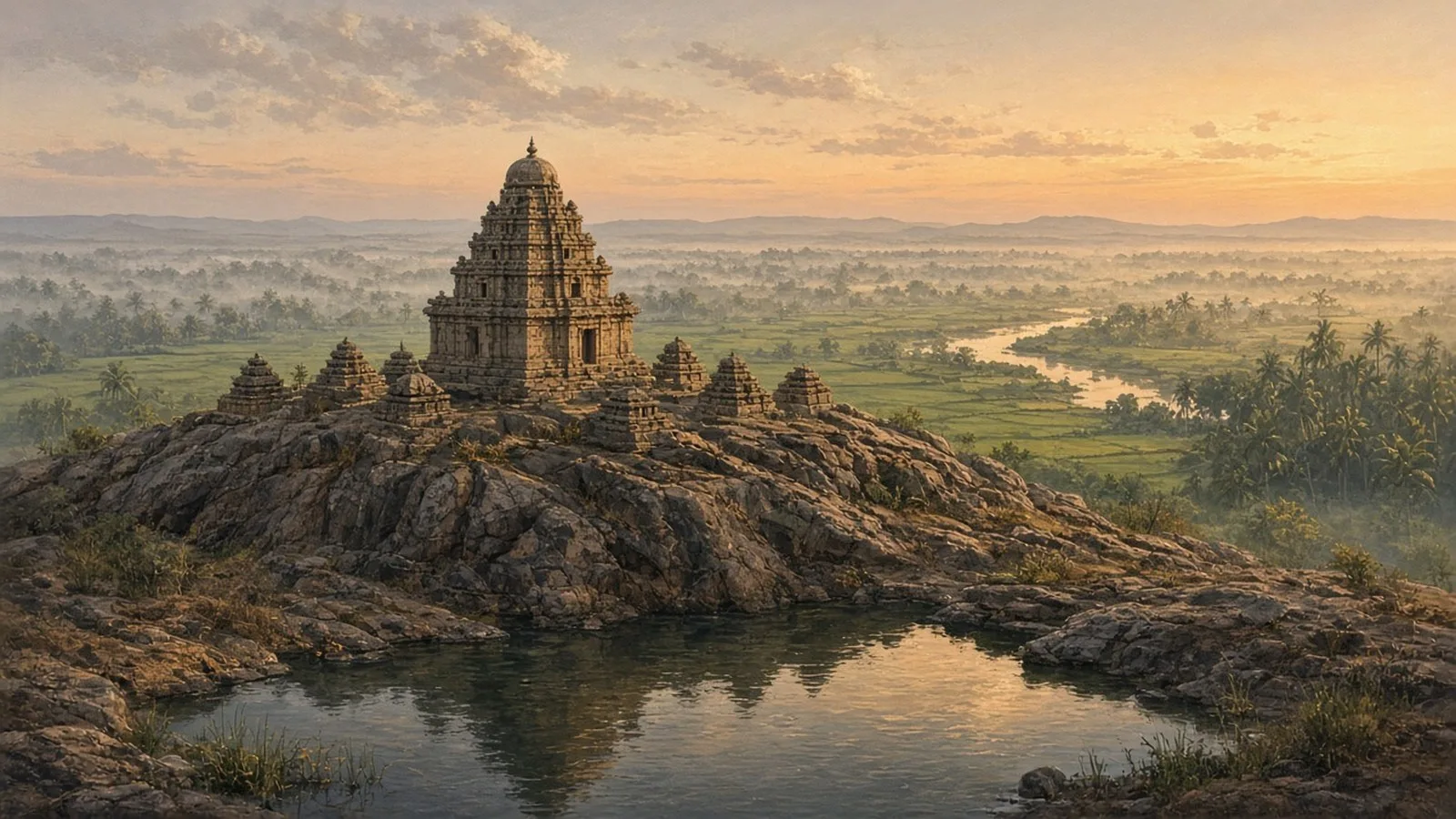
The hilltop temple at Narttamalai in Pudukkottai district, known as Vijayalaya Cholisvaram, is one of the finest early stone temples in Tamil Nadu: a small shrine with square lower storeys, a circular upper storey and a rounded dome, ringed by subsidiary shrines.
The name, however, first appears in a 13th-century Pandya inscription. An earlier inscription says the stone temple built by the Muttaraiyar chief Sattan Pudi (Ilango Adiaraiyar) was damaged by rain and renovated by Mallan Viduman. Some scholars place Ilango Adiaraiyar in Vijayalaya's time; others in the 8th century. So the temple may be early Chola, Muttaraiyar, or both. Either way, it shows the style from which Chola architecture grew.
Aditya I: from vassal to overlord
Vijayalaya's son Aditya I (c. 871–907) turned a delta principality into a regional power, mostly by choosing his moment well.
Sripurambiyam
In the 880s the Pandya king Varaguna II invaded the Chola country. At Sripurambiyam (Tiruppurambiyam), near Kumbakonam, he was crushed by the Pallava king Aparajita and his Ganga ally Prithivipati I, who died making Aparajita "unconquered" in fact as well as in name. The year is debated, between about 879 and 885.
No document proves Aditya fought there, but most historians assume he did, on the Pallava side, as told in Part 16 and Part 17. The Pandyas never recovered, the Ganga king was dead and the Pallava victor was exhausted.
The end of the Pallavas
Some years later Aditya turned on his overlord. The Tiruvalangadu plates say he defeated Aparajita and "took possession of his beloved country"; the 11th-century Kanyakumari inscription says he pounced on the Pallava king seated on a tall elephant and killed him. Sastri places the annexation of Tondaimandalam, the Pallava heartland around Kanchi, around 890; others put it closer to 897. After about 600 years, the Pallavas disappear as an independent dynasty.
Aditya also seems to have taken the Kongu country (around Coimbatore and Karur), and he married a daughter of the Rashtrakuta king Krishna II. That marriage would cause trouble later.
Temples along the Kaveri
The Anbil plates of Sundara Chola (c. 961) say Aditya built tall stone temples to Shiva along both banks of the Kaveri, "from the Sahya mountain to the sea". That is exaggeration, but the Cholas did begin replacing brick shrines with granite ones. Aditya died around 907 at Tondaimanad near Kalahasti, and his son built a memorial temple (pallippadai), the Adityesvara, over his remains.
Parantaka I: the first Chola empire
Parantaka I (907–c. 955) ruled for 48 years, the high point of the early Chola state.
- Madurai. By his third year he was styled Madurai-konda, "who took Madurai". Around 915, at Vellur, his army defeated the Pandya king Rajasimha II and an army sent from Sri Lanka. Rajasimha fled to Sri Lanka, leaving his crown and regalia there.
- Sri Lanka. Parantaka later invaded the island to seize the Pandya regalia, but King Udaya IV fled with them into the hills of Rohana. Rajendra I recovered them some 70 years later.
- The Rashtrakutas. Krishna II tried to put his own grandson, Aditya's son Kannaradeva, on the Chola throne. Parantaka and his Ganga ally defeated him at Vallala (Tiruvallam), around 910–916.
- Chidambaram. The Tiruvalangadu and Leiden plates say he covered the Shiva temple at Chidambaram with gold.
His inscriptions also show village assemblies at work, above all the records of 919 and 921 from Uthiramerur on choosing members by lot (kudavolai). They get a part of their own, Part 22.
Disaster at Takkolam, 949
The new Ganga king, Butuga II, was the brother-in-law of the ambitious Rashtrakuta king Krishna III. In 949 Krishna invaded. At Takkolam, near Arakkonam, the Chola crown prince Rajaditya was killed on his war elephant; the Atakur inscription says Butuga "aimed at, pierced and killed" him, and the Chola Leiden plates agree.
Krishna III later called himself "conqueror of Kanchi and Thanjavur", and his inscriptions replace Parantaka's in the northern Tamil country for years, though his capture of Thanjavur is doubtful. Sastri's verdict: "The Cola empire was no more; it had to be built up all over again."
After Parantaka
For three decades the throne passed between Parantaka's sons and grandsons. His son Gandaraditya was a Shaiva poet whose hymns are in the Tirumurai (see Part 18), and Gandaraditya's widow, Sembiyan Mahadevi, became a great temple builder. Under Sundara Chola the Cholas slowly won back lost ground, and in 985 his son became king as Rajaraja I.
Historians still debate what kind of state this was. Noboru Karashima saw the early Chola state as loose and "segmentary", truly centralised only under Rajaraja I; others see Parantaka's reign as the real beginning of the Chola system.
Timeline
| Date (approx.) | Development | How firm? |
|---|---|---|
| After c. 3rd century CE | Sangam-age Cholas fade; Kalabhra period follows | Broad outline only |
| c. 575–600 | Pallava Simhavishnu claims the Chola country | Pallava claim |
| c. 846–850 | Vijayalaya takes Thanjavur from the Muttaraiyar | Approximate |
| c. 871 | Aditya I succeeds | Approximate |
| c. 879–885 | Battle of Sripurambiyam | Year debated |
| c. 890–897 | Aditya I annexes Tondaimandalam | Approximate |
| 907 | Accession of Parantaka I | Firm |
| c. 915 | Battle of Vellur | Approximate |
| 919 and 921 | Uthiramerur assembly inscriptions | Firm |
| 949 | Battle of Takkolam; Rajaditya killed | Firm |
| c. 955 | Last records of Parantaka I | Fairly firm |
| 985 | Accession of Rajaraja I | Firm |
What we can say with confidence
- Confident: Vijayalaya took Thanjavur around the mid-9th century; Aditya I ended the Pallava kingdom; Parantaka I came to the throne in 907, conquered the Pandyas and failed to take their regalia from Sri Lanka; the Rashtrakutas won at Takkolam in 949.
- Uncertain: Vijayalaya's exact dates and power; which Muttaraiyar lost Thanjavur; whether Aditya fought at Sripurambiyam, and when; who first built the Narttamalai temple; how real Krishna III's claim to Thanjavur was.
Next part
Part 20, Rajaraja Chola I: Conquests and the Big Temple, follows the king who rebuilt the Chola state after Takkolam, carried its armies to Sri Lanka and the Maldives, and raised the great Rajarajeswaram at Thanjavur, today one of the Great Living Chola Temples.
Sources
- K. A. Nilakanta Sastri, The Colas (2nd ed., University of Madras, 1955), chapters V–VIII
- K. A. Nilakanta Sastri, A History of South India
- South Indian Inscriptions III, no. 205: the Tiruvalangadu copper plates of Rajendra I (translation of the genealogy verses); volume contents, with the inscriptions of Aditya I and Parantaka I
- Epigraphia Indica XV: the Anbil plates of Sundara Chola
- Noboru Karashima (ed.), A Concise History of South India: Issues and Interpretations (Oxford University Press, 2014)
- S. R. Balasubrahmanyam, Early Chola Temples: Vijayalaya
- Archaeological Survey of India, Chennai Circle: Monuments under the Trichy Circle (National Culture Fund) (Vijayalaya Cholisvaram, Narttamalai)
- Puratattva, Narthamalai: An Enigma of Art (the Narttamalai inscriptions and the dating debate)
- The Hindu, Millennium inscriptions shed light on polling system of Tamils (Uthiramerur)
- DHARMA project (Emmanuel Francis), Uttiramerur inscription of Parakesarivarman, year 14
- Tamil Virtual Academy, The imperial Cholas (Tamil)
- UNESCO World Heritage Centre, Great Living Chola Temples