This is Part 13 of HorizonDesk's chronological series on Tamil history, from prehistory to modern Tamil Nadu. The previous instalment was Part 12: Silappathikaram and Manimekalai – The Twin Epics.
For roughly three centuries after the Sangam age, the familiar Tamil kings almost vanish from the record. The Chera, Chola and Pandya rulers of Sangam poetry give way to a people later records call the Kalabhras (Kalappirar or Kalappalar in Tamil). Then, in the late 6th century, the Pandyas return in the south, the Pallavas push down from the north, and Tamil history fills up again with copper plates, temples and named kings. The gap, very roughly the 3rd to 6th centuries CE, is called the "Kalabhra interregnum", and for much of the 20th century it was described as a "dark age". This part asks what we actually know, why historians disagree, and whether "dark" is the right word.
The Kalabhras at a glance
| Question | Short answer |
|---|---|
| When? | Roughly 3rd–6th century CE; the start is very uncertain, the end (c. 560–590 CE) is clearer |
| Where? | Mainly the Pandya and Chola countries south of the Pennar river; the Pallavas held the north (Tondai Nadu) |
| Who? | Unknown. Theories include invaders from the Karnataka region, local Tamil groups, and an ancestor of the Muthuraiyar chiefs |
| Known kings | Achyuta Vikranta (in a Pali text and later Tamil verses); possibly Chendan Kurran of the Pulankurichi inscriptions |
| Religion | Linked to Jain and Buddhist patronage, but the evidence also shows Vishnu, Shiva and Murugan worship |
| How it ended | Pandya Kadungon in the south and Pallava Simhavishnu in the Kaveri delta, late 6th century |
Piecing together the evidence
Almost nothing about the Kalabhras was written by the Kalabhras. Most of our evidence comes from people who wrote long after them, some of them their enemies.
The Velvikudi copper plates
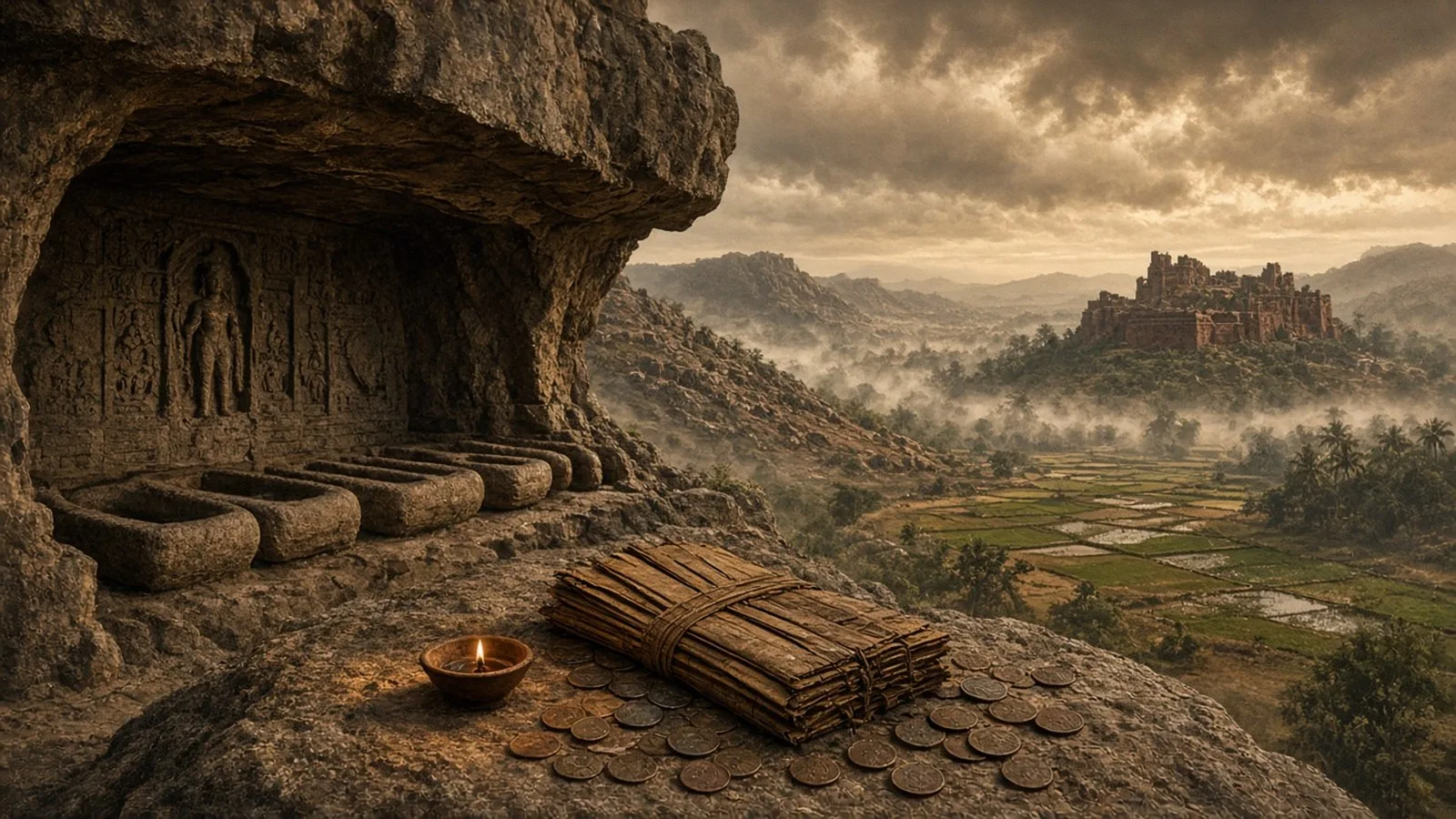
The Kalabhras entered modern scholarship through one passage. The Velvikudi plates, issued around 770 CE by the Pandya king Nedunchadaiyan and published in 1923, record a Brahmin's petition: his ancestor had received the village of Velvikudi from the Sangam-era Pandya Palyagasalai Mudukudumi Peruvazhuthi. Then "a Kali king named Kalabhran took possession of the extensive earth, driving away numberless great kings (adhiraja)", and resumed the village. After that the Pandya Kadungon "sprang forth like the sun rising from the ocean" and restored royal order. Nedunchadaiyan, hearing the petition generations later, returned the land.
This is precious evidence, but it is a legal document written two centuries later, with every interest in painting the Kalabhras as usurpers; kali evokes the Kali age, the dark era of Hindu cosmology. The 10th-century Dalavaipuram plates repeat that Kadungon uprooted the Kalappazhar, so the name was at least a real part of Pandya memory.
Buddhadatta and Achyuta Vikranta
The closest thing to a contemporary voice is Buddhist. Buddhadatta, a Pali scholar usually dated to the 5th century, wrote his Vinayavinicchaya (a manual of monastic discipline) at a monastery on the Kaveri. Its closing verse says it was finished "while Achyuta Vikranta, the joy of the Kalamba family, ruled the earth"; a later commentary calls him king of the Chola country. Buddhadatta also describes Kaveripattinam, the old Chola port, as a crowded city of bazaars, gardens and monasteries. Most scholars read "Kalamba" as Kalabhra, though manuscripts differ.
Verses in the Yapparungalam commentary
A 10th-century Jain commentary on the Yapparungalam, a treatise on Tamil prosody, quotes old verses about a king called Achyuta, sometimes "Achyuta Kalappalan". In some, the Chera, Chola and Pandya kings, held captive in his court, each sing a verse. Others ask both Vishnu and the Jain Arhat to protect Achyuta, and give him the fish, bow and tiger emblems of all three Tamil dynasties. Similar verses appear in the later anthology Tamil Navalar Charitai. This is poetry, not chronicle, but it suggests an overlord who claimed the whole Tamil land.
The Periyapuranam and Murthi Nayanar
The 12th-century Shaiva hagiography Periyapuranam tells how a "king of the Vaduga-Karnataka" country conquered Madurai, embraced Jainism and harassed Shaiva devotees. When he cut off the merchant Murthi's supply of temple sandalwood, Murthi ground his own elbow on the stone instead. The king died that night without an heir, and the state elephant chose Murthi as ruler. Many historians identify this king as a Kalabhra. Yet the same tradition honours Kootruva Nayanar of Kalandai, a Shaiva saint later called a Kalappalar, so not every Kalabhra fits the "anti-Shaiva" picture.
Pulankurichi and the coins
In 1979 the Tamil Nadu State Department of Archaeology documented rock inscriptions at Pulankurichi, in today's Sivaganga district, issued under a king named Chendan Kurran in "year 192". They record two Hindu shrines (devakulam) and an ascetics' retreat (tapata-palli) in Madurai. R. Nagaswamy read the year in the Saka era, giving 270 CE; Iravatham Mahadevan and others date the script to around 500 CE, note Kannada features, and treat Chendan Kurran as a Kalabhra. Either way, it is among the earliest dated Tamil stone inscriptions.
Coins add a little. In 1986 the numismatist R. Krishnamurthy published a square copper coin from the Amaravati riverbed near Karur with an elephant and a legend he read as "Galapira". Coins from the Madurai–Karur region showing a seated Jain monk or a swastika have also been linked to the period, but other scholars question the readings and dates.
Who were the Kalabhras?
There is no agreed answer. The main theories are:
- Invaders from the Karnataka region. The Periyapuranam's "Vaduga-Karnataka" king, the Kannada flavour of the Pulankurichi text and their links with Jainism led R. Narasimhacharya, V. Venkayya and later Mahadevan to see them as a group from the southern Deccan. Mayilai Seeni Venkatasamy tied them to Kalbappu, the Jain hill at Shravanabelagola.
- Local Tamil groups. M. Raghava Iyengar and S. Krishnaswami Aiyangar looked for local roots: the Kalvar of the Venkatam hills, ruled in Sangam poems by "Pulli, lord of the Kalvar", or the Kalappalar, a Vellala landholding lineage.
- Ancestors of the Muthuraiyar. T. A. Gopinatha Rao and Seeni Venkatasamy linked them to the Muthuraiyar chiefs of the Thanjavur–Pudukkottai region; many historians reject this as unproven.
- A label more than a people. Some recent scholars argue that "Kalabhra" in the Velvikudi plates is an ideological device, a convenient villain in a land dispute, not proof of a three-century foreign dynasty.
As Hermann Kulke and Dietmar Rothermund put it, "nothing is known about the origins or tribal affiliations" of the Kalabhras.
Religion: Jain, Buddhist and more
The Kalabhras are traditionally linked with the shramana faiths, the Jain and Buddhist traditions (introduced in our Indian history series on Mahavira and the origins of Jainism and Gautama Buddha and the origins of Buddhism). Jain monks had lived in Tamil rock shelters with carved stone beds since the earliest Tamil-Brahmi inscriptions. According to the 10th-century Jain text Darshanasara, the monk Vajranandi founded the Dravida Sangha, a Jain monastic order, at Madurai in Vikrama year 526, about 469–470 CE. Buddhadatta worked on the Kaveri under royal patronage.
Yet the picture is mixed. The Achyuta verses invoke Vishnu as well as the Arhat, the Pulankurichi king endowed Hindu and Jain shrines alike, and Mahadevan notes that Jain inscriptions actually become rarer in this period. The image of Kalabhras as enemies of Hindu worship comes mainly from Shaiva and Pandya sources written after the Bhakti revival.
A literary flowering?
If politics is obscure, literature is not. Much of the post-Sangam canon is placed, with wide margins, in these centuries:
- The Pathinenkilkanakku ("eighteen minor works"), mostly short didactic poems, including the Thirukkural, the Naladiyar (traditionally credited to Jain monks), Pazhamozhi Nanuru and Acharakkovai.
- The twin epics Silappathikaram and Manimekalai, which many scholars date to the 5th–6th centuries.
- Probably the final arrangement of the older Sangam anthologies.
Their stress on non-violence, self-control and charity fits Jain and Buddhist influence. So Seeni Venkatasamy, in Kalappirar Atchiyil Tamilagam ("Tamil Nadu under Kalabhra Rule", 1975), argued that Tamil language and literature flourished in this period; as early as 1922 M. S. Ramaswami Aiyangar had called it an "Augustan age" of Tamil letters. Caution is needed: the dates of nearly all these texts are debated.
The "dark age" debate
Four broad positions have emerged:
- Dark age. Building on the Velvikudi passage, K. A. Nilakanta Sastri, the leading South Indian historian of the mid-20th century, described an interregnum in which obscure "evil" rulers overturned the old order, a view that shaped textbooks for decades.
- Social upheaval. R. S. Sharma read the Kalabhra episode as a sign of the "Kali age" crisis, a revolt against the Brahmin-led agrarian order. Burton Stein saw it as a bid for power by non-peasant warrior groups backed by Jain and Buddhist institutions.
- Transition, not collapse. R. Champakalakshmi and others treat these centuries as a transition from the Sangam chiefdoms to the temple-centred agrarian kingdoms of the Pallavas and Pandyas.
- No real break. Valérie Gillet, of the French School of the Far East in Pondicherry, argued in 2014 that archaeology and epigraphy show no actual interruption; the thinner record reflects perishable building materials, and the idea of a three-century Kalabhra rule "does not withstand a fact-based investigation".
As the historian Rebecca Darley notes, every theory runs into a "profound lack of evidence" about what Kalabhra rule was actually like.
The end of the Kalabhras
The end is better documented. In the south, Pandya plates credit Kadungon (c. 560–590 CE) with ending Kalabhra rule and founding the early medieval Pandya line at Madurai. In the north, the Pallava Simhavishnu (c. 575–600) took the Kaveri delta, and Pallava records claim he defeated the Kalabhras. Shortly before, his father Simhavarman issued the Pallankovil copper plates (c. 550 CE), granting a village to the Jain teacher Vajranandi of Tiruparuttikunram near Kanchipuram; among the earliest bilingual Sanskrit–Tamil charters, they show Jain institutions still honoured as the new order began. Later Pallava and Chalukya kings still boasted of defeating "Kalabhras", by then probably minor chiefs.
Timeline
| Date (approx.) | Development | How firm? |
|---|---|---|
| c. 3rd century CE | Sangam-era kingdoms fade from the record | Scholarly estimate |
| 270 CE or c. 500 CE | Pulankurichi inscriptions of Chendan Kurran | Debated |
| 5th century | Buddhadatta writes under Achyuta Vikranta | Scholarly estimate |
| c. 469–470 CE | Vajranandi founds the Dravida Sangha at Madurai | Later Jain tradition |
| c. 550 CE | Pallankovil plates of Simhavarman | Fairly firm |
| c. 560–590 CE | Kadungon restores Pandya rule | Scholarly estimate |
| c. 575 CE | Simhavishnu takes the Kaveri delta | Scholarly estimate |
| c. 770 CE | Velvikudi plates name the "Kali king Kalabhran" | Firm |
| 12th century | Periyapuranam tells the Murthi Nayanar story | Firm |
| 1923 | Velvikudi plates published in Epigraphia Indica | Firm |
| 1975 | Seeni Venkatasamy's Kalappirar Atchiyil Tamilagam | Firm |
| 1979 | Pulankurichi inscriptions documented | Firm |
What we can say with confidence
- Confident: later Pandya and Pallava records remember a Kalabhra power that displaced the old dynasties; Kadungon and Simhavishnu ended it in the late 6th century; Jain and Buddhist institutions were active; important Tamil literature dates from this broad period.
- Uncertain: who the Kalabhras were, when they arrived, how much territory they ruled and for how long, whether they persecuted anyone, and whether the "interregnum" was a real break at all.
Next part
Part 14, The Rise of the Pallavas: Simhavishnu and Mahendravarman I, follows the Kanchipuram dynasty that took the Kaveri delta, and the artist-king behind the first Tamil rock-cut temples.
Sources
- H. Krishna Sastri, "The Velvikudi Grant of Nedunjadaiyan", Epigraphia Indica XVII (1923–24), pp. 291–309
- Mayilai Seeni Venkatasamy, Kalappirar Atchiyil Tamilagam (1975; expanded edition 2000), Tamil Wikisource
- Iravatham Mahadevan, Early Jainism in Tamilnadu, and Early Tamil Epigraphy from the Earliest Times to the Sixth Century A.D. (Cre-A/Harvard, 2003)
- Tamil Virtual Academy, Pulankurichi inscriptions (Tamil text); R. Nagaswamy, Tamil Nadu, The Land of the Vedas, chapter on Pulankurichi
- Pallankovil copper plates of Simhavarman, text and purport in Jaina Literature in Tamil; The Hindu, Chronicles of the past in copper
- Sekkizhar, Periyapuranam, The Puranam of Moorti Nayanar (English translation, Shaivam.org)
- K. A. Nilakanta Sastri, The Pandyan Kingdom (1929) and A History of South India (4th ed., 1966)
- R. S. Sharma, "Problems of Peasant Protest in Early Medieval India", Social Scientist 16 (1988); Burton Stein, Peasant State and Society in Medieval South India (1980)
- R. Champakalakshmi, Trade, Ideology and Urbanization: South India 300 BC to AD 1300 (Oxford University Press, 1996); Noboru Karashima (ed.), A Concise History of South India (Oxford University Press, 2014)
- Valérie Gillet, "The Dark Period: Myth or reality?", Indian Economic and Social History Review 51.3 (2014)
- Hermann Kulke and Dietmar Rothermund, A History of India (4th ed., Routledge, 2004); Upinder Singh, A History of Ancient and Early Medieval India (Pearson, 2008)
- The New Indian Express, 'Galapra' period coin die made by Roman smiths minted in Sangam Era? (2017); The Hindu, No proof in literature for Kalabhras defeating Pandiyas, says scholar (2015)