This is Part 6 of HorizonDesk's chronological series on Tamil history, from prehistory to modern Tamil Nadu. The previous instalment was Part 5: Tamil-Brahmi – How Tamil First Came to Be Written.
Some 2,000 years ago a poet asked a simple question: "What is my mother to yours? What is my father to yours? How did you and I ever meet?" The answer came in one image. Their hearts had mingled "like rain poured on red earth". The poet's real name is lost; tradition calls him Sempulapeyaneerar, "the poet of rain on red earth", after his only surviving poem (Kurunthogai 40).
That five-line poem belongs to Sangam literature, the oldest body of Tamil poetry. In Part 5 we met kings and chiefs carved into rock; here, many of the same names come back in verse.
What does "Sangam" mean?
Sangam (Tamil caṅkam) comes from the Sanskrit saṅgha, "assembly" or "fraternity". The poems themselves do not use it for a literary academy. Medieval commentators called them sāṉṟōr ceyyuḷ, "the poetry of the noble ones". The modern label comes from a legend.
The legend of the three Sangams
The fullest version is in a prose commentary on the Iraiyanar Akapporul, a treatise on love poetry. The commentary is credited to one Nakkirar and dated by most scholars to around the 8th century CE. It says Pandya kings hosted three academies of poets:
- First Sangam at a southern Madurai later swallowed by the sea: 4,440 years, 4,449 poets, with the gods Shiva and Murugan and the sage Agastya among the members.
- Second Sangam at Kapatapuram, also lost to the sea: 3,700 years. Its grammar books included the Tolkappiyam.
- Third Sangam at the present Madurai: 1,850 years and 449 poets, who composed the anthologies we still have.
By the 10th century the story was official history: the larger Sinnamanur copper plates of the Pandyas praise an early king for "establishing the Tamil Sangam in the town of Madura".
What historians accept
No historian accepts academies lasting thousands of years, and the sunken-continent tales later called "Kumari Kandam" have no geological or archaeological support. But the legend probably preserves a real memory: Madurai, the poets' Koodal, "rich in Tamil" (Purananuru 58), was a centre of learning under Pandya patronage. Today "Sangam" is simply a convenient name for the early corpus.
The corpus at a glance
The core is the Pathinenmelkanakku, the "Eighteen Greater Texts": eight anthologies (Ettuthokai) and ten long poems (Pathupattu). Kamil Zvelebil, the Czech scholar whose histories are still standard, counted 2,381 poems by 473 named poets, plus 102 anonymous poems. Sixteen poets wrote about half of them. Poems range from three lines to 782 lines.
Ettuthokai: the eight anthologies
| Anthology | Meaning | Poems | Genre and notes |
|---|---|---|---|
| Natrinai (நற்றிணை) | "The good tinai (landscape)" | 400 | Akam (love); 9–12 lines each |
| Kurunthogai (குறுந்தொகை) | "The short collection" | 401 | Akam; 4–8 lines; the source of Ramanujan's Interior Landscape |
| Ainkurunuru (ஐங்குறுநூறு) | "Five hundred short poems" | 500 | Akam; five poets, 100 poems for each landscape |
| Pathitrupathu (பதிற்றுப்பத்து) | "Ten tens" | 80 of 100 survive | Puram (public life); praise of Chera kings |
| Paripadal (பரிபாடல்) | "Poems in the paripadal metre" | 22 of 70 survive, plus fragments | Songs on Tirumal (Vishnu), Murugan and the Vaigai river; later than most |
| Kalithogai (கலித்தொகை) | "Anthology in the kali metre" | 150 | Akam, dramatic dialogues; generally dated later |
| Akananuru (அகநானூறு) | "Four hundred on akam" | 400 | Akam; longer poems, 13–31 lines |
| Purananuru (புறநானூறு) | "Four hundred on puram" | 400 (a few lost) | Puram: war, kings, patrons, death, ethics |
Pathupattu: the ten long poems
Five of the ten are arruppadai, "guide poems". In them a bard who has been richly rewarded meets a poor fellow artist on the road and tells him how to reach the generous patron, describing the lands and people on the way.
| Poem | Poet | Subject or patron |
|---|---|---|
| Thirumurugatruppadai | Nakkirar | A guide to the god Murugan and his shrines; probably the latest of the ten |
| Porunaratruppadai | Mudathama Kanniyar | Karikala Chola, victor of Venni |
| Sirupanatruppadai | Nallur Nathathanar | Nalliyakkodan, a chief of Oymanadu |
| Perumpanatruppadai | Kadiyalur Uruthirankannanar | Thondaiman Ilanthiraiyan of Kanchi |
| Mullaippattu | Napputhanar | A queen waiting for her king to return from war; 103 lines, the shortest |
| Maduraikanchi | Mangudi Maruthanar | Pandya Nedunchezhiyan and a day and night in Madurai; 782 lines, the longest |
| Nedunalvadai | Nakkirar | "The long good north wind": a king in his war camp, a queen in the palace |
| Kurinjippattu | Kapilar | Hill-country love; said to have been composed to teach Tamil poetics to a northern king, Pirakathan |
| Pattinappalai | Kadiyalur Uruthirankannanar | Karikala Chola and the port of Puhar (Kaveripattinam) |
| Malaipadukadam | Perunkunrur Perunkausikanar | Nannan, a hill chief; a guide for travelling performers |
Akam and puram: the inner and the outer
Classical Tamil sorted poems into two kinds. Akam ("inside") poems are about love. Most are dramatic monologues by stock speakers: the heroine, the hero, the heroine's friend (thozhi), her foster mother, her mother. By convention no lover is ever named, which is one reason the poems travel so well across cultures. Puram ("outside") poems are about everything public: war, kings, generosity, grief and the brevity of life. These name real people and places, which makes them valuable to historians.
The most quoted puram poem is Purananuru 192 by Kaniyan Poongundranar: yādum ūrē, yāvarum kēḷir, "Every town is my town, everyone is my kin." It goes on to say that good and evil do not come from others.
Tinai: love mapped onto landscape
Akam poetry links each phase of love to a landscape, or tinai, named after a typical flower or tree. Each has its own season, time of day, birds, beasts and people:
- Kurinji (mountains): lovers' union
- Mullai (forest and pasture): patient waiting
- Marutham (farmland): sulking and quarrels, often over the husband's infidelity
- Neythal (seashore): anxious waiting and lament
- Palai (parched wasteland): separation and hard journeys
A heron on a beach or a peacock in the hills can carry a hidden meaning (ullurai). Puram poetry has its own set of tinai, such as cattle raids, sieges and victory. We will look at what these landscapes tell us about daily life in Part 9.
Who wrote the poems?
Colophons describe the poets as teachers, merchants, goldsmiths, potters and physicians, as well as kings. A few stand out:
- Kapilar, the most prolific, with about 235 poems by the Tamil Virtual Academy's count. He is remembered as the loyal friend of the chief Vel Pari.
- Paranar, whose poems are full of historical allusions to kings and battles.
- Avvaiyar, the best known of many women poets. She was the court poet and envoy of Atiyaman Netuman Anci, the chief named in the Jambai inscription covered in Part 5. She should not be confused with the medieval Avvaiyar of children's proverbs.
- Other women poets include Vellivedhiyar, Okkur Masathiyar and Kakkaipadiniyar Nachellaiyar, who composed the sixth decade of Pathitrupathu.
Colophons: notes that came later
Almost every poem carries a colophon, a short note naming the poet, the landscape, the situation and, for puram poems, the king. The decades of Pathitrupathu also have epilogues (pathikam) listing each Chera king's deeds. These notes were added by later editors and are not always reliable, but they tell us, for example, that Uruthirasanman compiled the Akananuru under the Pandya Ukkira Peruvazhuthi.
Tolkappiyam: the grammar behind the poems
The Tolkappiyam ("the ancient book", by Tolkappiyar) is the oldest surviving Tamil grammar. It has three books (adhikaram), each of nine chapters, about 1,610 short rules (nurpa) in all:
- Ezhuthathikaram, on letters and sounds. It states the rule of the pulli, the dot that marks a bare consonant, which Part 5 traced in the inscriptions.
- Sollathikaram, on words: morphology, syntax and meaning.
- Porulathikaram, on "subject matter": akam and puram, tinai, metre, simile and poetic convention.
Its date is fiercely argued. Tradition places it in the Second Sangam; most scholars now treat it as a layered text. Zvelebil dated an original core of the first two books to roughly the 2nd–1st century BCE. He judged that the third book contained later material, and placed the final redaction around the 5th century CE. Others date the whole work later. The safest statement is that it grew over several centuries alongside the poetry it describes.
How old are the poems?
The mainstream view
Most scholars place the bulk of the poems between about the 3rd century BCE and the 3rd century CE. Zvelebil's narrower window is 100 BCE–250 CE, and K. A. Nilakanta Sastri placed the core in the first two or three centuries CE. The main arguments are:
- Silence about the Pallavas. The Pallavas ruled the Tamil north from about the 3rd–4th century CE, yet the poems never mention them.
- Roman trade. The poems describe Yavana ships bringing gold and wine for pepper at Muziris. This matches finds from the age of the Roman Empire and Graeco-Roman accounts of the 1st–2nd centuries CE.
- Inscriptions. Chera kings in the Pugalur Tamil-Brahmi inscriptions match kings praised in Pathitrupathu. The Atiyaman chief of Jambai matches Avvaiyar's patron. Urban sites such as Keezhadi show the kind of world the poems describe.
- Language. The grammar and vocabulary are clearly older than the devotional hymns of the 6th–9th centuries. The poems also borrow far fewer Sanskrit words.
The poems were composed and transmitted orally for a long time, as the Vedic texts were in the north. The anthologies were compiled much later, roughly between the 5th and 8th centuries, and some would say later still. Zvelebil noted that the group names Ettuthokai and Pathupattu first appear in commentators of the 13th–14th centuries. Several texts, notably Kalithogai, Paripadal and Thirumurugatruppadai, are generally judged later than the rest.
The late-dating challenge
In Kāvya in South India (2001), the Dutch Indologist Herman Tieken argued that the poems were not early at all. In his view, Pandya court poets of the 9th or 10th century created them, imitating Prakrit genres and inventing an archaic past. The book sharpened debate about anthologies and colophons, but most specialists rejected its central claim. George L. Hart of Berkeley wrote that there is "overwhelming and indisputable evidence that the anthologies were not written as late as the ninth or tenth century". He pointed to archaic language, a culture unlike that of the 9th century, and kings confirmed by coins and inscriptions.
Lost and found
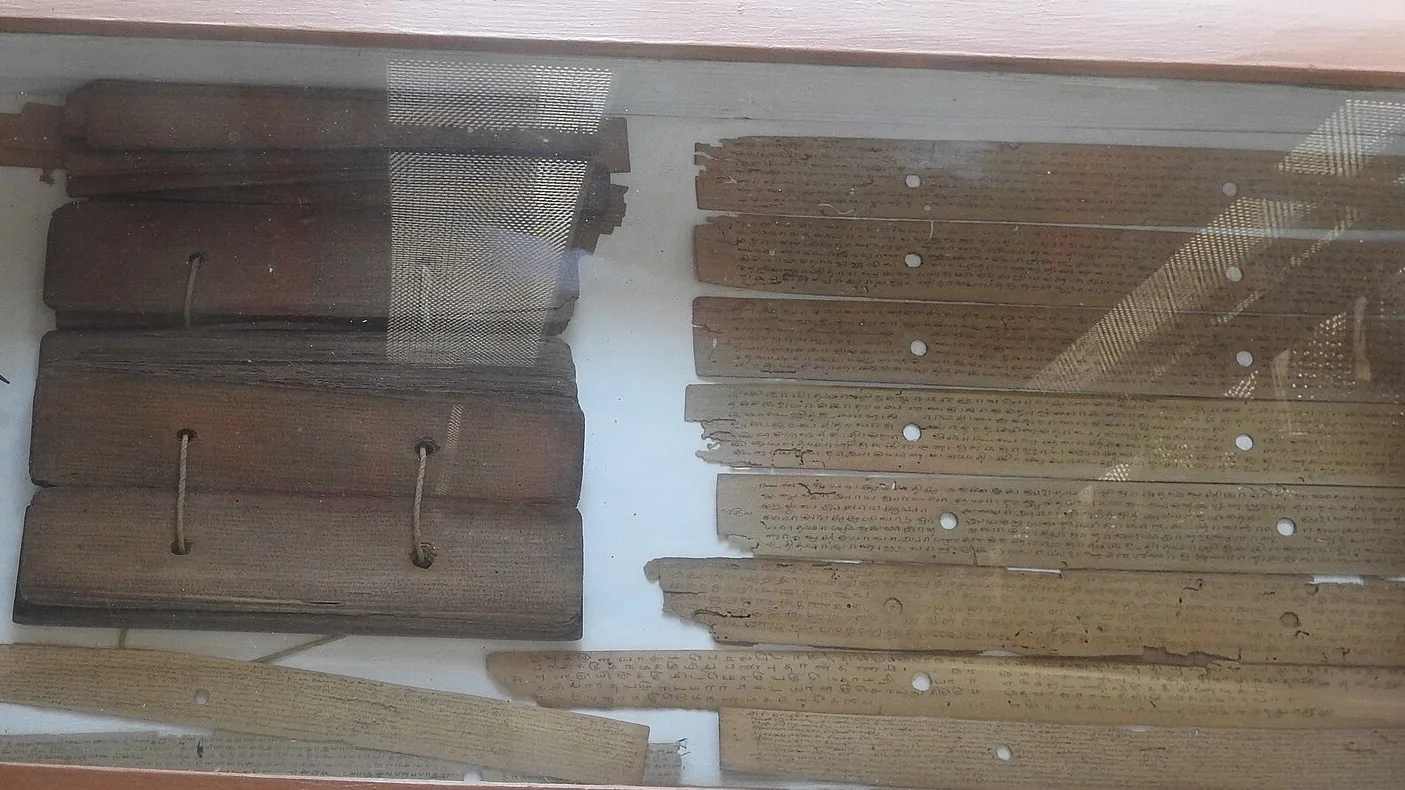
Palm-leaf manuscripts rot in the South Indian climate, and by the 19th century the old poems were barely read. Two scholars brought them back into print: C. W. Damodaram Pillai, who published Kalithogai in 1887, and U. V. Swaminatha Iyer, whose editions of Pathupattu (1889) and Purananuru (1894) were landmarks. By about 1920 the whole corpus was in print. Their story gets its own chapter in Part 43.
Reading Sangam poetry in English
- A. K. Ramanujan, The Interior Landscape (1967), 76 love poems from Kurunthogai, and Poems of Love and War (1985).
- George L. Hart and Hank Heifetz, The Four Hundred Songs of War and Wisdom (1999), the complete Purananuru.
- Martha Ann Selby, Tamil Love Poetry (2011), the Ainkurunuru.
The age did not end with the anthologies. The didactic "Eighteen Lesser Texts", including the Thirukkural (Part 11), and the epic Silappathikaram (Part 12) come from the centuries that followed.
What we can say with confidence
- About 2,381 poems by some 473 named poets survive, the oldest body of Tamil literature.
- Most of it was composed, probably orally, in the centuries around the turn of the Common Era, and compiled much later.
- Its akam–puram division and landscape code are distinctively Tamil, and the Tolkappiyam sets them out.
- The three-Sangam story is legend, though Madurai's role as a centre of Tamil learning is real.
Next part
Part 7, The Three Crowned Kings: Cheras, Cholas and Pandyas of the Sangam Age, uses these poems, together with coins and inscriptions, to meet the dynasties who paid the poets.
Sources
- Kamil V. Zvelebil, Tamil Literature (Brill, 1975); The Smile of Murugan, ch. 3: Problems of dating and ch. 9: Tolkāppiyam (1973)
- Encyclopaedia Britannica, Sangam literature
- Tamil Virtual Academy, Sangam poetry: poems and poets (Tamil); Central Institute of Classical Tamil, Ettuthokai e-books and early editions
- University of Hamburg, Historical Dictionary of Classical Tamil: Iṟaiyaṉār Akapporuḷ; IFP, Caṅkam literature and its public (IFP)
- H. Krishna Sastri (ed.), South Indian Inscriptions Vol. III: Pandya copper-plate grants from Sinnamanur
- Herman Tieken, Kāvya in South India: Old Tamil Caṅkam Poetry (2001); George L. Hart, Remarks on Tieken's Kavya in South India and review in the Journal of the American Oriental Society (2004)
- The Indian Express, The 'rediscovery' of Sangam literature (2025); Tamil Heritage Foundation, U. V. Swaminatha Iyer
- Columbia University Press, The Four Hundred Songs of War and Wisdom; Internet Archive, The Interior Landscape; David Shulman, Waiting for the Perfect Word (New York Review of Books, 2019)
- Learn Sangam Tamil, Sangam Literature overview; K. A. Nilakanta Sastri, A History of South India (OUP); Eva Wilden, Manuscript, Print and Memory: Relics of the Caṅkam in Tamilnadu (De Gruyter, 2014)
Featured image: Tamil palm-leaf manuscripts on display at Auroville, Villupuram district, Tamil Nadu. Photo by Yercaud-elango, via Wikimedia Commons, CC BY 4.0.