This is Part 1 of World Wars, our series on the First and Second World Wars, from the July Crisis of 1914 to the world that emerged in 1945. New parts appear every Monday, Wednesday and Friday.
In the spring of 1914 Europe looked like a continent at the height of its power. Its empires ruled most of Africa and much of Asia, and its great powers had not fought a general war against each other since 1815. Yet within weeks of a single assassination in the Balkans, almost all of them were at war. To understand why, we start not in Sarajevo (that is Part 2) but in the four decades before, when Europe slowly divided itself into two armed camps.
The great powers of 1914
Historians usually count six European "great powers" in 1914:
- Britain – the world's largest empire, covering roughly a quarter of the globe's land and people, with India as its most valuable possession. Its security rested on the Royal Navy, by far the strongest fleet in the world. Its army was small and professional.
- France – a republic since 1870, with a large empire in Africa and Indochina (Vietnam, Laos, Cambodia). It had lost Alsace and Lorraine to Germany in 1871.
- Germany – the newest power, unified only in 1871 under Prussian leadership after the Franco-Prussian War. By 1914 it had the strongest army in Europe, the fastest-growing industry and a ruler, Kaiser Wilhelm II, who wanted a "place in the sun" to match Britain's.
- Russia – a vast empire ruled by Tsar Nicholas II, with the biggest army on paper but a shaky economy. Defeated by Japan in 1904-05 and shaken by revolution in 1905, it saw itself as protector of the Balkan Slavs.
- Austria-Hungary – a "dual monarchy" under the elderly Emperor Franz Joseph, holding together a dozen nationalities. Rising nationalism among them was its greatest fear.
- The Ottoman Empire – losing territory for a century and often called the "sick man of Europe"; reforming officers, the Young Turks, held real power after 1908.
Italy, unified in the 1860s (we covered that story in our article on the unification of Germany and Italy), wanted to be counted among them, but it was weaker than the others and would change sides before it fought.
Two armed camps: Triple Alliance and Triple Entente
The first German chancellor, Otto von Bismarck, tried to protect the new Germany by keeping France isolated. In 1879 he signed the Dual Alliance with Austria-Hungary; Italy joined in 1882, creating the Triple Alliance. After Wilhelm II dismissed Bismarck in 1890, a secret treaty with Russia was allowed to lapse, and the diplomatic map began to change.
France and Russia, an unlikely pair (a republic and an autocracy), formed an alliance that was finalised by 1894. Britain, which had prided itself on "splendid isolation", started looking for partners. It made an alliance with Japan in 1902, then settled its colonial quarrels with France in the Entente Cordiale of 1904 (Egypt for Britain, Morocco for France) and with Russia in the Anglo-Russian Convention of 1907, which divided Persia (Iran) into spheres of influence and settled disputes over Afghanistan and Tibet.
Together these became the Triple Entente. An entente is an understanding, not a binding alliance: Britain was not formally obliged to fight for France or Russia, though staff talks with France after 1905 created what many British ministers felt was a moral commitment. In Berlin the new friendships looked like a plan to surround Germany, and leaders spoke of Einkreisung, "encirclement".
The Anglo-German naval race
Nothing poisoned relations between Britain and Germany more than warships. Britain depended on imported food and raw materials and on seaborne trade, and since the Naval Defence Act of 1889 it had followed a "two-power standard": a battle fleet at least as large as the next two navies combined.
From 1898, under Admiral Alfred von Tirpitz, Germany passed a series of Navy Laws to build a large battle fleet in the North Sea. Berlin called it a deterrent and a symbol of world-power status; London saw a fleet that could only be aimed at Britain.
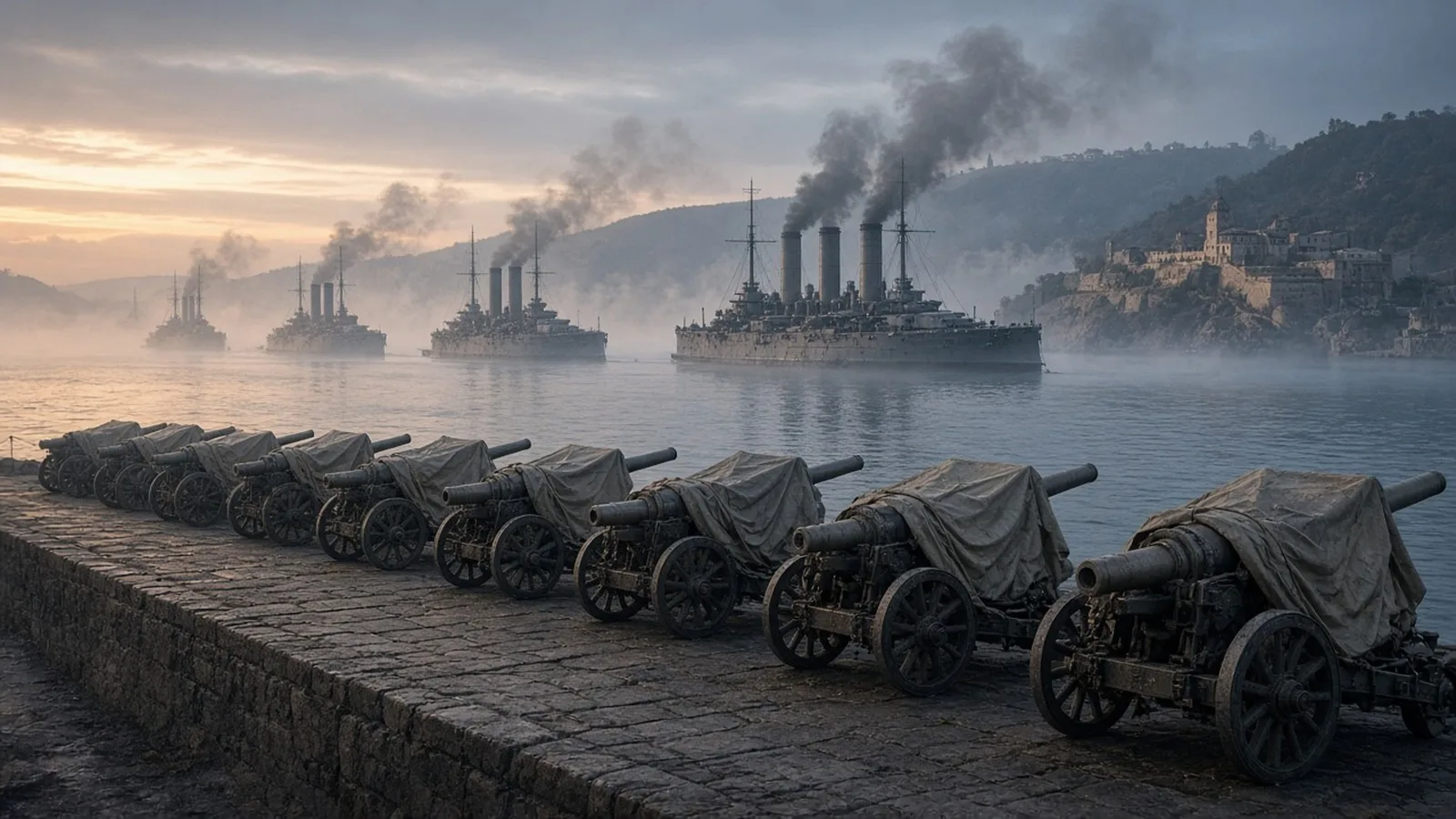
In 1906 Britain raised the stakes with HMS Dreadnought, the brainchild of First Sea Lord Admiral John "Jacky" Fisher. With ten 12-inch guns and steam-turbine engines giving 21 knots, it made every older battleship obsolete. The irony was that it also wiped out much of Britain's own lead: both nations now raced to build "dreadnoughts" from almost the same starting line. Germany launched its first, Nassau, in 1908. In 1909 a press and political scare in Britain produced the popular slogan "We want eight and we won't wait", demanding eight new battleships in a year.
By 1914, according to the Imperial War Museums, Britain had 29 dreadnoughts and Germany 17 (counts vary slightly depending on whether battlecruisers are included). Britain had clearly won the race, and from about 1910 Germany shifted more of its spending to the army. A British attempt at a naval agreement, the Haldane mission of 1912, failed; the damage to trust was done.
Armies, timetables and militarism
The land arms race mattered at least as much. Germany, France, Russia and Austria-Hungary all relied on conscription: young men served two or three years and then joined the reserves, so that in a crisis millions could be called up within days. In 1913 Germany passed a major army expansion law, France extended military service to three years, and Russia announced a "Great Programme" to enlarge its army by 1917.
Every general staff had war plans built around railway timetables. Mobilisation, calling up reservists and moving them to the frontier, was seen as almost the same as war, because whoever mobilised first could strike first. Germany's plan, associated with Alfred von Schlieffen, aimed to knock France out quickly through Belgium before turning on Russia (Part 3).
"Militarism" was also a culture of parades, naval reviews and invasion novels, and many officers believed a short, decisive war was possible. Not everyone agreed: Norman Angell argued in The Great Illusion (1910) that war between industrial economies would ruin winners and losers alike.
Empires collide: the Moroccan crises
Imperial rivalry turned into direct confrontation twice over Morocco. In 1905 the Kaiser landed at Tangier and backed Moroccan independence, challenging France. The Algeciras conference of 1906 sided with France, with Britain firmly beside it.
In 1911 France sent troops to Fez and Germany sent the gunboat Panther to the port of Agadir, hoping to force compensation. Britain again backed France, and David Lloyd George publicly warned Germany in his Mansion House speech. The Agadir crisis ended with France taking Morocco as a protectorate and Germany receiving a strip of French Congo. Both crises drew Britain and France closer, the opposite of what Berlin intended, while quarrels over African colonies and Germany's Berlin-Baghdad railway added to a sense of rivalry everywhere at once.
The Balkan powder keg
The most dangerous region was the Balkans, the peninsula of south-east Europe the Ottomans were slowly losing. Nationalism, the idea that each nation should have its own state, made it explosive.
- In 1908 Austria-Hungary formally annexed Bosnia-Herzegovina, which it had occupied since 1878. Serbia, which wanted to unite the South Slavs, was furious; Russia backed down under German pressure and resolved not to be humiliated again.
- In 1911-12 Italy attacked the Ottoman Empire and took Libya, exposing Ottoman weakness.
- In the Balkan Wars of 1912-13, Serbia, Bulgaria, Greece and Montenegro first drove the Ottomans almost out of Europe and then fought each other over the spoils. Serbia nearly doubled its territory and emerged confident and ambitious; Austria-Hungary now saw it as a threat to its very survival.
Secret nationalist societies in Serbia, including the group known as the Black Hand, linked to senior Serbian army officers, worked for a Greater Serbia. It was a young Bosnian Serb, armed with the help of Black Hand members, who would fire the shots in Sarajevo. (For a one-article overview of how the assassination and the alliances combined, see our explainer on how the First World War began.)
India and the British Empire in 1914
When Britain went to war, so did its entire empire, without any vote in Delhi. India in 1914 was ruled by the British Raj under the Viceroy, Lord Hardinge; the move of the capital from Calcutta (Kolkata) to Delhi had been announced at the Delhi Durbar of 1911.
Indian revenues paid for a large standing army, the Indian Army, of roughly 150,000 Indian soldiers in peacetime alongside a British garrison (figures vary by source). Much of British policy, including the 1907 deal with Russia, was about protecting India and the Suez Canal route to it. That army would soon be sent abroad: according to the National Army Museum, Indian divisions were on the Western Front by the end of 1914, and about 1.27 million Indians served as soldiers and labourers during the war (other estimates are higher).
Politically, India was stirring. The partition of Bengal in 1905 had sparked the Swadeshi movement before it was reversed in 1911, and the Ghadar Party, founded by Indians in North America in 1913, hoped a European war would weaken British rule. Most Congress leaders in 1914, though, backed the war effort, hoping loyalty would bring self-government, a thread we will follow in later parts.
Myth vs evidence: what historians still argue about
Students often learn the causes as MAIN: Militarism, Alliances, Imperialism and Nationalism. It is a useful checklist, but historians warn it is not an explanation by itself. Several debates remain open:
- Did the alliances make war inevitable? No. Italy, a Triple Alliance member, stayed neutral in 1914 and joined the other side in 1915, and Britain was not bound by treaty to France. Alliances shaped choices; people still made them.
- Was Germany chiefly to blame? In 1961 the German historian Fritz Fischer argued that Germany's leaders deliberately pursued war for European dominance. His thesis caused a storm and remains influential.
- Or did everyone "sleepwalk" into war? Christopher Clark's The Sleepwalkers (2012) spreads responsibility more widely, stressing decisions in Vienna, St Petersburg, Paris and Belgrade too. Margaret MacMillan's The War That Ended Peace (2013) argues that surviving earlier crises made leaders over-confident. Lloyd George later wrote that the nations "slithered over the brink" into war, a phrase some historians now find too forgiving.
- Was the naval race decisive? Britain had effectively won it by 1912, and Anglo-German relations were calmer in 1913-14. Many historians see it as poisoning trust rather than directly causing war.
Long-term tensions made a great war possible, not certain. What turned a Balkan quarrel into a world war were decisions taken in five weeks in the summer of 1914.
At a glance: Europe before 1914
| Period | 1871 (German unification) to June 1914 |
| Triple Alliance | Germany, Austria-Hungary, Italy (1882) |
| Triple Entente | France, Russia (1894), Britain (1904, 1907) |
| Key rulers | Kaiser Wilhelm II, Tsar Nicholas II, Emperor Franz Joseph, King George V, President Raymond Poincaré |
| Naval race | From 1898 (German Navy Laws); HMS Dreadnought 1906; about 29 British vs 17 German dreadnoughts by 1914 (IWM) |
| Crises | Morocco 1905-06 and 1911; Bosnia 1908; Balkan Wars 1912-13 |
| India | British Raj, capital moved to Delhi (1911); Indian Army about 150,000 in peacetime; at war automatically from 4 August 1914 |
Next in the series
Part 2: Sarajevo and the July Crisis of 1914. On 28 June 1914 Archduke Franz Ferdinand was shot in Sarajevo. We follow the five weeks of ultimatums, the "blank cheque", mobilisation orders and Belgian neutrality that took Europe from an assassination to a continental war.
Sources
- Outbreak of the First World War, Imperial War Museums
- How alliances led to the First World War, Imperial War Museums
- The naval race between Britain and Germany before the First World War, Imperial War Museums
- Triple Entente, Encyclopaedia Britannica
- Anglo-Russian Entente 1907, History of Government blog, UK Government
- Dreadnought (1906) ship model, Royal Museums Greenwich
- The Commonwealth and the First World War, National Army Museum
- Clark, C. (2012), The Sleepwalkers: How Europe Went to War in 1914; MacMillan, M. (2013), The War That Ended Peace; Fischer, F. (1961), Griff nach der Weltmacht (English: Germany's Aims in the First World War)