This is Part 9 of HorizonDesk's chronological series on Indian history, from the Stone Age to Independence in 1947.
In Part 8 of this series, we followed Siddhartha Gautama from Lumbini to Sarnath. Walking the same roads of Magadha at the same time was another renouncer, whom Buddhist texts call Nigantha Nataputta, "the unbound one of the Nata clan". His followers knew him as Vardhamana and remember him as Mahavira, the "great hero". The tradition he shaped, Jainism, has survived in India without a break for some 2,500 years.
This part looks at the teachers Jains place before Mahavira, what we can say about his life and teachings, how the community preserved its scriptures and split into two branches, and how it spread as far as Tamil country. As with the Buddha, most details come from texts written down centuries later, so tradition and evidence need to be kept apart.
Before Mahavira: the 24 Tirthankaras
Jains do not regard Mahavira as the founder of their religion. In Jain belief, time turns in endless cycles, and in each half-cycle 24 Tirthankaras ("ford-makers") appear: perfected human teachers who make a crossing over the river of rebirth. They are also called Jinas, "conquerors" of the passions, which gives us the word Jain. The first of our age is Rishabhanatha (Adinatha); Mahavira is the 24th and last.
The earlier Tirthankaras are given lifespans of thousands of years or more, and historians treat them as figures of faith. The 23rd, Parshvanatha, is different. Tradition places him about 250 years before Mahavira, in the 9th–8th century BCE; historians who accept him usually prefer the 8th–7th century BCE. Britannica calls him the first Tirthankara "for whom there is historical evidence", though that evidence is "intricately interwoven with legend". Early texts mention an older "fourfold restraint" (chaturyama) kept by Parshva's followers, forbidding killing, lying, stealing and owning property, and describe Mahavira's monks meeting them. Sceptics note that full biographies of Parshva appear only around the turn of the Common Era. The safest view is that Mahavira reformed an existing ascetic tradition rather than inventing a new one.
When did Mahavira live?
Mahavira's dates are as disputed as the Buddha's, and the two debates are linked: the texts make them contemporaries under Bimbisara and Ajatashatru, the Magadhan kings of Part 7.
- Traditional dates: born 599 BCE, died (attained nirvana) 527 BCE, the start of the Jain era Vira Nirvana Samvat. Some Digambara reckonings differ slightly.
- Revised dates: the 12th-century scholar Hemachandra placed Chandragupta Maurya only 155 years after Mahavira's death. Building on this, scholars such as Hermann Jacobi proposed roughly 549–477 or 540–468 BCE.
- Later dates: if the Buddha died around 400 BCE, Mahavira must move too. Paul Dundas suggests a death "around 425 BCE, or a few years after"; some writers give c. 497–425 BCE.
Britannica notes that many scholars think the traditional birth date may be "as much as 100 years early". All accounts give him about 72 years; the open question is the century.
Mahavira's life: what the tradition says
The oldest source is the first book of the Acharanga Sutra, which describes his austerities in terse verse. The fuller biography is in the Shvetambara Kalpa Sutra, traditionally credited to Bhadrabahu; Digambara accounts such as the 9th-century Uttarapurana differ in places.
Vardhamana was born into a kshatriya family at Kundagrama, which most scholars place near Vaishali, seat of the Licchavis of the Vajji confederacy in north Bihar; many identify it with the village of Basokund, though the exact site is debated. His father, Siddhartha, was a chief of the Jnatrika (Naya) clan, and his mother, Trishala, is described as a Licchavi noblewoman. Shvetambaras say he married Yashoda and had a daughter, Priyadarshana; Digambaras hold that he never married.
Both agree that at about 30 he gave away his possessions and became a wandering ascetic. For some twelve and a half years he fasted, meditated in silence and endured heat, cold, insects and hostile villagers. The Acharanga says he soon gave up even his single robe. For a time he is said to have travelled with Makkhali Gosala, later leader of the rival Ajivika sect.
Kevala jnana and the teaching years
At about 42, tradition says, Mahavira attained kevala jnana, complete knowledge, under a sal tree beside the Rijupalika river near Jrimbhikagrama. For Jains, once the karma clouding the soul is destroyed, it sees all things as they are. He was now a Jina and a Tirthankara.
His first chief disciples (ganadharas) were eleven learned brahmins led by Indrabhuti Gautama, credited with turning his sermons into scripture. For about 30 years he taught across Magadha and Videha. He died at about 72 at Pava, which Jains identify with Pavapuri near Rajgir, where the marble Jal Mandir stands in a lotus pond; some scholars place ancient Pava further north. Jains remember his nirvana at Diwali and his birth on Mahavir Jayanti.
What did Mahavira teach?
For Jains the universe is eternal and uncreated, with no creator god. It holds countless souls (jiva), each capable of infinite knowledge and bliss, and non-soul (ajiva), including matter, space and time. Souls live in humans, animals and plants, and even in tiny bodies of earth, water, fire and air.
- Karma as matter. Karma is a subtle substance that clings to the soul when it acts with passion, like dust on an oiled surface, binding it to rebirth. Liberation (moksha) comes from stopping new karma and burning off the old through restraint and austerity; the freed soul rises to the top of the universe as a siddha.
- Ahimsa. Since harming any being binds karma, non-violence is the supreme rule. It shapes the strictly vegetarian Jain diet and monastic habits such as sweeping the path and filtering water.
- The five great vows (mahavratas) of monks and nuns: non-violence, truthfulness, not stealing, celibacy and non-possession (aparigraha). Shvetambara tradition says Mahavira added celibacy to Parshva's four. Lay people take lighter vows, the anuvratas.
- The three jewels (triratna): right faith, right knowledge and right conduct, which together form the path to liberation, as the Tattvartha Sutra says in its first line.
- Anekantavada, "non-one-sidedness": reality has many aspects and no single statement captures it all. Its logical tool, syadvada, qualifies each claim with syat ("in some respect") in seven possible forms, often explained through the parable of the blind men and the elephant. Later philosophers systematised these ideas, but Jains trace them to Mahavira.
The fourfold community
Mahavira organised a fourfold sangha of monks, nuns, laymen (shravakas) and laywomen (shravikas). Shvetambara texts say he left 14,000 monks and 36,000 nuns, led by Chandana; the numbers are symbolic, but nuns have outnumbered monks ever since. Historians often credit the bond between ascetics and a disciplined lay community of traders and farmers for Jainism's survival in India, where Buddhism largely vanished.
The Agamas and the councils
The teachings were passed down by memory. Tradition says the ganadharas arranged them into 12 Angas ("limbs"). Jain sources describe gatherings to save them:
- A council at Pataliputra under Sthulabhadra, traditionally around 300 BCE, after a 12-year famine scattered the monks.
- Parallel councils at Mathura and Valabhi in Saurashtra, around the 4th century CE.
- A final council at Valabhi under Devarddhigani Kshamashramana, traditionally in 453 or 466 CE, which had the canon written down.
The surviving Shvetambara Agamas, in Ardhamagadhi Prakrit, are counted as 45 texts by image-worshipping Murtipujakas and 32 by the Sthanakavasi and Terapanthi groups. Digambaras hold that the original canon was lost and revere later works such as the Shatkhandagama and Kundakunda's writings. Umasvati's Tattvartha Sutra is accepted by both. The council accounts survive in late sources, so their dates are uncertain.
Digambara and Shvetambara
Digambara ("sky-clad") monks go naked; Shvetambara ("white-clad") monks and nuns wear white. They also disagree on whether a woman can attain liberation without rebirth as a man (Digambaras say no), on Mahavira's marriage and on the canon.
A famous story explains the split. The teacher Bhadrabahu foresaw a 12-year famine in Magadha and led monks south to Shravanabelagola in Karnataka, accompanied, it is said, by Chandragupta Maurya, who had renounced his throne and later fasted to death on Chandragiri hill. Those who stayed under Sthulabhadra began wearing white. Historians treat this as tradition: the earliest Shravanabelagola inscription about Bhadrabahu's journey dates from around the 7th century CE. The sects date the formal break to around 79–82 CE, but most scholars see a gradual parting completed by about the 5th century CE.
Spread and royal patronage
Jain sources claim many early kings, including Bimbisara (also claimed by Buddhists), Chandragupta Maurya and Ashoka's grandson Samprati. Firmer evidence starts with Kharavela of Kalinga, whose Hathigumpha inscription near Bhubaneswar, usually dated to the 1st century BCE, opens with a salutation to the arhats. At Mathura, the Kankali Tila excavations revealed a Jain stupa and many Kushan-period inscriptions recording gifts by women, merchants and artisans.
In the south, the Western Gangas, Kadambas and Rashtrakutas patronised Jains; in 981 or 983 CE the Ganga minister Chavundaraya had the 17-metre Bahubali (Gommateshwara) carved from a granite outcrop at Shravanabelagola. Jain caves were cut at Ellora, and western India produced marble masterpieces such as the Dilwara temples at Mount Abu, featured in our Rajasthan travel guide, and the temple-crowned hill of Palitana in Gujarat.
Jainism in the Tamil land
Natural caverns in the hills around Madurai hold polished stone beds and some of the oldest Tamil inscriptions, in the Tamil-Brahmi script described in our Tamil history series. At Mangulam, inscriptions dated by the epigraphist Iravatham Mahadevan to about the 2nd century BCE record beds made for a monk named Nanda-siri Kuvan, with donors linked to the Pandya king Nedunchezhiyan. Mahadevan saw most such caves as Jain, though some may have sheltered Ajivikas or Buddhists.
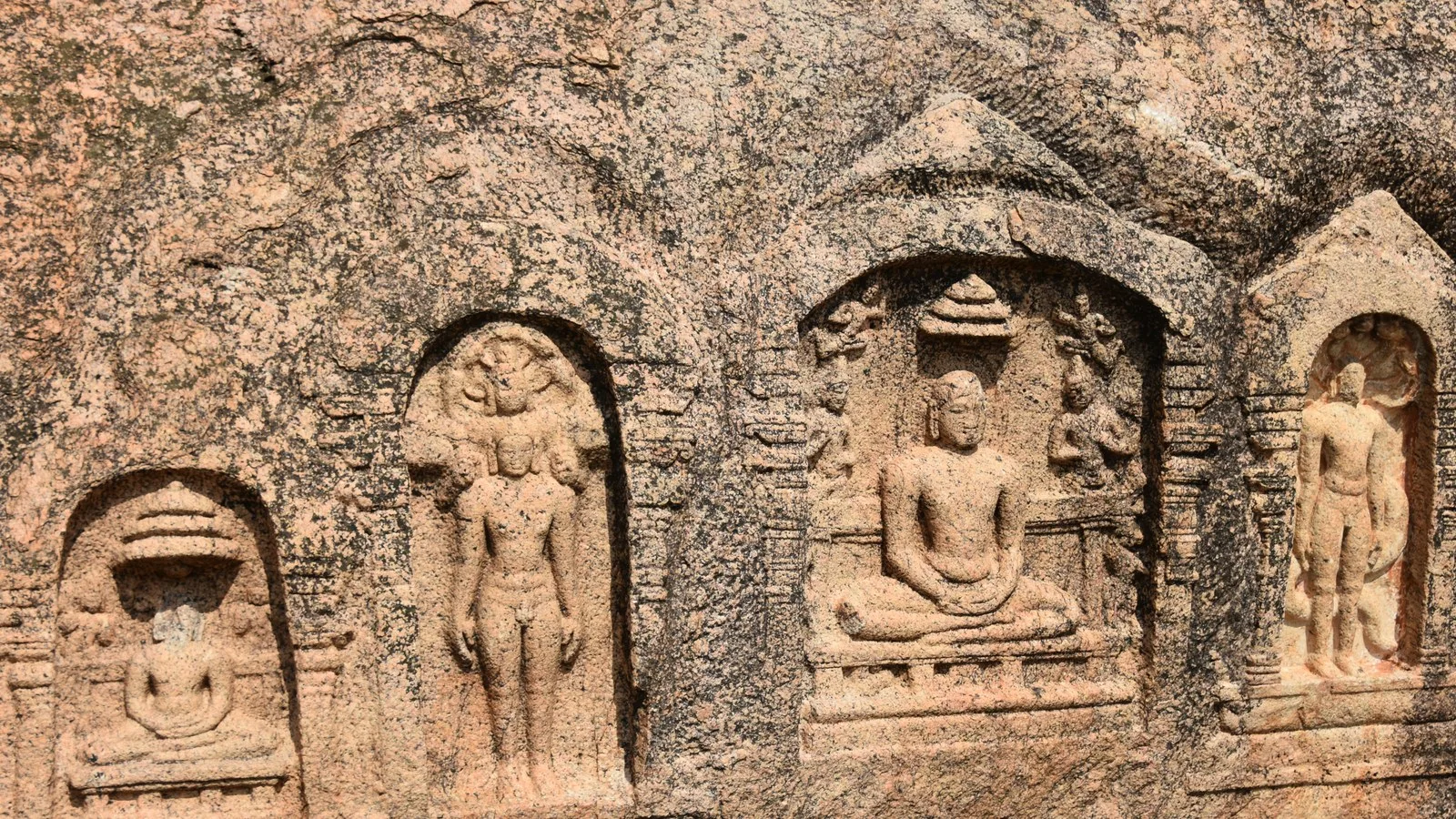
Later, mostly in the 9th–10th centuries, Tirthankara reliefs were carved on the Samanar Hills at Keezhakuyilkudi, shown in our featured image, and at Kalugumalai, while the Sittannavasal cave temple near Pudukkottai keeps faded paintings of a lotus pond. Jain authors enriched Tamil literature, from the Naladiyar to the epic Jivaka Chintamani. The bhakti movement pushed Jainism to the margins from the 7th century, but Tamil Jains still live in northern Tamil Nadu, and the temples of Tiruparuttikunram near Kanchipuram remain in worship.
Jainism and Buddhism compared
Both traditions had kshatriya founders in the eastern Ganga plains, rejected Vedic authority and animal sacrifice, taught karma, rebirth and liberation, and built orders of monks and nuns supported by lay people. But they differ:
- The self: Jainism teaches an eternal individual soul; early Buddhism denies any unchanging self.
- Austerity: Jainism prizes rigorous fasting; the Buddha chose a Middle Way, and Pali texts criticise the Nigantha's followers for self-mortification.
- Karma: a physical substance for Jains, above all intention for Buddhists.
- Survival: Buddhism spread across Asia but faded in India; Jainism stayed largely Indian and endured.
Legacy
The 2011 Census counted about 4.45 million Jains, around 0.4 per cent of India's people, yet their influence is far larger. Jain ideas helped make vegetarianism and non-violence core Indian values, and Mahatma Gandhi acknowledged a debt to the Jain thinker Shrimad Rajchandra. Jain temple libraries at Patan and Jaisalmer preserved thousands of manuscripts, and Jain authors shaped Prakrit, Sanskrit, Kannada, Gujarati and Tamil literature.
Key takeaways
- Jains see Mahavira as the 24th Tirthankara, not the founder; Parshvanatha was probably a real earlier teacher.
- Tradition dates Mahavira to 599–527 BCE; many scholars prefer c. 540–468 or c. 497–425 BCE.
- Born near Vaishali, he attained kevala jnana after about 12 years of austerity and died at Pava.
- His teaching centres on ahimsa, karma as matter, the five vows, the three jewels and anekantavada.
- The Shvetambara canon was written down at Valabhi in the 5th century CE; the sect split was gradual.
- Jain monks were among the earliest users of writing in Tamil country.
Next part
In Part 10, we look west to Persian and Greek contact: how the Achaemenid empire reached the Indus, and how Alexander's invasion of India in 327–325 BCE brought the subcontinent into the Greek world's view.
Sources
- Dundas, P. (2002), The Jains, 2nd edn, Routledge
- Jaini, P. S. (1979), The Jaina Path of Purification, University of California Press
- Long, J. D. (2009), Jainism: An Introduction, I. B. Tauris
- Singh, U. (2008), A History of Ancient and Early Medieval India: From the Stone Age to the 12th Century, Pearson, chapter 6
- Thapar, R. (2002), Early India: From the Origins to AD 1300, Penguin and University of California Press
- Mahadevan, I. (2003), Early Tamil Epigraphy: From the Earliest Times to the Sixth Century A.D., Cre-A and Harvard University
- Jacobi, H. (trans.) (1884), Jaina Sutras, Part I: Akaranga Sutra and Kalpa Sutra, Sacred Books of the East vol. 22
- Encyclopaedia Britannica, Mahavira, Parshvanatha and Jainism
- Internet Encyclopedia of Philosophy, Jain Philosophy
- Archaeological Survey of India, Chennai Circle, List of protected monuments (Samanar Malai, Sittannavasal, Mangulam)
- Jain, M. (2015), The Tamil Jains: a minority within a minority, LSE South Asia blog
- Census of India 2011, religion data (C-1 tables)
Featured image: rock-cut reliefs of Jain Tirthankaras on the Samanar Hills (Samanar Malai) at Keezhakuyilkudi, near Madurai. Photo by Richard Mortel, via Wikimedia Commons, CC BY 2.0.