This is Part 5 of HorizonDesk's chronological series on Tamil history, from prehistory to modern Tamil Nadu. The previous instalment was Part 4: Sivakalai, Kodumanal and Porunthal – New Excavations and Iron Age Dates.
On a granite hill at Mangulam, north-east of Madurai, six short lines are cut into the rock above a group of natural caverns. One names a Pandya king, Nedunchezhiyan. The lines are more than 2,000 years old, and the epigraphist Iravatham Mahadevan counted inscriptions like these among the oldest writing in any Dravidian language.
The script is Tamil-Brahmi, also called Tamili (தமிழி). It survives on cave walls, pots, coins and memorial stones, and on potsherds found as far away as Egypt and Thailand. Here is what it is, who wrote it and why its age is still argued over.
What is Tamil-Brahmi?
Brahmi is the ancestor of most scripts of South and Southeast Asia. Its first large, securely dated body of texts is the edicts of the Mauryan emperor Ashoka (reigned c. 268–232 BCE), written in Prakrit, the vernacular Indo-Aryan languages of the north. Tamil-Brahmi is a regional variant adapted to Tamil; Jain texts list a script called Damili, and many Tamil scholars prefer Tamili.
The cave inscriptions were long misread as Prakrit. In 1919 H. Krishna Sastri spotted letters for Tamil-only sounds, and in 1924 K. V. Subrahmanya Aiyar showed that the language was Tamil. Mahadevan's Early Tamil Epigraphy (2003; revised 2014) remains the standard corpus.
How it differs from Ashokan Brahmi
- Letters dropped: signs for sounds Tamil lacks, such as voiced and aspirated consonants, sibilants and conjuncts.
- Letters added: signs for ḻ (ழ, the "zha" in Tamiḻ), ḷ (ள), ṟ (ற) and ṉ (ன). Mangulam has the earliest known ழ.
- The vowel problem: in Ashokan Brahmi a bare consonant carries a built-in "a". Prakrit words rarely end in a consonant, but Tamil words often do (many names end in -aṉ), so scribes needed a way to write a consonant with no vowel.
Mahadevan's three stages
- TB-I: a bare consonant is read as a pure consonant (k, not ka); Ashoka's long-ā mark stands for both a and ā.
- TB-II: a bare consonant may or may not carry an inherent a; the ā-mark means only long ā.
- TB-III: the bare consonant always carries a, as elsewhere in Brahmi, and a dot, the pulli (புள்ளி), cancels the vowel.
The pulli is still used today. The grammar Tolkappiyam states the rule: meyyiṉ iyaṟkai puḷḷiyoṭu nilaiyal, "the nature of a consonant is to stand with a dot". Mahadevan dated the early stage to the 2nd–1st centuries BCE, a middle stage to the 1st–2nd centuries CE and a late stage to the 3rd–4th centuries CE.
Cave inscriptions: monks, kings and merchants
Most stone inscriptions sit under overhanging boulders on granite hills, many around Madurai. Monks slept on smoothed rock beds (kal-paḍukkai), and a drip-ledge cut above the entrance kept rain out. The inscriptions record who gave the shelter (paḷi, later paḷḷi) and to whom. The Tamil Nadu Archaeology Department, summarising Mahadevan, counts nearly 110 cave inscriptions at 32 sites, overwhelmingly linked to Jain monks. Mahadevan called them some of the oldest Jain inscriptions in India.
Mangulam: a Pandya king's gift
Noticed by Robert Sewell in 1882 and dated to about the 2nd century BCE, the Mangulam inscriptions record that Kaṭalaṉ Vaḻuti, an officer of Nedunchezhiyan, had a monastery made for the Jain monk Nanda Siri Kuvan. Others name the king's relative Caṭikaṉ and a member of the merchant guild of Veḷaṟai.
Arittapatti, Mettupatti and Kongar Puliyankulam
- Arittapatti: a 2nd-century-BCE record says Ceḻiyaṉ Atiṉaṉ Veḷiyaṉ of Nelveli sponsored the beds.
- Mettupatti (Siddharmalai): short labels over the beds name monks, many with the honorific antai.
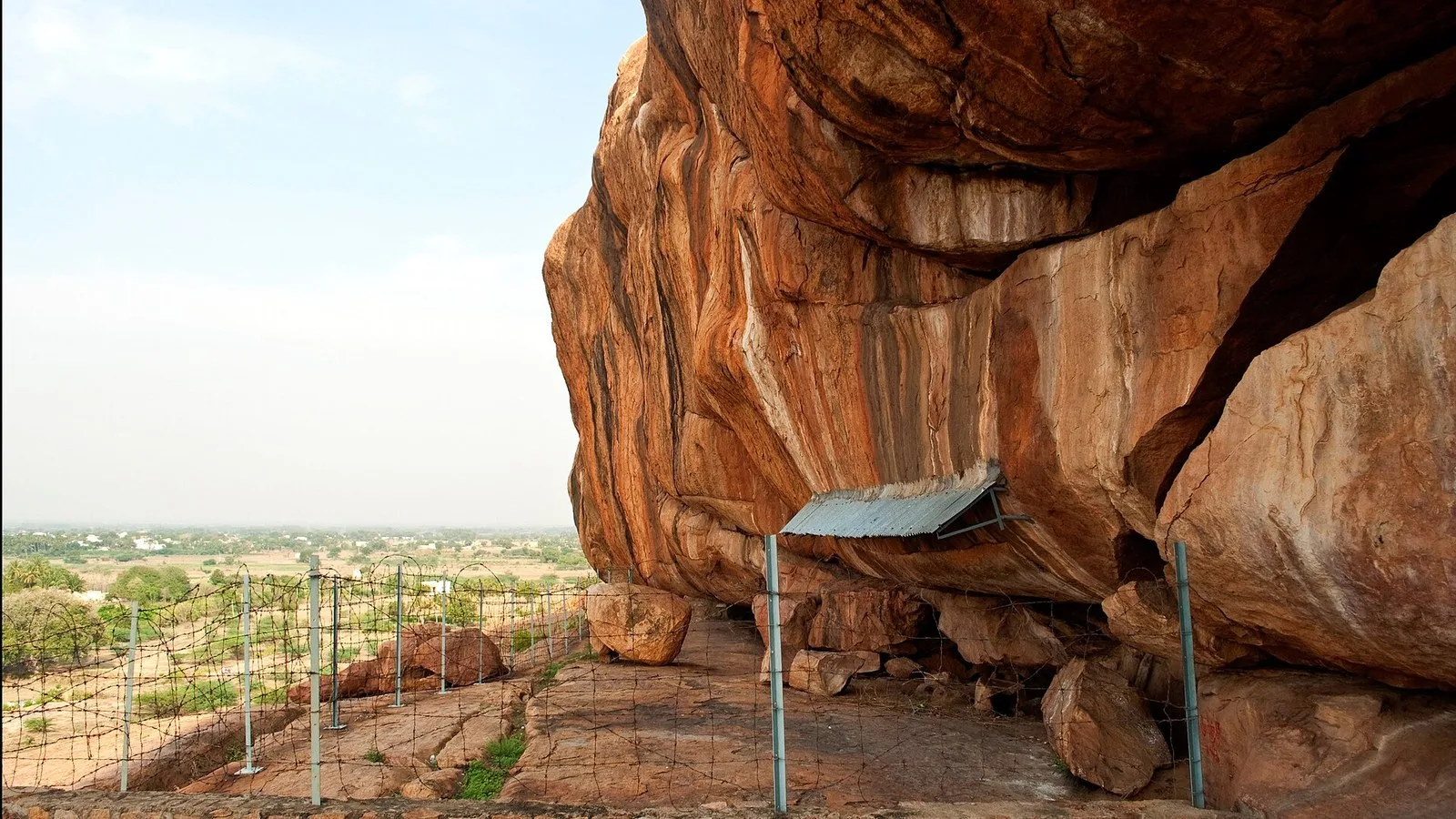
- Kongar Puliyankulam (pictured above): a cavern with more than 50 rock-cut beds and three inscriptions of about the 2nd century BCE recording gifts by named donors.
Jambai: Ashoka's "Satiyaputo" identified
In October 1981 K. Selvaraj, a student with the state archaeology department, found a one-line inscription at Jambai near Tirukkoyilur: satiyaputo atiyaṉ neṭumāṉ añci ītta paḷi, "the abode given by Atiyan Netuman Anci, the Satiyaputo". Ashoka's Second Rock Edict names Cholas, Pandyas, Keralaputras and Satiyaputras as southern neighbours. Jambai showed that the Satiyaputras were the Atiyaman chiefs of Takatur (Dharmapuri). Netuman Anci is the chief the poet Avvaiyar praises in the Purananuru. The inscription is dated to about the 1st century CE.
Pugalur: three generations of Chera kings
At Arunattarmalai near Pugalur (Karur district), two near-identical inscriptions record a shelter for the Jain monk Cenkāyapaṉ of Attur. It was made when Iḷaṅkaṭuṅkō was invested as heir. They name three generations of the Chera Irumporai line: Kō Ātaṉ Cel Irumpoṟai, his son Peruṅkaṭuṅkō and grandson Iḷaṅkaṭuṅkō. Scholars match them with kings praised in the Sangam anthology Pathitruppathu. Nearby records name merchants of salt, gold and cloth. Mahadevan dated the royal records to about the 2nd century CE.
Writing for everyone: names on pots
Mahadevan stressed that inscribed pottery is far commoner in Tamil Nadu than elsewhere in India, and that it is secular:
- Kodumanal (Erode): 500+ inscribed sherds, mostly personal names, some Prakrit names of northern traders.
- Keezhadi (Sivaganga): 56 Tamili sherds from the state's digs, such as Kuviraṉ Ātaṉ, and 1,001 sherds with graffiti marks (see Part 3 on Keezhadi).
- Arikamedu and Alagankulam: ports with Tamil and Prakrit sherds in Tamil, northern and Sri Lankan Brahmi, beside Mediterranean wares.
- Porunthal (near Palani): grave ring stands reading va-y-ra, probably "diamond".
The script also appears on hero stones of about the 1st century BCE at Pulimankombai and on coins of the Pandya king Peruvazhudi. A later pot from Andipatti reads nākaṉ uṟal, "Nakan's toddy pot". Mahadevan saw in it a literate toddy-tapper.
Tamil letters abroad
- Sri Lanka: a dish at Tissamaharama reads tiraḷi muṟi, "written agreement of the assembly", provisionally dated to about 200 BCE.
- Egypt: at Quseir al-Qadim (Roman Myos Hormos), an Indian jar inscribed pāṉai oṟi, "pot suspended in a rope net" (about the 1st century BCE), was reported in 2007. At Berenike, a sherd naming ko(ṟ)ṟa-pūmāṉ is dated by stratigraphy to 60–70 CE.
- Thailand: a goldsmith's touchstone from Khuan Luk Pat reads perumpatan kal, "touchstone of Perumpattan" (3rd–4th century CE).
- Valley of the Kings: in 2026 Ingo Strauch and Charlotte Schmid reported about 30 Indian-language graffiti of the 1st–3rd centuries CE in six royal tombs, half in Old Tamil, including "Cikai Korran came here and saw", written eight times.
These finds match classical accounts of Red Sea trade with the Roman Empire.
How old is Tamil writing?
After Ashoka: the Mahadevan model
Mahadevan found the earliest Tamil-Brahmi "palaeographically near-identical" to Ashoka's southern edicts. Allowing time for adaptation, he dated its start to the late 3rd or early 2nd century BCE. The epigraphist Richard Salomon favoured this view.
The radiocarbon challenge
K. Rajan, excavator of Porunthal and Kodumanal, cites AMS radiocarbon dates. Paddy buried with the Porunthal ring stands dated to about 490 and 450 BCE, and he argues the writing is as old as the grain. He places early inscribed levels at Kodumanal in the 5th century BCE and concludes that "Ashoka did not develop the Brahmi script." The state department's 2019 Keezhadi report used a 580 BCE sample to push Tamili to the 6th century BCE. In 2024 it announced about 685 BCE for charcoal with an inscribed sherd at Sivakalai, a date repeated in its 2025 Antiquity of Iron report (see Part 4).
The case for caution
The sticking point is association: a radiocarbon date belongs to the grain or charcoal, not automatically to a sherd near it. For Keezhadi, archaeologist Bishnupriya Basak said it was "not clear from the report" that the inscribed sherds came from the dated layer. Y. Subbarayalu placed the Porunthal letters around the 1st century BCE or CE. The Brahmi specialist Harry Falk argues that some early "letters" are misread graffiti and calls such claims, like Sri Lankan claims based on Anuradhapura dates, "regional chauvinism". The scholar David Shulman urges scepticism but an open mind. Settling the question needs more dates from sealed layers and peer-reviewed reports.
Graffiti marks and the Indus question
Before letters, Iron Age people scratched graffiti marks such as arrows, fish, ladders and crosses on pots, often on the black-and-red ware of megalithic graves. In January 2025 the state department released Indus Signs and Graffiti Marks of Tamil Nadu by K. Rajan and R. Sivanantham. It analysed 15,184 marks from 140 sites and reported that over 90% have exact or near parallels among the signs of the Harappan civilisation; Rajan said they "were not accidental".
Caution is needed. The Indus script is undeciphered, simple shapes recur independently across cultures, and a similar shape does not prove a shared language or descent. A graffiti bridge between the Indus signs and Tamil-Brahmi is still only a hypothesis.
Timeline
| Date (approx.) | Evidence | Status |
|---|---|---|
| c. 685 BCE | Sivakalai charcoal with inscribed sherd | Claimed; association debated |
| c. 580 BCE | Keezhadi sample cited for Tamili | Claimed; layer link unclear |
| c. 490–450 BCE | Porunthal paddy with inscribed ring stands | Contested |
| c. 268–232 BCE | Ashoka's edicts naming southern kingdoms | Firm |
| c. 2nd century BCE | Mangulam, Arittapatti, Kongar Puliyankulam | Palaeographic, widely accepted |
| c. 1st century BCE–1st century CE | Quseir al-Qadim and Berenike sherds; Jambai | Well supported |
| c. 2nd century CE | Pugalur Chera inscriptions; pulli in use | Palaeographic |
| c. 500 CE | Early Vatteluttu (Pulankurichi) | Firm |
From Tamil-Brahmi to Vatteluttu and Tamil
From about the 4th century CE the letters grew rounder, probably helped by writing on palm leaves, becoming Vatteluttu ("round script") in the Pandya and Chera country. In the north, under the Pallavas of Kanchi, a southern Brahmi gave rise to Grantha, for Sanskrit, and to the ancestor of the modern Tamil script. As Chola power spread, the Tamil script displaced Vatteluttu in Tamil Nadu by about the 10th–11th centuries, while Vatteluttu survived longer in Kerala. The pulli has remained part of Tamil writing throughout.
What we can say with confidence
- Tamil was written in an adapted Brahmi by the 2nd century BCE at the latest, the earliest of any Dravidian language.
- Monks, kings, merchants and ordinary villagers all used it.
- Its distinctive spelling, above all the pulli, was a Tamil innovation.
- Dates of the 5th–7th centuries BCE, and any Indus link, remain open.
Next part
Part 6, The Sangam Literature: Ettuthokai, Pathupattu and Tolkappiyam, turns from stones to poems, where Nedunchezhiyan, Atiyaman and the Irumporai kings reappear in verse.
Sources
- Iravatham Mahadevan, Early Tamil Epigraphy, Vol. I (CICT, 2014); Recent discoveries of Jaina cave inscriptions in Tamilnadu; An epigraphic perspective on the antiquity of Tamil (The Hindu, 2010)
- Frontline, A magnum opus on Tamil-Brahmi inscriptions; Interview with Mahadevan
- Unicode, Proposal on Tamil-Brahmi characters and the pulli (2012)
- Tamil Nadu State Department of Archaeology: Jambai, Pugalur, Keeladi, Alagankulam
- Madras Musings, Mahadevan and Tamil-Brahmi; Google Arts & Culture, Mangulam Inscriptions; South First, Arittapatti (2022)
- The Hindu, Keezhadi findings traceable to 6th century BCE (2019); The Wire Science, Experts question dates of script (2019); Deccan Herald, Fresh dates push origin of Tamili script (2024)
- K. Rajan and R. Sivanantham, Antiquity of Iron and Indus Signs and Graffiti Marks of Tamil Nadu (TNSDA, 2025); Times of India, report on the graffiti study (2025)
- The Hindu, Palani excavation triggers fresh debate (2011); Tamil Brahmi script in Egypt (2007)
- Live Science, 'Cikai Korran came here and saw' (2026)
- Richard Salomon, Indian Epigraphy (1998); Harry Falk, "Owners' graffiti on pottery from Tissamaharama" (2014); David Shulman, Tamil: A Biography (2016)
Featured image: Jain rock shelter with Tamil-Brahmi inscriptions at Kongar Puliyankulam, near Madurai. Photo by Udhayan1983, via Wikimedia Commons, CC BY-SA 4.0.