This is Part 11 of HorizonDesk's chronological series on Tamil history, from prehistory to modern Tamil Nadu. The previous instalment was Part 10: Yavana Trade – Arikamedu, Muziris and Rome.
Board a state bus or walk into a government office in Tamil Nadu and you will likely meet a two-line verse from the Thirukkural. Tamils call it Ulaga Podhumarai, "the common scripture of the world", and politicians of every party quote it. Yet the book does not name its author, nobody knows exactly when it was written, and almost everything popularly said about the poet Thiruvalluvar is legend. This part looks at what the Kural is, what it says, and how historians try to date it.
What is the Thirukkural?
The title joins tiru, an honorific meaning "sacred", and kural, "short". A kural is a couplet in the kural venba metre: a line of four metrical feet and a line of three. The form forces extreme compression.
The work is arranged with unusual care:
| Book | Tamil name | Theme | Chapters | Couplets |
|---|---|---|---|---|
| I | Arathuppal | Virtue (aram) | 38 | 380 |
| II | Porutpal | Wealth, statecraft and public life (porul) | 70 | 700 |
| III | Kamathuppal or Inbathuppal | Love (inbam) | 25 | 250 |
| Total | 133 | 1,330 |
Every chapter (adhikaram) has exactly ten couplets on one subject. The Czech Tamil scholar Kamil Zvelebil argued that its consistent language and design point to a single author and that the three-book division is original; the grouping of chapters into sections (iyal) differs between medieval commentators and is probably later.
Tamil literary tradition places the Kural among the Pathinenkilkanakku, the "Eighteen Minor Works", a group of mostly didactic texts that came after the Sangam anthologies described in Part 6. It is usually regarded as the oldest of them.
What the book teaches
The Kural opens with praise of God and of rain, "the nectar" that sustains the world, then moves through the life of a householder, a ruler and a lover. It addresses ordinary people, not monks.
Virtue. The first book insists on truthfulness, gratitude, self-control, hospitality and compassion. Two chapters stand out: chapter 26, against eating meat, and chapter 33, on not killing. Couplet 314 asks the reader to punish those who do harm by doing them good, so that they are put to shame:
Innaasey thaarai oruththal avarnaana
nannayan seythu vidal (Kural 314)
Wealth. The longest book is close to a manual of government: kings, ministers, spies, forts, armies and alliances. It is practical, and accepts war and punishment as a ruler's duty. It praises learning ("learn flawlessly what should be learnt, then live by it", Kural 391), clear thinking ("whatever is said, by whoever, wisdom is seeing the truth in it", Kural 423) and farming: "the world follows the plough wherever it turns" (Kural 1031). One couplet often quoted today rejects inequality by birth:
Pirappokkum ellaa uyirkkum sirappovvaa
seythozhil vetrumai yaan (Kural 972)
"All living beings are alike at birth; distinction comes from the quality of the work they do."
Love. The third book, the most purely poetic, speaks in the voices of lovers in courtship and marriage, drawing on the akam (love) conventions of Sangam poetry.
When was it written?
Nothing inside the text can be dated directly, so every date is an inference, ranging from about 300 BCE to the 6th century CE and beyond.
| View | Proposed date | Main basis |
|---|---|---|
| Traditional (e.g. Somasundara Bharathiar, M. Rajamanickam) | As early as c. 300 BCE | Tradition that the Kural was the last work of the third Sangam |
| Tamil scholars' meeting led by Maraimalai Adigal (1921); later Tamil Nadu government convention | Valluvar born 31 BCE | Adopted as a cultural convention, not a proven date |
| Historian K. K. Pillay | Early 1st century CE | Historical arguments |
| Kamil Zvelebil (1973–75) | c. 450–500 CE (first 450–550) | Language, grammar, Sanskrit loanwords, borrowings |
| S. Vaiyapuri Pillai (1950s) | 6th century CE or later | Sanskrit loanwords and sources |
| Stuart Blackburn (2000) | c. 500 CE, the "current scholarly consensus" | Summary of scholarship |
The case for a post-Sangam date rests on several points. The Kural is in venba metre, which the classical anthologies do not use. Its grammar has features rare in early Tamil but common by about the 5th century. Vaiyapuri Pillai listed 137 words he thought were Sanskrit loans; Thomas Burrow and Murray Emeneau later showed that about 35 of them are Dravidian, but Zvelebil still found around 100 genuine loans, more than in Sangam poems. Some couplets closely resemble ideas in Sanskrit works such as the Arthashastra attributed to Kautilya (see our piece on Chandragupta Maurya and Chanakya) and the Manusmriti. It also condemns meat-eating and drinking, which Sangam poems treat as normal.
An upper limit comes from the epic Manimekalai, which quotes Kural 55 and credits it to poyyil pulavan, "the poet who does not lie"; but the epic's own date (2nd to 6th century CE) is debated.
Many Tamil scholars still defend an earlier date and question whether loanword counts and metre can date a single text. A fair summary: most specialists place the Kural around the 5th century CE, give or take a century, while Tamil Nadu officially uses 31 BCE as Valluvar's birth year.
Who was Valluvar?
The honest answer is: we do not know. The Kural never names its author. The 19th-century French translator E. S. Ariel called it "the book without a name by an author without a name". The name Thiruvalluvar ("the revered Valluvar") first appears in the Thiruvalluva Malai, a garland of 55 verses praising the book that tradition attributes to Sangam poets and even to gods; its date is uncertain, and Blackburn tentatively suggested around the 10th century.
Popular stories fill the gap. In the best-known versions Valluvar was a weaver of Mylapore in today's Chennai, married to a devoted wife, Vasuki; he was one of seven children of a Brahmin father, Bhagavan, and a low-caste mother, Adi; and his book passed a miraculous test at the Madurai Sangam. The family story comes from the Kapilar Agaval, which Zvelebil dates on linguistic grounds to about the 15th century. Stuart Blackburn's study "Corruption and Redemption" (2000) shows how these tales were combined and printed in the 19th century, partly by missionaries and colonial scholars, until they became standard school history.
The text itself suggests only that its author knew earlier Tamil poetry and some Sanskrit ethical literature, and wrote for a settled agrarian society with kings and markets.
Whose book is it?
Because the Kural praises God without naming a sect, nearly every religious community has claimed it.
- Jain: The stress on non-killing, vegetarianism and self-restraint fits Jain ethics (see our part on Mahavira and Jainism). Some epithets for God in the first chapter, such as "he who walked on the flower", have Jain parallels. Jain tradition links the author with the teacher Elacharya (Kundakunda), but only in late sources. Zvelebil concluded that Valluvar was "probably a learned Jain with eclectic leanings".
- Hindu: The threefold division mirrors dharma, artha and kama. Couplets refer to the goddess of fortune and to Vishnu's strides, and the opening line speaks of Adi Bhagavan, the Primal Lord. The most influential commentator, Parimelalagar, read the text through Brahmanical Hindu ideas. In Mylapore, Shaiva devotees worship Valluvar at a shrine inside a temple complex.
- Buddhist: In the early 20th century the reformer Iyothee Thass argued that Valluvar was a Buddhist; compare the ethics in our part on Gautama Buddha.
- Christian: The missionary G. U. Pope thought Valluvar had absorbed Christian teaching in the 9th century, and a 1960s theory made him a disciple of St Thomas. Scholars reject both.
The safest position is that the Kural is deliberately non-sectarian, which is exactly why it became a shared Tamil classic.
Commentators: how the text was read
From about the 10th century, scholars wrote prose commentaries (urai). Tradition counts ten medieval commentators; the works of Manakkudavar, Paridhiyar, Kalingar, Pariperumal and Parimelalagar survive. Parimelalagar, a Vaishnava Brahmin of about the 13th century, became the standard, and modern editions still follow his numbering. As Norman Cutler has shown, commentators shaped what generations understood the Kural to mean.
From palm leaf to the world
For centuries the Kural survived in palm-leaf manuscripts and in memory. A Malayalam translation was made by the late 16th century. The first printed edition appeared in 1812, together with the Naladiyar, and in 1861 the Jaffna scholar Arumuka Navalar published a carefully edited text.
The Italian Jesuit Constanzo Beschi rendered the first two books into Latin around 1730, leaving out the love poems. G. U. Pope published the first complete English translation by a single translator in 1886. Today the Kural exists in dozens of languages, with well over a hundred English versions.
Leo Tolstoy quoted couplets on non-violence in his A Letter to a Hindu (1908), which M. K. Gandhi translated into Gujarati; Gandhi later spoke of the Kural with admiration.
Valluvar in modern Tamil Nadu
- Thiruvalluvar Day was first celebrated in 1935, when it was observed in the Tamil month of Vaikasi (May–June). Since the DMK government of 1967–71 it has been fixed on the second day of the month of Thai, during Pongal, usually 15 January, and it is a state holiday.
- The Thiruvalluvar Year counts from 31 BCE, so it is the Common Era year plus 31: 2026 is Thiruvalluvar year 2057. It is used in government orders.
- Valluvar Kottam, a Chennai memorial shaped like a temple chariot (1976), has all 1,330 couplets inscribed in its halls.
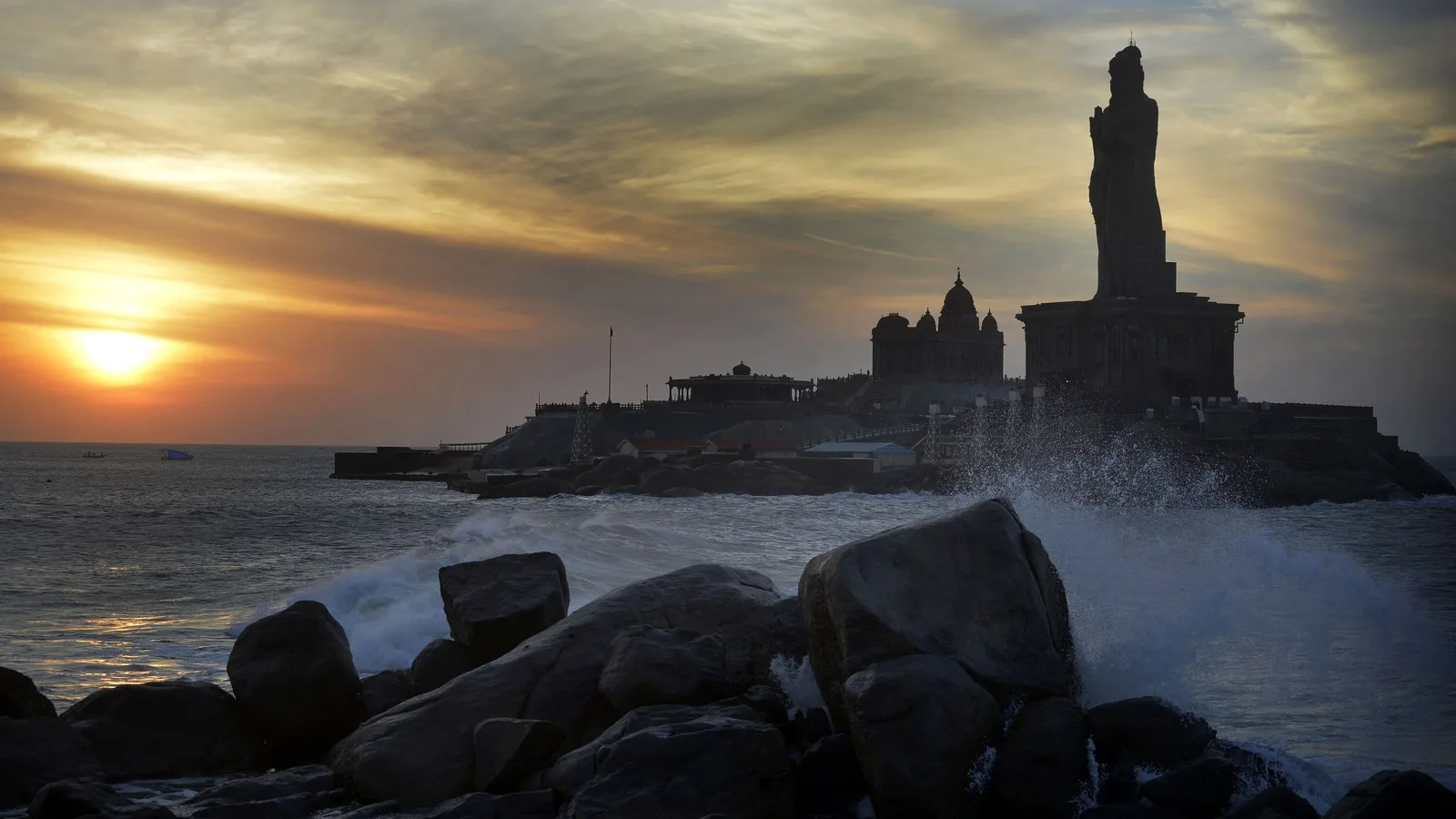
- The Kanyakumari statue, carved by V. Ganapati Sthapati, was unveiled on 1 January 2000 on a rock off India's southern tip. Its total height of 133 feet stands for the 133 chapters: a 38-foot pedestal for the 38 chapters on virtue and a 95-foot figure for the rest. At its silver jubilee, in December 2024, the Tamil Nadu government named it the "Statue of Wisdom" and opened a 77-metre glass bridge to the neighbouring Vivekananda Rock Memorial.
Timeline
| Date (approx.) | Development | How firm? |
|---|---|---|
| c. 5th century CE (± a century) | Most likely period of composition (Zvelebil, Blackburn) | Scholarly estimate |
| c. 10th–13th century | Medieval commentators, ending with Parimelalagar | Fairly firm |
| c. 1730 | Beschi's Latin translation | Firm |
| 1812 | First printed edition | Firm |
| 1886 | G. U. Pope's complete English translation | Firm |
| 1921 | Scholars led by Maraimalai Adigal adopt 31 BCE for Valluvar | Widely cited |
| 1935 | First Thiruvalluvar Day celebrations | Firm |
| 1971–72 | Thiruvalluvar Year enters official use | Firm |
| 1 January 2000 | Kanyakumari statue unveiled | Firm |
| December 2024 | "Statue of Wisdom" naming and glass bridge | Firm |
What we can say with confidence
- Confident: the Kural is a single, carefully structured work of 1,330 couplets in three books; it is post-Sangam in metre and language; it was widely quoted by medieval times; and it has been continuously studied, printed and translated since 1812.
- Uncertain: its exact date, its author's real name, life and religion. The 31 BCE birth year is an official convention, and the popular biography is legend.
Next part
Part 12, Silappathikaram and Manimekalai: The Twin Epics, moves from aphorism to story: Kannagi's anklet, the Buddhist nun Manimekalai, and what the epics reveal about Tamil society.
Sources
- Thirukkural, Tamil text: Project Madurai; with Parimelalagar's commentary: Tamil Virtual Academy
- Kamil V. Zvelebil, The Smile of Murugan: On Tamil Literature of South India (Brill, 1973) and Tamil Literature (Brill, 1975)
- Stuart Blackburn, "Corruption and Redemption: The Legend of Valluvar and Tamil Literary History", Modern Asian Studies 34.2 (2000), 449–482
- Norman Cutler, "Interpreting Tirukkural: The Role of Commentary in the Creation of a Text", Journal of the American Oriental Society 112.4 (1992)
- G. U. Pope, The Sacred Kurral of Tiruvalluva-Nayanar (London, 1886)
- S. Vaiyapuri Pillai, History of Tamil Language and Literature (1956)
- The Hindu, CM inaugurates India's first glass bridge over sea in Kanniyakumari (December 2024)
- The New Indian Express, Thanksgiving fest that gives Tamil Nadu its longest cultural break (January 2026), on the history of Thiruvalluvar Day
- Government of Tamil Nadu, public holidays notification for 2025 (G.O. Ms. No. 792, dated in Thiruvalluvar year 2055)
- Leo Tolstoy, A Letter to a Hindu (1908)
Featured image: the Thiruvalluvar statue and the Vivekananda Rock Memorial off Kanyakumari at dusk. Photo: "Indian Temple at dusk Thiruvalluvar Statue" by PKharote, via Wikimedia Commons, CC BY-SA 4.0, cropped.