This is Part 8 of HorizonDesk's chronological series on Indian history, from the Stone Age to Independence in 1947.
In Part 7 of this series, the Ganga plains filled with walled cities, punch-marked coins, ambitious kings and debating clan assemblies, and Magadha began its climb to power. In this part we meet the most influential person that world produced: Siddhartha Gautama, the Shakya-born seeker remembered as the Buddha, the "awakened one".
This part looks at what we can and cannot know about the man, what he taught and how the first Buddhist community took shape. A word of caution: scholars accept that he was a real historical person, but most details of his life are tradition rather than recorded fact, and even his century is debated.
How do we know about the Buddha?
The oldest accounts are scattered through the Pali Canon, the Tipitaka ("three baskets") of the Theravada tradition: the Vinaya (monastic rules), the Sutta (discourses) and the Abhidhamma (systematic analysis). Parallel versions survive in Sanskrit, Gandhari, Chinese and Tibetan. Sri Lankan tradition says the Pali texts were first written down in the 1st century BCE, centuries after the Buddha's death.
The early discourses tell us surprisingly little about his childhood. Some of the most famous episodes, such as the prince who never saw old age until he met an old man, a sick man, a corpse and a wandering ascetic, are told in the canon about an earlier, legendary buddha named Vipassi, and were only later attached to Gautama. Full life stories, such as Ashvaghosha's Sanskrit poem Buddhacharita (around the 1st–2nd century CE), add miracles and royal splendour. Archaeology and inscriptions add a second line of evidence, though most of it dates from the Mauryan emperor Ashoka's time, in the 3rd century BCE, or later.
When did he live? The dating debate
The tradition says the Buddha lived for 80 years; the problem is fixing the year of his death, the parinirvana. Modern scholarship has narrowed the choice to two main camps:
- The long chronology. Sri Lankan chronicles place Ashoka's coronation 218 years after the Buddha's death. Combined with Greek-based dates for the Mauryas, this gives a death around 486 or 483 BCE and a life of roughly 563–483 BCE, the dates found in many textbooks. The Theravada calendar of Sri Lanka and South-East Asia goes further back, to 544/543 BCE.
- The short chronology. Northern Buddhist sources put Ashoka only about a century after the Buddha. Since a 1988 conference organised by Heinz Bechert, many specialists, including Richard Gombrich, have favoured a death around 400 BCE or a little earlier, giving a life of roughly 480–400 BCE.
Britannica sums up the state of the debate: opinion is "divided between those who placed his death about 480 BCE and those who placed it as much as a century later". The only firm anchor is Ashoka, in the mid-3rd century BCE.
Birth: the Shakyas, Lumbini and Ashoka's pillar
Siddhartha (Pali Siddhattha, "one who achieves the goal") belonged to the Gautama (Gotama) family of the Shakyas, a clan republic in the Himalayan foothills that lay under Kosala's shadow. His father, Shuddhodana, is remembered in later texts as a king, but was more likely a leading member of the Shakya assembly; no trace of the grand palaces of legend has been found. His mother, Maya, is said to have died soon after his birth, and her sister Mahaprajapati Gautami raised him.
Tradition places his birth in a grove at Lumbini, now in Nepal's Terai and a UNESCO World Heritage Site. Here the evidence is unusually strong. In 1896 a sandstone pillar was identified at Rummindei with an inscription in Brahmi script, recording that King Piyadasi (Ashoka), 20 years after his consecration, came in person and worshipped "because here the Buddha, the Shakya sage, was born". He set up a stone pillar, exempted the village of Lumbini from tax and reduced its share of the harvest to one-eighth.
Between 2011 and 2013 a UNESCO-backed team co-directed by Robin Coningham and Kosh Prasad Acharya excavated beneath the brick temple of Ashoka's time inside the Maya Devi Temple. They found traces of an earlier timber structure, apparently a railing around an open space where a tree once grew, with radiocarbon dates from the postholes falling in the range 800–550 BCE. The team argued that this was the earliest known Buddhist shrine, supporting an earlier date for the Buddha. Others caution that the dates are broad and that a tree shrine could have been sacred before it was Buddhist, so the find has sharpened the debate rather than closed it.
The location of Kapilavastu, the Shakya capital where he grew up, is also contested. Nepal identifies it with Tilaurakot, while Indian archaeologists point to Piprahwa–Ganwaria in Uttar Pradesh. At Piprahwa in 1898 William Peppé found a relic casket whose Brahmi inscription is often read as naming relics of the Buddha enshrined by his Shakya kin, and later Archaeological Survey of India digs found sealings naming Kapilavastu. The inscription's reading and date are still argued over.
Renunciation and awakening
Tradition says Siddhartha married (later texts name his wife Yashodhara), had a son called Rahula, and at about 29 left home for the life of a wandering ascetic. He became one of many shramanas (strivers) of the age, who rejected the household and often the Vedic sacrifice in search of release from samsara, the cycle of rebirth governed by karma, ideas that had grown in the Upanishads and in shramana circles alike.
He studied meditation under two teachers, then spent some six years in extreme fasting with five companions. Concluding that starvation led nowhere, he took food again, and his companions left him. Seated under a pipal (Ficus religiosa) tree at Uruvela on the Niranjana river, at about 35, he attained bodhi, awakening. The place is now Bodh Gaya in Bihar, and the tree, the Bodhi tree, became Buddhism's most sacred symbol. Ashoka is credited with the first shrine there, and the present brick Mahabodhi Temple, a UNESCO World Heritage Site, dates largely from the 5th–6th centuries CE.
The first sermon at Sarnath
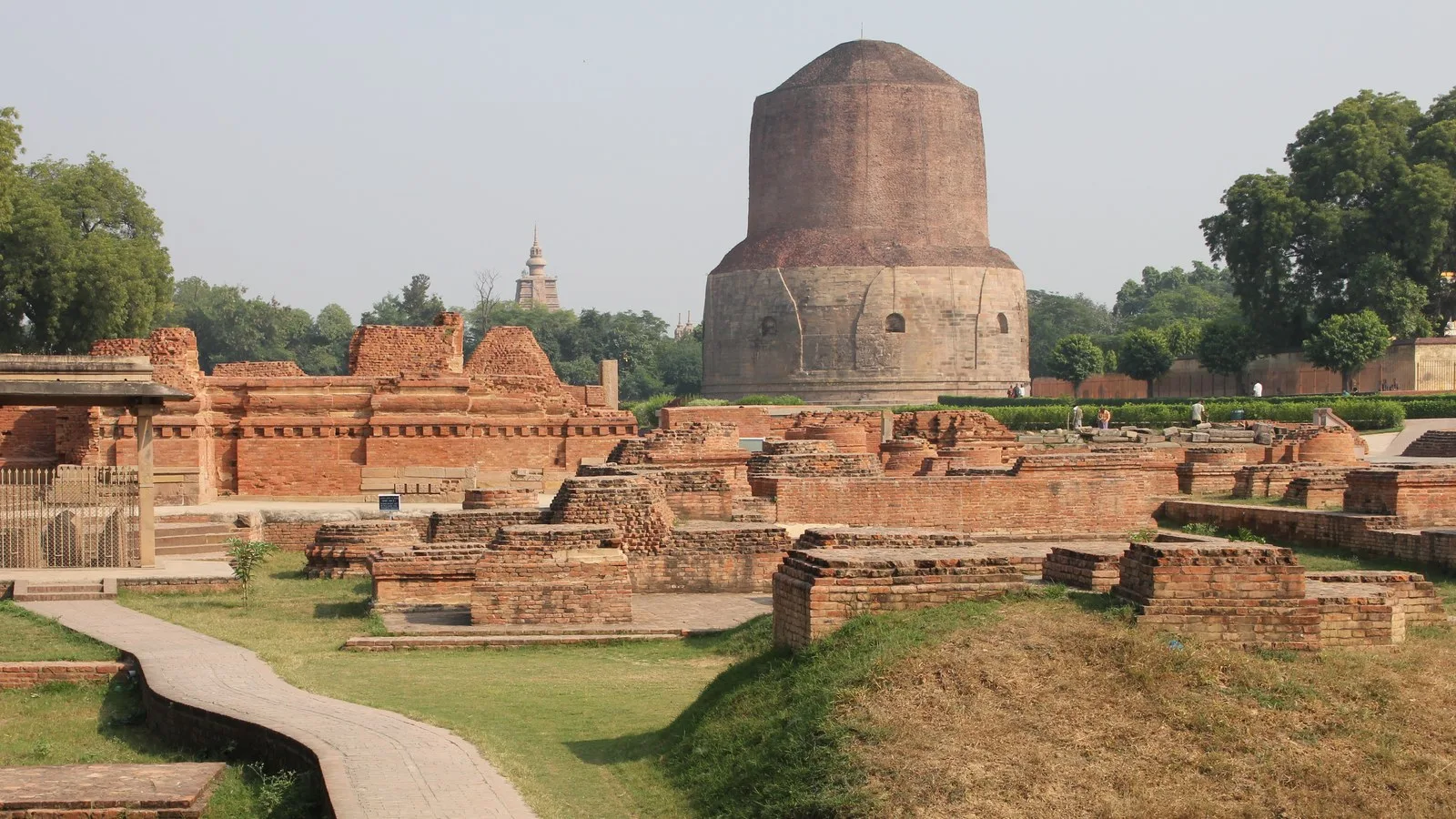
The Buddha walked some 250 km west to the deer park at Isipatana, now Sarnath near Varanasi, where he found his five former companions. There, the tradition says, he "set in motion the wheel of the Dhamma" in the Dhammacakkappavattana Sutta, and the five became his first monks. Sarnath, shown in our featured image, became one of the four great pilgrimage places. Its ruins include monasteries, Ashoka's pillar, whose lion capital is now India's national emblem, and the massive Dhamek Stupa, whose present form is usually dated to the Gupta period. In July 2026 UNESCO inscribed the Ancient Buddhist Site of Sarnath on the World Heritage List. Sarnath is an easy trip from Varanasi, as our Uttar Pradesh travel guide explains.
What did the Buddha teach?
The first sermon sets out the core in compact form:
- The Middle Way between sensual indulgence and harsh self-torment, both of which the Buddha had tried.
- The Four Noble Truths: life as ordinarily lived is marked by dukkha (suffering or unsatisfactoriness); it arises from craving (tanha); it can cease, in nibbana (nirvana, literally "blowing out"); and there is a path to that cessation.
- The Noble Eightfold Path: right view, intention, speech, action, livelihood, effort, mindfulness and concentration, often grouped as ethics, meditation and wisdom.
Other ideas run through the early discourses: all conditioned things are impermanent (anicca); no unchanging self (anatta) can be found in body or mind, a challenge to the Upanishadic atman; experience arises through a chain of causes, "dependent origination"; and karma is fundamentally intention, a moral act rather than a ritual one.
He also redefined status: in several discourses a true brahmin is one by conduct, not birth, and the order admitted people of every background, including barbers and courtesans. Historians caution, though, that he did not campaign to abolish caste in wider society.
The Sangha: monks, nuns and lay patrons
For about 45 years the Buddha walked the roads of Magadha, Kosala and the clan republics, staying put only in the rainy season. His followers formed the Sangha, a community of fully ordained monks (bhikkhus) and, according to the tradition, later of nuns (bhikkhunis), after his foster-mother Mahaprajapati and Shakya women asked to be ordained. The canonical account of the nuns' founding, with its extra rules for women, is debated by modern scholars, but the Therigatha, verses attributed to early nuns, is among the oldest collections of women's religious poetry anywhere.
The Buddha, his teaching and the community became the "Three Jewels" (triratna). The order depended on lay supporters, many of them from the new urban classes. King Bimbisara is said to have given the Bamboo Grove (Veluvana) at Rajagriha; the merchant Anathapindika bought the Jetavana park at Shravasti; and the courtesan Ambapali gave a mango grove at Vaishali.
He had rivals, among them the Ajivika Makkhali Gosala and Nigantha Nataputta, better known as Mahavira, whom we meet in Part 9.
Death at Kushinagar and the relics
The Mahaparinibbana Sutta describes the Buddha's last journey, aged 80, from Rajagriha through Pataligrama and Vaishali to Kushinagar (Kusinara), the town of the Malla clan, where he fell ill and died between two sal trees. His reported last words: all conditioned things decay, strive on with diligence. The Mallas cremated him, and the text says the relics were divided among eight claimants, including Ajatashatru of Magadha, the Licchavis and the Shakyas, who built stupas over them. Later relic stupas, such as the great Sanchi Stupa, grew out of this tradition of honouring relics.
The early councils and the first split
Buddhist tradition says that soon after his death some 500 senior monks met at Rajagriha under Mahakashyapa, while Upali recited the monastic rules and Ananda the discourses. Many scholars doubt that this First Council happened as described.
A Second Council at Vaishali, about a century later, is more widely accepted as historical. It was called over ten disputed practices of the Vaishali monks, such as storing salt, eating after midday and accepting gold and silver. Around this time, or in the decades after, the Sangha split into the Sthaviravada ("teaching of the elders") and the Mahasanghika ("great community"), the first of many schools. The traditions' accounts differ, so details are uncertain. A Third Council under Ashoka belongs to a later part.
Why did Buddhism take root?
It spoke to a new urban world of merchants and artisans, for whom costly sacrifices meant little; its ethics of non-violence and moderation suited trade and farming; and a disciplined, mobile order carried it along trade routes with royal backing. Monasteries later became great centres of learning, such as Nalanda. Yet Buddhism faded in most of India after about the 12th century, even as it flourished elsewhere in Asia.
Key takeaways
- Siddhartha Gautama of the Shakya clan is accepted as historical, but most details of his life come from texts written down centuries later.
- His dates are debated: the long chronology gives c. 563–483 BCE, the short chronology c. 480–400 BCE.
- Ashoka's Lumbini pillar marks his birthplace; recent excavations there point to an early shrine, but their meaning is debated.
- He attained awakening at Bodh Gaya, preached first at Sarnath and died at Kushinagar, teaching the Middle Way, the Four Noble Truths and the Eightfold Path.
- The Sangha of monks and nuns, backed by kings and merchants, spread the teaching; the Vaishali council led to the first split.
Next part
In Part 9, we turn to the Buddha's great contemporary, Mahavira, and the ancient tradition of Jainism, with its vows of non-violence, its Tirthankaras and its long story in India, including Tamil country.
Sources
- Singh, U. (2008), A History of Ancient and Early Medieval India: From the Stone Age to the 12th Century, Pearson, chapter 6
- Thapar, R. (2002), Early India: From the Origins to AD 1300, Penguin and University of California Press
- Harvey, P. (2013), An Introduction to Buddhism: Teachings, History and Practices, 2nd edn, Cambridge University Press
- Gombrich, R. (2006), Theravada Buddhism: A Social History from Ancient Benares to Modern Colombo, 2nd edn, Routledge
- Bechert, H. (ed.) (1991–97), The Dating of the Historical Buddha, Vandenhoeck & Ruprecht
- Encyclopaedia Britannica, Buddha (D. S. Lopez) and Buddhist council
- UNESCO World Heritage Centre, Lumbini, the Birthplace of the Lord Buddha and Mahabodhi Temple Complex at Bodh Gaya
- UNESCO, Ancient Buddhist Site of Sarnath inscribed on UNESCO World Heritage List (25 July 2026)
- Coningham, R. A. E. et al. (2013), The earliest Buddhist shrine: excavating the birthplace of the Buddha, Lumbini (Nepal), Antiquity 87
- Archaeological Survey of India, Excavation reports, including Excavations at Piprahwa and Ganwaria (K. M. Srivastava)
- SuttaCentral, Mahaparinibbana Sutta (DN 16); Access to Insight, Dhammacakkappavattana Sutta (SN 56.11)
- World History Encyclopedia, Siddhartha Gautama
- Hultzsch, E. (1925), Inscriptions of Asoka, Corpus Inscriptionum Indicarum vol. 1 (Rummindei pillar inscription)
Featured image: Monastery ruins around the Dhamek Stupa at Sarnath, near Varanasi, where the Buddha is said to have given his first sermon. Photo by R. M. Calamar, via Wikimedia Commons, CC BY 2.0.