This is Part 12 of HorizonDesk's chronological series on Tamil history, from prehistory to modern Tamil Nadu. The previous instalment was Part 11: Thirukkural and Thiruvalluvar – The Book, the Poet and the Debates.
On Chennai's Marina beach stands a bronze woman with one arm raised, an anklet in her hand. She is Kannagi, heroine of the Silappathikaram, "the Tale of an Anklet", and for Tamils she stands for justice demanded from a king who got it wrong. Her story is the first great Tamil epic. Its sequel, the Manimekalai, follows the daughter of Kannagi's husband by another woman, who turns away from love and becomes a Buddhist nun. This part looks at who wrote the "twin epics", what they say, when they were composed, and what they reveal about early Tamil society.
The twin epics at a glance
Later Tamil tradition lists five "great epics" (aimperumkappiyangal); of these, the Silappathikaram and Manimekalai share characters and settings, so Tamils call them the irattai kappiyangal, the twin epics.
| Silappathikaram | Manimekalai | |
|---|---|---|
| Author (by tradition) | Ilango Adigal | Seethalai Sathanar |
| Structure | 3 books, 30 cantos (kathai) | 30 cantos |
| Length (approx.) | 5,700 lines | 4,800 lines |
| Heroine | Kannagi | Manimekalai |
| Core themes | Fate, royal justice, a wife's fidelity | Renunciation, feeding the hungry |
| Religious colour | Jain-leaning, open to every faith | Openly Buddhist |
Both use akaval, the flowing metre of Sangam poetry, but the Silappathikaram also weaves in songs and folk dances. Because it blends poetry, music and drama, it is called the muthamizh kappiyam, the epic of all three branches of Tamil, and because its heroes are merchants rather than kings, a "citizens' epic".
Ilango Adigal and Seethalai Sathanar
A verse preface (patikam) says Ilango, the younger brother of the Chera king Senguttuvan, had renounced royal life, heard Kannagi's story from the poet Sathan, and composed the epic, which "Sathan the grain merchant" heard. It states three lessons: dharma becomes death to kings who err in governing; the great praise a renowned faithful wife; and past deeds (oozhvinai) inevitably bear fruit.
Many scholars treat this preface as a later addition: Sangam poems about Senguttuvan mention no monk-brother, and Gananath Obeyesekere called the story an interpolation. The title Adigal ("revered ascetic") and the honour shown to the Jain nun Kavunthi suggest a Jain author, yet the poem warmly describes the worship of Shiva, Vishnu, Murugan and the goddess Korravai, so this too is debated. Translator R. Parthasarathy suggests Ilango may have reworked a story already alive in oral tradition.
The Manimekalai is credited to Seethalai Sathanar, a grain merchant of Madurai. He was clearly Buddhist; little else about him is reliably known.
The story of the anklet: Puhar, Madurai, Vanji
The three books are named after the capitals of the three crowned Tamil dynasties: Chola Puhar, Pandya Madurai and Chera Vanji.
Book 1: Puhar (10 cantos)
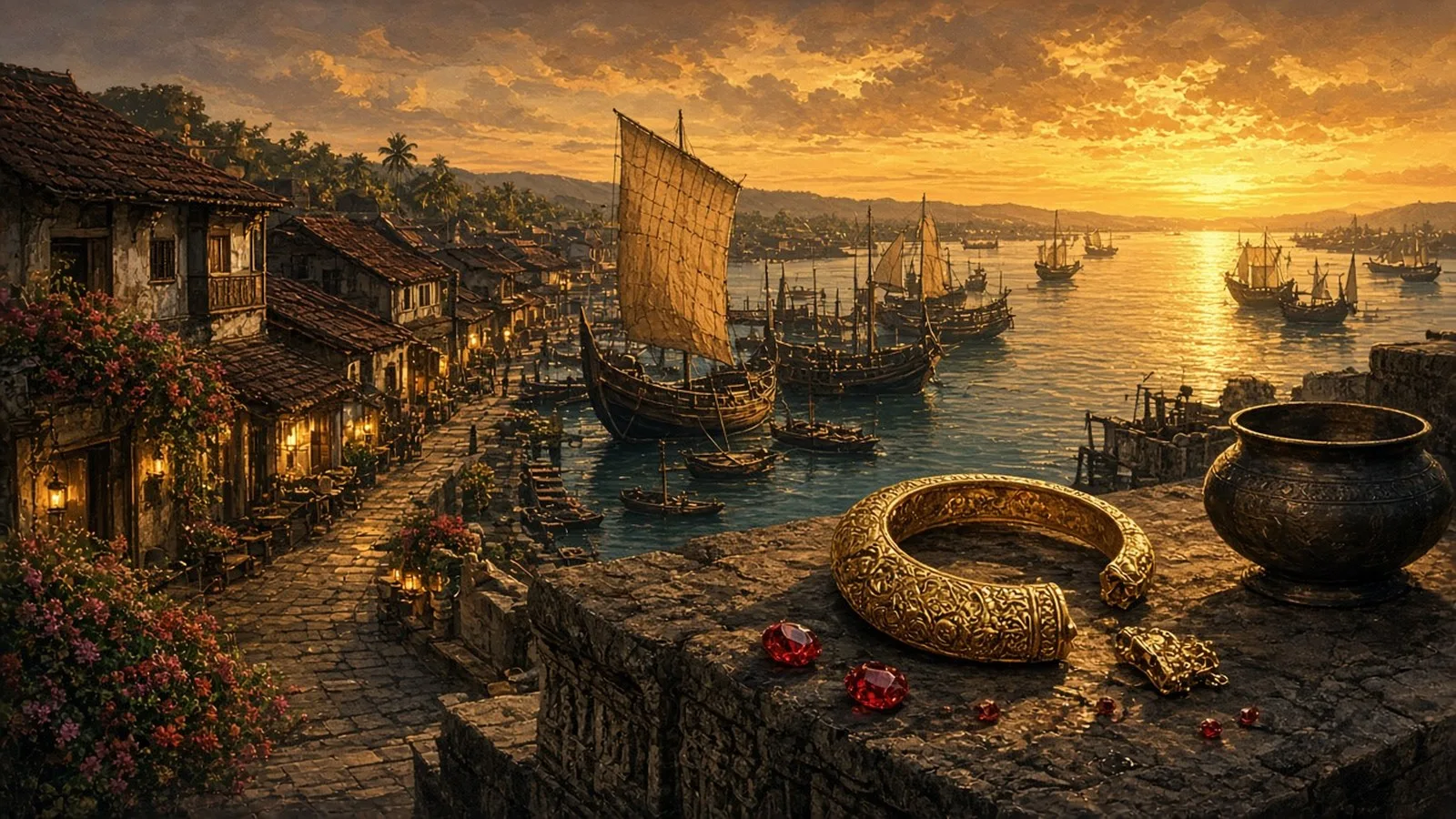
In the Chola port of Puhar, where the Kaveri meets the sea, the merchant's son Kovalan marries Kannagi, then falls for the court dancer Madhavi and spends his fortune on her. At the Indra festival the lovers sing on the beach; each hears a hint of infidelity in the other's song, and Kovalan walks out. Ruined, he returns to Kannagi, who offers her anklets so they can begin again in Madurai.
Book 2: Madurai (13 cantos)
Guided by the Jain nun Kavunthi, they reach Madurai. Kovalan goes to sell one anklet, but a royal goldsmith who had himself stolen the queen's anklet accuses him, and the Pandya king Nedunchezhiyan orders him executed without inquiry.
Kannagi storms into court with the other anklet. Hers holds rubies, she says; the queen's held pearls, the king replies. She breaks it open and rubies scatter. The king cries "Am I a king? I am the thief" and dies on his throne; the queen follows. Kannagi tears off her breast and flings it at the city, which burns, sparing, the poem says, Brahmins, the virtuous, cows, faithful wives, the old and children.
Book 3: Vanji (7 cantos)
On the fourteenth day Kannagi ascends to heaven in the Chera hills. King Senguttuvan brings a Himalayan stone, bathed in the Ganges and carried by two defeated northern kings, and enshrines her as the goddess Pattini. Among the kings at the consecration the last canto names "Kayavaku, king of sea-girt Lanka", a single line that became the basis of a long dating debate. Kovalan's and Kannagi's fathers renounce the world, and Madhavi becomes a nun.
Manimekalai: sequel and Buddhist epic
Madhavi's daughter Manimekalai chooses the Buddhist path. Pursued by the Chola prince Udayakumaran, she is carried by the sea goddess Manimekala to the island of Manipallavam, where she recalls her past lives and receives the Amudasurabhi, a begging bowl that never empties. Back in Puhar she feeds the hungry; the prince is killed by the jealous sky-being Kanchanan; imprisoned, she persuades the king to turn the prison into a house of charity. At Vanji she hears exponents of rival schools (Vedic, Shaiva, Vaishnava, Ajivika, Jain, Sankhya, Vaisheshika and materialist), and at Kanchi she learns the Buddha's teaching from Aravana Adigal.
Paula Richman (1988) showed how its many embedded "branch stories", often about women, work as religious arguments. Kamil Zvelebil judged it more Buddhist propaganda than a literary equal of the Silappathikaram, but it is the only complete Buddhist epic surviving in Tamil. For background, see our parts on Gautama Buddha and Buddhism and Mahavira and Jainism. As noted in Part 11, it quotes Kural 55, so it postdates the Thirukkural.
Why "twin epics"?
- Shared characters: Kovalan, Madhavi and Kavunthi appear in both, and Manimekalai worships at Kannagi's shrine.
- Shared world: Both open at Puhar's Indra festival and move through Puhar, Madurai, Vanji and Kanchi.
- Mirror images: a tragedy of household love versus a story of renunciation; one shows past deeds catching up, the other how to escape rebirth.
When were they written?
| View | Proposed date | Main basis |
|---|---|---|
| V. Kanakasabhai (1904) and traditional scholarship | 2nd century CE | "Gajabahu synchronism": Kayavaku = Gajabahu I of Sri Lanka (c. 113–135 CE) |
| V. R. Ramachandra Dikshitar (1939) | c. 171 CE | Reckoning of events in the epic |
| Alain Daniélou | Near Dikshitar's date; Manimekalai 2nd–3rd century | Traditional chronology |
| Kamil Zvelebil | Silappathikaram not before the 5th–6th century; Manimekalai c. 6th | Language, loanwords, ideas |
| Iravatham Mahadevan | c. 450–550 CE | Mention of a weekday |
| Paula Richman | Manimekalai: 6th century most persuasive | Internal and comparative evidence |
The Gajabahu line appears only in the final canto, in passages many regard as later, and in 1970 Obeyesekere argued that the Gajabahu story mixes myth with history. Some scholars link the Manimekalai's logic chapter to the 5th–6th-century Buddhist logician Dignaga. In short: traditional Tamil scholarship places both epics around the 2nd century CE; most international specialists put the Silappathikaram around the 5th century and the Manimekalai in the 6th or later. The story itself may be older: the Sangam anthology Natrinai alludes to a woman who cut off a breast.
What the epics reveal
- The port of Puhar: a seaside district (Maruvurpakkam) and an inner city (Pattinappakkam), with a Yavanar irukkai, a quarter of "Yavanas", the Tamil term for Greek and Roman traders. Yavana guards even stand at Madurai's fort gate. Compare Part 10 on Yavana trade and Part 8 on Karikala Chola.
- Trade and crafts: streets of cloth, gems, pearls and perfumes, and quarters of goldsmiths and other artisans. The plot turns on a goldsmith's fraud.
- Music and dance: Madhavi's debut canto details the stage, her teachers and instruments such as the yazh (harp), and her eleven classical dances. Adiyarkkunallar's medieval commentary is a key source on early Tamil music.
- Faiths side by side: Hindu deities, Jain monasteries, Buddhist teachers and Ajivikas share the cities. Rivalry sharpens in the Manimekalai.
- A drowned city: the Manimekalai says the sea swallowed Puhar, which may be myth or a memory of a real disaster.
For the earlier poetry, see Part 6 on Sangam literature.
From palm leaf to print
The epics survived on palm leaves. Portions of the Silappathikaram were printed from 1872, but U. V. Swaminatha Iyer, revered as Tamil Thatha ("grandfather of Tamil"), collated manuscripts and published the complete text with Adiyarkkunallar's commentary in 1892, and the Manimekalai with his own notes in 1898. English translations include those by Dikshitar (1939), Daniélou (1965) and Parthasarathy (1993).
Kannagi the goddess: from Vanji to Sri Lanka
- Tamil Nadu and Kerala: the hilltop Mangaladevi Kannagi temple on the border near Kumily opens only on Chitra Pournami, the April–May full moon, drawing devotees from both states.
- Sri Lanka: Sinhala Buddhists invoke Pattini against disease and drought; Tamils in the east worship Kannaki Amman. Tradition credits King Gajabahu with bringing her anklet from the Chola country.
Obeyesekere's The Cult of the Goddess Pattini (1984) argues instead that the cult reached the island in medieval times through traders, and that the Gajabahu link came later.
Modern legacy
- Marina statue: installed in January 1968 for the Second World Tamil Conference, removed after a lorry hit its pedestal in December 2001, and reinstalled by Chief Minister M. Karunanidhi on 3 June 2006.
- Poompuhar: the seven-storey Silappathikaram Art Gallery, with sculpted panels of the story, opened in 1973; the complex has recently been under renovation.
- Films and books: Kannagi (1942), Poompuhar (1964, written by Karunanidhi), the Sinhala Paththini (2016), Bharathidasan's verse retelling and Jeyamohan's novel Kotravai (2005). A Chennai–Manamadurai train is the Silambu Express.
Timeline
| Date (approx.) | Development | How firm? |
|---|---|---|
| 2nd century CE | Traditional date (Gajabahu synchronism) | Debated |
| c. 5th–6th century | Likely Silappathikaram | Scholarly estimate |
| 6th century or later | Likely Manimekalai | Scholarly estimate |
| 1892 / 1898 | U. V. Swaminatha Iyer's editions | Firm |
| January 1968 | Kannagi statue on the Marina | Firm |
| 1973 | Poompuhar art gallery | Firm |
| 3 June 2006 | Statue reinstalled | Firm |
What we can say with confidence
- Confident: the two epics are linked post-Sangam narratives; the Manimekalai quotes the Thirukkural; both portray a port society of trade, arts and coexisting faiths.
- Uncertain: their exact dates, whether Ilango was Senguttuvan's brother, and whether the Gajabahu synchronism is history.
Next part
Part 13, The Kalabhra Interregnum, asks who the Kalabhras were, the rulers who held the Tamil country between the Sangam age and the rise of the Pallavas and Pandyas, and whether their era really was a "dark age".
Sources
- Silappathikaram, Tamil text: Project Madurai, Puhar book, Madurai book, Vanji book; Manimekalai: Project Madurai
- U. V. Swaminatha Iyer's first editions: Silappathikaram (1892) and Manimekalai (1898), Central Institute of Classical Tamil
- Kamil V. Zvelebil, The Smile of Murugan: On Tamil Literature of South India (Brill, 1973) and Tamil Literature (1974–75)
- R. Parthasarathy (trans.), The Cilappatikaram of Ilanko Atikal: An Epic of South India (Columbia University Press, 1993)
- Alain Daniélou (trans.), Shilappadikaram (The Ankle Bracelet) (New Directions, 1965); Alain Daniélou with T. V. Gopala Iyer, Manimekhalai: The Dancer with the Magic Bowl (1989)
- Paula Richman, Women, Branch Stories, and Religious Rhetoric in a Tamil Buddhist Text (Syracuse University, 1988)
- Gananath Obeyesekere, The Cult of the Goddess Pattini (University of Chicago Press, 1984); "Gajabahu and the Gajabahu Synchronism", Ceylon Journal of the Humanities 1 (1970)
- V. R. Ramachandra Dikshitar, The Silappadikaram (Oxford University Press, 1939)
- The Hindu, Kannagi statue in Chennai: an embodiment of justice and wrath caught up in controversy; Oneindia, Kannagi statue reinstalled on Marina (June 2006)
- The Hindu, Poompuhar awaits funds to regain glory and Poompuhar tourist complex nears completion
- The Hindu, Thousands from Tamil Nadu and Kerala take part in Mangaladevi Kannagi Temple festival