This is Part 10 of HorizonDesk's chronological series on Tamil history, from prehistory to modern Tamil Nadu. The previous instalment was Part 9: Sangam Society – Tinai Landscapes, Economy and Daily Life.
Some two thousand years ago a Tamil poet described a busy river port on the Kerala coast. The well-made ships of the Yavanas, he wrote, churned the white foam of the Periyar and "came with gold and left with pepper" (Akananuru 149). The port was Muciri, which Greek and Latin writers called Muziris. That line sums up a trade linking the Tamil country to the Roman Empire, one of the rare ancient episodes that can be checked against three independent kinds of evidence: Tamil poetry, Greek and Roman texts, and archaeology.
Who were the Yavanas?
Yavana comes, through Persian and Prakrit, from "Ionian", the old name for Greeks; Ashoka's edicts call Greek kings Yona. North India had known Greeks since Alexander's invasion. In Tamil it came to mean westerners in general. After Rome annexed Egypt in 30 BCE, most merchants reaching South India were Greek-speaking imperial subjects based in Alexandria. "Roman trade" here means trade with the Roman world, not visits from Italians.
Riding the monsoon
Ships left the Egyptian Red Sea ports of Myos Hormos and Berenike. The geographer Strabo heard that, under Augustus, about 120 vessels a year sailed from Myos Hormos to India. The key was the southwest monsoon. The Periplus of the Erythraean Sea, a Greek merchant's handbook written around 40–70 CE, credits a pilot named Hippalus with discovering how to cross the open ocean instead of hugging the coast, and advises leaving Egypt in July. Pliny the Elder (77 CE) says that with a fair wind a ship could reach Muziris from the Arabian coast in 40 days, and return in December or January on the northeast monsoon.
Indian and Arab sailors probably used the monsoon earlier; the Hippalus story is best read as the moment Greek traders learned the route.
What the Sangam poems say
The Sangam anthologies (introduced in Part 6) mention Yavanas and their goods several times:
- Akananuru 149: the gold-for-pepper ships at Muciri. The same poem, like Akananuru 57, recalls a Pandya king besieging the port, which shows that it was worth fighting over.
- Purananuru 343 (Paranar): sacks of pepper piled in houses, and gold brought by the ships carried ashore in small boats. Pliny likewise says large ships anchored offshore at Muziris while cargo went back and forth by boat.
- Purananuru 56 (Nakkirar): a Pandya king is wished long life while women pour him cool, fragrant wine "brought by the fine ships of the Yavanas" into golden cups.
- Nedunalvadai: palace lamps shaped as women holding the oil bowl, "made by Yavanas".
- Mullaippattu: grim-looking Yavana guards in tight tunics at a king's war camp.
- Pattinappalai: the Chola port of Puhar heaped with horses that came by sea, sacks of black pepper that came overland, pearls, coral, sandalwood, gold and goods from Sri Lanka and Southeast Asia.
The later epic Silappathikaram mentions a Yavana quarter at Puhar, but it postdates the Sangam poems by centuries.
The view from the Mediterranean
Three classical texts form the core: the Periplus, Pliny's Natural History and Ptolemy's Geography (c. 150 CE). The Periplus lists ports along the coast its author called Limyrike, the Tamil country, and several can be matched with Tamil names:
| Classical name | Tamil name / modern location | How certain? |
|---|---|---|
| Muziris | Muciri; Periyar estuary, Pattanam or Kodungallur area | Name certain; exact site debated |
| Tyndis | Tondi on the Kerala coast; several candidate sites | Uncertain |
| Nelcynda | A Pandya-controlled port in southern Kerala | Uncertain |
| Kolchoi | Korkai, Thoothukudi district | Firm |
| Camara | Kaveripattinam (Puhar) | Widely accepted |
| Poduke | Arikamedu, near Puducherry | Widely accepted |
| Sopatma | Marakkanam area | Uncertain |
The Periplus says large ships went to Muziris because of "the great quantity and bulk of pepper and malabathrum" (cinnamon-tree leaf), and that the ports took in "a great quantity of coin".
The goods
Exports from the Tamil country: black pepper from the hinterland the Periplus calls Cottonara (probably Kuttanad), malabathrum, Gangetic nard re-exported from the north, pearls from Korkai and the Gulf of Mannar, ivory, tortoiseshell, fine cotton cloth, silk, and gems including diamonds, sapphires and beryl.
Imports: gold and silver coin; wine, olive oil and fish sauce in clay jars called amphorae; coral, raw glass, copper, tin, lead, antimony, orpiment and topaz; wheat for the crews; and glossy red Italian tableware known as terra sigillata or Arretine ware.
Arikamedu: a Tamil port, not a Roman colony
Arikamedu sits on the Ariyankuppam river about 4 km south of Puducherry. French scholars collected beads and Roman objects there in the 1930s, and in 1945 Mortimer Wheeler, then head of the Archaeological Survey of India, excavated it. His finds of Arretine ware, amphorae, glass and a Roman lamp led him to publish it in 1946 as an "Indo-Roman trading-station" founded under Augustus. Jean-Marie Casal dug again in 1947–50.
Between 1989 and 1992 Vimala Begley led new excavations for the University of Pennsylvania Museum and the University of Madras, and her re-study of the older material changed the picture. The settlement began in the mid-3rd century BCE; Mediterranean contact may go back to the late 2nd century BCE; the Arretine phase falls in the first quarter of the 1st century CE, a little earlier than Wheeler thought; and the fine "rouletted ware" dishes were probably made locally. Arikamedu was an Indian port that traded with the Mediterranean long before Augustus, as well as a major bead-making centre whose glass beads reached Southeast Asia. Sherds carrying Tamil-Brahmi graffiti (see Part 5) were found there too. The brick ruins visitors see today belong to an 18th-century French-era building; the ancient port lies in the ground around them.
Muziris and Pattanam
The medieval copy of a late Roman road map, the Peutinger Table, marks a "Temple of Augustus" at Muziris. Yet the port's location was lost, probably when a great flood in 1341 reshaped the Periyar.
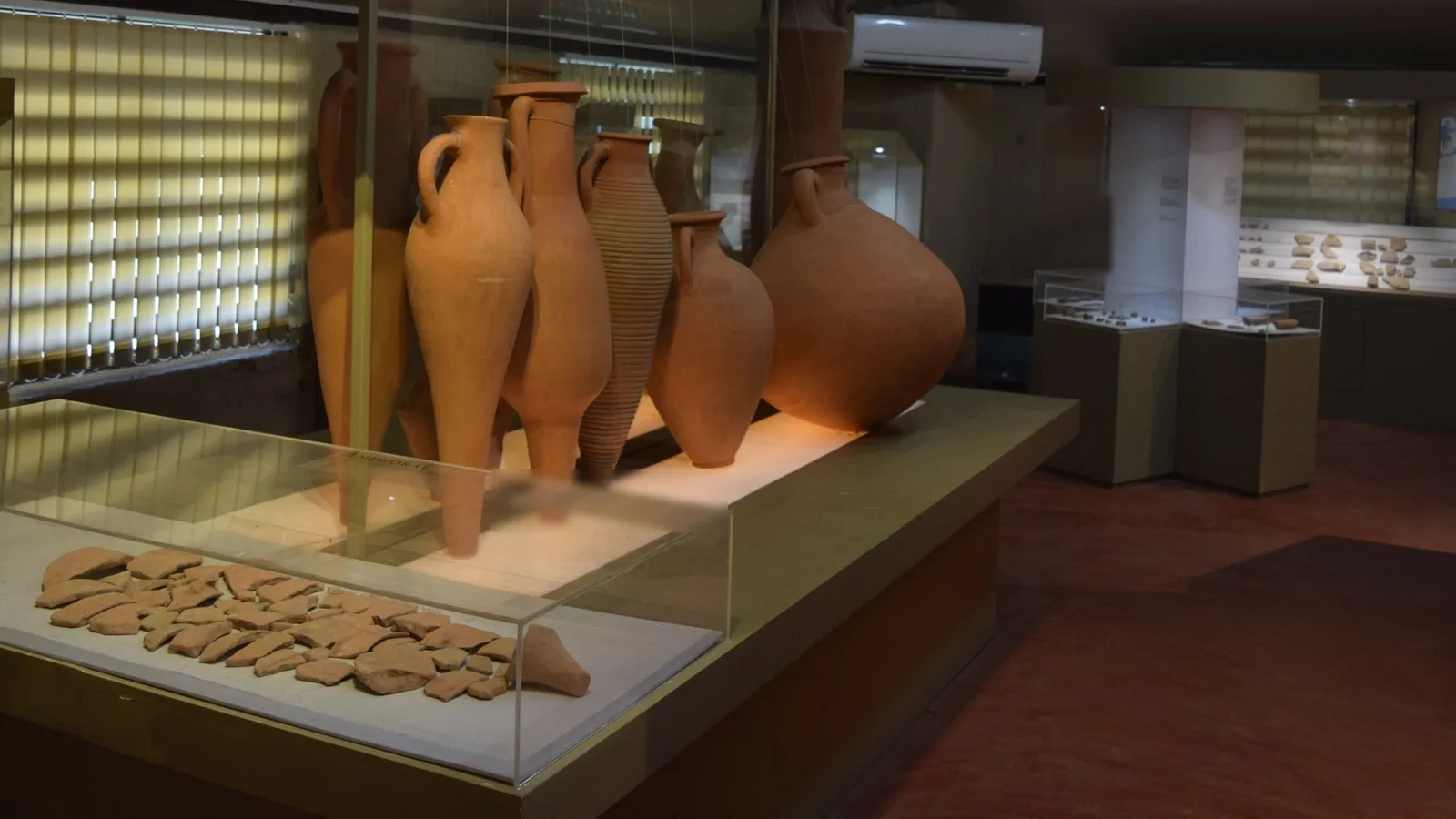
From 2007 the Kerala Council for Historical Research (KCHR), led by P. J. Cherian, excavated at Pattanam near North Paravur. The first five seasons alone produced more than 6,000 amphora sherds, more than any other site in South Asia, mostly from wine jars made in Italy, the Greek islands, Spain and Egypt. There was terra sigillata, West Asian pottery, Tamil-Brahmi inscriptions, and a wharf with teak bollards and a dugout canoe. Radiocarbon dates put the Roman-contact phase as early as the 1st century BCE.
Is Pattanam Muziris? KCHR describes it as an integral part of the ancient port, and historian Rajan Gurukkal agrees, though he sees a seasonal traders' settlement rather than a city. Others, including M. G. S. Narayanan, argue that amphorae turn up all along the coast and that Muziris lay near Kodungallur at the river mouth. The safest statement is that Pattanam was probably part of the Muziris complex.
The Muziris papyrus
A Greek papyrus in Vienna (P. Vindob. G 40822), from the mid-2nd century CE, shows how big this trade could be. One side holds part of a loan contract for a voyage to Muziris. The other values three-quarters of the cargo of a ship called the Hermapollon at more than 1,150 talents, roughly 6.9 million drachmas. The legible entries are 60 containers of Gangetic nard and more than three tonnes of ivory; Federico De Romanis argues that most of the rest was pepper and malabathrum. Rome took a 25 per cent import duty on such cargoes.
Roman coins in Tamil soil
Hoards of Roman coins cluster in the Coimbatore–Karur region, inland of the Palghat Gap that links the Kerala coast with the Tamil plains:
- Vellalur, 1841: 522 silver denarii, 378 of them of Tiberius and 135 of Augustus; another 547 turned up there in 1891.
- Pudukkottai, 1898: about 501 gold aurei from Augustus to Vespasian, some 90 per cent bearing cut marks.
- Karur: thousands of later Roman copper coins from the Amaravathi riverbed, plus silver coins naming Chera kings.
The cut marks suggest many coins were valued as bullion rather than spent, though some scholars think they also circulated. The gem and bead industries of Kodumanal and the beryl of Padiyur (see Part 4) may explain why they gathered here.
Tamils on the Red Sea
The traffic ran both ways. At Berenike in Egypt, excavations led from 1994 by Steven Sidebotham and Willeke Wendrich found an amphora sherd scratched in Tamil-Brahmi with the name Korra pumaan, which Iravatham Mahadevan dated to the 1st century CE; pottery from the same layer dates to about 60–70 CE. Berenike also yielded 7.55 kg of black peppercorns in a temple courtyard jar, teak timbers, Indian cooking pots and Indian-made sailcloth; Tamil-Brahmi sherds also turned up at Quseir al-Qadim (ancient Myos Hormos). Tamil merchants were living on the Red Sea coast.
Back home, the Tamil Nadu Archaeology Department's excavations from 1986 at Alagankulam, at the mouth of the Vaigai, found rouletted ware, amphorae, late Roman coins and a sherd scratched with a many-masted ship; it was probably a Pandya port.
How big was it?
Pliny complained that India drained at least 50 million sesterces a year from the empire, and that India, China and Arabia together took 100 million: "that is what our luxuries and our women cost us." He was a moralist, and his figures have no stated basis. But the 25 per cent duty earned the treasury large sums, and the Hermapollon's cargo shows that a single shipment could be worth a fortune, so some historians now think Pliny was not wildly wrong. Scholars such as Himanshu Prabha Ray have also pushed back against a Rome-centred story, stressing Indian shipping, Buddhist networks and the routes east to Sri Lanka, Bengal and Southeast Asia, which complemented the overland Silk Road. The western trade shrank during Rome's 3rd-century crisis but never quite stopped.
Timeline
| Date (approx.) | Development | How firm? |
|---|---|---|
| Mid-3rd century BCE | Arikamedu settlement begins (Begley) | Fairly firm |
| Late 2nd century BCE | First Mediterranean contact at Arikamedu | Debated |
| 30 BCE | Rome annexes Egypt | Firm |
| 1st century BCE–1st century CE | Silver denarii of Augustus and Tiberius reach Tamil Nadu; Pattanam's Roman phase | Firm |
| c. 40–70 CE | Periplus written; Berenike Tamil-Brahmi sherd | Fairly firm |
| 77 CE | Pliny's Natural History | Firm |
| Mid-2nd century CE | Ptolemy's Geography; Muziris papyrus | Firm |
| 3rd century CE | Western trade declines | Fairly firm |
| 4th–5th century CE | Late Roman copper coins at Karur and Alagankulam | Firm |
What we can say with confidence
- Confident: from roughly the 1st century BCE to the 2nd century CE there was heavy seaborne trade between the Tamil country and Roman Egypt; pepper was the main export; gold, silver and wine came in; Tamil traders lived in Red Sea ports; poems, classical texts and excavations agree in outline.
- Uncertain: the exact site of Muziris, several Periplus ports, the real scale of the trade, and whether Roman coins circulated as money.
Next part
Part 11, Thirukkural and Thiruvalluvar, turns from ships to a book: when the Thirukkural was composed, what we know about its author, and how much history lies behind the legends.
Sources
- Vaidehi Herbert, translations: Akananuru 121–300; Purananuru 1–200 and 201–400; Pattinappalai; Mullaippattu; Nedunalvadai
- The Periplus of the Erythraean Sea, trans. W. H. Schoff (1912)
- Pliny, Natural History 6.26 and 12.41 (Perseus); Strabo, Geography 2.5.12 (LacusCurtius)
- R. E. M. Wheeler, A. Ghosh and Krishna Deva, "Arikamedu: An Indo-Roman Trading-Station on the East Coast of India", Ancient India 2 (1946)
- Vimala Begley, "Arikamedu Reconsidered", American Journal of Archaeology 87 (1983); Begley et al., The Ancient Port of Arikamedu: New Excavations and Researches 1989–1992 (EFEO, 1996 and 2004)
- P. J. Cherian, "Pattanam Archaeological Site: Evidence of Maritime Exchanges"; The Hindu, Pattanam antiquity authenticated by radiocarbon dating and Kerala historians at loggerheads over Pattanam findings
- Federico De Romanis, The Indo-Roman Pepper Trade and the Muziris Papyrus (OUP, 2020), and "Playing Sudoku on the Verso of the 'Muziris Papyrus'"
- Coin Hoards of the Roman Empire (Oxford): Vellalur 1841, Pudukkottai 1898; Klaus Karttunen, "Early Roman Trade with South India", Arctos 29 (1995)
- Steven E. Sidebotham, Berenike and the Ancient Maritime Spice Route (University of California Press, 2011); Frontline, South Indians in Roman Egypt?; Iravatham Mahadevan, Early Tamil Epigraphy (2003; rev. 2014)
- Himanshu Prabha Ray, The Archaeology of Seafaring in Ancient South Asia (Cambridge University Press, 2003); K. Rajan, Early Writing System: A Journey from Graffiti to Brahmi (2015)
Featured image: Mediterranean amphorae on display at the Pattanam excavation museum in Kerala, with excavated amphora sherds in the case in front. Photo: "Amphorae sherds, Pattanam excavation site (Kerala)" by KannanVM, via Wikimedia Commons, CC BY-SA 4.0, cropped and lightly retouched.