This is Part 8 of HorizonDesk's chronological series on Tamil history, from prehistory to modern Tamil Nadu. The previous instalment was Part 7: The Three Crowned Kings – Cheras, Cholas and Pandyas of the Sangam Age.
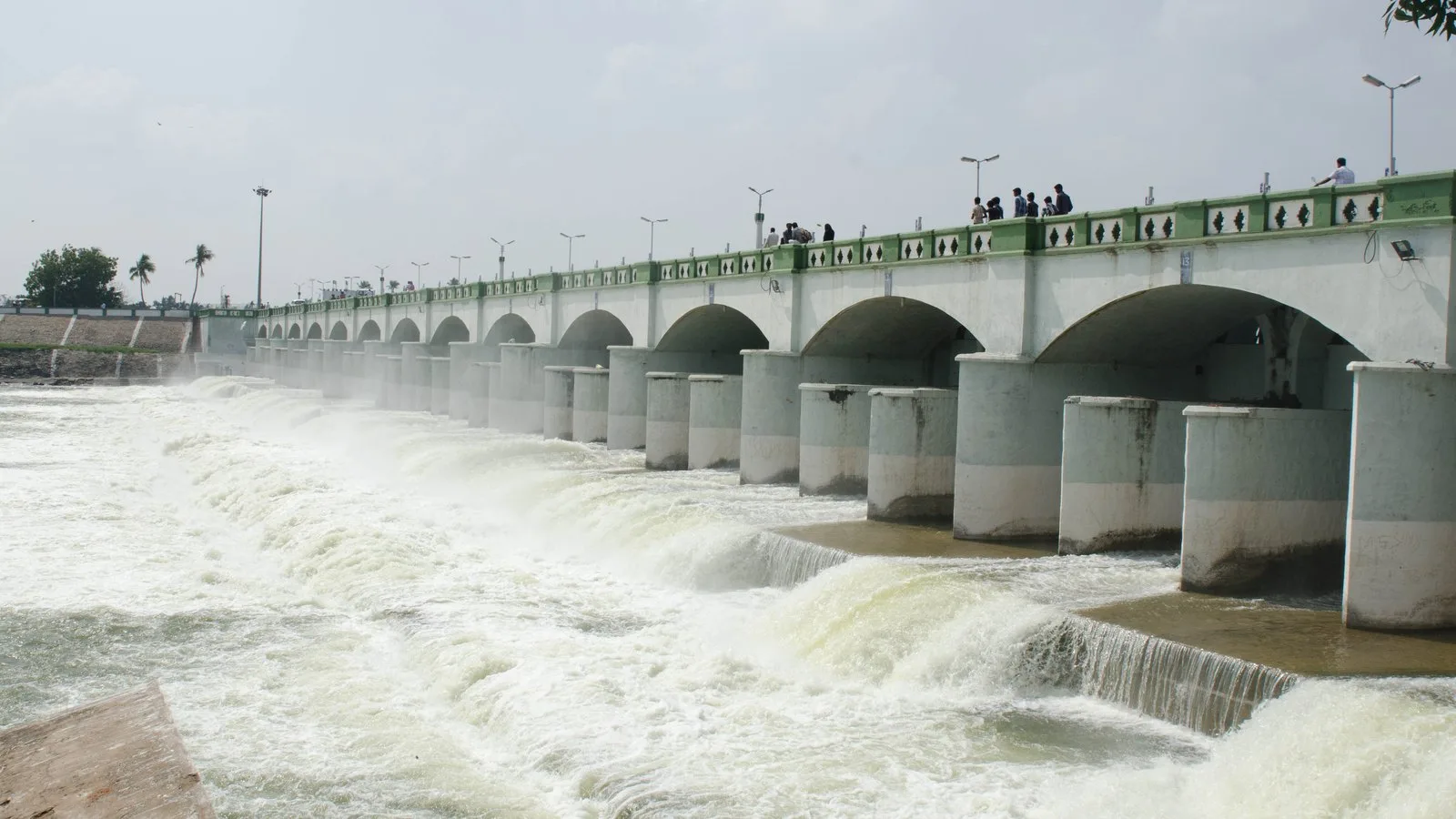
About 15 km east of Tiruchirappalli, the Kaveri river pours through a row of arches and over a low, curving stone weir. Tamils call it the Kallanai, the "stone dam". British engineers called it the Grand Anicut (anicut comes from the Tamil anaikattu, a dam or weir). Tradition credits it to Karikala, the most celebrated of the early Chola kings.
Part 7 met Karikala briefly as the victor of Venni. This part asks what the sources really say about him, and how much of the Kallanai goes back to his time.
What the sources are
Karikala left no inscription of his own. Everything we know comes from poems written for him and from much later records that claimed him as an ancestor.
Sangam poems (see Part 6 for the anthologies):
- Pattinappalai, a 301-line poem by Kadiyalur Uruthirankannanar in the Pathuppattu ("Ten Idylls") collection, addressed to him as Thirumavalavan.
- Porunar Arruppadai, a 248-line "guide poem" by Mudathama Kanniyar, in which one bard directs another to Karikala's generous court.
- Individual poems in the Purananuru (7, 65, 66, 224) and Akananuru (55, 125, 246).
Later records, written 500 to 1,000 years or more after him:
- Telugu Choda and imperial Chola copper plates and inscriptions (7th–11th centuries).
- Medieval Tamil works such as the Silappathikaram epic and the 12th-century Kalingattupparani.
- Sri Lankan chronicles such as the Pujavaliya (13th century) and Rajavaliya (17th century).
That gap matters: the poems describe a war leader and patron, while the engineering stories appear mostly in the later layer.
A boy king and a burnt leg
The Porunar Arruppadai calls Karikala the son of Ilanchetchenni and says he "obtained the throne while still in his mother's womb" (line 132), meaning his father died before he was born. The Pattinappalai adds that as a young man he was held captive by rivals and escaped "like a tiger cub raised in a cage" that grows strong, breaks out and wins back its kingdom (lines 220–227).
The name Karikal literally means "charred leg". The didactic collection Pazhamozhi Nanuru (verse 239), written several centuries later, mentions "the Chola's son who survived being burnt" and went on to rule, and later tradition built this into a story of a palace fire in which the prince's leg was scorched. The 11th-century Thiruvalangadu plates offer a different, flattering etymology: Kali-kala, "death to the Kali age" or "death to the elephants (kari) of his enemies". Neither explanation can be proved; the fire story is best treated as legend.
The Battle of Venni
Karikala's defining victory came at Venni, usually identified with the village of Kovil Venni near Needamangalam in the Thiruvarur district. The Porunar Arruppadai (lines 143–147) says he destroyed "the two great kings" there, the Pandya wearing neem and the Chera wearing palmyra. Akananuru 246 adds that eleven velir chiefs (minor hill and forest rulers) fell with them.
The Chera king, Perum Cheralathan, was wounded in the back, a disgrace for a warrior. Rather than live with it, he sat facing north with his sword and starved himself to death, a ritual suicide called vadakkiruththal (Purananuru 65). In Purananuru 66 the woman poet Venni Kuyathiyar praises Karikala as heir of ancestors who "sailed ships on the vast ocean, mastering the wind", then tells him bluntly that the Chera who died of shame was "a better man than you".
A second battle, at Vakai, is recalled in Akananuru 125, attributed to Paranar: nine kings abandoned their royal umbrellas there in a single day. Who they were is not known.
Puhar and the poet's reward
The Pattinappalai opens by praising the river: even if Venus strays south (an omen of drought) and the rains fail, the Kaveri, born in the mountains and running to the sea, never fails, and its spreading water "yields gold" (lines 1–7). It is our best picture of Karikala's kingdom. It describes the port of Puhar (Kaveripattinam) at the Kaveri's mouth: ships unloading horses and goods, customs officers stamping cargo with the Chola tiger, public kitchens and Buddhist and Jain monasteries. It also contains the two lines most often quoted about Karikala the builder (283–284):
kaadu konru naadaakki, kulam thottu valam perukki
"He cleared forests and made them into habitable land, dug tanks and increased prosperity."
The same passage says he expanded his capital, Uraiyur; many historians think Puhar became a second capital. Medieval works claim he paid the poet 1.6 million gold pieces for the poem, which belongs to legend rather than the treasury.
The poet Karunkuzhal Athanar mourned him in Purananuru 224: the king who stormed forts, fed bards and completed a Vedic sacrifice with a tall sacrificial post is gone, and his queens have cast off their jewels like vengai trees stripped bare by herders in summer.
Notice what the Sangam poems do not say: none of them describes a dam across the Kaveri.
How Karikala became the builder of the Kaveri banks
The engineering credit appears in later dynastic records, which steadily enlarge it:
| Record | Approx. date | What it says about Karikala |
|---|---|---|
| Malepadu plates of Punyakumara (Telugu Choda) | 7th–8th century | Had the banks of the Kaveri built by subordinate kings led by the Pallava "Trilochana" |
| Larger Leiden plates (Chola) | Early 11th century | "Constructed embankments to the Kaveri" |
| Thiruvalangadu plates of Rajendra I | 11th century | Renovated Kanchi with gold and "established his fame by constructing flood-embankments for the river Kaveri" (verse 42) |
| Kanyakumari inscription and Charala plates of Virarajendra | c. 1069 | Checked the Kaveri's destructive floods with a bund of earth carried in baskets by defeated kings |
| Pujavaliya, Rajavaliya (Sri Lanka) | 13th and 17th centuries | A Chola king carried off 12,000 Sinhalese captives, apparently to work on the Kaveri |
Note the details. The records speak of embankments (flood banks) along the river; equating them with the Kallanai weir is a later, popular step. Kings carrying baskets and the blinding of Trilochana's third eye are mythic. The captive story is absent from the older Sri Lankan Mahavamsa, and historians treat the Gajabahu episode it belongs to as legend. Medieval Chola kings also used the name Karikala; Virarajendra bore it himself.
None of this proves Karikala did not build river works; his reputation as an improver of land is already in the Pattinappalai. But the attribution is a tradition, not a recorded fact.
The Kallanai today
The Kallanai stands at Thogur in the Thanjavur district, where the Kaveri, having split around the island of Srirangam, comes close again to its northern branch, the Kollidam (Coleroon). The Kollidam bed is lower, so left alone most of the water would run off into it and out to sea. The weir holds the Kaveri up and spills only the surplus into the Kollidam through a short channel called the Ullar, sending the rest into the delta through the Kaveri and Vennar channels.
The old core is a weir of unhewn stone about 329 m long, roughly 12–20 m wide and 4.5–5.5 m high, with a gently winding plan. The usual explanation is that builders kept dropping large boulders into the sandy bed until they settled into a stable mass, but there is no record of how it was actually built. A study by Chitra Krishnan, cited by the International Commission on Irrigation and Drainage (ICID), reconstructs a curved masonry section with a sloping crest. ICID estimates that it first served about 69,000 acres; the system now serves roughly 1.3 million acres.
What the British changed
What visitors see today is mostly 19th- and 20th-century work:
- 1804: Captain Caldwell repaired the anicut and raised its crest with about 0.69 m of "dam stones".
- 1829–1830: after Major Sim proposed under-sluices to flush silt, Arthur Cotton built scouring sluices in 1830.
- 1836–1846: Cotton built the Upper Anicut at Mukkombu and the Lower Anicut on the Kollidam, reportedly adapting what he learned from the old structure.
- 1839: a bridge of 30 arches was built on top of the anicut, reducing its effective weir length to about 224 m.
- 1883–1886: regulators were built at the heads of the Kaveri and Vennar.
- 1886 and 1899: the dam stones were replaced by falling shutters, then by 1.5 m lift shutters in all 30 arches.
- 1925–1931: new scouring vents and the regulator of the Grand Anicut Canal, fed by the new Mettur Dam, were added.
As one 2021 survey put it, "very little of the original stone anicut remains today". The ancient part lies largely under and inside the later structure.
"The oldest working dam"?
The Kallanai is often called the oldest water-regulating structure in the world still in use. ICID, which listed it as a World Heritage Irrigation Structure in 2021, calls it the "fourth oldest dam in the world, and first in India". Both claims rest on the traditional 2nd-century date, which comes from the Karikala attribution rather than scientific dating, and on counting a heavily rebuilt structure as continuous. The site has probably regulated the Kaveri for many centuries, but "oldest in the world" deserves caution. Organised water management in South Asia goes back much further, as the reservoirs of Dholavira show.
One Karikala or two?
The Silappathikaram (probably 5th–6th century) has Karikala march to the Himalayas, carve his tiger emblem there and receive gifts from the kings of Vajra, Magadha and Avanti. Such stories made some scholars ask whether more than one Karikala was being remembered. K. N. Sivaraja Pillai (1932) argued for two early Karikalas; V. R. Ramachandra Dikshitar thought the epic's Karikala might be a later king. Most historians, following K. A. Nilakanta Sastri, treat the Karikala of the Sangam poems as one historical ruler, and the Himalayan campaign as poetic convention.
His date is just as uncertain. Most historians place him in the 1st or 2nd century CE; Sastri, relying partly on the much-debated link between the Chera Senguttuvan and Gajabahu of Sri Lanka, put the core of the Sangam age at roughly 100–250 CE.
Timeline
| Date (approx.) | Event or evidence | How firm? |
|---|---|---|
| c. 1st–2nd century CE | Reign of Karikala; Venni and Vakai battles | Poems only; no exact dates |
| Same period or soon after | Pattinappalai, Porunar Arruppadai, Purananuru poems | Dating debated |
| 7th–8th century | Malepadu plates credit Karikala with Kaveri banks | Firm record of a tradition |
| 11th century | Leiden, Thiruvalangadu, Kanyakumari records repeat the claim | Firm record of a tradition |
| 1804–1839 | Caldwell's repairs, Cotton's sluices, bridge over the anicut | Documented |
| 1883–1931 | Regulators, shutters, scouring vents, Grand Anicut Canal | Documented |
| 2021 | ICID World Heritage Irrigation Structure listing | Documented |
What we can say with confidence
- Karikala was a real and powerful early Chola king, celebrated in several Sangam poems for Venni and for clearing land and digging tanks.
- From the 7th century onwards, dynasties that claimed descent from him credited him with building flood banks on the Kaveri.
- A stone weir at the Kallanai site was old when the British arrived in 1804; its exact age and builder are not recorded.
- Most of the present structure is 19th- and 20th-century work built on the old core.
The later Cholas who carried his memory forward built the great temples described in Wonders of India: the Great Living Chola Temples.
Next part
Part 9, Sangam Society: Tinai Landscapes, Economy and Daily Life, steps back from kings to ordinary people: the five tinai landscapes of the poems, farming and herding, craftspeople and traders, food, clothes and festivals.
Sources
- Vaidehi Herbert, translations: Pattinappalai; Porunar Arruppadai; Purananuru 1–200 and 201–400; Akananuru 121–300
- Project Madurai, Pazhamozhi Nanuru (Tamil text), verse 239
- South Indian Inscriptions Vol. III, Tiruvalangadu copper-plates of Rajendra Chola I
- Epigraphia Indica Vol. XXV, Charala plates of Virarajendradeva (same text as the Kanyakumari inscription)
- ICID, Grand Anicut Canal (Kallanai), World Heritage Irrigation Structure
- Nandita Singh and Om Prakash Singh, The Grand Anicut Complex: History of its development, Millennium Water Story (2021)
- The Hindu, The Anicuts of Sir Arthur Thomas Cotton (2018)
- K. A. Nilakanta Sastri, The Colas (2nd ed., University of Madras, 1955) and A History of South India (OUP)
- N. Venkataramanayya, Trilochana Pallava and Karikala Chola (Madras, 1929); K. N. Sivaraja Pillai, The Chronology of the Early Tamils (University of Madras, 1932)
- B. Gunasekara (trans.), The Rajavaliya (Colombo, 1900); Upinder Singh, A History of Ancient and Early Medieval India (Pearson, 2008)
Featured image: Water pouring over the Kallanai (Grand Anicut) on the Kaveri at Thogur, Thanjavur district. The arched bridge and shutters on top were added from 1839 onwards; the ancient stone weir lies beneath them. Photo: "Grand Anicut, Kallanai" by Ashwin Kumar from Bangalore, India, via Wikimedia Commons, CC BY-SA 2.0.