This is Part 16 of HorizonDesk's chronological series on Indian history, from the Stone Age to Independence in 1947. It follows Part 15: The Satavahanas and the Deccan.
South of the Satavahana Deccan lay a land that no northern empire ever ruled in these centuries. Its people called it Tamilakam, the Tamil country, stretching roughly from the Venkatam hills (Tirupati) to Kanyakumari and from the Bay of Bengal across to the Malabar coast. Three royal houses shared it: the Cheras, the Cholas and the Pandyas. Wandering bards, whose poems are our main window on the age, moved between their courts.
Those poems give the period its name, the Sangam age, after a tradition of literary academies (sangam, "assembly") at Madurai. The poetry is real and remarkable; some of the tradition around it is legend. This article tries to keep the two apart.
When was the Sangam age?
There is no single agreed date. Most historians place the core of the poetry and the society it describes roughly between the 3rd century BCE and the 3rd century CE, and that is the range used in this series. Britannica gives a later window, the 1st to 4th centuries CE. Scholars such as Kamil Zvelebil and Takanobu Takahashi see the poems as composed over several generations, probably first in oral form, and gathered into anthologies only later, perhaps between the 4th and 8th centuries, when the colophons naming poets and kings were also added. Dates for individual kings are approximate.
Three Sangams: legend and history
The story of three academies comes from a commentary on the Iraiyanar Akapporul, usually dated to around the 8th century. It says the first Sangam met at a southern Madurai for 4,440 years, the second at Kapatapuram for 3,700 years, and that both cities were swallowed by the sea; the third, at the present Madurai, lasted 1,850 years and produced the poems we have. Historians treat the huge spans and lost cities as legend; what seems real is a memory of Pandya royal patronage of poets.
How we know: poems, stones, coins and foreigners
The Sangam corpus is commonly counted at about 2,381 poems by some 470 named poets, with roughly a hundred anonymous. They include kings, women such as Avvaiyar, and men named by trade, such as a potter or a grain merchant. The poems are grouped in two collections:
- Ettuttokai ("Eight Anthologies"): Natrinai, Kuruntokai, Ainkurunuru, Patirruppattu, Paripatal, Kalittokai, Akananuru and Purananuru.
- Pattuppattu ("Ten Idylls"): longer poems such as the Maduraikkanci on Madurai, the Pattinappalai on the Chola port of Puhar, and the arruppadai or "guide poems", in which one bard directs another to a generous patron.
The grammar Tolkappiyam, in three books on letters, words and subject matter (porul), sets out the conventions the poems follow. Its date is contested, from before the Common Era to around the 5th century CE, and many scholars think it too grew in layers.
Outside the poems, short Tamil-Brahmi inscriptions, carved in natural caverns given to Jain monks, name kings and chiefs; the epigraphist Iravatham Mahadevan dated the earliest to the late 3rd or 2nd century BCE (some excavators now argue for earlier dates).
Seen from the north
The first datable reference to these kingdoms comes from Ashoka. In his Second Rock Edict, around 250 BCE, he lists the Chodas (Cholas), Pandiyas, Satiyaputras and Keralaputras as neighbours beyond his frontier where he arranged medical care for people and animals; his Thirteenth Edict says his "conquest by dharma" reached the Cholas and Pandyas (see Part 12 on Ashoka's edicts). The Keralaputras are generally taken to be the Cheras. A Tamil-Brahmi inscription found at Jambai in 1981 names "Satiyaputo Atiyan Neduman Anji", identifying the Satiyaputras with the Atiyaman chiefs of Thagadur (Dharmapuri).
The Hathigumpha inscription of Kharavela of Kalinga, probably 1st century BCE, claims he broke up a confederacy of Tamil (Tramira) states that had lasted, on one reading, 113 years, and later received pearls and jewels from the Pandya king. Readings of the damaged text differ.
The three crowned kings
Tamil poems call the three dynasties the moovendar, the "three crowned kings". Each had its own heartland, emblem and garland flower.
- Cholas: the Kaveri delta, with the inland capital Uraiyur (now part of Tiruchirappalli) and the port of Puhar (Kaveripattinam). Emblem: the tiger. The most famous Sangam Chola is Karikala, celebrated in the Pattinappalai and the Porunararruppadai for his victory at Venni over the Chera and Pandya kings and eleven chiefs. He left no inscription; his dates (often put around the 1st–2nd century CE) are uncertain, and the later tradition that he built the Kallanai dam on the Kaveri rests on records written centuries afterwards.
- Pandyas: the Vaigai and Tamirabarani valleys, with their capital at Madurai and the pearl port of Korkai. Emblem: the fish. A Pandya called Nedunchezhiyan is named in the Mangulam cave inscriptions near Madurai, of about the 2nd century BCE; a later Nedunchezhiyan, victor of Talaiyalanganam, is the hero of the Maduraikkanci.
- Cheras: the Malabar coast and part of the Kongu country, with the capital Vanji and the port of Muziris (Tamil Muciri). Emblem: the bow. Whether Vanji was Karur (Karuvur) in Tamil Nadu or a site near Kodungallur in Kerala is still argued. The anthology Patirruppattu praises Chera kings such as Imayavaramban Nedunjeral Adan and Senguttuvan, and at Pugalur near Karur two Tamil-Brahmi inscriptions of about the 2nd century CE record three generations of the Irumporai Chera line, matching names in that anthology. That match is one of the best links between poem and stone.
Our Tamil history series looks at these kingdoms in more depth in its part on the three crowned kings. The three fought each other often.
Velir chiefs and the seven patrons
Below the crowned kings were the velir, chiefs of hills and forests, some claiming descent from ancient Dvaraka, and below them village headmen called kizhar. Later tradition counted seven celebrated patrons of poets, the kadai ezhu vallalgal: Pari of Parambu hill, Ori of the Kolli hills, Kari, Pegan, Ay, Nalli and Atiyaman Neduman Anji. Pari is said to have left his chariot for a jasmine creeper to climb, and Atiyaman gave Avvaiyar a rare gooseberry said to grant long life. Pari's end shows the politics: the three kings besieged and killed him, as the crowned houses squeezed the independent chiefs.
Akam and puram: the poetry of landscape
Sangam poetics divides poems into akam ("inner"), on love, and puram ("outer"), on war, kings, death and generosity. Akam poems never name their lovers; they speak through types: the heroine, her friend, the hero, her foster mother. Each mood of love is tied to a landscape, or tinai, with its own season, flower, god and people:
- Kurinji (mountains): lovers' union; god Murugan.
- Mullai (forest and pasture): patient waiting; god Mayon.
- Marutam (farmland): lovers' quarrels and the husband's infidelity; god Ventan.
- Neytal (seashore): anxious pining; god Varunan.
- Palai (parched wasteland): separation and hardship; goddess Kotravai.
A single flower or bird can carry the whole mood. Puram poems are more direct: praise of a king's gifts, laments for fallen warriors, and frank advice to rulers. In Purananuru 192, Kaniyan Pungunranar wrote the famous line yaadhum oore yaavarum kelir, "every town is our town, everyone our kin".
Society and belief
The poems show farmers, herders, hill hunters, fishers and salt-makers. Warfare was honoured: memorial hero stones (nadukal) were set up for men who died in battle or cattle raids, and the Tolkappiyam describes the rites of choosing, carving and installing them. Hero stones with Tamil-Brahmi inscriptions found at Pulimankombai in Theni district are dated to roughly the 1st century BCE, with some scholars arguing for an earlier date. Worship included Murugan, Mayon, Kotravai and hero cults, Vedic sacrifice appears at royal courts, and the cave inscriptions show Jain monks.
The Tirukkural, Thiruvalluvar's 1,330 couplets on virtue, wealth and love, is often grouped with the Sangam works in popular memory, but most scholars place it a little later, among the "Eighteen Minor Works" (Patinenkilkanakku), with dates ranging widely; Zvelebil suggested around 450–500 CE.
Economy, towns and Yavana trade
Paddy from the river deltas, pepper from the Western Ghats, pearls from the Gulf of Mannar, beryl and other gems from the Kongu country, and fine cotton cloth were the wealth of Tamilakam. At Kodumanal near Erode, a bead-making centre, hundreds of potsherds bear Tamil-Brahmi names. At Keeladi (Keezhadi), near Madurai, excavations since 2015 have found brick buildings, drains, ring wells and many inscribed sherds. Its dating is debated: the Tamil Nadu State Department of Archaeology has reported radiocarbon dates going back to about 580 BCE, while critics point out that a charcoal date does not automatically date the objects or writing found near it (see our full piece on Keezhadi).
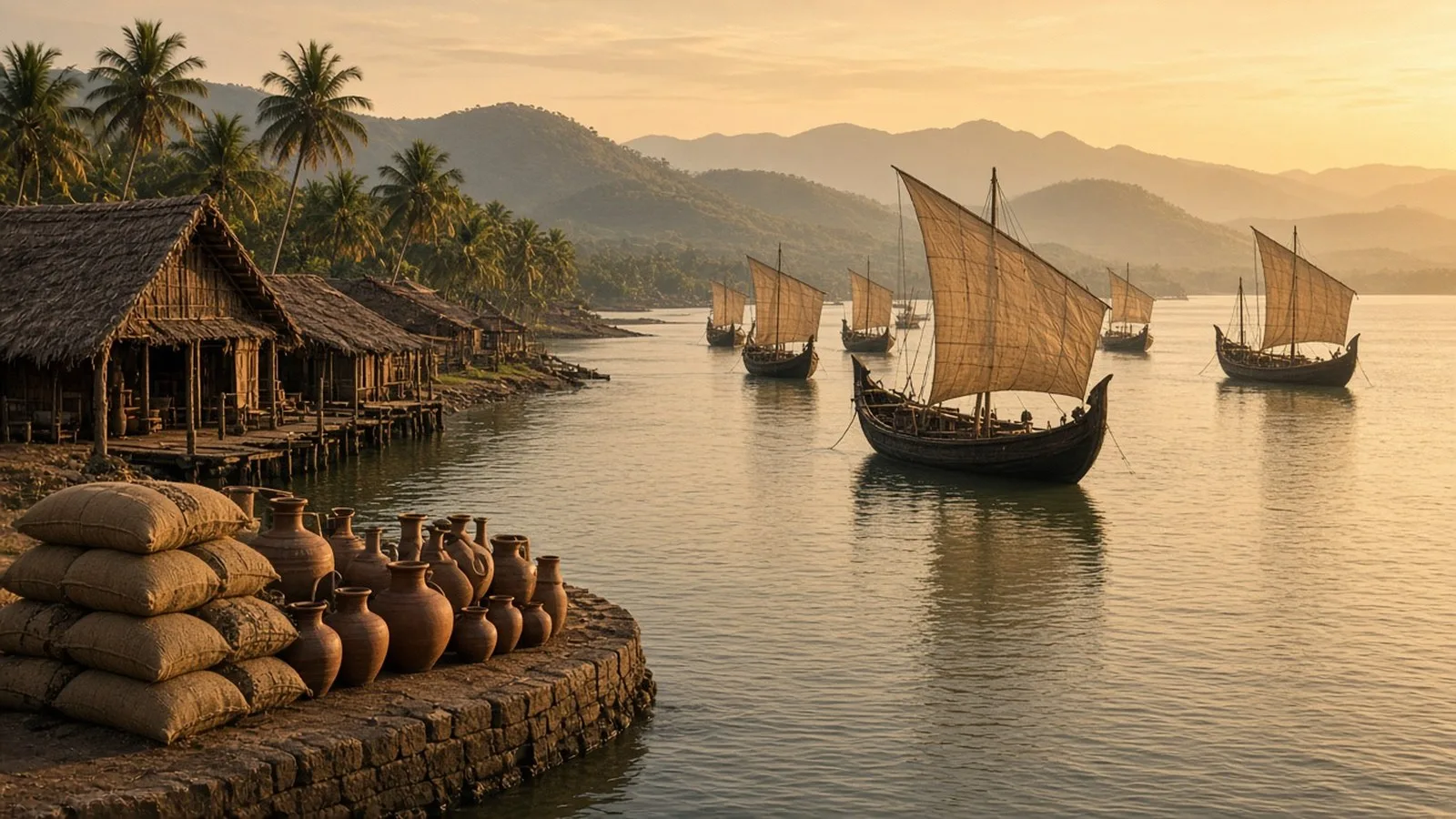
The ports looked west and east. The Greek Periplus of the Erythraean Sea (1st century CE) describes Muziris as crowded with ships bringing gold and wine for pepper and malabathrum, and lists Tamil ports down the east coast, including Poduke, usually identified with Arikamedu near Puducherry, where Italian Arretine pottery and amphorae were found. The Roman writer Pliny complained that India drained the empire of 50 million sesterces a year. A Tamil poem, Akananuru 149, describes the same trade from the other side: at Muciri, "the beautifully made ships of the Yavanas" came "with gold and returned with pepper". (Yavana, originally "Ionian", came to mean any westerner.) Since 2007 excavations at Pattanam in Kerala, a likely candidate for Muziris, have produced more than 6,000 amphora sherds, mostly from the 1st century BCE and 1st century CE. Hoards of Roman silver coins, mostly of Augustus and Tiberius, have turned up around Coimbatore and Karur. More on this trade is in our part on Yavana trade and Arikamedu.
The kings issued their own coins: square copper Pandya coins with fish symbols, Chola coins with the tiger, and Chera coins with the bow and arrow. Some Chera silver coins from the Amaravati riverbed at Karur carry portraits and names such as Makkotai and Kuttuvan Kotai, apparently modelled on Roman coins.
Decline and the Kalabhras
From about the 3rd century CE the Sangam kings fade from view. Later records say a people called the Kalabhras seized the Tamil country. The main source, the Pandya Velvikudi copper plates of about 770 CE, says a "Kali king named Kalabhran" drove out many great kings until the Pandya Kadungon restored order in the late 6th century; at about the same time the Pallava Simhavishnu took the Kaveri delta. Who the Kalabhras were is unclear, and the old label "dark age" is now questioned, since the period saw Jain and Buddhist activity and important Tamil works. Our Tamil history series examines the evidence in its part on the Kalabhra period.
Key takeaways
- The Sangam age is usually placed around the 3rd century BCE to the 3rd century CE, but the poems were composed over time and compiled later, so dates are approximate.
- Ashoka's edicts, Kharavela's inscription, Tamil-Brahmi records such as Mangulam, Jambai and Pugalur, and coins confirm the Chera, Chola and Pandya kings outside the poems.
- Akam and puram poems, organised by the five tinai landscapes, are among the world's great early lyric poetry.
- Pepper, pearls, gems and cloth drew Roman and other traders to Muziris, Arikamedu and Puhar, as finds at Pattanam and Arikamedu show.
Next part
In Part 17, we return north to the Gupta Empire: India's Classical Golden Age, from Chandragupta I and Samudragupta's conquests to Chandragupta II and the court of Pataliputra.
Sources
- Encyclopaedia Britannica, Sangam literature and Chera dynasty
- Nilakanta Sastri, K. A. (1955), A History of South India from Prehistoric Times to the Fall of Vijayanagar, Oxford University Press
- Zvelebil, K. V. (1973), The Smile of Murugan: On Tamil Literature of South India, Brill
- Takahashi, T. (1995), Tamil Love Poetry and Poetics, Brill
- Hart, G. L. (1975), The Poems of Ancient Tamil: Their Milieu and Their Sanskrit Counterparts, University of California Press
- Ramanujan, A. K. (1985), Poems of Love and War: From the Eight Anthologies and the Ten Long Poems of Classical Tamil, Columbia University Press
- Mahadevan, I. (2003), Early Tamil Epigraphy: From the Earliest Times to the Sixth Century A.D., Cre-A / Harvard University
- Hultzsch, E. (1925), Inscriptions of Asoka, Corpus Inscriptionum Indicarum, Vol. 1
- Jayaswal, K. P. and Banerji, R. D., "The Hathigumpha Inscription of Kharavela", Epigraphia Indica 20 (1929–30)
- Schoff, W. H., trans. (1912), The Periplus of the Erythraean Sea (§§ 53–60), Silk Road Seattle edition, University of Washington
- Cherian, P. J., "Pattanam Archaeological Site: Evidence of Maritime Exchanges", Tamil Civilization 24 (2012); Tomber, R. (2008), Indo-Roman Trade: From Pots to Pepper, Duckworth
- Begley, V. et al. (1996, 2004), The Ancient Port of Arikamedu: New Excavations and Researches, École française d'Extrême-Orient
- Tamil Nadu State Department of Archaeology (2019), Keeladi: An Urban Settlement of Sangam Age on the Banks of River Vaigai
- Krishnamurthy, R. (1997), Sangam Age Tamil Coins, Garnet Publications
- Champakalakshmi, R. (1996), Trade, Ideology and Urbanization: South India 300 BC to AD 1300, Oxford University Press
- Thapar, R. (2002), Early India: From the Origins to AD 1300, University of California Press
- Singh, U. (2008), A History of Ancient and Early Medieval India: From the Stone Age to the 12th Century, Pearson