This is Part 3 of HorizonDesk's chronological series on Tamil history, from prehistory to modern Tamil Nadu. The previous instalment was Part 2: Adichanallur – Urn Burials of the Iron Age.
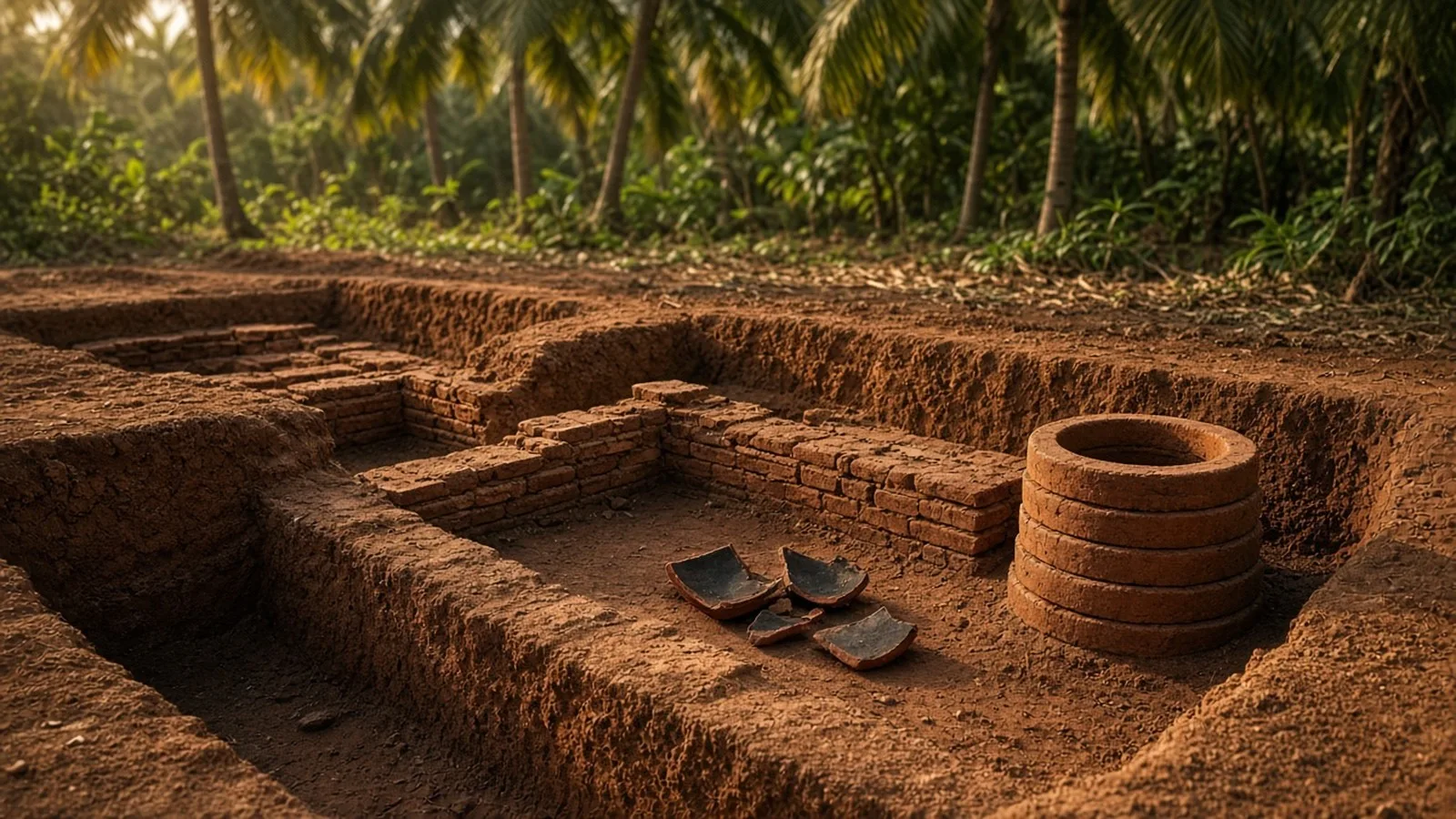
About 12 km south-east of Madurai, in coconut groves on the south bank of the Vaigai river, farmers harvested nuts for generations above a buried town. Under their feet lay brick walls, terracotta ring wells, drains, ivory dice and hundreds of potsherds scratched with personal names in an early Tamil script. This is Keezhadi, also spelled Keeladi (the "zh" stands for the Tamil letter ழ, a sound between an "l" and an American "r").
Adichanallur, the subject of Part 2, showed how Iron Age people buried their dead; Keezhadi shows how people of the Sangam age lived. Sangam is the oldest body of Tamil poetry, traditionally dated to about 300 BCE–300 CE, and its busy cities had little archaeological backing before Keezhadi. The site has also sparked a decade of argument over its dates and its official report. This instalment separates what is established from what is contested.
The setting
Keezhadi lies in Tiruppuvanam taluk of Sivaganga district, although it is effectively on Madurai's doorstep. The excavated mound, locally called Pallichandai Thidal, spreads over more than 110 acres amid coconut groves, according to the Tamil Nadu State Department of Archaeology (TNSDA). Manalur lies to the east, Agaram to the south-east and Konthagai to the west; together the four villages are now treated as the "Keeladi cluster".
Madurai was the capital of the Pandya kings, one of the three ancient Tamil dynasties, and the poem Maduraikkanchi celebrates its markets. The living city is almost impossible to excavate, but Keezhadi's mound had stayed under coconut trees for more than 40 years, safe from construction.
How Keezhadi was found
In 1978 V. Balasubramaniam, who taught history at Keezhadi's government high school, noticed terracotta figurines on the mound and alerted V. Vedachalam, then an epigraphist with the state archaeology department, Frontline magazine recorded. Nothing followed for decades.
In 2013–14 the Archaeological Survey of India's (ASI) Excavation Branch VI in Bengaluru, led by Superintending Archaeologist K. Amarnath Ramakrishna, surveyed the Vaigai valley from Theni to Ramanathapuram, logging 293 sites with burials, hero stones, inscriptions and habitation mounds. From about 90 settlement sites it picked Keezhadi, largely for its well-fired bricks.
Timeline
| Year | Who | What happened |
|---|---|---|
| 2013–14 | ASI (Ramakrishna's team) | Vaigai valley survey records 293 sites |
| 2015–16 | ASI, seasons 1–2 | 102 trenches; brick structures, ring wells, drains; about 5,800 artefacts |
| 2017 | ASI, season 3 (P. S. Sriraman) | Ramakrishna transferred to Assam; "no significant finds" reported |
| 2018 | TNSDA, phase 4 | 5,820 antiquities; six carbon samples sent to the US |
| 2019 | TNSDA, phase 5 | Report announces a 580 BCE date |
| 2020–23 | TNSDA, phases 6–9 | Konthagai, Agaram and Manalur added |
| 2023 | ASI / Tamil Nadu | Ramakrishna's 982-page report submitted (January); Keeladi museum opens (5 March) |
| 2024 | TNSDA, phase 10 | Terracotta pipeline, fish-motif sherds |
| 2025–26 | ASI | Revisions demanded; Ramakrishna refuses; on-site re-examination ordered |
| 2026 | TNSDA, phase 11 | Begins 18 March; continuous brick structures |
The ASI seasons, 2015–2017
Seasons one and two
The ASI dug 43 trenches in 2015 and 59 in 2016, the largest excavation Tamil Nadu had seen, working in small squares between coconut palms. The first season produced brick structures, deep terracotta ring wells (wells lined with stacked clay rings), large storage jars and 32 sherds inscribed in Tamil-Brahmi, the early form of Tamil writing adapted from the Brahmi script.
The second season revealed north–south aligned brick buildings, open, covered and terracotta-pipe drains, brick tanks and six furnaces. Some read the tanks and channels as dyeing vats for textiles; the excavators called that premature. Digging to 4.5 m showed about 3 m of Early Historic deposits above 1.5 m of Iron Age layers, suggesting the town grew out of an older iron-using village, the culture explored in Part 1 on Tamil Nadu's megaliths.
A transfer and a quiet third season
In March 2017, just before the third season, Ramakrishna was transferred to the ASI's Guwahati circle, officially under a two-year rotation rule, a move that caused a political storm in Tamil Nadu. His successor, P. S. Sriraman, recovered about 1,800 artefacts, mostly beads, but reported no continuation of the earlier structures and "no significant discoveries". Two charcoal samples the ASI had dated came back at around 200 BCE.
The state takes over
The TNSDA has run every season since 2018. Phase 4 alone yielded 5,820 antiquities. From phase 6 in 2020, Konthagai, Agaram and Manalur were dug alongside Keezhadi, followed by phases 7 (2021), 8 (2022) and 9 (2023). Phase 10 (from June 2024) produced more than 500 antiquities, over 100 inscribed sherds, fish-decorated red-slipped ware and a 174 cm terracotta pipeline.
No phase ran in 2025: ASI permission, sought in July 2025, came only on 13 March 2026. In phase 11, begun five days later, excavation director Ramesh Masethung reported continuous brick structures in all nine squares, a pipeline, a closed drain and more than 1,300 artefacts, including ivory dice, tiny gold ornaments and an intact pot marked with a fish.
What the soil has given up
- Buildings: fired bricks of 38×23×6 cm and 38×26×6 cm, a wall about 13 m long, clay floors, roof tiles with grooves and paired holes to shed rainwater, and iron nails for timber posts.
- Water: ring wells, open and covered drains, pipelines and tanks.
- Industry: "many cart loads" of pottery below 4 m point to local production; University of Pisa analysis found the pots used local clay. Spindle whorls, bone points and a copper needle suggest spinning and weaving.
- Writing: phase 4 alone produced 56 Tamil-Brahmi sherds and 1,001 sherds with graffiti marks (symbols scratched on pots, possibly owners' marks). The ASI seasons yielded about 70 inscribed sherds with names such as Athan, Tisan and Uthiran. Most were scratched after firing, which suggests ordinary owners could write.
- Ornaments and games: seven gold ornament pieces, more than 4,000 beads of agate, carnelian, crystal and other stones, glass beads, shell bangles, an ivory comb, dice, and terracotta gamesmen and hopscotch discs.
- Trade: Rouletted Ware, a fine pottery found around the Bay of Bengal, and a few sherds of Arretine Ware, the glossy red tableware made in Italy in the age of the Roman Empire. Both tie Keezhadi to coastal trade networks.
- Food: Deccan College, Pune, identified bones of cattle, buffalo, sheep, goat, nilgai, blackbuck, wild boar and peafowl.
The 2019 report also noted that no objects of worship had been found so far, a provisional observation rather than a conclusion.
Konthagai, Agaram and Manalur
Konthagai, west of Keezhadi, was its cemetery. By mid-2023 more than 137 urns had been exposed, according to the Hindustan Times, including a child's skeleton, an intact crouched skeleton, two people in one urn and paddy in an offering pot. A double burial recalls Purananuru 256, in which a widow asks the potter to make the urn wide enough for her too. In 2025 Madurai Kamaraj University and Liverpool John Moores University's Face Lab digitally reconstructed two male faces from Konthagai skulls; DNA work continues.
Agaram and Manalur, to the east, show habitation. Together the cluster forms one landscape of houses, workshops and a cemetery.
The dating debate
| Study | Result | Note |
|---|---|---|
| ASI, 2017 (two charcoal samples) | About 200 BCE | Upper levels of seasons 1–2 |
| TNSDA 2019 report (Beta Analytic, USA) | Six samples, 6th–3rd century BCE; 580 BCE at 353 cm depth | Settlement placed between the 6th century BCE and 1st century CE |
| Ramakrishna's final report (2023) | 8th century BCE to 3rd century CE | 23 AMS dates plus stratigraphy; not accepted by ASI |
| TNSDA, cumulative by 2025 | 29 samples, 580 BCE to 200 CE | Most samples above the brick structures post-date the 3rd century BCE |
Supporters, notably archaeologist K. Rajan, an adviser to the TNSDA, argue that the Vaigai plain saw India's "second urbanisation" (the first being the Harappan or Indus Valley civilisation) around the 6th century BCE, at roughly the same time as the Ganges plain, and that Tamil-Brahmi writing goes back that far too.
Sceptics raise solid methodological points. Bisnupriya Basak of the University of Calcutta noted that the 2019 report did not make clear whether the inscribed sherds came from the same layers as the dated charcoal, and a charcoal date does not automatically date the objects found near it. Ramakrishna's own 2018 paper had dated the inscribed sherds, on stratigraphic and palaeographic grounds, to the 2nd century BCE–1st century CE, and tentatively placed the Iron Age layer "pre-300 BCE". The epigraphist Iravatham Mahadevan's chronology put the earliest Tamil-Brahmi inscriptions in the late 3rd or early 2nd century BCE. In 2025 the ASI wrote that the earliest period "can be, at the maximum, somewhere in pre-300 BCE".
The broad agreement: by the 3rd century BCE Keezhadi was a literate town with brick buildings, drains and crafts, flourishing into the early centuries CE. How much older its lowest layers are, and whether writing reached back with them, will be settled only by fully published, peer-reviewed data.
The report dispute
After prodding by the Madras High Court, Ramakrishna submitted his 982-page report on seasons one and two in January 2023. In May 2025 the ASI, citing two experts, asked for renamed periods, "concrete justification" for the 8th–5th century BCE bracket, layer numbers for dated samples and better maps. He refused, saying the chronology rested on stratigraphy, material culture and AMS dates. Union Culture Minister Gajendra Singh Shekhawat said in June 2025 that more scientific validation was needed, and on 17 June Ramakrishna was transferred to Greater Noida.
A five-member ASI internal committee sent a 114-page critique in December 2025; in February 2026 Ramakrishna called the review "unprecedented" and asked for publication unchanged. In a letter dated 24 June 2026, ASI Director General Yadubir Singh Rawat said the committee would re-examine the report on site first. In September 2026 Tamil Nadu Archaeology Minister A. Rajmohan dared the Centre to send experts. The report remains unpublished.
Visiting the Keeladi museum
On 5 March 2023 then Chief Minister M. K. Stalin opened the state's Keeladi museum, built on 2 acres for ₹18.43 crore. It displays more than 15,000 artefacts from phases 4 to 8 in six themes, from farming and water to sea trade, weaving and pottery. Pair it with Madurai using our Tamil Nadu travel guide.
What Keezhadi tells us
Keezhadi gave Tamil archaeology its first convincing Sangam-age town: brick houses, wells, drains, workshops and people who scratched their names on pots. Whatever its starting date, the cities of Sangam poetry clearly had real counterparts on the Vaigai, and only a small part of the mound has been dug.
Next part
Part 4, Sivakalai, Kodumanal and Porunthal: New Excavations and Iron Age Dates, visits three sites where fresh digs and radiocarbon results are reshaping the Iron Age story.
Sources
- Tamil Nadu State Department of Archaeology, Keeladi
- TNSDA (2019), Keeladi: An Urban Settlement of Sangam Age on the Banks of River Vaigai, Tamil Digital Library
- Frontline, Keezhadi treasures caught in a swirl (2017)
- Scroll.in, Interview with K. Amarnath Ramakrishna (2017)
- The Hindu, No significant finds at Keezhadi this season, reports ASI (2017)
- The Hindu, Keezhadi excavations: Sangam era older than previously thought (2019)
- The Wire Science, Experts question dates of script in Keeladi report (2019)
- The Federal, Potsherds in Keeladi site not as old as 6th century BC (critique, 2019)
- The Hindu, ASI's Keeladi report pushes Sangam age further back to 800 BCE and Keeladi museum opened (2023)
- Hindustan Times, Konthagai burial site reveals ancient practices of Keeladi (2023)
- The Indian Express, ASI asks archaeologist to resubmit Keeladi report and Archaeologist refuses to revise (2025)
- The Economic Times, Keeladi finds backed by radiocarbon dating (2025)
- BBC News, How researchers recreated faces of 2,500-year-old skulls (2025)
- Hindustan Times, Archaeologist dismisses ASI's objections on Keeladi report (2026)
- ThePrint, ASI to re-examine Keezhadi excavation report on site (2026)
- The Hindu, More brick structures unearthed at Keeladi (2026)