This is Part 15 of HorizonDesk's chronological series on Indian history, from the Stone Age to Independence in 1947. It follows Part 14: The Kushan Empire and Kanishka.
While Kushan kings ruled the north-west and the Ganga plains, a different power held the great plateau south of the Vindhyas. The Satavahanas were the first dynasty to build a large kingdom in the Deccan, or Dakshinapatha, "the southern road". At their height their coins and inscriptions reached from the Konkan coast to the Krishna delta, and their name is linked with some of India's best-known Buddhist monuments, from the Karle and Nashik caves to the great stupa at Amaravati.
They are also hard to pin down: their origin, homeland and dates are all argued over. Where scholars disagree, this article says so.
How we know: Puranas, caves and coins
Three kinds of evidence survive. The Puranas, compiled centuries later, list the kings of an "Andhra" dynasty that took power from the Kanvas, but the versions disagree: the Matsya Purana counts about 30 kings over roughly 450 years, others fewer. Then there are inscriptions, mostly Prakrit donation records at Buddhist cave sites such as Naneghat, Nashik, Karle and Kanheri, and coins of lead, copper and potin that help map where the kings ruled. Greek and Roman writers add a little about trade.
Who were the "Andhras"? Name and homeland
The kings called themselves Satavahana or Satakarni (Satakani in Prakrit); the word "Andhra" never appears in their own records. So where did they come from? There are three main views.
- Andhra/Telangana: the Puranic label "Andhra" led scholars such as E. J. Rapson to place the homeland in the eastern Deccan. Early coins found at Kotilingala in Telangana, some reading "Siri Chimuka Satavahana", are cited in support, though whether this Chimuka is the founder Simuka is disputed.
- Western Maharashtra: all the earliest dynastic inscriptions, from Nashik and Naneghat, are in the western Deccan, and the capital later named by Ptolemy, Pratishthana (Paithan on the Godavari), is in Maharashtra. Historians such as V. V. Mirashi argue the "Andhra" label reflects where the dynasty ended up, not where it began.
- Karnataka: V. S. Sukthankar pointed to a district called Satavahanihara in the Bellary region; the excavated stupa at Kanaganahalli (Sannati) has limestone panels labelled with the names of Satavahana kings.
Upinder Singh and the archaeologist Carla Sinopoli both stress that the evidence is thin and the question open; Sinopoli calls the western-origin case "tentative at best". Their social origin is debated too: the Puranas call the founder a vrishala, a low-born man, while Gautamiputra Satakarni's eulogy calls him eka-bamhana, which some read as "the unique Brahmana".
When did they rule? Long and short chronologies
Taken at face value, the Puranic totals of about four and a half centuries would push the start back to the third century BCE, soon after Ashoka. This "long chronology" has supporters, but most historians now prefer a "short chronology" that starts in the first century BCE (some say late second century BCE), because the early inscriptions and coins are palaeographically later than Mauryan times. Britannica places Satavahana ascendancy late in the first century BCE; D. C. Sircar dated the fall of the Kanvas to about 30 BCE. Even then, later reign dates differ by decades between scholars.
Simuka, Kanha and Satakarni: the early kings
Simuka heads the list of royals carved at Naneghat, and the Puranas say the first Andhra king overthrew the last Kanva, a story we left hanging in Part 13. His brother Kanha (Krishna) is named in a small cave at Nashik, Cave 19, cut by an official "in charge of the shramanas" (ascetics), one of the oldest Satavahana inscriptions.
The first great king was Satakarni I. Naneghat, a pass that carried trade from the Konkan ports up to the plateau, holds a long inscription of his widow, Queen Naganika (or Nayanika). It lists Vedic sacrifices, including two ashvamedha (horse sacrifices) and a rajasuya, and huge fees to priests: thousands of cows, horses, elephants and coins. The cave once had labelled relief portraits of the royal family; only the labels and traces survive. A Satakarni (identification debated) appears in the Hathigumpha inscription of Kharavela of Kalinga, who says that he sent an army westward "disregarding Satakamni". Another Satakarni is named on the southern gateway of the Great Stupa at Sanchi, where Ananda, foreman of the artisans of "rajan Siri Satakarni", donated a top architrave.
Nahapana and the Western Kshatrapas
After these early successes the record goes quiet. In the first century CE the Western Kshatrapas, Shaka rulers in Gujarat and Malwa (mentioned in Part 14 in connection with the 78 CE era), pushed into the northern Deccan. The Kshaharata ruler Nahapana held Nashik, Junnar and the Pune region. His son-in-law Ushavadata (Rishabhadatta) left inscriptions at Nashik and Karle recording rich gifts to Buddhist monks and Brahmanas, and an investment of 3,000 karshapanas with weavers' guilds at Govardhana near Nashik, whose interest paid for monks' robes.
Gautamiputra Satakarni: "restorer of Satavahana glory"
The dynasty's revival came under Gautamiputra Satakarni, usually counted its greatest king. Britannica gives his reign as about 106–130 CE; several recent scholars, including the numismatist Shailendra Bhandare and the Sanskritist Andrew Ollett, place him earlier, around 60–85 CE. The difference depends partly on which era Nahapana's dated inscriptions (years 41 to 46) belong to.
The evidence of his victory is concrete. At Jogalthembi near Nashik, a hoard of more than 13,000 silver coins of Nahapana was found in 1906, about two-thirds of them overstruck with Gautamiputra's name. A Nashik inscription of his 18th year grants monks land "formerly belonging to Ushavadata".
The fullest portrait is the Nashik prashasti (eulogy) in Cave 3, carved for his mother Gautami Balashri in the 19th year of his son. It praises him as the one who "crushed the pride of the Kshatriyas", "destroyed the Shakas, Yavanas and Pahlavas", "rooted out the Khakharata [Kshaharata] family" and "restored the glory of the Satavahana race", whose horses had "drunk the water of the three oceans". It lists lands from Saurashtra and Malwa to Vidarbha and the Konkan. Eulogies exaggerate, but the core claim, the defeat of Nahapana, is confirmed by the coins.
Pulumavi, Rudradaman and Yajna Sri
His son Vasishthiputra Pulumavi (c. 130–159 CE in Britannica's dating) is probably the "Siro Polemaios" whom the geographer Ptolemy places at Baithana, that is Paithan. His inscriptions and coins appear in both the western Deccan and the Andhra country, and he seems to have taken over the Amaravati region. The names "Gautamiputra" and "Vasishthiputra", son of Gautami and son of Vasishthi, show the dynasty's habit of naming kings after their mothers. Its meaning is debated: some scholars see a trace of matrilineal custom, others simply a way to tell apart sons of different queens. Succession still passed through the male line.
The Kshatrapas struck back. Rudradaman's Junagadh rock inscription (c. 150 CE) boasts that he twice defeated "Satakarni, lord of Dakshinapatha", but did not destroy him "on account of the nearness of their connection". A Kanheri inscription names a queen of Vasishthiputra Satakarni as the daughter of a Mahakshatrapa Ru[dra]; which Satakarni Rudradaman fought is disputed. Late in the second century Yajna Sri Satakarni (c. 174–203 CE, per Britannica) recovered much lost ground; his coins circulated from the Krishna and Godavari valleys to the Konkan and Saurashtra, and his inscriptions are found at Nashik, Kanheri and in Guntur district.
Ports, ships and Roman trade
Satavahana prosperity rode on trade. The first-century Greek merchants' handbook, the Periplus of the Erythraean Sea, names two great inland markets, Paithana (Paithan), "about twenty days' journey south from Barygaza", and Tagara (Ter), which sent carnelian, cotton cloth and muslins by wagon to the port of Bharuch. It adds that Calliena (Kalyan) had been a lawful market "in the time of the elder Saraganus" (probably a Satakarni) but was now obstructed, with Greek ships taken under guard to Barygaza, an echo of Kshatrapa-Satavahana rivalry.
Some lead coins of Vasishthiputra Pulumavi and Yajna Sri show a two-masted ship, found mainly on the Andhra coast and the Coromandel coast, and are evidence of seafaring on the east coast. Roman coins reached the Deccan and the far south, and the Tamil ports of the same age are covered in our piece on Yavana trade, Arikamedu and Muziris. The Satavahanas also issued silver portrait coins copied from the Kshatrapas, some with a Prakrit legend on one side and a Dravidian-language legend on the other; whether that language is early Tamil or an early form of Telugu is debated.
Caves and stupas
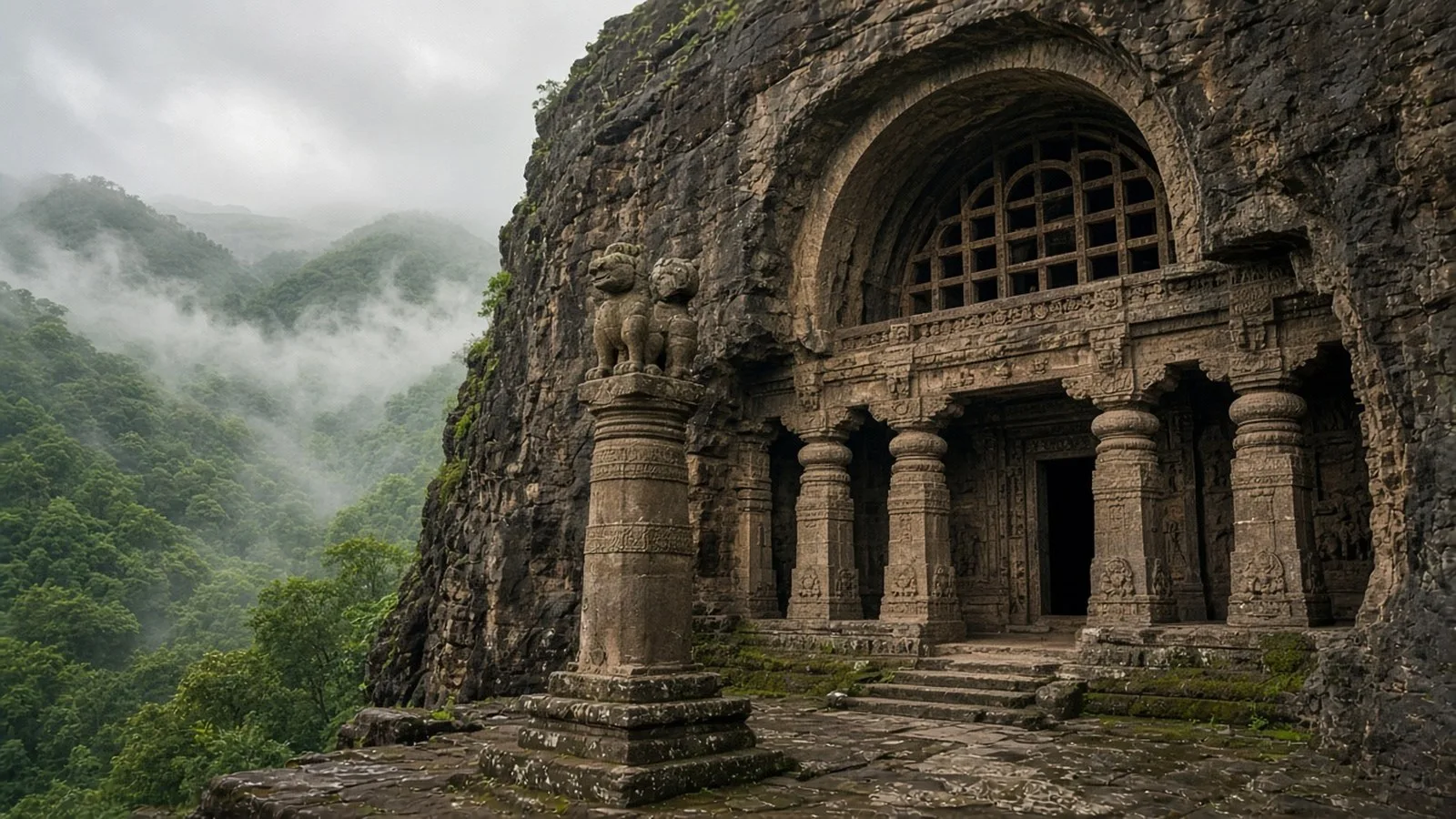
The most visible legacy of the age is in stone. Along the trade routes of the Western Ghats, monks, merchants, guilds, officials and royal women paid for rock-cut monasteries (viharas) and prayer halls (chaityas), many in today's Maharashtra. Bhaja, among the earliest, copies timber architecture in rock. The Great Chaitya at Karle, usually dated to around the first century CE, is the largest of its kind: a long apsidal hall with a horseshoe-shaped window and a lion-topped pillar outside. Its inscriptions name a merchant of Vaijayanti (Banavasi) who "established this rock mansion", and several pillars were gifts of Yavanas, foreigners with Indian names. The early caves 9 and 10 at Ajanta, Nashik's Pandavleni caves and the large complex at Kanheri near Mumbai also belong largely to this period.
In the east the great limestone stupa of Amaravati, near ancient Dhanyakataka on the Krishna, is famous for its carved reliefs. It was long credited to the Satavahanas, but Akira Shimada's study argues it grew over centuries under local patrons, including a "Sada" dynasty, before Satavahana rule reached the area around the second century CE.
The kings themselves sponsored Vedic sacrifices and claimed Brahmanical duties, yet they and their queens also gave land and villages to Buddhist monks. The Nashik grants are early examples of land grants with immunities, under which royal soldiers could not enter the land and revenue officers could not touch it. R. S. Sharma saw such grants as the start of a long trend.
A Prakrit court: Hala and the Gathasaptashati
Satavahana inscriptions and coins are almost all in Prakrit, not Sanskrit. Tradition credits King Hala, the 17th king in the Puranic list, with the Gaha Sattasai (Gathasaptashati), "Seven Hundred Verses" of short love poems in Maharashtri Prakrit about village and farming life. Scholars think the text we have was expanded and re-edited later, so Hala is at most its first compiler.
Decline and successors
After Yajna Sri the kingdom shrank. Kings known mostly from coins and the Puranas ruled smaller areas, and by about the 220s–230s CE the realm had broken into regional states. The Ikshvakus ruled the Krishna valley from Vijayapuri (Nagarjunakonda), where their queens built more Buddhist monuments. The Abhiras took the Nashik region, the Chutus held Banavasi in Karnataka, and the Pallavas later rose in the south-east. In the early fourth century the Vakatakas emerged in Vidarbha. As Britannica puts it, the historical period proper in the Deccan began under the Satavahanas.
Key takeaways
- The Satavahanas were the first big Deccan dynasty; the Puranas call them "Andhras", a word missing from their own records.
- Their homeland (Andhra/Telangana, western Maharashtra or Karnataka) and start date (third or first century BCE) are still debated; most historians prefer a first-century BCE start.
- Gautamiputra Satakarni defeated the Kshaharata ruler Nahapana, shown by the Jogalthembi hoard and his mother's Nashik eulogy.
- Rudradaman later beat the Satavahanas twice; Yajna Sri revived them in the late second century.
- Trade through Paithan, Ter and the western ports helped pay for caves at Karle, Nashik, Kanheri and Ajanta.
Next part
In Part 16, we go further south to the Sangam Age: Cheras, Cholas and Pandyas, the three crowned Tamil kingdoms, their poets and their ports.
Sources
- Encyclopaedia Britannica, Satavahana dynasty
- Schoff, W. H., trans. (1912), The Periplus of the Erythraean Sea (§§ 51–52), Silk Road Seattle edition, University of Washington
- Bhandare, S., "Ship-type Satavahana coins: an examination", Institute for Oriental Study, Thane
- Senart, E., "The Inscriptions in the Cave at Karle", Epigraphia Indica 7 (1902–03), and "The Inscriptions in the Caves at Nasik", Epigraphia Indica 8 (1905–06)
- Burgess, J. and Indraji, B. (1881), Inscriptions from the Cave-Temples of Western India, Archaeological Survey of Western India
- Mirashi, V. V. (1981), The History and Inscriptions of the Satavahanas and the Western Kshatrapas, Maharashtra State Board for Literature and Culture
- Sinopoli, C. M. (2001), "On the Edge of Empire: Form and Substance in the Satavahana Dynasty", in S. E. Alcock et al. (eds), Empires: Perspectives from Archaeology and History, Cambridge University Press
- Ray, H. P. (1986), Monastery and Guild: Commerce under the Satavahanas, Oxford University Press
- Shimada, A. (2013), Early Buddhist Architecture in Context: The Great Stupa at Amaravati (ca. 300 BCE–300 CE), Brill
- Ollett, A. (2017), Language of the Snakes: Prakrit, Sanskrit, and the Language Order of Premodern India, University of California Press
- Dehejia, V. (1972), Early Buddhist Rock Temples: A Chronology, Thames and Hudson
- Sharma, R. S. (1965), Indian Feudalism: c. 300–1200, University of Calcutta
- Thapar, R. (2002), Early India: From the Origins to AD 1300, University of California Press
- Singh, U. (2008), A History of Ancient and Early Medieval India: From the Stone Age to the 12th Century, Pearson