This is Part 12 of HorizonDesk's chronological series on Indian history, from the Stone Age to Independence in 1947.
In Part 11 of this series, we saw Chandragupta Maurya and Chanakya overthrow the Nandas and build India's first great empire. That empire passed to Chandragupta's son Bindusara and then to his grandson, Ashoka. Ashoka is the first Indian ruler whose own words survive in quantity. He had them carved on rocks and polished stone pillars from Afghanistan to Karnataka, and in them he tells us about a bloody war in Kalinga, his remorse, and his new policy of dhamma.
Few ancient kings have been so admired, or so mythologised. This part sets out what the inscriptions actually say, and where the later legends take over.
Accession: a prince, a war of succession and uncertain dates
Ashoka's inscriptions say almost nothing about his early life. Buddhist tradition fills the gap. The Sri Lankan chronicles, the Dipavamsa and Mahavamsa, say that Bindusara had many sons, that the young Ashoka served as viceroy at Ujjain, and that on his father's death he seized the throne and killed 99 of his half-brothers, sparing only one. The Sanskrit Ashokavadana, compiled perhaps in the 2nd century CE, has him govern at Taxila and win the throne with the help of a minister, Radhagupta.
The figure of 99 murdered brothers is almost certainly a pious exaggeration, meant to make his later conversion more dramatic. His own Rock Edict V mentions officials working in the households of his brothers and sisters, so some were clearly alive in his reign. What the sources do suggest is a disputed succession: the chronicles place a gap of about four years between his seizure of power and his formal coronation (abhisheka).
The dates are approximate. Ashoka counts his years from the coronation, which most historians place around 268 BCE, with accession a few years earlier (c. 272–269 BCE). Upinder Singh gives his reign as c. 269–232 BCE; Britannica offers c. 265–238 or c. 273–232 BCE. The anchor for all of these is Rock Edict XIII, which names five Hellenistic kings who were alive together only in the 250s BCE.
The Kalinga war: Rock Edict XIII
Kalinga, roughly coastal Odisha and parts of northern Andhra Pradesh, lay across the Mauryas' routes to the south and the Bay of Bengal. In the eighth year after his coronation, around 261–260 BCE, Ashoka conquered it. We know this only because he told us, in one of the most remarkable royal statements of the ancient world.
In Rock Edict XIII he says that "one hundred and fifty thousand were deported, one hundred thousand were killed and many more died". After the conquest, he continues, "Beloved-of-the-Gods feels deep remorse for having conquered the Kalingas." He is pained above all that brahmins, ascetics and ordinary householders "are injured, killed or separated from their loved ones". The numbers may be round figures, but even so the scale is huge.
Two details keep this from being a simple story of conversion. First, the edict was not carved in Kalinga itself. At Dhauli near Bhubaneswar and at Jaugada in Ganjam, Rock Edicts XI–XIII are left out and replaced by two "Separate Edicts" telling local officials to be fair and to win the people's trust. Second, Ashoka kept Kalinga, and in the same edict he warns the forest peoples that he still "has the power to punish them". Remorse did not mean giving back the conquest. Today Dhauli, with its edicts, its rock-cut elephant and the modern white Peace Pagoda on the hill above, is one of the highlights of an Odisha itinerary.
What did Ashoka mean by dhamma?
Dhamma (Sanskrit dharma) is the key word of the edicts. Pillar Edict II asks, "Dhamma is good, but what constitutes Dhamma?" and answers: "little evil, much good, kindness, generosity, truthfulness and purity". In practice the edicts ask for respect for parents, elders and teachers; generosity to brahmins and ascetics; kind treatment of slaves and servants; restraint in killing animals; and tolerance between sects. Rock Edict XII urges people not to praise their own sect while condemning others, because "contact between religions is good".
Ashoka also turned dhamma into government. He appointed new officials, the dhamma-mahamattas, to look after the welfare of all religious groups, including the Buddhist sangha, brahmins, Ajivikas and Jains (Niganthas). He went on "dhamma tours" instead of royal hunts, banned the killing of many animals, gave prisoners on death row a three-day reprieve, granted 25 amnesties in 26 years and had wells dug and banyan and mango trees planted along the roads. He swapped "conquest by the sword" for "conquest by dhamma" and sent envoys to the Hellenistic kings Antiochus II, Ptolemy II, Antigonus Gonatas, Magas and Alexander (of Epirus or Corinth).
Historians argue about what all this was. Ashoka was clearly a Buddhist: Minor Rock Edict I says he had been a lay follower (upasaka) for more than two and a half years and then became more zealous after drawing close to the sangha. The Bairat (Calcutta-Bairat) edict addresses monks directly and recommends seven Buddhist texts. Yet the dhamma of the major edicts never mentions the Four Noble Truths or nirvana. Romila Thapar has argued that it was a broad ethical policy, partly meant to hold a vast and varied empire together. Others, such as the translator S. Dhammika, read it as sincere Buddhist ethics applied to public life. Many scholars, including Upinder Singh and Nayanjot Lahiri, see both: a deeply personal faith expressed in a moral language that people of any sect could accept. Tellingly, the Greek version at Kandahar translates dhamma as eusebeia, "piety", and the Aramaic version uses a word for "truth".
The edicts: rocks, pillars and a forgotten king
Ashoka's inscriptions are usually grouped like this:
- Major Rock Edicts: a set of fourteen, carved at frontier and trade-route sites such as Girnar (Gujarat), Kalsi (Uttarakhand), Shahbazgarhi and Mansehra (Pakistan), Dhauli and Jaugada (Odisha), Erragudi (Andhra Pradesh) and Sopara (Maharashtra).
- Minor Rock Edicts: shorter, more personal messages, found at about eighteen sites, many of them in the south, including Maski, Brahmagiri and Siddapura in Karnataka, the southernmost of all.
- Pillar Edicts: seven edicts issued in his 26th and 27th regnal years on polished sandstone columns, mostly from the Chunar quarries near Varanasi, at sites such as Delhi-Topra, Delhi-Meerut, Allahabad, Lauriya-Nandangarh, Lauriya-Araraj and Rampurva. Minor Pillar Inscriptions include the Lumbini pillar, which records that "here the Buddha, the sage of the Sakyans, was born" and cuts the village's tax to one-eighth, and the "Schism Edict" at Sarnath, Sanchi and Kaushambi warning monks who split the sangha.
Most are written in Prakrit in the Brahmi script, the ancestor of most later Indian and many Southeast Asian scripts. In the north-west, at Shahbazgarhi and Mansehra, the script is Kharoshthi, written right to left. Near Kandahar in Afghanistan, a bilingual rock inscription found in 1958 is in Greek and Aramaic, the languages of the region's Hellenistic settlers and old Persian administration. Harry Falk's Asokan Sites and Artefacts (2006) maps them all.
For centuries no one could read any of it. In 1837 James Prinsep, assay master of the Calcutta mint and secretary of the Asiatic Society of Bengal, cracked Brahmi, partly by studying short donor inscriptions at Sanchi, and read the Delhi-Topra pillar. Kharoshthi followed soon after, with the help of bilingual Indo-Greek coins. But the king of the inscriptions called himself Devanampiya Piyadasi, "Beloved of the Gods, He Who Looks with Kindness", not Ashoka. Scholars suspected that he was the Ashoka of Buddhist legend, but proof came only in 1915, when a Minor Rock Edict at Maski in Karnataka was found to read "Devanampiya Asoka". A second edict naming him, at Gujarra in Madhya Pradesh, was spotted in 1953 and studied in 1954, and later finds at Nittur and Udegolam in Karnataka confirmed it.
The Third Council and the missions
The Pali tradition says that in Ashoka's reign the elder Moggaliputta Tissa held a Third Buddhist Council at Pataliputra to purge the sangha of false monks, and then sent missionaries in all directions: to Kashmir and Gandhara, to the Himalaya, to Suvarnabhumi (perhaps lower Myanmar) and, most famously, Ashoka's son Mahinda and daughter Sanghamitta to Sri Lanka, where Sanghamitta is said to have planted a cutting of the Bodhi tree at Anuradhapura. (We met the Buddha's own teaching in Part 8 on Gautama Buddha.)
Ashoka's own inscriptions never mention a council or Mahinda, so all of this is tradition, not documented fact. The Schism Edict does show him trying to keep the sangha united, and Buddhism did reach Sri Lanka at about this time. Northern traditions credit him with building 84,000 stupas; the real figure is unknown, but archaeology does link Mauryan phases to great stupas such as the one at Sanchi, whose brick core is generally attributed to Ashoka.
Legend versus evidence
The Ashokavadana tells a vivid tale of "Chandashoka", Ashoka the Fierce, who built a torture chamber known as "Ashoka's hell" before a young monk's serenity converted him. The Sri Lankan chronicles, for their part, present him as a model patron of Theravada Buddhism. These texts were written centuries later by monks with their own aims, and they barely mention Kalinga, which is the turning point in his own account. Historians therefore give priority to the inscriptions, while accepting that the inscriptions are themselves royal publicity, telling us what Ashoka wanted his subjects to think.
The lion capital and the wheel
At Sarnath, where the Buddha preached his first sermon, an Ashokan pillar was topped by four lions standing back to back above a drum carved with an elephant, a bull, a horse and a lion separated by wheels. On 26 January 1950 the Republic of India adopted this Lion Capital as its national emblem, with the motto Satyameva Jayate ("Truth alone triumphs") beneath. The 24-spoked wheel on the drum, the Dharma Chakra (often called the Ashoka Chakra), was placed at the centre of the national flag when the Constituent Assembly adopted it on 22 July 1947. The original is in the Sarnath Museum, an easy side trip on any Uttar Pradesh trip.
After Ashoka: a rapid decline
Ashoka died around 232 BCE. The empire then seems to have split among successors whose names and order differ from one source to another: Kunala, Dasharatha (whose cave dedications to the Ajivikas survive in the Nagarjuni hills of Bihar), Samprati (a hero of Jain tradition) and others. Within about fifty years the last Maurya, Brihadratha, was assassinated by his general Pushyamitra Shunga, around 185 BCE. Explanations vary. An older view blamed a Brahmanical reaction against Ashoka's policies, and some historians argued that his pacifism weakened the army. Thapar and most recent scholars point instead to weak successors, the strain of governing so vast an empire from one centre, and the loose hold of Pataliputra over its far provinces.
Key takeaways
- Ashoka, grandson of Chandragupta, was crowned around 268 BCE after a disputed succession; the "99 brothers" story is legend.
- In Rock Edict XIII he admits that the Kalinga war (c. 261–260 BCE) deported 150,000 people and killed 100,000, and records his remorse.
- His dhamma combined personal Buddhist faith with a broad, non-sectarian ethic of tolerance and welfare; how to balance the two is still debated.
- His edicts, in Brahmi, Kharoshthi, Greek and Aramaic, were deciphered from 1837; the Maski edict of 1915 proved that "Devanampiya Piyadasi" was Ashoka.
- The Third Council and Mahinda's mission to Sri Lanka come from tradition; the Sarnath lion capital and the Dharma Chakra are India's emblem and flag wheel.
Next part
In Part 13, we follow what came after the Mauryas: the Shungas and Kanvas in the Ganga valley, and the Indo-Greek kings who crossed the Hindu Kush into the Punjab.
Sources
- Encyclopaedia Britannica, Ashoka, James Prinsep and Mauryan Empire
- World History Encyclopedia, Ashoka the Great, Kalinga War and Edicts of Ashoka
- Dhammika, S. (1993), The Edicts of King Asoka, Buddhist Publication Society (English rendering of the Rock, Pillar and Minor edicts)
- Hultzsch, E. (1925), Inscriptions of Asoka, Corpus Inscriptionum Indicarum vol. 1, Clarendon Press
- Falk, H. (2006), Asokan Sites and Artefacts: A Source-Book with Bibliography, Philipp von Zabern
- Thapar, R. (1961; rev. 1997), Asoka and the Decline of the Mauryas, Oxford University Press
- Singh, U. (2008), A History of Ancient and Early Medieval India: From the Stone Age to the 12th Century, Pearson
- Lahiri, N. (2015), Ashoka in Ancient India, Permanent Black and Harvard University Press
- Strong, J. S. (1983), The Legend of King Asoka: A Study and Translation of the Asokavadana, Princeton University Press
- Geiger, W., trans. (1912), The Mahavamsa or the Great Chronicle of Ceylon, Pali Text Society
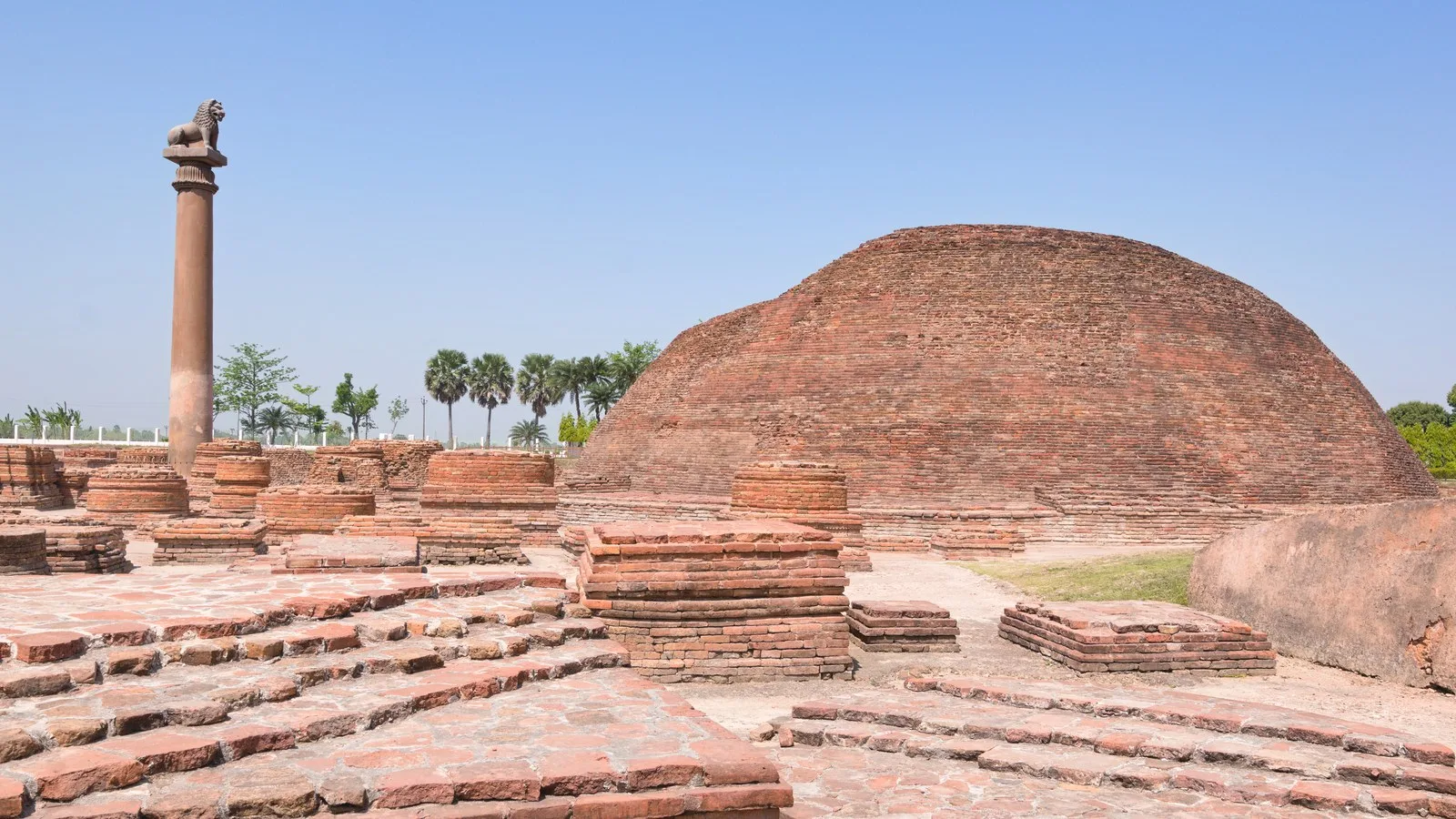
Featured image: the brick stupa and the lion-topped stone pillar at Kolhua, Vaishali, Bihar, a Buddhist site long associated with Ashoka (the pillar itself carries no edict). Photo by Rohit Sharma, via Wikimedia Commons, CC BY-SA 4.0.