This is Part 7 of HorizonDesk's chronological series on Tamil history, from prehistory to modern Tamil Nadu. The previous instalment was Part 6: Sangam Literature – Ettuthokai, Pathupattu and Tolkappiyam.
Around 250 BCE the Mauryan emperor Ashoka had a list of his neighbours carved into rock. Beyond his frontiers, he said, lived the Cholas, the Pandyas, the Satiyaputras and the Keralaputras, "as far as Tamraparni" (Sri Lanka). He was describing kingdoms he never conquered.
Those southern kingdoms are the moovendhar, the "three crowned kings" of early Tamil history: the Cheras, the Cholas and the Pandyas. Part 6 introduced the Sangam poems that praise them. This part sets the poems beside inscriptions, coins and Greek and Roman reports.
Who were the three crowned kings?
Power in the Sangam age (roughly the 3rd century BCE to the 3rd century CE) had three tiers: the three vendhar, or crowned kings; the velir, hill and forest chiefs who ruled around and between them; and the kizhar, village headmen. The Tolkappiyam grammar calls the Tamil land the realm of "the three of great fame". Each dynasty had its own symbols:
| Cheras | Cholas | Pandyas | |
|---|---|---|---|
| Heartland | West coast (modern Kerala) and part of the Kongu region around Karur | The Kaveri delta | The Vaigai and Tamirabarani valleys down to Kanyakumari |
| Capitals | Vanji (location debated), Karuvur (Karur) | Uraiyur (now part of Tiruchirappalli), Puhar | Madurai, called Koodal |
| Main port | Muziris, Tondi | Puhar (Kaveripattinam) | Korkai |
| Emblem | Bow | Tiger | Fish (carp) |
| Garland flower | Palmyra (ponthai) | Bauhinia (ar, athi) | Neem |
| Common titles | Vanavan, Villavan, Kuttuvan, Poraiyan | Valavan, Killi, Senni, Sembiyan | Chezhiyan, Vazhuthi, Maran, Thennavan |
The garlands mattered. When two Chola princes, Nalankilli and Nedunkilli, went to war, the poet Kovur Kizhar reminded them that neither wore the Chera palmyra or the Pandya neem. Both wore the Chola bauhinia, so "if either of you loses, it is your own clan that loses" (Purananuru 45).
Seen from outside
Ashoka's edicts
Ashoka (reigned c. 268–232 BCE) names the southern kingdoms twice. His Second Rock Edict lists the Codas (Cholas), Pandyas, Satiyaputras and Keralaputras as border peoples where he provided medical care; his Thirteenth claims his "conquest by dharma" reached the Cholas and Pandyas. So by the 3rd century BCE the Cholas and Pandyas were independent states outside the Mauryan empire, which had grown out of the kingdom of Magadha (covered in Indian History Part 7). Keralaputra is generally taken to mean the Cheras. The Satiyaputras were a puzzle until a 1981 find at Jambai identified them with the Atiyaman chiefs, as told in Part 5.
Tamil poems recall the vamba Moriyar, the "upstart Mauryas", cutting roads through hills for their chariots (Akananuru 69, 251, 281), but there is no evidence that they ever conquered the far south.
Kharavela's boast
At Udayagiri in Odisha, the Hathigumpha inscription of the Kalinga king Kharavela says that in his eleventh year he broke up a "confederacy of Tamil states" (Tramira-deha-sanghatam) that had threatened his country. Most editors read it as 113 years old; a minority read 1,300 years.
Almost every detail is debated. Kharavela is dated to the 2nd or 1st century BCE, the members are not named, and it is a victor's boast. Some historians suggest the Tamil kings first allied against the Mauryas. A damaged later line, as some read it, has a Pandya king sending Kharavela pearls, horses and elephants.
Greek and Roman writers
- Megasthenes (c. 300 BCE) told a legend of Pandaia, ruled by a daughter of Heracles, and Strabo records an embassy to Augustus from a king called Pandion.
- The Periplus of the Erythraean Sea, a 1st-century CE sailing guide, puts Muziris in the Chera kingdom and Nelkynda in Pandion's, and mentions pearl-fishing near Korkai.
- Pliny the Elder places Pandion's capital, Modura (Madurai), far inland; Ptolemy (2nd century CE) calls Karoura (Karur) the Chera royal seat.
Stones and coins at home
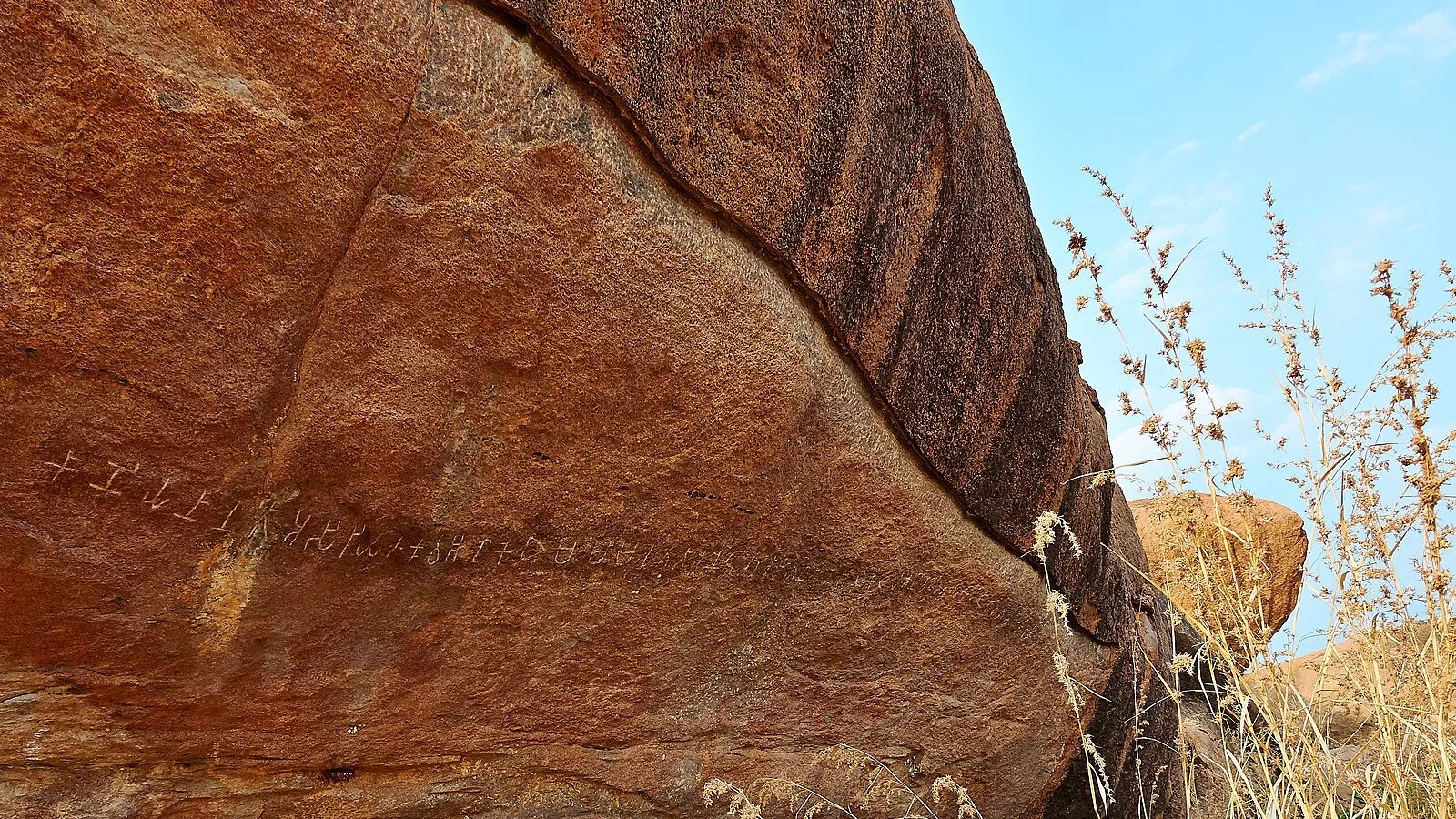
At Mangulam, near Madurai, Tamil-Brahmi inscriptions of about the 2nd century BCE record that an officer of the Pandya king Nedunchezhiyan had a rock shelter made for a Jain monk. Which of the several Nedunchezhiyans of the poems this was is not certain; Pandya names repeat across generations.
At Pugalur, near Karur, two near-identical inscriptions of about the 2nd century CE name three generations of the Chera Irumporai line: Ko Athan Chel Irumporai, his son Perunkadungo and his grandson Ilankadungo. The epigraphist Iravatham Mahadevan, among others, matched them with three kings praised in decades 7–9 of the Chera anthology Pathitrupathu, the strongest link between Sangam poetry and stone.
Then there are coins, studied above all by the numismatist R. Krishnamurthy:
- Pandya square copper coins carry a stylised fish. One bears the Tamil-Brahmi legend Peruvazhuthi, which Krishnamurthy dated on letter forms to around 200 BCE.
- Chera coins carry the bow and arrow. Portrait coins from the bed of the Amaravati river at Karur, modelled on Roman issues, bear names such as Makkotai, Kuttuvan Kotai and Kolli-purai.
- Chola coins show an elephant on one side and a tiger on the other. One was found in a stratified layer during excavations at Puhar.
Excavations at Karur have also produced Roman coins and amphora fragments. The industrial town of Kodumanal, covered in Part 4, sat on the route from Karur to the coast.
The Cheras: bow and pepper
The main source for the Cheras is Pathitrupathu ("The Ten Tens"), which once held ten decades of poems on ten Chera kings; the first and last are lost. Some of its kings:
- Udiyan Cheralathan "of the great feeding". Purananuru 2 praises his gifts of food at a war between "the five and the hundred", which commentators took to mean he fed both armies of the Mahabharata. Historians read it as a memorial feast or flattery, not fact.
- Imayavaramban Nedum Cheralathan, "whose border is the Himalaya", a title nobody takes literally. A verse summary says he captured Yavana (Greek or Roman) traders, poured ghee on their heads and tied their hands.
- Senguttuvan, hero of the fifth decade by Paranar. The later epic Silappathikaram says he brought a Himalayan stone for a shrine to the heroine Kannagi, with King Gajabahu of Sri Lanka in attendance.
- The Irumporai line confirmed at Pugalur. Perum Cheral Irumporai is said to have sacked Atiyaman's fort at Tagadur (modern Dharmapuri).
The "Gajabahu synchronism" long anchored Sangam chronology in the 2nd century CE, but many scholars now treat it cautiously because the epic is later than the poems.
Where was Vanji?
The Chera capital, Vanji, has been argued over for a century. One camp places it at Karur in Tamil Nadu, citing the Chera coins, the Pugalur inscriptions and Ptolemy's Karoura. The other places it at Thiruvanchikulam near Kodungallur in Kerala, which did become the capital of the later Chera Perumals from the 9th century. Many historians think the early Cheras had two branches, a coastal Udiyan–Kuttuvan line and an inland Irumporai line. In a 2022 doctoral study, Roland Ferenczi argued that Pathitrupathu was compiled under the late Irumporai rulers, perhaps in the 3rd or 4th century CE.
Chera wealth rested on pepper. One poem describes Yavana ships arriving at Muziris with gold and leaving with pepper (Akananuru 149). That trade, which tied south India to the Roman Empire, gets its own chapter in Part 10.
The Cholas: the Kaveri and the tiger
The Cholas drew their strength from the rice fields of the Kaveri delta, with an inland capital at Uraiyur and a great port at Puhar, whose docks and customs officers the poem Pattinappalai describes.
- Karikala defeated the Chera and Pandya kings and eleven chiefs at Venni. The Chera, wounded in the back and ashamed, starved himself to death facing north (Purananuru 65–66). Karikala is the subject of Part 8.
- Nalankilli and Nedunkilli fought the civil war over Uraiyur mentioned above.
- Perunarkilli performed the Vedic rajasuya royal sacrifice. The poet Avvaiyar once saw him seated in friendship with a Chera and a Pandya king and likened the three to a Brahmin's three sacred fires (Purananuru 367), a rare scene of harmony.
Several centuries separate these early Cholas from the imperial Cholas of the 9th–13th centuries, whose temples are described in Wonders of India: the Great Living Chola Temples.
The Pandyas: Madurai and pearls
The Pandyas ruled from Madurai on the Vaigai and from Korkai, a port famous for pearls. Their patronage of poets lies behind the Sangam legend of Part 6.
- Mudukudumi Peruvazhuthi, praised for many sacrifices, is remembered in the 8th-century Velvikudi copper plates for granting the village of Velvikudi, a rare later record of a Sangam king.
- Nedunchezhiyan of Talaiyalanganam defeated "the seven", the Chera and Chola kings and five chiefs, while still young (Purananuru 19). In a vow attributed to him (Purananuru 72) he swears that if he loses, the poets led by Mangudi Maruthan may refuse to sing of him. Maduraikanchi and Nedunalvadai are addressed to him.
- Nedunchezhiyan "who defeated the Aryan army" is credited with a poem on the value of learning (Purananuru 183); in Silappathikaram he dies of shame after wrongly executing Kannagi's husband.
- Ukkira Peruvazhuthi is named as patron of the Akananuru.
The chiefs in between
Between the kingdoms lay the lands of the velir. Seven became legendary as the "last seven patrons": Pari, Ori, Kari, Ay, Atiyaman, Pegan and Nalli. Many poets knew them better than the kings. The crowned kings gradually swallowed them. When all three besieged Pari's hill fort, the poet Kapilar told them that even together they could not take it by force (Purananuru 109). Pari fell in the end.
Kings or chiefs?
Older historians such as K. A. Nilakanta Sastri described hereditary monarchies with ministers, councils and armies. Later scholars including Rajan Gurukkal, R. Champakalakshmi and Kesavan Veluthat argued that the vendhar were closer to powerful chiefs whose power rested on raids, plunder, tribute and gifts to bards; a full state with regular land tax and officials came only with the Pallavas and later Pandyas. Others point to royal coins, ports and customs officers as signs of a state in the making. Many textbooks now call the period a transition from chiefdoms to kingdoms.
Timeline
| Date (approx.) | Event or evidence | How firm? |
|---|---|---|
| c. 300 BCE | Megasthenes' Pandaia story | Legend |
| c. 268–232 BCE | Ashoka names Cholas, Pandyas, Keralaputras, Satiyaputras | Firm |
| c. 2nd century BCE | Mangulam inscription of Nedunchezhiyan; Peruvazhuthi coin | Palaeographic |
| 2nd or 1st century BCE | Kharavela breaks a "Tamil confederacy" | Inscription firm; date and reading debated |
| 1st century CE | Periplus and Pliny: Muziris, Nelkynda, Korkai, Madurai | Firm |
| c. 1st–3rd century CE | Most Sangam kings: Karikala, Nedunchezhiyan, Senguttuvan | Poems only; no exact dates |
| c. 2nd century CE | Pugalur Irumporai inscriptions; Ptolemy's Karoura | Strong |
| c. 3rd–4th century CE | Decline of the three dynasties; Kalabhra period begins | Broad consensus |
What we can say with confidence
- All three dynasties were independent by the 3rd century BCE, and inscriptions and coins confirm the poems' kings and emblems.
- Individual reigns and dates are uncertain; feats like feeding the Mahabharata armies are praise.
- Vanji's location, Kharavela's "113 years", the Gajabahu synchronism and the state-or-chiefdom question remain open.
Next part
Part 8, Karikala Chola and the Kallanai, follows the victor of Venni and asks what history can confirm about the "Grand Anicut", the ancient dam across the Kaveri that tradition credits to him.Sources
- Ashoka's edicts: Livius, Ashoka's Rock Edicts; Girnar Major Rock Edict II, text and translation
- Hathigumpha inscription: Epigraphia Indica Vol. XX; The Hindu, A confederacy of Tamil kings (2019)
- Iravatham Mahadevan, Early Tamil Epigraphy, excerpt (Harvard Oriental Series 62); Google Arts & Culture, Mangulam Inscriptions
- Tamil Nadu State Department of Archaeology: Chera Site Museum, Karur; Pugalur Tamil-Brahmi inscription
- Government Museum, Chennai, Coins of Tamilnadu: Sangam period; e-PG Pathshala, Ancient Tamil Coinage from the Sangama Period
- The Periplus of the Erythraean Sea, trans. W. H. Schoff
- Vaidehi Herbert, Purananuru text and translation: poems 1–200 and 201–400
- Roland Ferenczi, An annotated translation of the Patiṟṟuppattu and the political geography of the early Cēra kingdom (2022)
- Rajan Gurukkal, Structure of the chiefdom in peninsular India; Kesavan Veluthat, From Chiefdom to Kingdom and Empire (2019)
- Encyclopaedia Britannica: Chera dynasty, Chola dynasty, Pandya dynasty
- K. A. Nilakanta Sastri, A History of South India (OUP); Upinder Singh, A History of Ancient and Early Medieval India (Pearson, 2008); R. Champakalakshmi, Trade, Ideology and Urbanization: South India 300 BC to AD 1300 (OUP, 1996); George L. Hart and Hank Heifetz, The Four Hundred Songs of War and Wisdom (Columbia University Press, 1999)
Featured image: A Tamil-Brahmi inscription on the rock of Ovamalai (Kalvettu Malai) at Mangulam, Madurai district, Tamil Nadu, where inscriptions name the Pandya king Nedunchezhiyan. Photo: "S-TN-36 Ovamalai Kallvettu Hill Mangulam Madurai" by R.K.Lakshmi, via Wikimedia Commons, CC BY-SA 4.0.