Long before container ships, undersea cables and global supply chains, a web of caravan routes and sea lanes tied together the economies of Asia, the Middle East, Africa and Europe. We call it the Silk Road, although the people who used it never did. For India, this network was not a distant curiosity. Indian merchants, monks, textiles, spices and ideas travelled along it for centuries, and its story is a useful lens on globalisation, trade policy and even today's debates about connectivity projects across Asia.
A name invented in the 19th century
The term "Silk Road" is surprisingly modern. UNESCO and historians credit the German geographer Ferdinand von Richthofen with coining the word Seidenstraße (Silk Road) in 1877, in his work on China. The label stuck because Chinese silk was one of the most prized goods moving west. Many historians now prefer the plural "Silk Roads", because there was never a single highway. Instead, there were many overlapping overland and maritime routes that shifted with politics, climate and demand.
How the routes opened
A key moment in the traditional story comes from Han dynasty China. According to Britannica, in 138 BCE Emperor Wudi sent an envoy named Zhang Qian west to seek an alliance against the Xiongnu, a powerful nomadic confederation. Zhang Qian was captured and held for about a decade, but he eventually reached Central Asia and returned with detailed reports about the peoples, economies and products of the lands beyond China. His missions helped open regular contact and trade between Han China and Central Asia, and they are often described as a foundation of the Silk Road.
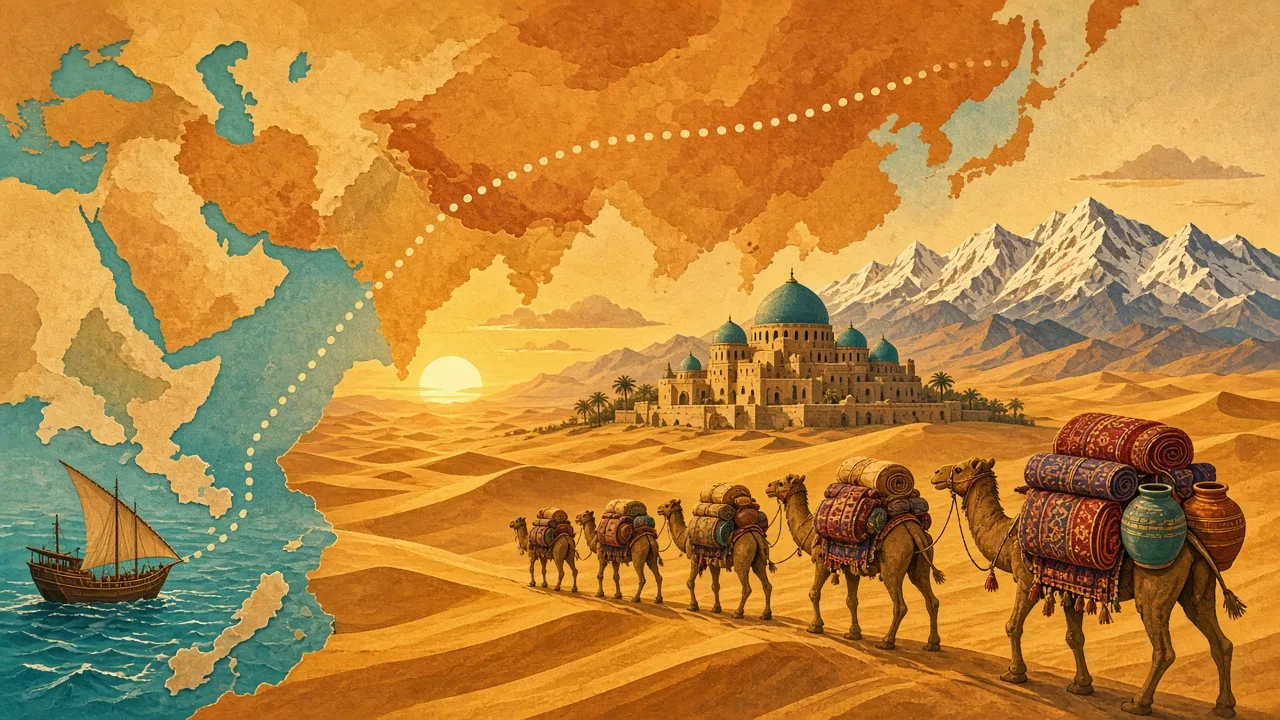
Trade across Eurasia certainly existed before Zhang Qian, but from around this period the exchange became more organised. Over the following centuries, goods moved through a relay of middlemen: few traders went the whole distance. Silk might pass through Chinese, Sogdian, Persian, Indian and Arab hands before reaching the Mediterranean.
What moved along the Silk Roads
The trade was far broader than silk.
- From China: silk, porcelain (in later centuries), paper-making know-how and tea.
- From India: cotton textiles, pepper and other spices, precious stones, indigo and fine craft goods.
- From Central and West Asia: horses, glassware, carpets, metalwork and dried fruits.
- From the Mediterranean world: gold and silver coins, wine, glass and luxury goods.
Just as important were things that could not be loaded on a camel: languages, scripts, music, mathematics, medicine, religion and technology.
India's place on the map
The Indian subcontinent sat at a crossroads between the overland routes of Central Asia and the maritime routes of the Indian Ocean. A few connections stand out:
- Buddhism travelled north and east. Buddhist teachings, texts and art spread from India through Central Asia into China and beyond, carried by monks and merchants. Chinese pilgrims such as Xuanzang later travelled west to India to study and collect texts.
- The Kushan connection. In the early centuries CE, the Kushan Empire, which ruled across parts of Central Asia, Afghanistan and northern India, sat astride important trade routes and helped link Indian, Chinese and Roman-era commerce.
- The sea routes. Ports on India's western and eastern coasts linked into Indian Ocean networks that connected the Red Sea, the Persian Gulf and Southeast Asia. Roman-era coins found in southern India point to that long-distance trade.
The network's long life and decline
The Silk Roads were not one continuous era but a series of booms and busts. Trade flourished when large, stable states kept routes safe, for example under the Tang dynasty in China and later under the Mongol Empire in the 13th and 14th centuries, when travellers such as Marco Polo journeyed east. It slowed during wars and political fragmentation.
The same connectivity also carried disease. Historians link the spread of the 14th-century plague known as the Black Death westward along trade routes, a reminder that open networks transmit risks as well as rewards.
Over time, the balance shifted towards the sea. After European navigators opened direct ocean routes to Asia around 1500, maritime trade became cheaper and larger in scale for many goods, and the overland caravan routes gradually lost their central role.
Timeline: key moments
- 138 BCE: Han Emperor Wudi sends Zhang Qian west; his missions help open Han trade with Central Asia.
- Early centuries CE: The Kushan Empire links Central Asia and northern India along key trade routes.
- 7th century CE: The Chinese monk Xuanzang travels to India and returns with Buddhist texts.
- 13th-14th centuries: The Mongol Empire's reach eases long-distance overland travel.
- c. 1500: New European sea routes to Asia begin shifting trade towards the oceans.
- 1877: Ferdinand von Richthofen coins the term "Silk Road".
- 2014: UNESCO inscribes the "Silk Roads: the Routes Network of Chang'an-Tianshan Corridor" across China, Kazakhstan and Kyrgyzstan as a World Heritage Site.
Why it matters today
The Silk Roads are more than a romantic story of camels and caravanserais. They are an early case study in how trade networks shape economies.
- Trade is built on intermediaries. Most Silk Road goods passed through many hands. Modern supply chains work the same way, and disruptions in one link, whether a war, a pandemic or a blocked shipping lane, ripple across the world.
- Connectivity is geopolitics. Today's infrastructure projects across Asia, including China's Belt and Road Initiative and India's own interest in corridors linking it to the Middle East and Europe, are often framed using Silk Road imagery. The history shows that whoever controls routes gains influence.
- Ideas travel with goods. The spread of Buddhism, paper and mathematical knowledge reminds us that trade is also a channel for culture and innovation, much as digital platforms are now.
- Openness brings risks too. The movement of disease along trade routes in the 14th century has obvious echoes in the COVID-19 pandemic, and in the debate over balancing openness with resilience.
- Heritage tourism. For Indian travellers, the Silk Road cities of Central Asia, such as Samarkand and Bukhara in Uzbekistan and sites in Kyrgyzstan and Kazakhstan, are increasingly popular destinations that bring this history to life.
The Silk Roads remind us that globalisation is not a 20th-century invention. For more than a thousand years, Indian goods and ideas were part of a connected world economy, and the questions it raised about trade, security and cultural exchange are still with us.