This is Part 10 of HorizonDesk's chronological series on Indian history, from the Stone Age to Independence in 1947.
In Part 9 of this series, we followed Mahavira and the early Jain community across the Ganga plains. While Magadha was rising in the east, India's north-west was being drawn into a much larger world. From the late 6th century BCE, the Persian kings of the Achaemenid empire ruled Gandhara and the Indus valley, and in 327 BCE a Macedonian king who had recently destroyed that empire, Alexander the Great, marched over the Hindu Kush to claim its Indian provinces.
This part covers both encounters: two centuries of Persian rule, and Alexander's famous but brief campaign of 327–325 BCE. Almost everything we know about it comes from Greek and Roman writers, so we also need to ask whose story we are hearing.
The Persian empire reaches the Indus
Greek writers credit Cyrus the Great (died 530 BCE) with campaigns towards India, and many historians think Gandhara came under Persian control in his reign. The first firm evidence comes from his successor Darius I. His great rock inscription at Behistun in western Iran, carved around 520 BCE, lists 23 lands that obeyed him, among them Gandara and Thatagush (Sattagydia). Later lists of Darius at Persepolis, Susa and his tomb at Naqsh-e Rustam add a new land, Hindush, named after the river the Persians called Hindu (Sanskrit Sindhu), probably the middle or lower Indus valley. On gold and silver foundation tablets Darius describes his kingdom as reaching from Hindush in the east to Sardis in the west.
- Tribute. Herodotus, writing around 430 BCE, says the Indians formed the twentieth province and paid 360 talents of gold dust a year, "a greater tribute than any other province". The figure may be inflated (Herodotus also repeats tales of gold-digging ants), but it shows how rich the Indus lands seemed.
- Exploration. Darius sent Scylax of Caryanda, a Greek in Persian service, down the Indus to the sea; according to Herodotus he sailed on west and reached Egypt in the thirtieth month.
- Soldiers. Indian troops in cotton, with cane bows, marched with Xerxes against Greece in 480 BCE, and Indians with 15 elephants fought for Darius III at Gaugamela in 331 BCE.
What Persian rule left behind
Persian officials wrote in Aramaic, the empire's working language. In Gandhara a local script, Kharosthi, developed from Aramaic letters, written from right to left; it appears fully formed in Ashoka's edicts at Shahbazgarhi and Mansehra in the 3rd century BCE. Ashoka's north-western edicts also call an inscription dipi, a word borrowed from Old Persian. And the Persian name for the Greeks, Yauna (Ionians), became the Indian Yavana, used for Greeks and later for many westerners.
The city that most clearly bridged these worlds was Taxila (Takshashila), near today's Islamabad. Its earliest historic city, the Bhir Mound, has stone house walls and winding streets; UNESCO's description says it was probably founded in the 6th century BCE under the Achaemenids, though excavators still debate its earliest levels. The Indus basin had known cities two thousand years earlier, in the Harappan civilisation; Taxila became the crossroads of the new age.
How we know: Greek sources and their biases
Several of Alexander's companions, including Ptolemy, Aristobulus, Nearchus and Onesicritus, wrote about India, but their works are lost. What survives was written much later:
- Diodorus Siculus (1st century BCE) and Quintus Curtius Rufus (1st century CE), whose rhetorical history moralises about Alexander's decline.
- Plutarch (around 100 CE), a biographer interested in character more than campaigns.
- Arrian (2nd century CE), whose Anabasis is the most careful account but leans on Ptolemy and Aristobulus, both admirers of Alexander. His shorter Indica preserves Nearchus's voyage and material from Megasthenes.
- Justin, a late summary of the lost history of Pompeius Trogus.
These authors wrote three to five centuries later, inflate enemy numbers, minimise Macedonian losses and rarely let Indians speak.
Into the north-west, 327–326 BCE
In early summer 327 BCE Alexander left Bactria and recrossed the Hindu Kush. Plutarch speaks of 120,000 men, but Britannica estimates the fighting strength at perhaps 35,000. Half the army under Hephaestion and Perdiccas went down the Kabul valley and through the Khyber Pass to bridge the Indus, while Alexander fought his way through the hill country of Bajaur and Swat.
The fighting was brutal. At Massaga, the Assacenian stronghold, Indian mercenaries surrendered on terms; Arrian says that when they tried to leave, Alexander had them surrounded and killed, and Plutarch, who admired him, called it a stain on his record. Alexander then stormed the mountain refuge of Aornos, identified by the explorer Aurel Stein with Pir-Sar above the Indus; the Greeks claimed that even Heracles had failed to take it.
In spring 326 BCE the army crossed the Indus, probably near Attock or Hund. Ambhi, king of Taxila, whom the Greeks called Taxiles, had already submitted and now welcomed Alexander with gifts, troops and elephants, hoping for help against his rival to the east. At Taxila the Greeks met naked ascetics; one, Calanus, joined Alexander and later chose to die on a pyre in Persia.
Porus and the Battle of the Hydaspes
That rival was Porus, who ruled between the Hydaspes (Jhelum) and Acesines (Chenab) rivers. His Indian name is unknown; "Porus" may reflect Paurava, a descendant of the Vedic Puru clan, but that is a guess from the Greek spelling.
The two armies faced each other across the Jhelum, swollen by rain and Himalayan snowmelt, in late spring or early summer 326 BCE. Arrian dates it to the Athenian month Munychion, roughly April–May; Britannica gives June. Arrian credits Porus with about 30,000 infantry, 4,000 cavalry, 300 chariots and 200 elephants; Diodorus gives 130 elephants and Curtius 85. After nights of noisy feints, Alexander crossed roughly 27 km upstream under cover of a thunderstorm. Porus's son rode out to stop him and was killed.
The Macedonian cavalry broke the Indian wings, while the infantry with their long sarissa pikes faced the elephants, which caused heavy losses before they panicked and trampled their own side. Porus fought on from his elephant until wounded, and when asked how he wished to be treated, he is said to have replied, "Like a king."
How complete was the victory? Arrian admits only about 310 Macedonian dead against some 23,000 Indian, which few historians believe; Diodorus's figure of about 1,000 Macedonian dead seems more realistic. Some writers argue that Porus really won, but no ancient source supports that. The sources do suggest a hard fight, and Alexander restored Porus as an ally with an enlarged kingdom, a sign that he needed a strong local partner. The exact battlefield is still debated: Stein placed it between Haranpur and Jalalpur, others prefer the area near the town of Jhelum or Mong, and the river has shifted its course since. Alexander founded Nicaea ("Victory") and Bucephala, named after his horse Bucephalus, which died there.
Mutiny at the Beas
Alexander pushed east across the Chenab and Ravi, where he stormed and razed the Cathaean city of Sangala, and reached the Hyphasis, today's Beas in Punjab. Beyond lay rich lands and, rumour said, a great kingdom on the Ganga, almost certainly the Nanda state of Magadha we met in Part 7. Plutarch's 200,000 infantry and 6,000 elephants are surely exaggerated, but the fear was real.
After eight years of marching and weeks of monsoon rain, the army refused to go on. The officer Coenus spoke for the men, and after sulking in his tent for three days Alexander gave way. He set up twelve altars to the Olympian gods, never since located, and turned back in late summer 326 BCE.
Down the rivers to the sea
Late in 326 BCE a fleet of perhaps 800 to 1,000 vessels sailed down the Jhelum, with the army marching along both banks. This was among the bloodiest stages of the campaign. Attacking a town of the Malli (perhaps the Malavas of Indian texts) near the Ravi, Alexander leapt from the wall into the citadel almost alone and was struck by an arrow that pierced his chest and lung. He survived, barely. Further south, Arrian says he executed brahmins who had urged local kings such as Musicanus to revolt.
By mid-325 BCE he reached Patala at the head of the Indus delta and sailed out into the ocean. The fleet under Nearchus waited for the north-east monsoon and set out in the autumn along the coast to the Persian Gulf, while Alexander led part of the army west through the Gedrosian desert (Makran). Thirst and a flash flood killed many; Plutarch's claim that barely a quarter of the army came back from India is probably exaggerated, but the march was a disaster. Alexander died at Babylon in June 323 BCE, never having returned to India. You can follow the wider story in our feature on Alexander's empire and the battle with Porus.
A conquest that melted away
Alexander left satraps and garrisons behind, but the arrangement soon collapsed:
- Philip, son of Machatas, satrap of the upper Indus, was murdered by his own mercenaries within about a year; Eudemus and Ambhi took charge.
- After Alexander's death, Diodorus says, Eudemus treacherously killed Porus, then left in 317 BCE with 120 elephants to join the wars of Alexander's successors.
- Peithon, who held the lower Indus, moved west by about 316 BCE.
Within a decade of the Hydaspes, Macedonian rule east of the Indus had vanished. Justin says it was Sandrocottus, Chandragupta Maurya, who freed India from Alexander's governors. When Seleucus returned around 305 BCE, he made a treaty with Chandragupta instead and, Plutarch says, received 500 elephants.
Did Chandragupta meet Alexander?
Plutarch writes that "Androcottus, when he was a stripling, saw Alexander himself", and later said Alexander could have conquered the country because its king was despised for his low birth. That is possible but unproven. A passage of Justin was once read as saying Sandrocottus offended Alexander, but the best manuscripts read Nandrum, the Nanda king. Indian traditions about Chandragupta say nothing of Alexander.
Legacy: how much did the invasion matter?
Indian sources are silent: no Sanskrit, Pali or Prakrit text of the period records the invasion, and "Sikandar" entered Indian memory much later through Persian literature. Many historians of early India see the campaign as a brief frontier episode rather than a turning point; Persian rule lasted far longer and left more behind.
Its real effects were indirect. The Greek world gained first-hand reports of India, from cotton and banyan trees to the monsoon. The collapse of the small north-western states may have eased Chandragupta's rise. Lasting Greek influence came later, through the Indo-Greek kings and the art of Gandhara. Peninsular India and the Tamil country lay far beyond Alexander's reach; their Yavana contacts came centuries later through sea trade.
Key takeaways
- Darius I's inscriptions list Gandhara and later Hindush as Persian lands; Persian rule brought Aramaic writing, the root of Kharosthi.
- Alexander campaigned in the north-west from 327 to 325 BCE and beat Porus at the Hydaspes in 326 BCE, then restored him.
- His army mutinied at the Beas; he was badly wounded among the Malli and lost many men in Gedrosia.
- Macedonian rule in India collapsed by about 316 BCE, and Indian sources never mention Alexander.
Next part
In Part 11, we meet Chandragupta Maurya and his adviser Chanakya, who overthrew the Nandas and founded the Mauryan Empire, the first state to unite most of the subcontinent.
Sources
- Arrian, Anabasis of Alexander and Indica, trans. E. J. Chinnock, Book V via Wikisource
- Herodotus, Histories, trans. A. D. Godley (1920), 3.94 and 4.44
- Plutarch, Life of Alexander, trans. B. Perrin, chapters 62–63
- Livius, Four Achaemenid empire lists (Behistun, Persepolis, Susa, Naqsh-e Rustam)
- Encyclopaedia Iranica, India i. Introduction
- Encyclopaedia Britannica, Alexander the Great and Battle of the Hydaspes
- UNESCO World Heritage Centre, Taxila
- Fauconnier, B. (2015), Ex Occidente imperium: Alexander the Great and the rise of the Maurya Empire, Histos 9
- Stein, A. (1932), The site of Alexander's passage of the Hydaspes and the battle with Poros, The Geographical Journal 80
- Thapar, R. (2002), Early India: From the Origins to AD 1300, Penguin and University of California Press
- Singh, U. (2008), A History of Ancient and Early Medieval India: From the Stone Age to the 12th Century, Pearson
- Bosworth, A. B. (1988), Conquest and Empire: The Reign of Alexander the Great, Cambridge University Press
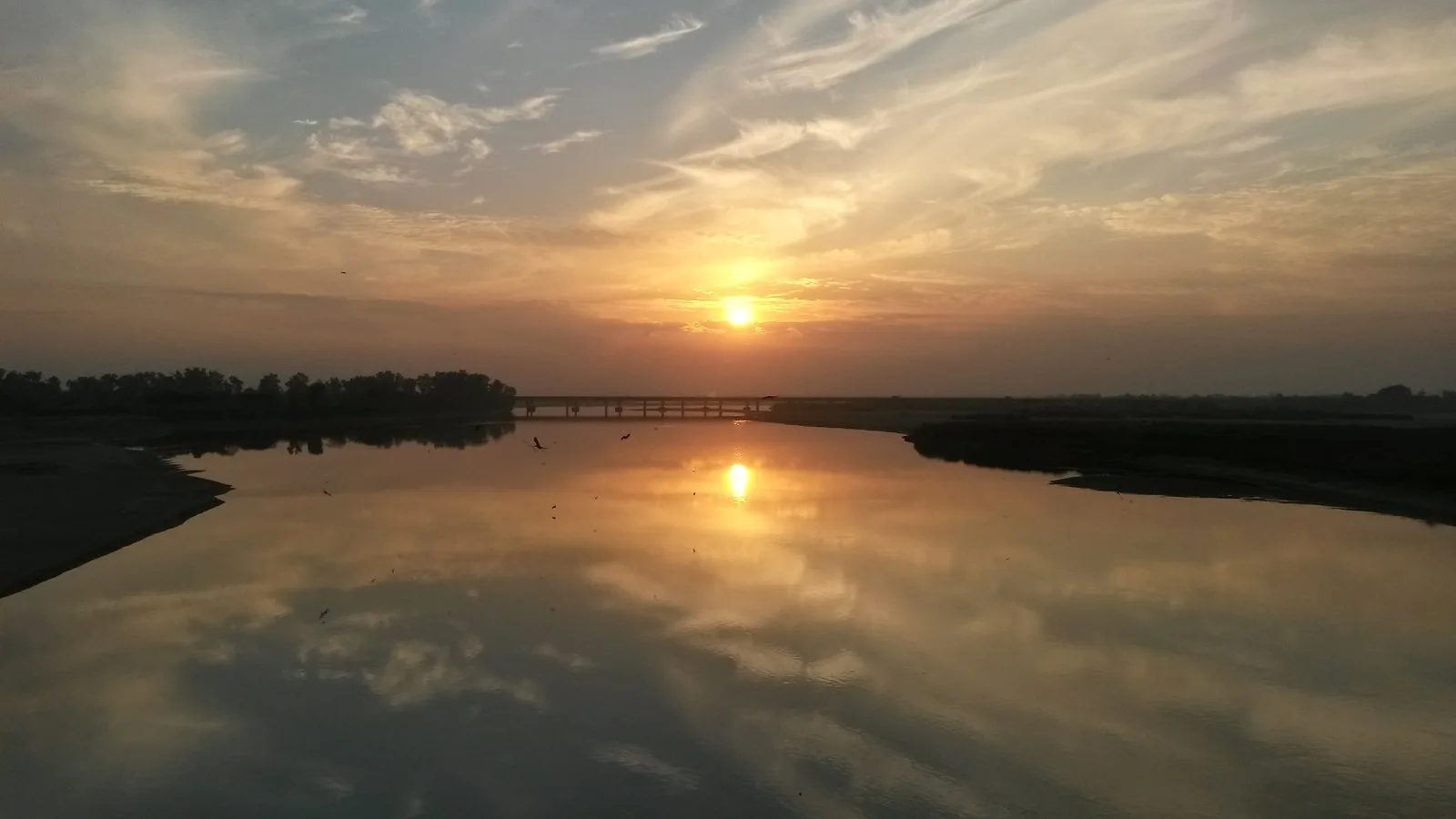
Featured image: the Jhelum River, the ancient Hydaspes, at sunset, seen from the old railway bridge at Jhelum city in Pakistan's Punjab. Photo by Muqaddas086, via Wikimedia Commons, CC BY-SA 4.0.